

Cultural highlights 2025: Five moments that mattered

Nia Medi
These highlights are in no particular order, and all carry equal weight. In the spirit of the season, and fresh from seeing her Christmas concert in Llandaff Cathedral, I’ll start with…
The Rise of Bronwen Lewis
Bronwen Lewis has had quite a year.
From her early days auditioning on The Voice UK in 2013 to being rejected by big record labels for being “too Welsh” to which she replied, “Well I can’t take it off like a Jumper, can I?” she walked out, never looked back, and kept every bit of herself intact.
She doubled down on who she was, embracing her Welshness even more by building a devoted online community and proving that truth travels further than trend.
BBC Radio Wales spotted it when station editor Carolyn Hitt brought her in to present her own shows.
And then, almost full circle, she returned to The Voice universe this year as a coach on Y Llais for S4C.
The nation immediately felt at home with her. Warm, funny, grounded, that unmistakable quiff, and a presence that feels like sitting at a kitchen table with someone who genuinely wants you to thrive.
And what a coach for any budding young singer to have – a formidable musician, vocalist, and songwriter.
Released this year, her album Finding Me has been played endlessly in our house and in the car. A mix of country, pop, Welsh roots and bilingual storytelling.
Gap Year sparked conversations about class and privilege, while Ti a Fi brings us to tears every single time. If you haven’t listened to it yet, I highly recommend giving it a spin or three.
But a moment that spoke volumes about a change in culture was Bronwen finally taking over the BBC Radio Wales morning show earlier this year.
The change spoke for itself. In came a broadcaster defined by respect, integrity and talent, the kind of presence that reflects the best of who we are and who we want representing us on the airwaves.
Cymru at the Euros
When it comes to representing Wales on the international stage, few moments carried as much pride and weight as the sight of eleven Welsh women walking onto the pitch in Lucerne for their opening match against the Netherlands, having qualified for the Euros for the first time in the history of the women’s game.
That alone would have been a landmark cultural moment, but in true Cymru style, it was never going to stop there.
As Aleighcia Scott put it so perfectly, “When Wales goes international, we take the whole country with us.” And that is exactly what happened.
Thanks to partnerships between the FAW, Welsh Government and Wales Arts International, Cymru arrived in Switzerland carrying more than a football team, bringing its language, its music and a deep sense of celebration with it.
As the final whistle blew, win or lose, the night continued with an afterparty gig in Lucerne, bringing together Welsh and Swiss artists in a campaign that featured Adwaith, Aleighcia Scott, Molly Palmer and others, curated by Merched yn Gwneud Miwsig, it was a reminder that when Wales breaks through – we really do take the whole choir, our nan and her piano with us.

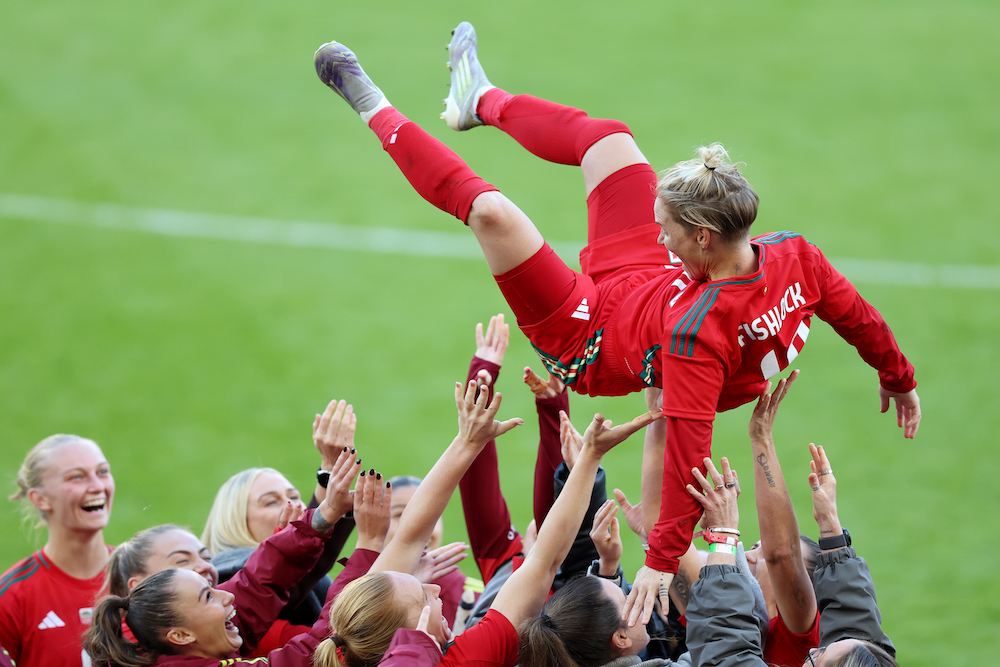
Back home, another history-making moment was unfolding in Splott, Cardiff, as a full-size pitch mural of Jess Fishlock was being created by Unify Studio, the first of its kind in Europe dedicated to a female footballer.
Rooted in her home community, the mural was more than a tribute to Wales’ most capped player. It was a statement about visibility, belonging and who football is for.
The atmosphere around the tournament reflected that shift too. The familiar image of topless men in the stands was replaced by girls and women of all ages, thrilled to finally feel part of something they could claim as theirs.
None of this happened by accident. It’s the result of the FAW’s long-term commitment to equality, visibility, and respect (something the WRU desperately need to learn from, but don’t seem to want to).
When young boys and girls proudly wear shirts with “Fishlock” on the back, you know real cultural change has taken root.
Aleighcia Scott Taking Cymraeg to the Reggae Charts
If 2025 was a year about who gets to belong, Aleighcia Scott stood right at the centre of that conversation.
Of Jamaican heritage, with grandparents who arrived in Wales during Windrush, her family story is literally written on her skin, with her grandfather’s entry stamp into Wales tattooed on her arm. A permanent reminder that Wales has always been shaped by people who arrived, stayed, contributed, and made it home.
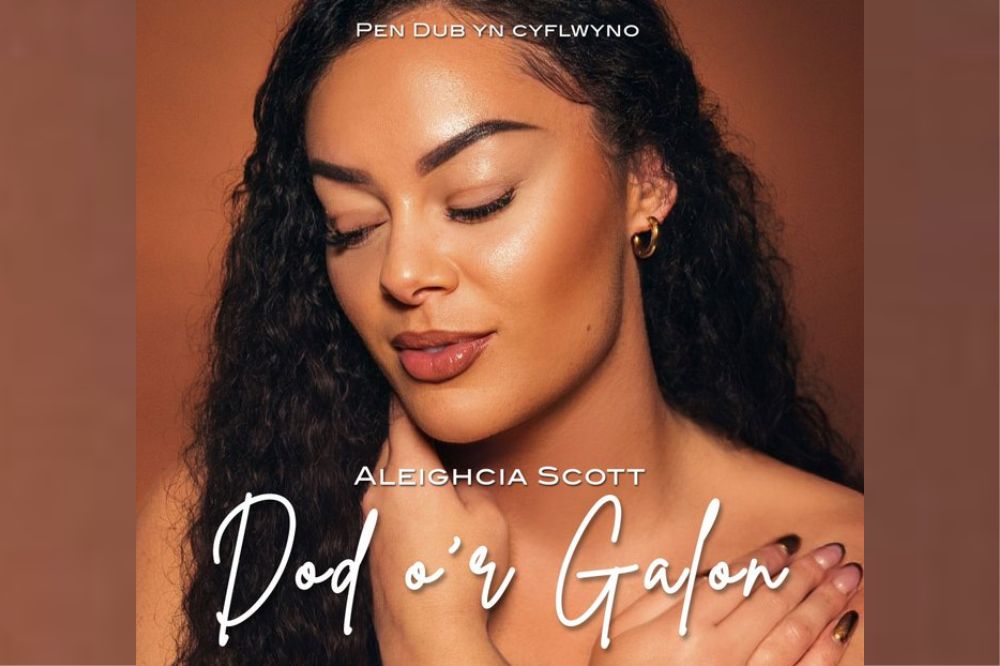
Over recent years, Aleighcia has been deepening her relationship with her Welsh heritage too. Learning Cymraeg, using it publicly and proudly, and championing the language everywhere she goes.
Back in March, she made history as the first artist to take a Welsh-language track to number one on the iTunes Reggae chart with Dod o’r Galon.
It was a joyful, deserved moment, but one that was followed by a wave of racism and backlash for daring to claim Welshness on her own terms.
Her response each time is to be more visible and present, and this is important, as the told the BBC in an interview: “For me, I didn’t really see a lot of Welsh media and British media that looked like me as a child growing up. If I can be like that for some of the children, they’ll never feel like they don’t belong somewhere.”
Along with her onging BBC Radio Wales programme, this year she presented her own show on BBC Radio Cymru 2, appeared confidently as a coach in Y Llais (S4C) where her artist, artist, Rose Datta, won the first series.
Aleighcia then rounded off the year by releasing the Welsh language classic ‘Ar Hyd y Nos’ with Celtica Electronica as her first ever Christmas Song.
Aleighcia’s impact goes far beyond music or broadcasting. She represents a modern, confident Wales that understands identity isn’t fixed or narrow.
And that when you insist on your place at the table, you don’t just make space for yourself, you make it wider for everyone else.
THAT Speech by Russell T Davies
Upon receiving the BAFTA Cymru Outstanding Contribution Award, Russell T Davies chose not to play it safe.
Instead of a retrospective victory lap, he used the platform to speak directly to the moment we’re in, one where fear has quietly crept into creative decision-making within broadcasting. Fear of backlash, fear of complaints, fear of funding being pulled, fear of social media outrage.
When the people who commission television are driven by that fear, it creates a climate where it becomes harder, not easier, for creators and writers to challenge, tell the truth and spark the conversations television is meant to have.
Difficult ideas are avoided, not because they’re wrong, but because they might provoke debate. Stories are softened, diluted, or quietly dropped before they ever reach an audience.
Davies’ warning was blunt and timely: when television becomes timid, the damage is already done.
View this post on Instagram
That message has only grown more urgent in the months since the awards. With figures on the hard right increasingly willing to weaponise the courts, including the recent spectacle of Donald Trump suing the BBC for eye-watering sums that could bankroll entire public services in smaller nations, broadcasters are being pressured not just politically, but financially.
This isn’t about editorial mistakes, it’s about intimidation, about exhausting institutions into silence, about forcing untruths into the mainstream and flattening nuance into something easier to control.
In this new context, Davies’ call wasn’t just about creativity.
It was about democracy and trusting audiences, backing talent, and defending truth-telling at a moment when disinformation and deliberate stupidity are being aggressively normalised.
If broadcasters don’t believe in their storytellers now, and in the value of telling the truth clearly and boldly, then there has rarely been a more dangerous time to hesitate.
What gave the speech even more power was that it came from a stage in Wales, delivered by one of the most influential writers of our time, with nothing left to prove and everything to protect.
It was a reminder that some of the clearest, bravest cultural leadership isn’t coming from political centres of power, but from nations and places that have long understood both the cost, and the necessity, of telling the truth when it’s uncomfortable.
And as Davies himself so powerfully put it: “Television at its best is a beacon. It’s a lighthouse, it’s an emergency flare, it’s a light in the dark.
“It is a torch bearer that stands for truth and insight and wisdom and justice. And we must not let that flame go out.”
Never has there been a time when we could afford not to listen.
Lost Boys and Fairies: From Wales to the World
Speaking of Awards, one of the big cultural highlights of 2025 was seeing Lost Boys and Fairies, and its writer Daf James, being rightly recognised with a truck load of awards at home and internationally.
It wasn’t just one of the strongest pieces of television the BBC has produced in the past decade, it was a series that understood the value of truth in all its beauty and ugliness.
Tender, funny, painful, and riotously joyful, it allowed contradiction to exist on screen without apology. Written with warmth and grit, it told a gay adoption story without smoothing off the uncomfortable edges.
For many watching, it would be the first time they would see themselves reflected on screen. And, as Russell T Davies so powerfully reminded us in his BAFTA Cymru speech, that kind of storytelling only happens when writers are trusted, and bold cultural leadership creates the space for them to go there.
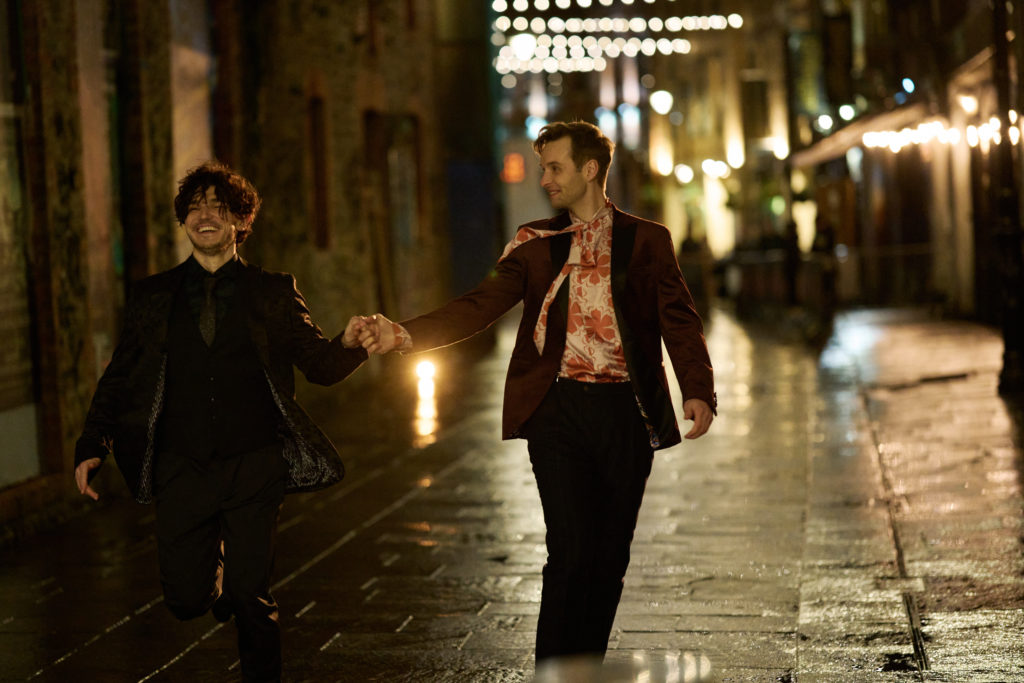
This year, it won five BAFTA Cymru Awards, an International Emmy, and saw Daf James named a BAFTA Breakthrough. And yet, we now understand there will be no second series, at least for now.
One suspects BBC Wales would have wholeheartedly wanted it to continue, but network appetite felt less certain, as if the box had already been ticked.
That’s deeply frustrating, because anyone who has been through the adoption process knows that a second series is where the real story begins.
But in a post-Emmy world, with international audiences having found and embraced it, this doesn’t have to be the end of the road.
Stories like Lost Boys and Fairies don’t disappear simply because one door closes. They grow, they travel, and sometimes they find their next chapter elsewhere.
There are, however, reasons to feel optimistic. The BBC’s recent announcement committing to increased investment in programmes made across the nations, and to moving decision-making closer to audiences, feels like an important shift.
As Interim Director of Nations Rhuanedd Richards said: “By spending more of our budget on homegrown storytelling and ensuring that more decision-making happens closer to audiences, we believe we can become even more relevant, distinctive and loved by audiences everywhere.”
It’s difficult not to see Lost Boys and Fairies as a powerful case study of why this matters so much, especially when set alongside the wider warnings articulated so clearly by Russell T Davies about what happens when bold, truthful work isn’t properly trusted or sustained.
As one of the series’ strongest champions, Rhuanedd will have seen both the extraordinary impact of the show and the disappointment of seeing a story like this not being sustained.
If these changes help ensure that future stories like Lost Boys and Fairies are better supported, then its influence already stretches beyond the screen.
Daf James will no doubt fly into the stratosphere, but with its growing international audience, there’s every reason to hope that we haven’t said goodbye to his exceptional series for good, and that one day we’ll step right back into ‘Neverland’ once more.
Looking back at this list, it’s clear these moments go far beyond artistic success or critical acclaim.
They speak to real, tangible cultural change, shaped by people who understand that culture isn’t a luxury, it’s a necessity.
Because what is art, if it doesn’t challenge, include, reflect and, at times, unsettle us just enough to move us forward?
Whether on a football pitch, a radio show, a television screen or on a stage, these moments reminded us that culture isn’t decoration. It’s how a nation tells the truth about itself and imagines what it might become next.
Nia Medi is the director of one of Wales’ leading public relations agencies, Medi Public Relations, specialising in the arts and creative industries in Wales.
Support our Nation today
For the price of a cup of coffee a month you can help us create an independent, not-for-profit, national news service for the people of Wales, by the people of Wales.


