


Cyfarwydd: Welsh mythology and history combine in new exhibition of Meinir Mathias paintings
Stephen Price
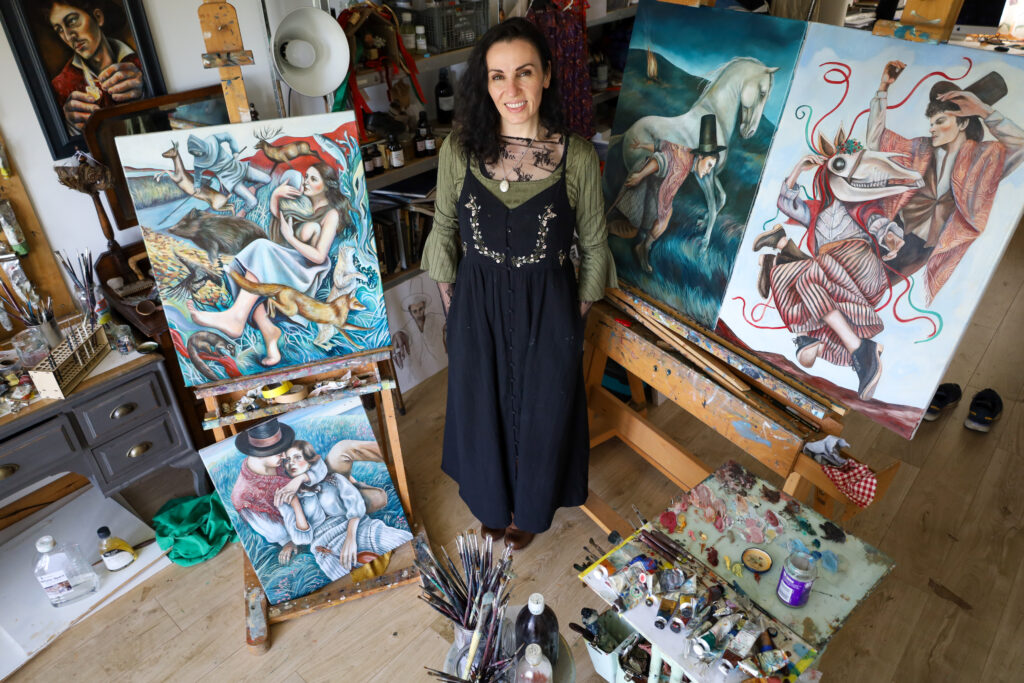
A major solo exhibition of new works by Meinir Mathias is set to take place this month, drawing on sources including Welsh mythology and history – including the Rebecca Riots, the Mabinogi and the earliest surviving Welsh lullaby.
On 15 May, Oriel Ffin y Parc in Llandudno will present Cyfarwydd, a major solo exhibition of new work by Meinir Mathias. Bringing together a substantial body of oil paintings, the exhibition marks a focused development in the artist’s exploration of narrative, identity, and cultural memory.
Mathias is widely recognised as a distinctive voice within contemporary painting. Her work engages with questions of language, place, and inheritance, and is held in international & national collections including the National Library of Wales and Bangor University. She is the recipient of the Ivor Davies Prize at the Lle Celf, National Eisteddfod of Wales.
Drawing on sources including the Mabinogion, Welsh folk traditions such as the Mari Lwyd, and histories of protest such as the Rebecca Riots, Cyfarwydd brings together myth, history, and lived experience within a contemporary visual language. Central to the exhibition is work responding to Pais Dinogad, the early medieval lullaby preserved in the Book of Aneirin. Here, the text is reimagined beyond its familiar reading as a meditation on inheritance, survival, and the transmission of knowledge across generations.
Ffin y Parc share: “In this work, the central figure becomes both mother and storyteller, embodying the narrative rather than illustrating it. Human, animal, and landscape elements converge, suggesting a continuity between body, memory, and land. The composition remains open, unfolding as a layered field where meaning is held rather than fixed.
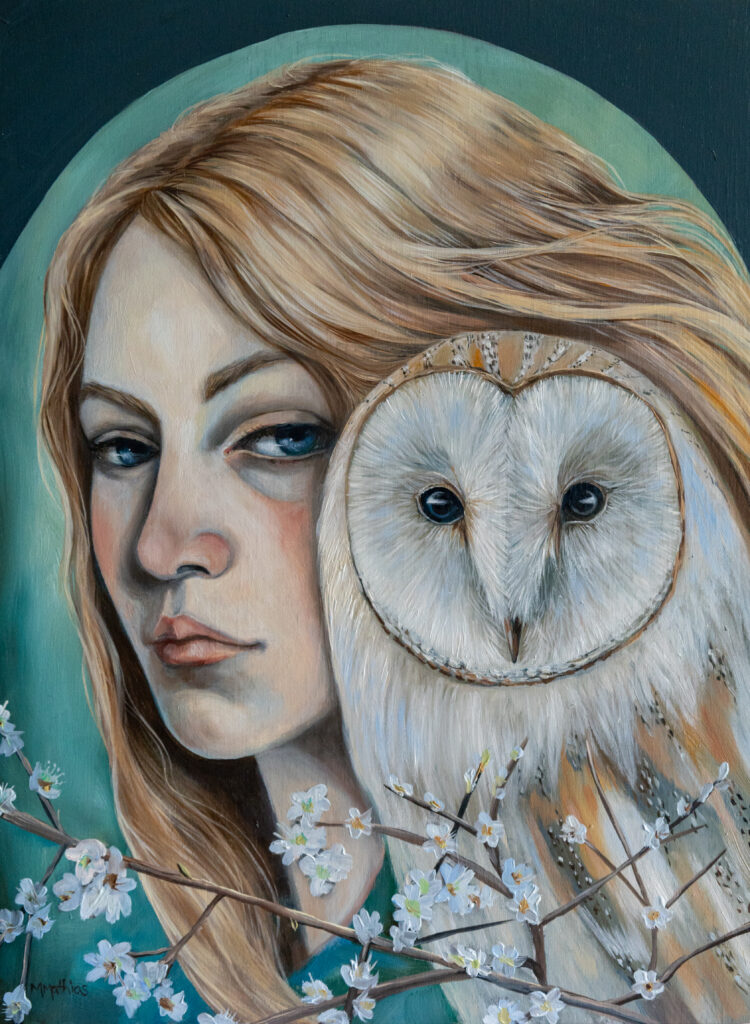
“This approach extends across the exhibition as a whole. Figures throughout Cyfarwydd act as vessels of narrative, holding and transmitting story rather than simply representing it. Portraiture plays a central role, yet these works resist fixed identity, occupying a space shaped by memory, myth, and observation, suspended between past and present.
“Alongside these cultural references, the work remains grounded in the artist’s own life. A rural upbringing informs Mathias’ relationship to landscape, while memory and family provide an underlying structure. Contemporary figures, often drawn from those close to her, anchor the work in the present, while symbolic objects and collected textiles introduce traces of domestic history, labour, and inheritance.”
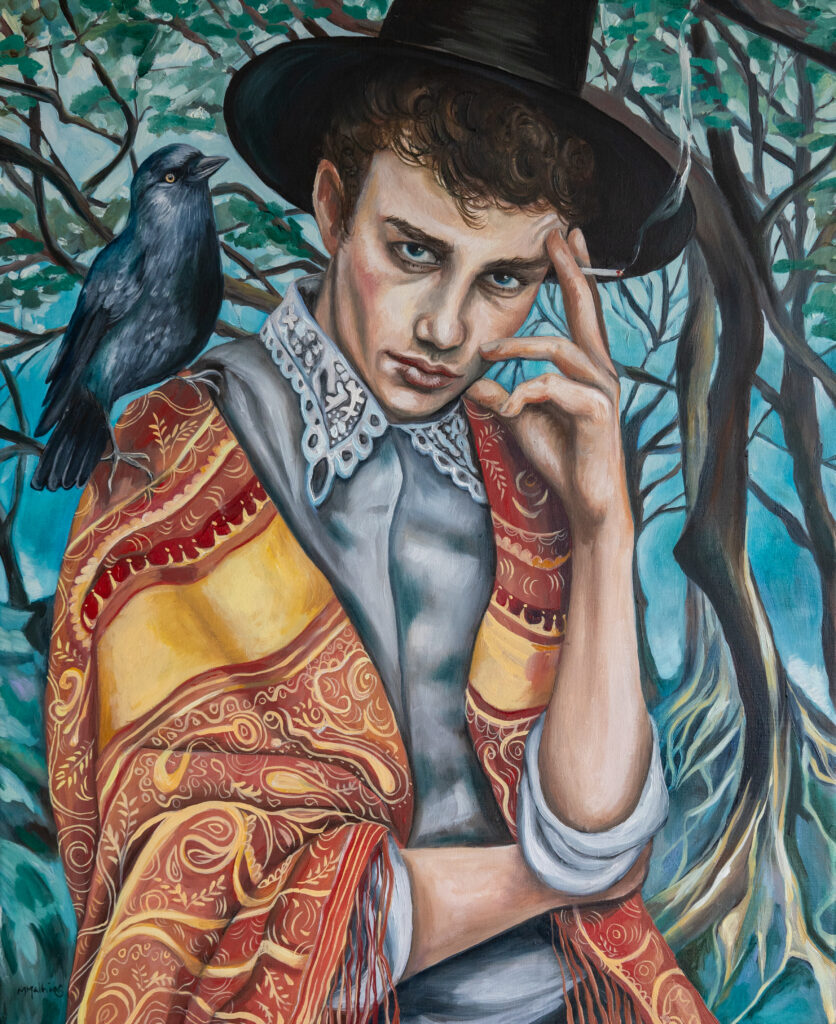
Recurring motifs appear throughout the exhibition. A series of works revisits the figure of the Rebecca Rioter, presenting Merched Beca as enduring symbols of resistance, carried forward into the present. Other paintings engage with ideas of collective action, solidarity, and community, extending the language of storytelling into lived experience.
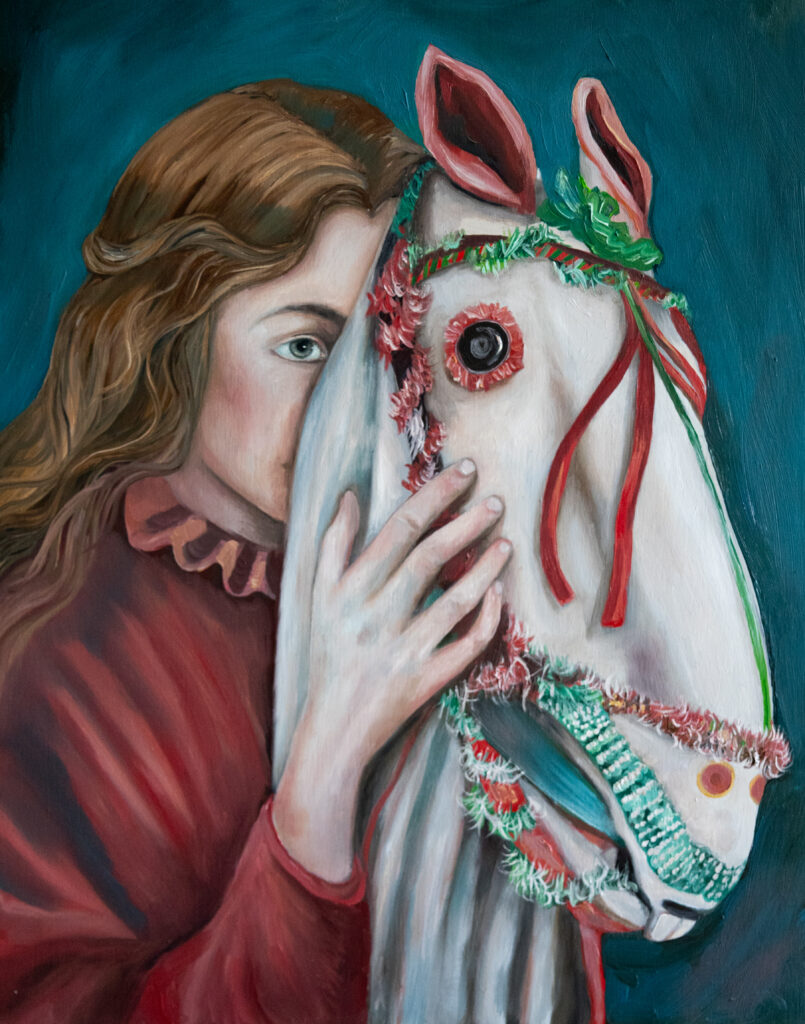
Folk elements run throughout: the masked presence of the Mari Lwyd, fragments of song, and figures drawn from myth. Birds recur as carriers of meaning, particularly the wren, long associated with knowledge and the sacred within Celtic tradition. In one painting, a young girl holds a singing wren, while its imagined dwelling appears within the landscape beyond, blurring the boundaries between memory, myth, and lived space.
The exhibition coincides with the release of Cyfarwydd, the second album by Mari Mathias. Sharing both title and thematic grounding, the two projects form a parallel exploration of storytelling through image and song. The album artwork, created by Meinir Mathias, extends the visual language of the exhibition into another medium.
Ffin y Parc add: “What defines Cyfarwydd is its insistence on the relevance of local narrative within a globalised cultural landscape. In this respect, Mathias’ work shares affinities with artists such as Wifredo Lam, Emily Kame Kngwarreye, and Frida Kahlo, whose practices foreground identity, place, and inherited systems of knowledge. Within Wales, this approach resonates with artists including Iwan Bala, Ivor Davies, and Luned Rhys Parri, who have each engaged with questions of language, identity, and cultural memory in the face of homoginizing, central British art trends.
“At the same time, this work also engages with broader human experience. Themes of memory, belonging, love, and loss create a connection that extends beyond its specific cultural context.
“Cyfarwydd positions narrative painting not as a means of looking back, but as a way of shaping meaning in the present, reaffirming the continued relevance of cultural memory within contemporary Welsh identity.”
Nation Cymru spoke with Meinir Mathias ahead of the exhibition to discuss some its central themes, and the duty she feels to bring forgotten and overlooked histories and mythologies back into Wales’ collective consciousness.
What made you title the exhibition Cyfarwydd?
The word cyfarwydd carries several meanings in Welsh , storyteller, guide, someone familiar with a landscape or body of knowledge. That felt central to the exhibition. The works are concerned with how stories are carried through people, places, objects, song and memory, often across generations.
I wasn’t interested in illustrating myths literally, but in thinking about how narrative survives and changes over time, and how we continue to hold fragments of history and identity within contemporary life. The figures in the paintings become vessels for that , part memory, part observation, part mythology. Cyfarwydd seemed to hold all of those ideas together naturally.
The exhibition coincides with Mari’s latest album, also titled Cyfarwydd, and while your works have intersected before in cover artwork or character study, you’ve not worked in this way before , how did that come about?
It happened quite organically really. Mari and I have always shared a similar landscape of references – Welsh folk tradition, song, storytelling, rural life ; so although we work in different mediums there’s often a natural overlap.
As the exhibition developed, we realised we were both circling similar themes independently: inheritance, memory, voice, and the passing on of stories. The title Cyfarwydd emerged separately in conversation and suddenly seemed to connect both bodies of work.
There’s something quite special about the projects sitting alongside one another because they approach similar ideas through different forms , one through image, the other through song. I also designed the album artwork, so visually the two became intertwined as well.
You’ve used Pais Dinogaid as a theme for one of the pieces, what led you to focus on this timeless piece?
I’ve always found Pais Dinogaid incredibly moving. It survives as this small, intimate fragment from the early medieval period, but it still feels emotionally immediate. People often focus on it simply as a children’s lullaby, but for me it contains much more than that , ideas around protection, inheritance, survival, knowledge passed between generations.
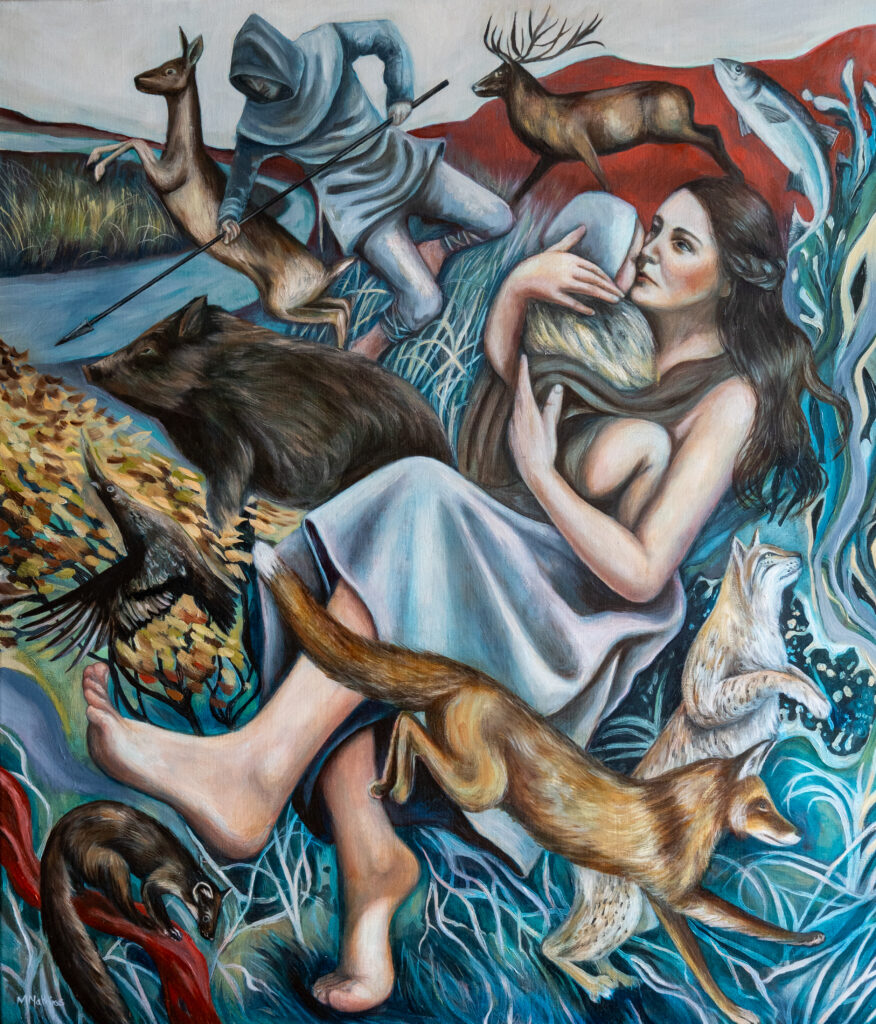
I became particularly interested in the presence of the mother within the text. She becomes more than a parent figure, almost a storyteller, preserving memory and identity through language and song. That felt deeply connected to the wider themes of the exhibition.
What fascinates me is that despite the centuries between us, the emotional core remains recognisable. It collapses time in a very powerful way.
The Mabinogi is another key theme , have you enjoyed diving into the stories again?
Very much. I grew up with many of these stories around me in one form or another, so returning to them feels less like discovering something new and more like uncovering layers within something already familiar.
What interests me most is how strange, psychologically complex and open these stories actually are. They’re full of transformation, ambiguity, grief, violence, tenderness and symbolism. They don’t behave like neat moral tales.
I think that openness is partly why they continue to resonate. They allow space for reinterpretation and for contemporary concerns to enter the work naturally. I’m interested in how these stories continue to live rather than preserving them as fixed historical artefacts.
We also see some recurring motifs such as the Rebecca Riots, a signifier of protest like no other. Did it feel perhaps more pertinent right now with so much polarisation around the Senedd elections?
I think the Rebecca Riots continue to resonate because they were never only about toll gates , they reflected wider frustrations around inequality, disenfranchisement and the survival of rural working communities. Those themes don’t disappear.
The figures of the Merched Beca have become symbolic within my work not simply as historical subjects, but as enduring images of resistance and collective action. There’s something powerful in the way identity was obscured and transformed through costume, performance and shared purpose.
I wasn’t making direct party-political paintings, but it’s impossible not to feel the atmosphere of division, uncertainty and cultural anxiety that exists at the moment. In periods like this, people often return to questions of identity, belonging and community, and I think the Rebecca Riots still speak into those conversations.
Your works bring to light many historical events which perhaps haven’t been taught in schools until recently, or ever. Do you feel a calling of sorts to use your voice, or brush even, to shine a spotlight on our forgotten histories and mythologies?
Yes, I think I probably do feel that responsibility to some extent, it has been lovely to hear from schools who have used my images and to see children’s artworks which have been inspired by this work is amazing.
Having said that, I wouldn’t describe the work as ‘historical’ in a straightforward sense. I’m not trying to recreate history literally. It’s more about creating emotional and cultural connections to it.
For a long time, many Welsh histories, voices and traditions were marginalised or absent from mainstream narratives and school curriculum.
As Saunders Lewis quoted’ There is no hope for Wales until the young generation study the past of Wales’.
When people encounter these references in art, it can sometimes reconnect them with something they already sensed belonged to them culturally but hadn’t fully seen reflected.
I’m also interested in how local stories can speak beyond Wales as well. Themes of memory, land, language, loss, resistance and inheritance are universal human experiences.
You can view and purchase Mathias’ latest works at Ffin y Parc’s website, and in person from 15 May.
Support our Nation today
For the price of a cup of coffee a month you can help us create an independent, not-for-profit, national news service for the people of Wales, by the people of Wales.
Get more trusted Welsh news
Choose Nation.Cymru as a preferred source in Google News to see more of our journalism.


