


Daunting D’Hondt Explained (hopefully!)
Gwern Gwynfil
Most people in Wales won’t know that the electoral system for the next Senedd elections in May is changing dramatically.
Fewer will understand how those changes will work.
Hardly anyone will have heard of the Belgian mathematician Victor D’Hondt. He devised the formula which calculates how seats are allocated based on the number of votes cast for each party on the party list. This type of proportional representation has been named after him.
It is popular, used in over 30 countries globally, with modified D’Hondt systems in use in Scotland, Wales, Northern Ireland and London Assembly elections since the advent of devolution.
Depth of Ignorance
Perhaps I should not have been surprised when, scrolling through LinkedIn early in December, I struck upon a short feed discussing the new electoral system for Wales.
The eminent economist Calvin Jones had asked if anyone knew the lowest possible percentage required to win a seat in the Senedd in the coming election under the new system.
I was surprised and disappointed to see the misunderstanding demonstrated in the replies – not least because the inaccuracy came from such luminaries as a lead candidate for the Senedd (certain to be elected and become an MS), and a former Future Generations Commissioner. Surely they should know and understand the new system?
More importantly, if such luminaries don’t really get it, what hope for most people?
The Mistake
Their mistake was to confuse the minimum vote percentage required to guarantee a seat, with the minimum possible to win the last of the six seats allocated to each constituency. The consensus response leant into the 12-14% of the vote which does guarantee a seat in the Senedd.
Let’s be generous and assume a hasty reading of the question (for those not sitting exams, it’s easy to forget the importance of reading the question carefully!).
This article is for the luminaries, but mostly for those who want to understand how things will work at the Senedd count in May this year, and why I believe there will be Senedd seats won in May 2026 with under 12% of the vote, perhaps as little as 10% of the vote in some constituencies (a very even vote distribution could take this slightly below 10% but this is highly unlikely based on current polling).
Had there been a 7th national party in the mix, (whatever its name), picking up a reasonable percentage of votes, then somewhat lower scores to win the 6th seat would have become more likely. Especially in those constituencies where there are other small parties in the mix.
This is not compulsory reading (and there won’t be an exam at the end) but I hope it will help you better understand the electoral mechanics of our democracy.
Extreme Examples and How it Works
The D’Hondt proportional representation electoral system is relatively simple in the way it calculates and allocates seats in an election (I appreciate that it doesn’t always seem that way but bear with me on this).
The first seat is easy – it goes to the party with the most votes. Half of those votes are then ‘used’ and are discarded. The party’s remaining votes still count and ensure that the party is still in the mix for the next seat, which is again awarded to the party with the highest number of votes.
This process essentially continues until all seats are awarded.
Here is a relatively extreme and simplistic example using made up numbers:
Party 1 gets a whopping 54% of the vote
Party 2 gets 22% of the vote
Party 3 gets 18% of the vote
Parties 4, 5, and 6 each get 2% of the vote
The first seat goes to Party 1 and half of their vote is discarded. With 27% of the vote they also get the 2nd seat.
At this stage it does become slightly trickier. Party 1’s remaining vote share to carry forward is now their original total number of votes divided by three – a number derived from their total number of seats already won plus one. In this case 54% divided by 3 equals 18%.
To recap – two seats have now been allocated with four to go.
Party 2’s 22% gets one of these and then party 1 and party 3 with their now matched 18% get the next two.
The residual vote share for party 1 after winning their third seat is now 54% divided by 4 (three seats plus one), 54 divided by 4 equals 13.5%.
This is enough for party 1 to secure 4 of the 6 seats (on considerably less than two thirds of the votes cast).
For the visual amongst you, this is laid out in the table with seat winners in each column in bold.
| SEAT 1 | SEAT 2 | SEAT 3 | SEAT 4 | SEAT 5 | SEAT 6 | |
| Party 1 | 54% | 27% | 18% | 18% | 13.5% | 13.5% |
| Party 2 | 22% | 22% | 22% | 11% | 11% | 11% |
| Party 3 | 18% | 18% | 18% | 18% | 18% | 9% |
| Party 4 | 2% | 2% | 2% | 2% | 2% | 2% |
| Party 5 | 2% | 2% | 2% | 2% | 2% | 2% |
| Party 6 | 2% | 2% | 2% | 2% | 2% | 2% |
Table 1: hypothetical breakdown of constituency seat allocation Senedd electoral system 2026
This is a very efficient example in terms of votes used – only 6% of the votes, for the very small parties are ‘wasted’, but in the real world there could be many more wasted votes in the new system.
The relatively high threshold to win a seat means that votes for parties with no real traction will more than likely be wasted. This does mean that, despite many claims that the system does not lend itself to tactical voting, it actually does the opposite – especially in the unusual circumstances of the coming Senedd election.
As a final observation, whilst this distribution is unlikely in any constituency in the Welsh elections in May 2026, there are one or two of our super constituencies where you can imagine a result along these lines, Ceredigion Penfro for example.
Realistic or not, it gives us a breakdown of the process and hopefully makes it easier to understand.
A Realistic Example
Now that we have some grasp of the system, here’s a realistic example across a wider range of constituencies, based on a relatively broad interpretation of the data we have from polling for the Senedd elections.
It is anonymised in terms of parties and constituencies, but it is realistic and it has some very interesting features.
| SEAT 1 | SEAT 2 | SEAT 3 | SEAT 4 | SEAT 5 | SEAT 6 | |
| Party 1 | 33% | 16.5% | 16.5% | 16.5% | 11% | 11% |
| Party 2 | 20% | 20% | 10% | 10% | 10% | 10% |
| Party 3 | 18% | 18% | 18% | 9% | 9% | 9% |
| Party 4 | 16% | 16% | 16% | 16% | 16% | 10% |
| Party 5 | 8% | 8% | 8% | 8% | 8% | 8% |
| Party 6 | 7% | 7% | 7% | 7% | 7% | 7% |
| Others* | 1% | 1% | 1% | 1% | 1% | 1% |
Table 2: hypothetical breakdown of constituency seat allocation Senedd electoral system 2026 based on current polling data
*Some constituencies will have independent or minor parties represented
This example demonstrates some of the flaws in the way the system has been designed for the coming elections. In defence of those who chose this system, they did not expect a six party system with the kind of support distribution indicated by current polling. However, against them is the truth that this system was not recommended and that they chose it instead of better alternatives.
This was done for political reasons mainly involving pressure from the Westminster branch of the Welsh Labour Party. Pressures and decisions which have ironically resulted in a system that will punish Labour in Wales such is the depth of collapse in their support.
Issues with Senedd D’Hondt
First up in this example, Party 1 gets three times the representation of any other party with only a third of the votes cast – this is not great proportionality. For me this is a major weakness in the system.
In terms of voter numbers in our Senedd constituencies, based on a reasonable turnout of around 50%, our example delivers three seats to Party 1 with around 25,000 votes but just one to Party 2 with around 15,000 votes.
To dwell on this a little longer, if the same example above was replicated across every one of the 16 constituencies we would see one party with around 400,000 votes winning 48 seats while the second placed party would win only 16 seats on 240,000 votes.
Next up, 16% of the votes cast, for parties 4, 5, and 6, are completely ‘wasted’. This is a lot of voters casting an ultimately meaningless vote as they end up with no representation despite the nominally proportional nature of the vote.
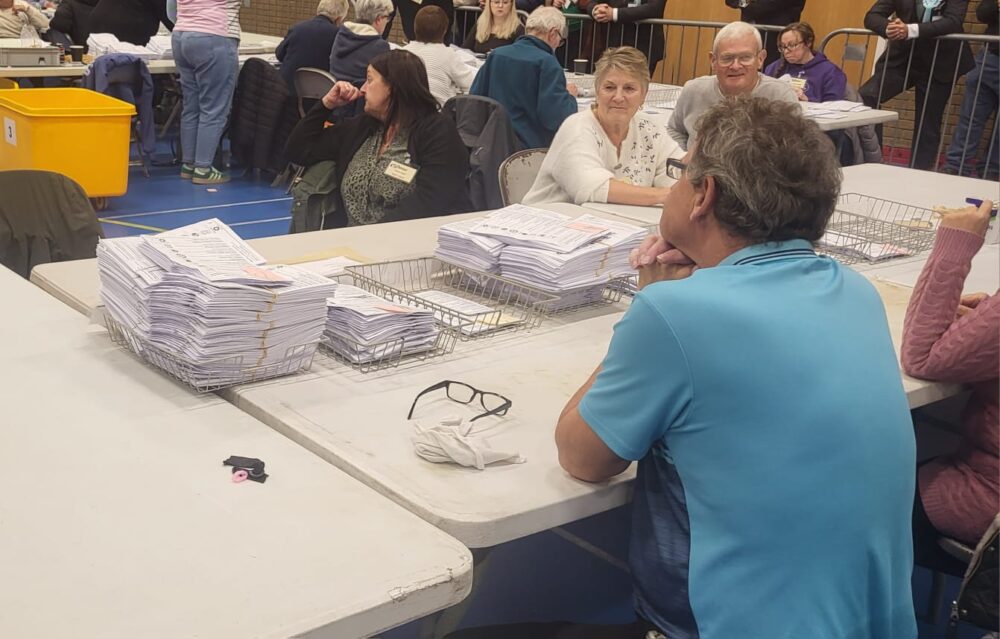
Undeniably, the system is far better than the old ‘first past the post’ system, which could plausibly result in 80% of the votes in a six party election being ‘wasted’ (it’s worth pausing to reflect on this – that’s four of every five votes having no meaning in a democratic election).
Despite being under the 12% ‘guaranteed’ seat threshold, Party 1 has secured the 6th seat. It is likely that some of the 6th seats in May will be secured with between 10-12% of the vote – it is an outcome that crops up more often than you’d expect.
But from an electoral outcome and prediction perspective, all this is insignificant relative to the implication of the last issue highlighted by this example.
Last but not Least
By the time we get to the 6th seat, margins are very tight – only 4% separating 5 parties in this example, with only a single percentage point between the top three contenders for that last seat.
In terms of numbers of actual votes, in a typical Senedd election, this would be perhaps three thousand votes separating 5th place from 1st place when it comes to winning that 6th seat.
The three lead contenders for that 6th seat may have only a few hundred votes between them determining the final toss in terms of who goes home unhappy and who gets the bonus seat in the Senedd.
This makes predicting the winners of 6th seats next to impossible based on polling data. These relatively small real world vote numbers are well within the margin of error of any poll, especially at the margins, and especially for the parties lower down the rankings, however sound the methodology, and however robust the sample size.
The Real Contest
16 seats out of the 96 available are all to play for, impossible to predict, and will almost certainly be the key determining factor in the balance of the final make up of the Senedd when the count ends on May 8th. This is where the real contest lies and it is here that tactical voting will most definitely make a difference.
In essence, for almost every constituency, there will be at least two parties for whom votes are ‘wasted’. With luck, polling will help make it clearer where votes will be wasted and may help individuals choose the most effective and impactful way to use their single vote in their own constituency.
Certainly something to revisit closer to the election.
There is an outside chance of a constituency returning one member from each of the six parties – my lead contender for this would be Brycheiniog Tawe Nedd – but on the whole constituencies are far more likely to be weighted towards three or four parties being represented, with all votes for the residual two or three parties being cast in vain.
It will be an exciting and unpredictable election!
An earlier version of this article contained some erroneous calculations. My thanks and praise to all those who pointed this out – you all passed the test 😉
Support our Nation today
For the price of a cup of coffee a month you can help us create an independent, not-for-profit, national news service for the people of Wales, by the people of Wales.



Good illustration of D’Hondt here.
Single Transferable Vote would produce a more equitable correlation between votes cast, and MS seats. But, we are where we are, and that’s a better place than First Past The Post.
I’m thankful the vote count for Senedd will not begin until the day after voting day. Even so, there’ll be sleepless nights for some!
From a lay voter perspective the main downside is the loss of our ability to vote for a named candidate. Where is the accountability? It sounds more like a mathematical exercise than a political choice.
I agree with you Felicity, and D’Hondt is far from ideal. FPTP at least has the merit of direct accountability, yet brings its own serious democratic shortfall.
Sometimes a dilemma (in this case say) has a least-worst option only, as the outcome of choice. If it helps, I remind myself when considering comment, how dreary the world would be if everyone thought like me for what’s best!
I think you’ve got the allocations of the seats highlighted incorrectly in table 2.
I think you are right. The Senedd published an example of how the voting system works about a year ago. In the example the party with the highest number of votes received 300 (party a) votes and took the first place. Their vote was then reduced by 50% giving them 150 votes left in the pool. After the other parties picked up seats party a eventually came to the top of the list again and we’re allocated a second seat. At this point in the example it was explained that the original vote of 300 votes was now divided by… Read more »
My brain hurts! I thought the process was to divide the number of votes each party has by the number of seats they have, plus 1. First round the biggest party gets first seat. For second round their total vote is divided by (1+1) i.e. 50% discarded as you say. But on the third seat that calculation isn’t 50% of 50% of 80% (your 20%) but rather the party’s total vote divided by 3 (2 previous seats won, plus 1) – that’s 33.3% of their vote. It’s numbers of votes that count, not percentages? Or is the result the same… Read more »
Gwern Gwynfil is incorrect in his analysis. In the comments Hywel Davies is correct and that is why you need approx 12% to secure one seat.
Ti’n iawn! Fersiwn cywir ar y ffordd maes o law
Diolch Gwern, – defnyddiol a diddorol !
Pretty much every system has its wasted votes and an imperfect proportionality, by virtue of their being fewer than 100 seats if nothing else. Also important to note votes can be ‘wasted’ by giving more votes to a single party than it needs and a tactical vote may on occasion be best used on a smaller party. For people who don’t think too much about these things they’re probably still just better off voting for whoever they simply want to win. STV does quite well on the proportionality front (still not perfectly), but it isn’t without its other problems. Looking… Read more »
If I understand correctly Cymru has adopted the simplest version of D’Hondt where the divisors, the numbers by which you divide the total votes of a party has gained by winning x seats already, are x+ 1, leading to 1,2,3,4,5,6. Other sets of divisor numbers are possible, not necessarily integers. They can be chosen to make it harder for the largest party to gain subsequent seats and maybe easier for a minor party to win one seat. I believe Norway uses such a system. Our political expert Richard Wyn Jones has a connection with Norway. Perhaps he could share his… Read more »