


‘Death is not meant to run that fast’: Remembering Aberfan
Brad Evans
Marking the 60th anniversary of the Aberfan disaster, this extract is published from the book How Black was my Valley (Repeater Press, 2025). The full chapter has been made available by the press and can be downloaded here.
The memorial service for the children of Aberfan lasted 13 minutes. What else could be said, when the pain was eternally suspended in the unforgiving air? Besides, how could one possibly mourn what was such an incomprehensible absence, which despite the appearance of representatives from every religion and political stripe, nothing any of them would say could bring their little spirits back to life?
The valley now had a tragedy everybody could connect to with broken dreams and damaged hearts. The dirty black waters that flooded the village after the slide would soon be coursing through the veins of its people. Aberfan was not a place any of us needed to visit. The community which lost its children wasn’t simply a location on a map, even though we knew it was just over the mountain from us. Aberfan was a tragedy we all learned to share in classrooms built just like those upon which discarded black rocks of no value fell upon disposable children with such indiscriminate abandon.
Aberfan still haunts the collective memory of the valleys, its history, its suffering, its fascination with the reality of death, its political neglect. If the disaster had people questioning what God could ever oversee such a killing of innocence, in many ways, it would also define the secular life of the valleys and even the wider landscape of industrial Britain. Yet some are still on the surface, in danger of forgetting perhaps what happened in a few seconds as a catastrophe which was building momentum for decades washed everything away and whose name is still pained by the momentous loss.
Aberfan was the unbearable that resided in the unreachable depths of the blackness. Survivors would speak of its reckoning as coming face-to-face with a darkened abyss. What is a tip, after all, if not the bowels of the earth, the pit below, ripped out from where it belongs, and its very naming turned inside out?
As one tip worker recalled:
I was standing on the edge of the depression, sir. I was looking down into it, and what I saw I couldn’t believe my eyes… It started to rise up slowly at first, sir. I still did not believe it, I thought I was seeing things. Then it rose up after pretty fast, sir, at a tremendous speed. Then it sort of came out of the depression and turned itself into a wave, that is the only way I can describe it, down toward the mountain… towards Aberfan village… I was looking down the crevice, sir, down at the drop, and it seemed to me like as if the bottom shot out.
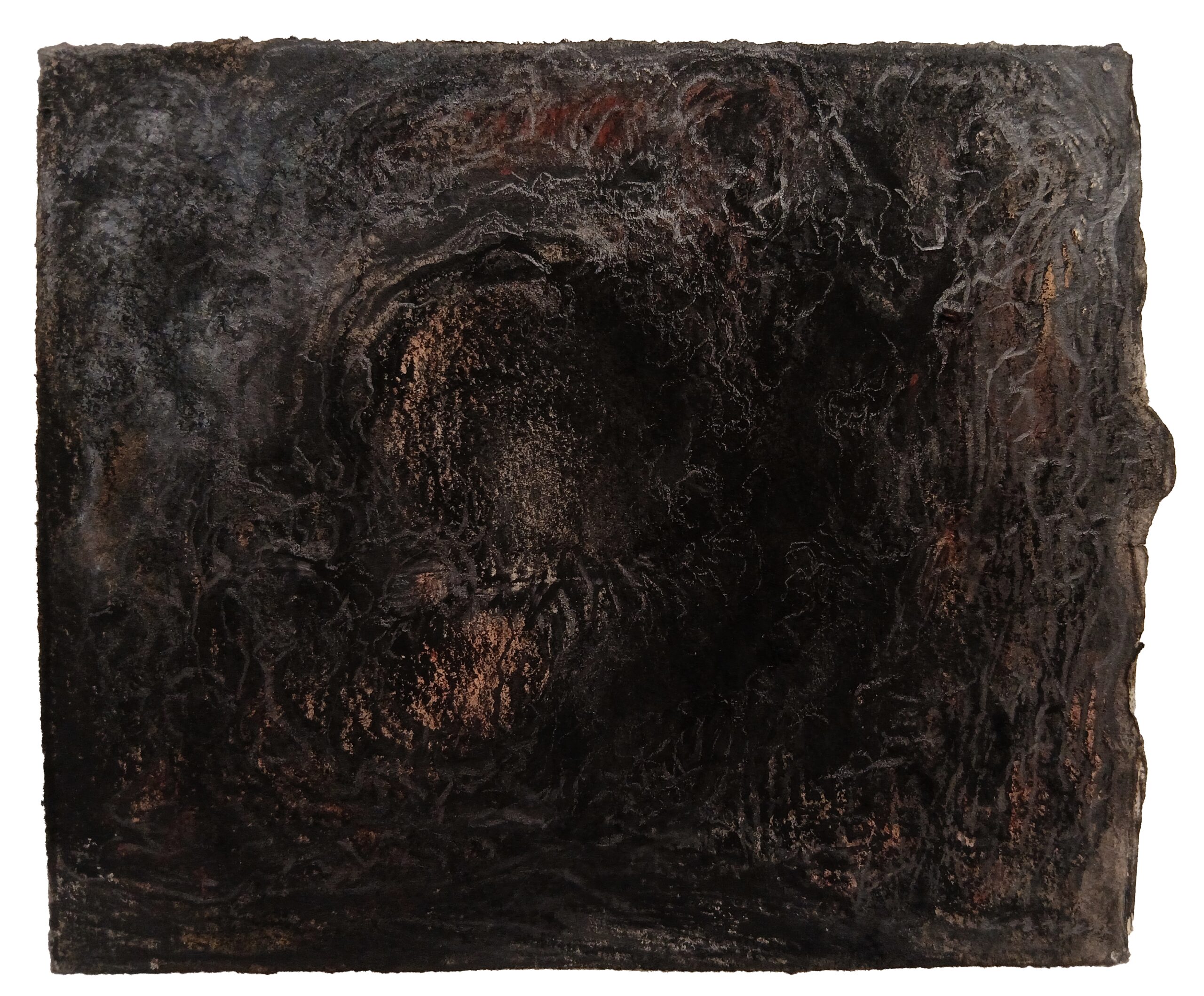
Aberfan was a testimony to colour. Black within black, depth upon depth, dust layering over dust, as the world sank beneath. The streets of Aberfan rose that day as the tormenting hill continued to breathe from within. Into the night, the smoke billowed from the ground as the black carried on creeping into the town. But what made that blackness so terrifying was its movement.
Mining communities had lived in the shadow of the black for as long as they could remember. It was respected. Yet often, as with death, when the blackness was feared it was because they were heading in its direction. That gave them a semblance of control, or at least a belief that the dark matter could be tamed. Aberfan was different. The abyss itself was moving towards. And once it was unleashed, it showed no mercy for the innocent or the town in which they dwelled. That which was meant to be static and fixed into place, showed how it could move at tremendous speeds, like a black bolt of lightning striking across darkened skies to leave mortality in its pass. Death is not meant to run that fast.
Aberfan was buried underneath what the South Wales Echo at the time called a “black glacier”, and the BBC later described as a “glistening black avalanche” of liquefied coal waste, the lingering memory of the colour is what dominates the encounter.
“It was suddenly growing darker”, Hettie Taylor, one of the child survivors, recalls, “and we couldn’t understand it”. Other child survivors like Bernard Thomas remembers the “wall of black”, Gareth Groves “a black wave of muck”, Gaynor Madgwick “turning my head seeing this black mass and trying to get up and run for the door… Then it was blackout”, Phil Thomas of a “rumbling noise” followed “then by quiet and black”, and Alan Thomas who, also speaking about the “black mass”, added, “Every time we opened a classroom or took windows out, there was nothing there — it was just a black canvass from ceiling to the door”. In all the recollections, the colour is the same.
Everything returns to the black valley. As another survivor Susan Robertson explained, “My abiding memory of that day is blackness and dark. I was buried by a horrible slurry, and I am afraid of the dark to this day.” A fear that also stayed with Gerald Kirwan, who admitted “since that day I don’t like the dark”. Aberfan was a trauma that took its toll upon the survivors from within for decades.
How terrifying must it have looked to see that black avalanche emerging through the deep white mist that hid its reckoning, until it arrived. But the black remained ever-present, and its infinite absence was revealed to be a force that contained all, for the peril it consumed remained inseparable to the way of life in these towns. And it would also carry over as the community laid its children to rest.
“We just couldn’t picture anything else”, one of the bereaved parents Marylyn Brown explained. “The one thing I remember was all the people walking on the streets, obviously all dressed in black, walking along the main road to the cemetery. It was one mass of black.”
Some lost more than most people could ever comprehend. Others lost everything. John Collins had his entire family wiped out as the family home was washed away with his wife and children inside. “It was as if life never existed”, Collins told, “There’s nothing left”.
The first rescuers on the scene were the town’s women and older children. In a state of bewilderment, they were left to frantically scour the mass with their own bare hands. Most of the men were either sleeping or down in the mine as the day shift and night shift changeover had already taken place. The speedy arrival of the men from the pits with headlights still on was a welcome relief, for they more than any other knew how to dig the earth.
They would soon be joined by the Mines Rescue Service, who were often tasked with dealing with explosions and fatalities below. The miners worked in teams and divided the ground as they would normally when cutting the seams. Aberfan was an ecology of suffering, which had turned this world upside down. The tragedy also symbolised a historical conjuncture where both religion and industrialisation had to reckon with their own histories, the false claims of their binding myths, from which neither has recovered.
We might also say the contemporary fascination with the labours of man and its destructive impact on the environment, which geologists now term the Anthropocene in relation to the untold devastation humans have brought to the planet, could be literally traced to this catastrophic moment. If we needed to come face-to-face with the realisation most “natural disasters” were the fault of human excessiveness and not simply a smiting phenomenon from a testing God or a freak pattern of nature, surely Aberfan sets the tragic scene? This would bring to light two remarkable developments, which we tend to so often take for granted today.
The remarkable power of televised humanitarianism, along with the inevitable problems such media spectacles can create despite all their best intentions. Aberfan was, in the words of the New York-based photojournalist Chuck Rapoport, “the first major disaster of its kind that was televised”. He arrived for Life magazine to document what he called “The Town Without Children”.
Rapoport was not alone. Over 2,000 volunteers and reporters would eventually arrive, though it was already too late to help the children. No child was brought out alive after 11am. There were less than 100 minutes to save the poorly beloved of Aberfan. Those who were brought out after were taken to the chapel, their lifeless bodies laid on the pews and covered in blankets for the parents to go and identify. That place held a different kind of silence.
Black is the colour of the night. And as the night descended upon Aberfan, so a different kind of illumination set in. Silhouetted pictures of miners were set among a ruin of the present, which because of the atmospheric presence of the smoke from the burning fires below looked more and more like a scene from the Somme.
As Life magazine’s London bureau chief Jim Hicks told: “No one who endured this night would ever forget it — the phantasmagoria of coal dust and smoke”. Other images that focused on the homes looked like a chaotic film set, as the miners and professional rescuers were now trying to manage the presence of well-intentioned volunteers who frequently got in the way. Nightfall was also backlit so that a world could be witness to every second of a tragedy unfolding. Such desire for witnessing carried over into the days ahead.
We cannot underestimate how important some of this was in terms of how we remember Aberfan today, even if locals soon became very weary of outsiders. Rapoport is notable here. Having arrived in the village on 29 October (the same day as Queen Elizabeth), Rapoport found the village a “hostile ground: sad, angry, wet and cold, half of it still covered in grime from the tip’s fallen slurry”. By the time he arrived attitudes to journalists were already strained.
Rapoport tells of a notable incident in the pub where he was staying when he came across the “toughest man in the valley”, Dai George, who allegedly had a great dislike for journalists. He recalled how he convinced George he wasn’t a writer but a “poet with a camera” quoting back to him Dylan Thomas as he won over the locals’ affection. Rapoport would end up staying in the village until Christmas Day of that year.
Of the many striking and black-and-white photographs he produced depicting the aftermath, the one that’s stayed with me is of a single child in a playground weighing down upon the air as they are propped up by a merry-go-round. His gaze is fixated on the ground before him. His body suspended in the fall. The world may be spinning, but this boy in this park is lonely, isolated and frozen. What is going on in this child’s mind as his chest is pressed against those cold steel bars, on apparatus which only gives merriment in the company of others who gift you their energies as they push the passenger into a delirium that sends the head spinning with the delight of friendship? Like so many of Rapoport’s intimate photographs, this image tells so much through its sorrows, solitudes and silences.
Brad Evans is a Professor of Political Violence & Aesthetics at the University of Bath. Born in the Rhondda valley, he has written over 20 books and edited volumes on the subject of violence, while having edited dedicated series and columns on the subject with the New York Times, the Los Angeles Review of Books and American Book Review. His book How Black was My Valley, which speaks of his own life growing up in conditions of poverty in South Wales, also inspired the two-part BBC radio Wales series, Despair to Where? The Valleys Then, Now and in the Future.
Support our Nation today
For the price of a cup of coffee a month you can help us create an independent, not-for-profit, national news service for the people of Wales, by the people of Wales.
Get more trusted Welsh news
Choose Nation.Cymru as a preferred source in Google News to see more of our journalism.


