


Elementary, Dear Aubrey – The First Welsh Literary Detective
Adam Pearce, Editor, Melin Bapur Books
(Yes. I know Sherlock Holmes never actually said that. Let’s get that out of the way, shall we?).
Before Jeff Evans, before Gareth Prior, before any other literary detective in Cymraeg… there was John Aubrey.
OK, technically Aubrey wasn’t actually the first Welsh literary detective. Crime fiction in Welsh has been around a lot longer than many might think and there was a fictional detective in Welsh at least as far back as Mr. Johns, a PI with a sideline in hypnosis in Mary Oliver Jones’s Nest Merfyn (1892).
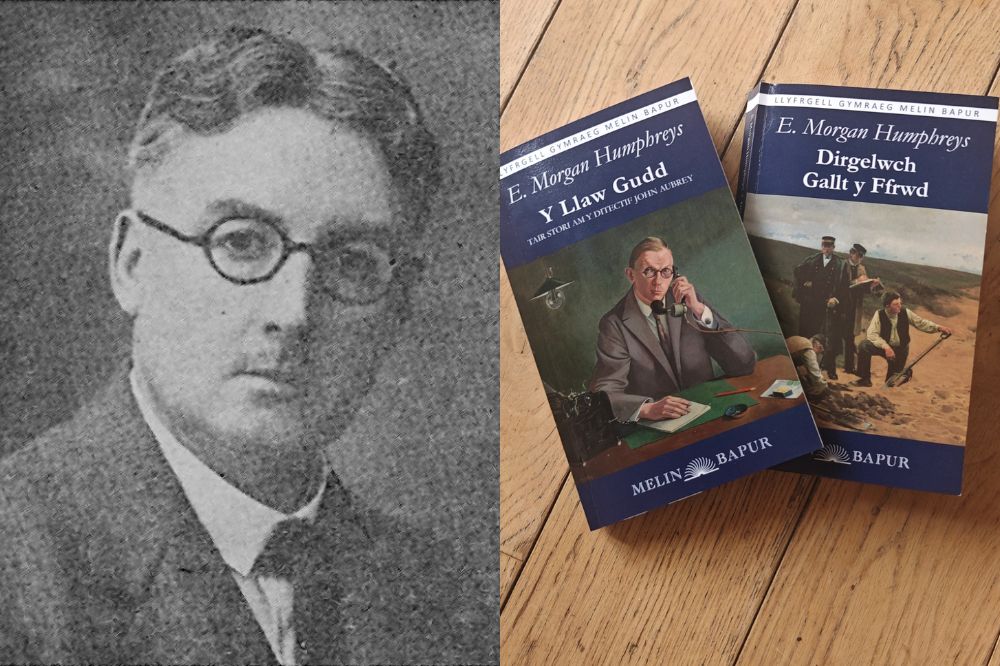
But John Aubrey is almost certainly the first detective in Welsh literature to appear across multiple stories. First appearing in 1926’s Y Llaw Gudd (The Hidden Hand), the scruffy, overweight and jovial sleuth – whose unassuming veneer, inevitably, masks a keen intellect – would make four separate appearances, making him the first serial detective in Welsh fiction and thus a milestone in Welsh crime and adventure writing.
Aubrey was the brainchild of E. Morgan Humphreys (1882-1955), a major journalist but also a writer who worked tirelessly to provide popular and genre fiction in Welsh in a period when very little was being produced. Originally from Dyffryn Ardudwy, southern Gwynedd, he spent most of his life in Caernarfon and for half a century he was a fixture of the town, a tall and striking figure whom many apparently knew by sight even if they weren’t familiar with his writing.
As a creative writer Humphreys contributed several anonymous stories and serials to the many Welsh magazines of the 1900s. He won a prize for a novel at the 1909 Eisteddfod that is probably now lost, and his true creative output is undoubtedly much larger than the relatively small body of written work that now bears his name.
These include some early adventure stories published in the 1910s but it is undoubtedly the John Aubrey stories, published between 1926-1952, which are his most famous and important creations. They are rare examples of genre fiction from the period in Welsh; ironically it is the very fact they were intended primarily to entertain and delight that makes them far more important pieces of Welsh literary history than many more self-consciously ‘literary’ novels of the time.
The first story, Y Llaw Gudd (the Hidden Hand, 1926), sets up a relatively conventional whodunnit when a farmer is found murdered. Humphreys’ most obvious model is Arthur Conan Doyle – new Sherlock Holmes stories were still appearing around this time, and some of the tropes are fairly transparently borrowed from them. The story is narrated by an associate of Aubrey’s, Harri, who, like Holmes’s Watson, knows exactly when to ask the questions on behalf of the reader; whilst the bumbling Police Inspector Owen (read: Lestrade) makes all the obvious mistakes. The story has a distinctly Welsh flavour though, populated by characters right out of a Daniel Owen novel, and if this aspect may seem almost laughably cliched today – a character tries to engage Aubrey in a conversation about his favourite Preacher – there is something subversive going on too: without wanting to give too much away, all is not as it seems, and respectability can hide a darker side. Daniel Owen would have approved.
Y Llaw Gudd was a good first effort. Although readers would have to wait twelve years for the follow-up, Dirgelwch Gallt y Ffrwd (‘The Mystery of Ffrwd Hill’, 1938), the wait was worth it. A significant step forward from its predecessor, the second John Aubrey story is the longest by far, and the most complex. Whilst mystery remains an important element, the novel is as much an adventure story as a work of crime fiction, involving multiple factions of jewel thieves on the track of a precious stone from India. The novel has it all: poisonous snakes, gunfights, kidnap, mistaken identities, back-stabbing, and a rather suspicious femme fatale. Humphreys wisely ditches the first-person narrator and moves out of Conan Doyle’s shadow a little, though he is very clearly the main influence. The book is sadly somewhat marred to contemporary eyes by an unpleasant orientalist attitude towards its characters of colour (interchangeably referred to as Indians and Gypsies, it’s never real made clear which they are supposed to be) but it’s no worse in this regard than Doyle or Agatha Christie, and readers who can look past this will find a gripping adventure nonetheless. No work of crime fiction written in the language beforehand comes even close, and in its context it demands acknowledgement as a pioneering work in Welsh.
The next John Aubrey story moves back firmly into Mystery territory, with the sleuth called in to investigate the disappearance of a businessman whose car is discovered abandoned. Ceulan y Llyn Du (‘The Black Lake’, 1944) shows Humphreys’ writing making progress in some areas, particularly with its more naturalistic dialogue; but compared to its predecessor it is a much shorter, more straightforward and less ambitious work. It does, however, hint at a taste for the macabre and gothic, to which Humphreys gives free reign in Llofrudd yn y Chwarel (1952), which sees Aubrey leading a group of officers tracking a vicious fugitive in an abandoned slate mine. As a work of crime fiction Aubrey’s last appearance (in which he himself plays no bigger role than the other policemen) is rather flat, but as a disturbing work in the horror genre it is a minor classic of its period: the scenes in the darkness of the mine, a vicious psychopath just out of sight, are again without precedent in Welsh.
The Aubrey stories are very much of their time, and compared to the gritty realism one expects from modern crime fiction they can appear rather twee. This is also a big part of their appeal of course, the tension of criminality being an excuse to spin a gripping yarn rather than psychological analysis. The stereotypically ‘Welsh’ elements Humphreys employs – chapel deacons and ministers, the quarry – can similarly appear cliched and even a bit silly now: we are told Aubrey has a good deal of experience with Scotland Yard, but the only cases we see him deal with take place in rural north Wales! Still, the role of these Welsh elements needs to be understood: Humprhreys was employing the tropes his audience would have understood and related to, and bringing crime fiction to them. They make these stories unique, and in their own way genuinely revolutionary.
As a series, there’s not much coherence to the Aubrey stories: they can be read in any order without issue, and though the later works have their merits one can’t help but feel a little disappointed that Humphreys didn’t build on Dirgelwch Gallt y Ffrwd. The collection amounts to a little over four hundred pages written over twenty-seven years: like so many Welsh authors of the time (and today) Humphreys was a busy man who had to juggle his writing with the demands of his career. It’s frustrating he wasn’t able to devote more time to his creation, and one can’t help but feel there were even better Aubrey stories left unwritten. There would be many more literary detectives series written in Welsh – in the 1950s and 60s J. Ellis Williams would build on Humphreys’s legacy with his Cyfres Hopkyn and Cyfres Parri, and in the hands of modern authors like John Alwyn Griffiths and Geraint Evans detective fiction is one of the most popular branches of fiction in Cymraeg. But John Aubrey was the first, and Humphreys the pioneer.
Whilst not exactly an obscure figure, the fact Humphreys wrote adventure and crime fiction has tended to mean he gets mentioned in passing only, or damned with the faint praise of being labelled a writer for children. Nothing wrong with that of course, but there is no particular suggestion from the time that these stories were actually intended for younger readers. It seems to me that the ‘children’s’ label is often used as a way to acknowledge the value of genre fiction without having to engage with it. There is not a question that Dirgelwch Gallt y Ffrwd is one of the best Welsh novels of the 1930s, and perhaps one of the best Welsh adventure novels published in the first half of the 20th century (though Madam Wen might have something to say about that). If you’ve even the slightest interest in Welsh crime fiction, these stories are worth checking out, and it’s high time they were back in print.
Dirgelwch Gallt y Ffrwd and Y Llaw Gudd: Tair Stori am y Detectif John Aubrey by Emyr Humphreys (the latter bringing together the three John Aubrey novellas) are both available now from www.melinbapur.cymru for £10.99 +P&P each, as well as from all good Welsh bookshops, and as eBooks from a range of popular eBook platforms.
Also available from Melin Bapur and mentioned in the above article Mary Oliver Jones’s Nest Merfyn for £7.99+P&P and W. D. Owen’s Madam Wen for £10.99+P&P.
Support our Nation today
For the price of a cup of coffee a month you can help us create an independent, not-for-profit, national news service for the people of Wales, by the people of Wales.
Get more trusted Welsh news
Choose Nation.Cymru as a preferred source in Google News to see more of our journalism.



Actually Conan Doyle wrote
“The answer is elementary, my dear Watson”