


Former Monsanto secretary fears for her health after BBC documentary
Alec Doyle, Local Democracy Reporter
A former secretary at Monsanto says her happy memories of working there have been replaced with fears following the BBC’s Buried documentary.
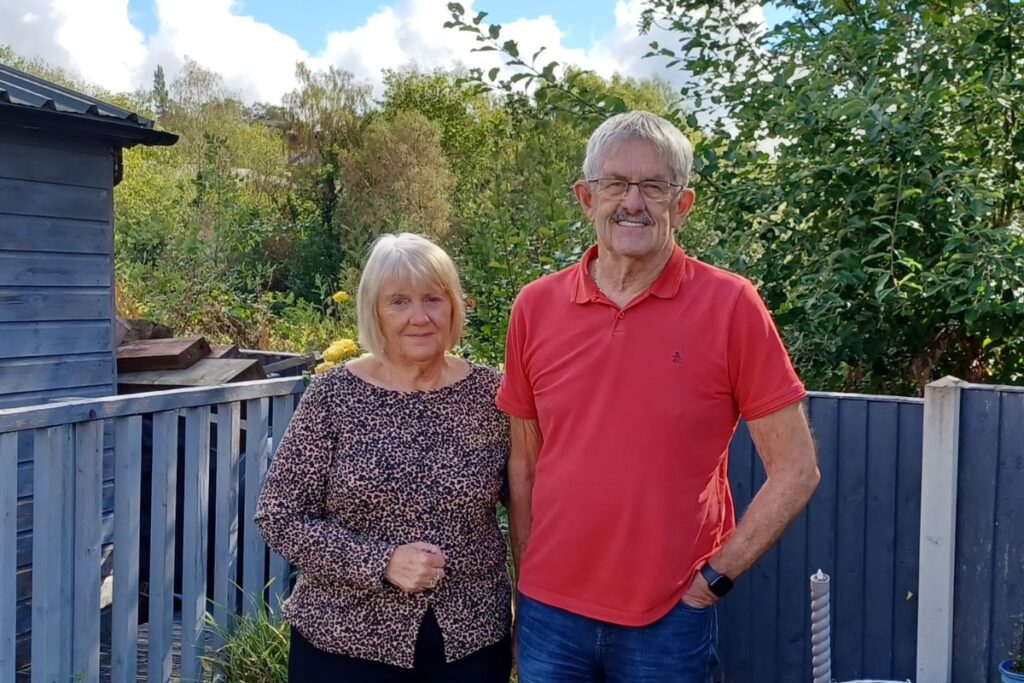
Susan Smith and her husband Geraint – whose Acrefair home is separated from the decommissioned Ruabon chemical works by a thin tree line – perfectly captured the concerns facing many former employees of the plant since the contaminated land documentary was broadcast.
The programme saw actor Michael Sheen and environmental journalists Lucy Taylor and Dan Ashby shine a light on historic industrial dumping of toxic, cancer-causing ‘forever chemicals’ across Wrexham, south Wales and Cheshire by Monsanto through the 20th century.
Susan and her husband – who have lived in the same home for 53 years – have both experienced cancer and while they admit they cannot say with certainty that Monsanto was responsible – the findings of the documentary have made them question the possible impact of the factory on their family’s health.
For Susan, it has cast a shadow over what was a happy time for her.
“I worked as a secretary for Monsanto for about four years aged 19,” she said. “Then I went back twice – once as temporary cover in my old role for a couple of months and once to overhaul their failing system in a different office in the middle of the site.
“Most of my time was spent in the telex office next to the warehouse. We used to send delivery notes, instructions, requests on little pieces of ticker tape through a machine to other Monsanto offices.
“We had a small glass hatch that the instructions would be passed through and it was never closed because people were passing things through so often. As a result dust and powders and all sorts would blow through and coat the desks, the paper, even our sandwiches.
“No-one ever gave us a safety briefing, protective clothing or anything. I was 19 when I started and as office staff we never knew we were at any risk where we were.”
Susan said she actually enjoyed her job – and the perks that came with it.
“I have no regrets about working there,” she said. “Everyone got on and at the time Monsanto seemed to really look after you. When I had to go for training at the London office, they put on a chauffeur to the airport and flew me down and that was common.
“They had open days where you would take your family on tours of the site and sometimes they would host emergency drills where they would hire actors to play victims of a major incident and they would be done up with stage make-up to replicate burns.
“Kids always used to flock down to see that because it was something unusual and interesting.
“I loved my job at Monsanto – now I worry about it may have harmed my family’s health.”
Creator of jobs
Geraint, who didn’t work for Monsanto, said at the time – in the aftermath of the closure of the local mining industry – the company was thought of highly as a creator of good-quality jobs.
“They had great sports facilities and recreational clubs,” he said. “I was a member of the rifle club and they had crown green bowling, football, cricket.
“The recreation club held 500 people and put on big name acts – Les Dawson, Russ Abbott, Crissy Rock – and tickets were impossible to get unless you worked at the plant.
“When you’d been there 25 years they gave you an atmospheric clock, which was the bee’s knees then. They were the best employer in the area at the time.”
But the findings of the documentary have made Susan and Geraint reassess their connection to Monsanto.
Cancer diagnosis
When she was 38 Susan developed breast cancer, meanwhile 13 years ago Geraint was diagnosed with prostate cancer before more recently developing skin cancer.
Susan had her blood tested by the documentary team and while the PCB levels in her blood were not deemed high, the fact there is no safe level of PCB and the lack of accountability from Eastman – the US company which now owns what was once Monsanto – has left her with unanswered questions.
“There was no history in my family of breast cancer,” said Susan. “This programme has made me wonder if there is more to it.
“Geraint used to work for Wrexham Council and worked outdoors all his life so again, it’s hard to prove. But if there is a connection the worry is that we may have passed it on to or children and grandchildren.
“They seem OK at the moment but the toxic effects can develop over time.
“Without proper testing and an admission from the company on what was dumped and what the potential impacts are we are just left living in fear and doubt.”
Geraint added that there was still a tunnel and a culvert running beneath the Ruabon site which no-one can fully access.
“You can get so far and then there’s a waterfall where you can go no further,” he said. “Whether that was used for any disposal or anything leached into it I don’t know, but that’s the problem – no-one knows.
“Back in the day kids would go and play in places like that blissfully unaware of any risk.”
Looking back, Susan says there were some signs that things were not right, but at the time they didn’t have the knowledge to question them.
“There were things like the orange puddles,” she said. “You would see them everywhere. Some people have said it’s iron deposits but these were bright orange.
“Then there was the drinking water – it always tasted so bad that for years we had to have a water filter but you just assume that’s the fluoride in the water or something. We never thought it could be the plant but now we are not so certain.
“It feels like the company has got away with it. They’ve got away with something that they should never have got away with. It makes you almost feel like you’re stupid or that they feel like we are stupid.”
Their home
Susan and Geraint’s home backs directly onto one of the Monsanto car parks and a warehouse known as the ‘Green Bag Warehouse’.
“I never found out what was stored in the Green Bag Warehouse,” she said. “But that was a few yards from our back fence.
“We don’t know whether being so close increased our risk or not – that’s the problem, we don’t know. It makes you paranoid.”
The couple have joined the Monsanto Contamination Action Group – which was set up for people in Wrexham who live in communities affected by historic industrial waste dumping.
“I never really thought about it until the documentary came out, but then I think back and so many people I worked with or knew who worked there developed cancers,” said Susan.
“Two women I worked alongside who were a little older than me got cancer at the same time as me, which was a strange coincidence.
“This has all made me want to get answers and ensure that the land is cleaned up and the area made safe.
“I am scared for future generations really. It really needs sorting, I want to carry on until something has been done.”
Support our Nation today
For the price of a cup of coffee a month you can help us create an independent, not-for-profit, national news service for the people of Wales, by the people of Wales.
Get more trusted Welsh news
Choose Nation.Cymru as a preferred source in Google News to see more of our journalism.


