


French lessons on Gallic Vitesse. A tale of two railways
Professor Stuart Cole, CBE. Emeritus Professor of Transport Economics and Policy, Prifysgol de Cymru / University of South Wales
In the UK we have spent fifteen years in unproductive bickering over the construction of the HS2 high-speed line: whether it should be classed as an England-only railway, and whether it should stick to the original plan or be cut back by successive UK governments.
In this column last month, I referred to a House of Commons report on the uneven pattern of railway investment in Great Britain. It compares the French approach to high-speed rail with the way HS2 has been managed.
Journey time comparison
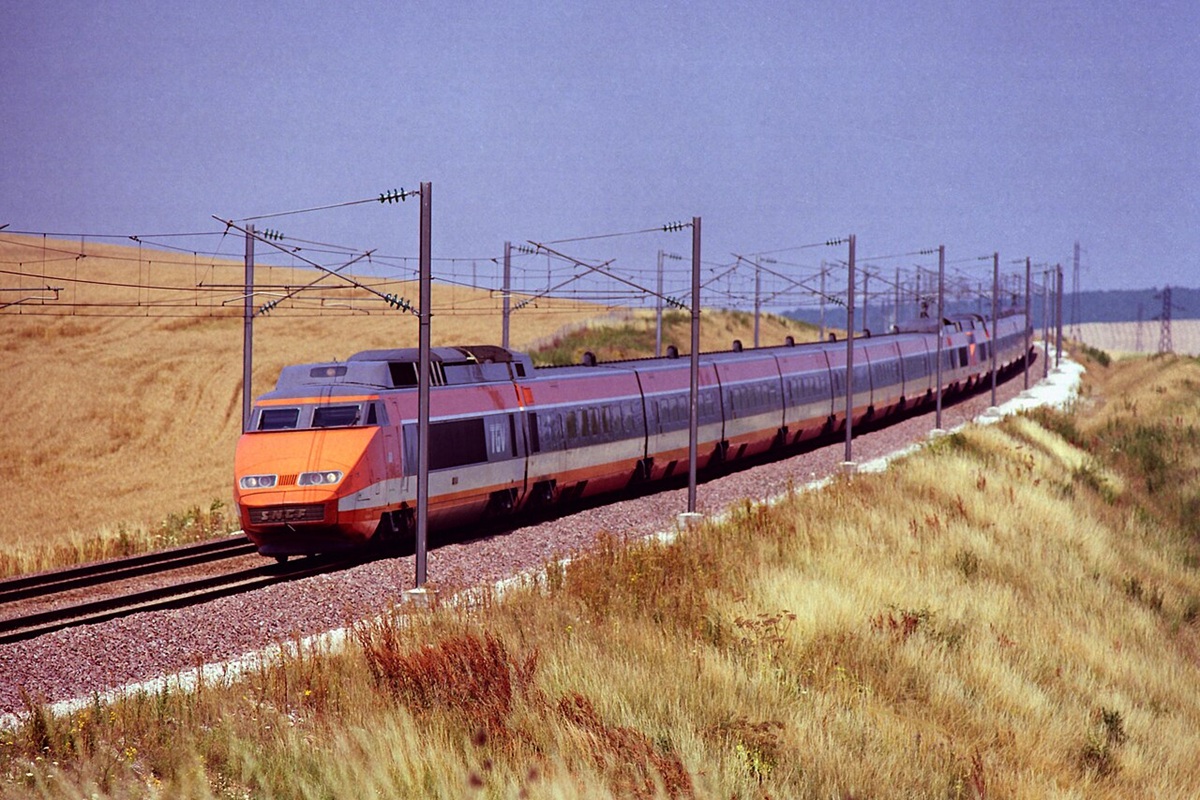
In May 1983, 43 years ago, this columnist had the pleasure, by invitation from the Société Nationale des Chemins de fer Français (SNCF), of travelling on the world’s first public Train à Grande Vitesse (TGV) service and on the first Ligne à Grande Vitesse (LGV).
Running between Paris and Lyon, it covered the 254 miles in 2 hours 40 minutes on the LGV Sud-Est, mostly at more than 180mph, at a construction cost of £3.75bn (2026 prices).
That is comparable with electrifying the existing 150-mile line between Cardiff and London at a cost of £2.8bn (2020 prices), reducing journey times to 1 hour 50 minutes. A considerable improvement on previous journey times, but still not matching the performance of the French line and trains.
Planning approach
HS1, covering 68 miles between London and the Channel Tunnel, opened in 2007. However, because the UK has not completed any further high-speed routes since then, there is now a significant gap between France and Britain in the delivery of high-speed rail.
There are several reasons why the French have built high-speed rail more quickly and at lower cost than the UK.
In the 40 years since the first French high-speed line opened, 1,740 miles of high-speed railway have been built at a cost of €80bn (£69.2bn), although relatively few towns and cities are served directly by TGV stations.
By comparison, Britain has built just 68 miles – HS1 between London and the Channel Tunnel.
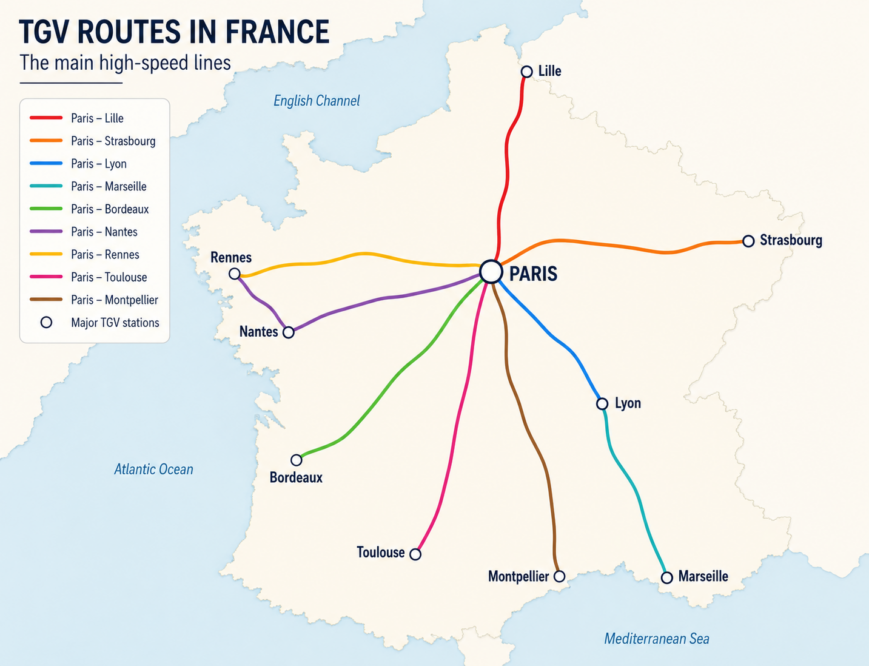
The success of the French, German and Spanish high-speed rail networks, compared with Britain’s achievements, reflects differences in philosophy and engineering. In France, high-speed rail is not a political football. It is a long-term planning, funding and engineering programme which, once approved, remains largely intact until completion.
At Westminster there have been 19 rail ministers and eight transport secretaries since HS2 was first conceived in 2009. Stability appears to have taken second place as political and public opinion increasingly overrode long-term planning and design.
In 1994, I was quoted in The Guardian saying: “The contrast is striking. The French show that with long-term planning and an appreciation of the railways you can achieve so much.” This was at a time when Lille Europe station, the northern European rail hub, and Roissy-Charles de Gaulle station – the first high-speed railway station in the world to be built at a major international airport – were well into construction.
The planning period for European high-speed rail projects averages more than 15 years before a spade enters the ground. Considerable work is completed before contractors begin construction. That lengthy planning phase allows funding risks to be properly assessed over several years.
In France, the process is managed through the Déclaration d’Utilité Publique (DUP). This provides for public consultation, the gathering of views from all interested parties, a cost-benefit analysis and planning for associated infrastructure. The DUP is subject to judicial review, which considers both the benefits and potential drawbacks, and may introduce constraints.
But here the process changes. Since the initial planning for HS2, the scheme has been significantly altered. By contrast, construction of the LGV Sud-Europe-Atlantique to Bordeaux did not begin until planning was complete and the DUP had been approved. Once agreed, very little of the plan could be changed.
It has been suggested that construction of HS2 began before all planning had been completed and before potential obstacles and delays had been identified. In 2025, the House of Commons Public Accounts Committee heard evidence that “plans had not matured fully in some areas and designs had not been finalised. Plans were still being developed when construction was going on.”
Tunnelled railways
In France, relatively little of the TGV network runs through tunnels, in contrast with HS2, where 27 miles (20%) will be tunnelled, adding significantly to construction costs. The French Government did, however, authorise an additional £350m to take the LGV Sud-Europe-Atlantique beneath the Vouvray vineyards – a prospect considered preferable to the wrath of French farmers.
High-speed rail for Wales, England and Scotland
HS2, originally planned to run between London and Manchester and Leeds – while providing only dubious benefits to north Wales – has been cut back to a London-Birmingham railway which will relieve congestion between those two cities. It comprises 140 miles of dedicated track at a current estimated cost of about £90bn.
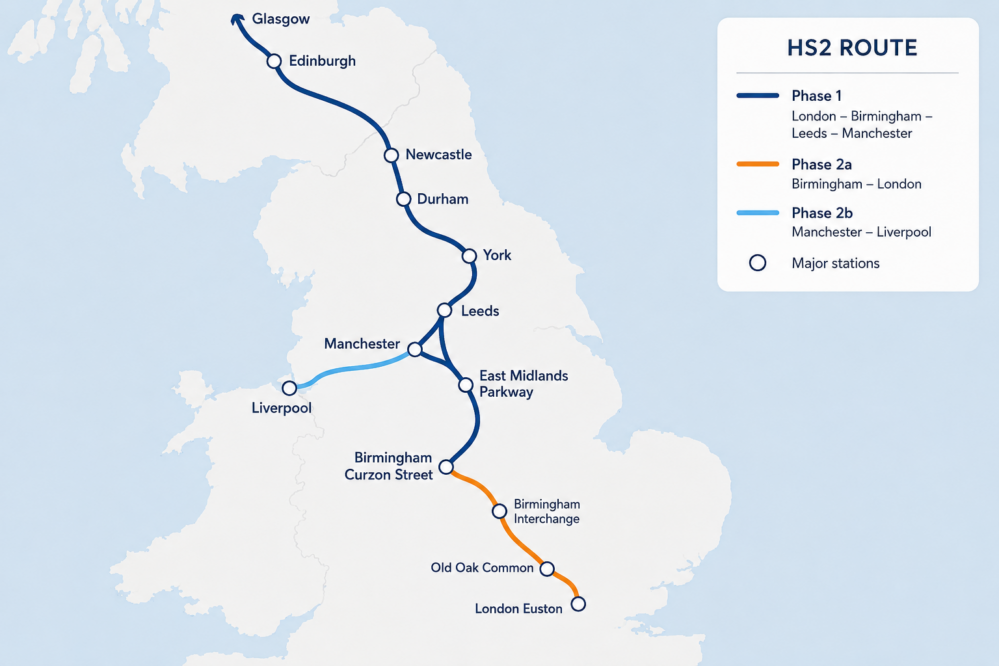
Since the opening of HS1 almost 20 years ago, Britain has witnessed the continuing saga of HS2, yet no comparable high-speed railway has been completed. France, by comparison, has built a national network. It wasn’t that Britain lacked a plan – it simply failed to follow through.
In 2005, a plan for a high-speed rail network across Wales, Scotland and England was published by the UK Government. South Wales would have been served by a dedicated line between Cardiff and London, serving Heathrow Airport en route with a journey time of just 45 minutes to a new Cardiff station.
InterCity operations in Britain and France
While the French Government pushed ahead with its high-speed rail infrastructure, it paid less attention to developing the Corail network, France’s equivalent of Britain’s InterCity services, such as the Great Western Main Line between south Wales and London.
Much of the French conventional network has been electrified, supported by new intercity trains and shorter journey times. If the new Welsh Government succeeds in securing powers over rail infrastructure funding, there is every hope that electrification could finally be extended to Swansea, or even Carmarthen.
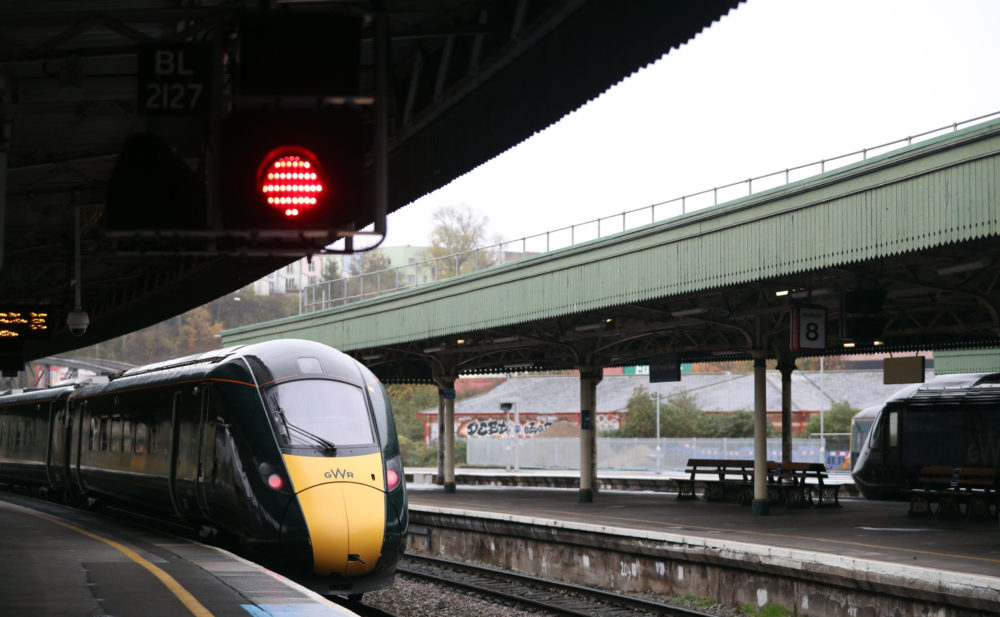
In Wales it seems the best we can hope for at present is a faster conventional railway.
What we are unlikely to see is a TGV-style high-speed railway with very high speeds and limited stops. That is what Wales really needs.
Or should Wales instead settle, at least in the medium term, for shorter journey times through faster-accelerating trains, more electrification and selective track straightening?
Support our Nation today
For the price of a cup of coffee a month you can help us create an independent, not-for-profit, national news service for the people of Wales, by the people of Wales.
Get more trusted Welsh news
Choose Nation.Cymru as a preferred source in Google News to see more of our journalism.



If a “faster conventional railway” can shave an hour off Swansea to London times, and 30 minutes off Swansea to Cardiff that’s worth having rather than dreaming of an alternative only possible with the French in charge.
France has also benefitted from strong growth at the TGV Hubs. June 1999 Air Canada launched flights to Lyon as one of its’ first secondary city routes. Where Air Canada flys there is also investment from Quebec Government / Pratt Canada opens offices etc https://www.prnewswire.com/news-releases/rtxs-pratt–whitney-canada-opens-new-manufacturing-facility-in-casablanca-morocco-302746413.html The same happens with Lufthansa and Siemens. Cardiff Airport will benefit from the nearby technical college opening as that will increase the demand for public transport to the region and so with better public transport it will be easier to get to Cardiff Airport – so can grow steadily over ten years and benefit from… Read more »