


From Pagan fires to chapel songs: 14 DIY rituals to bring magic to your Welsh Yuletide
Del Hughes
And so it’s Christmas. On one hand, I love it – the food, the TV specials, the twinkle of tree lights, the cinnamon and spices, the eggnog (more on that later), the presents.
And despite the festive frenzy, all those sparks of unexpected joy – the brief chats with passing strangers, the helping hands, the tiny kindnesses that make the season feel softer. Suddenly there’s more compassion, more patience, more smiles, more goodwill – and it’s gorgeous.
On the other hand, it’s a pain in the sodding backside. It costs a fortune, it’s exhausting, and once Boxing Day is done, time loses all meaning.
You drift along in a festive fugue of mincemeat, Quality Street, and acid reflux, broken only by the plinky-plonk piano of Jools Holland’s Hootenanny.
Then, once you emerge from New Year’s riotous revels, the world seems greyer, the lametta’s dusty, and the tree’s lost its bush and bravado. You spend days itching to pack it away, get the Dyson out, and take a spin to the tip – sorry, recycling centre – to bin boxes, ripped wrappings, and the empty bottles that have been blocking the back door for a fortnight. Sigh.
And yet, year on year, we do it, because beneath the glitter and the chaos, something deeper calls us to celebrate.
In Wales, Christmas wasn’t always about eating your body weight in pickled onions, juggling picky bits, or coming to blows over Pictionary.
Dig a little deeper, and you’ll find a season that’s stitched together from Pagan, Druidic, Christian, and even Neolithic threads.
So, in keeping with those traditions, I’ve pulled together fourteen mini rituals you can try at home. Nothing complicated. Nothing that needs an altar in the lounge, or a trip to B&Q for a bulk order of monoliths. (Good job too – one alone will set you back £407.00!)
These small, meaningful acts connect us to the seasonal rhythms our ancestors honoured. They let us cast off the old year’s burdens and enter the new with good intentions, and a clean slate.
(Worth noting, these are wildly candle-centric, so you might want to stock up on a few churchy-type ones – or treat yourself to a Yankee Candle, if you enjoy aromatic ambience with a side of financial peril.)
Think of it as a wander through Welsh midwinter: from fairy lights to the haunting harmonies of Plygain, past the trusty trio of winter greens, and ending with Alban Arthan, where the first hint of returning light begins.
It’s heritage you can feel in your bones – a way to make your season shine with mischief, memory, and magic enough to last the coming year. After all, who couldn’t use a bit more sparkle at Yuletide?
December 23: A Pilgrimage of Lights (Modern folk ritual, pagan resonance)
Origin: Kicking off with a modern ritual that carries ancient echoes. In pagan and Druidic practice, light was central with bonfires, candles, and solstice flames all symbolising the sun’s rebirth.
Today, our Christmas lights carry the same message: brightness and hope against the dark, and proof that even in the bleakest of times, people still choose to shine.
Ritual: So, step away from the sprouts – tonight’s ritual is blissfully simple: get in the car (or wrap up for a walk) and take a little tour around your neighbourhood, to admire your local displays. (Bonus points if you find the house that’s single-handedly keeping the National Grid in business.)
Pick one that really makes you smile, and pause to soak it in. End the night by lighting a candle at home, a nod to the old pagan fires.
Tip: Snap a pic of your favourite display and keep it on your phone. When the January blues creep in, you’ll have proof that brightness is always there… if you know where to look.
Tipple: Assuming everyone here is over 18 (and knows the drill on responsible drinking), this ritual pairs perfectly with mulled cider. Spicy and hot, it’s communal warmth in a glass. Yum.
December 24: Noson Gyflaith/Toffee Night (Welsh folk tradition)
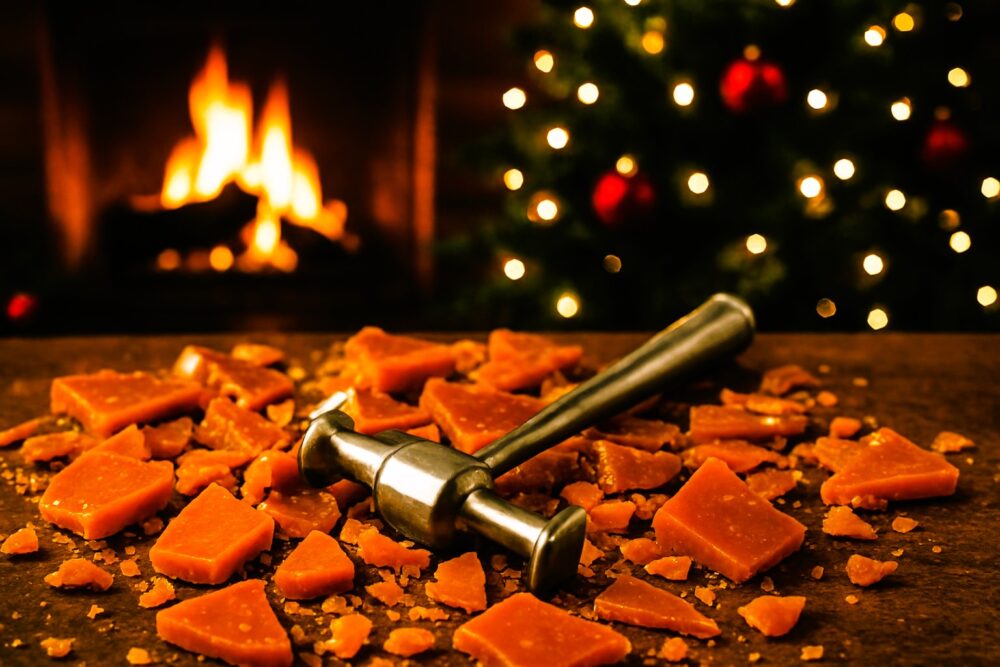
Origin: A Christmas Eve custom in north Wales, families gathered at the hearth to boil sugar, cooling it until it snapped into shards of sticky toffee. Known as pulled toffee, the name comes from the whole family getting involved, and each taking a turn at stretching the pliable, sticky mixture.
It signalled joy, community, and rare indulgence at a time when sugar was precious, and pricey.
Ritual: Less ritual and more recipe (of which there are many online), but basically, boil sugar (450g of white granulated) with a splash of water and a squeeze of lemon juice. Heat gently until the sugar dissolves.
It needs to reach the ‘hard crack’ stage (150–155°C). If you don’t have a sugar thermometer – who does? – drop a blob into icy water and, if it turns into a brittle thread that snaps cleanly when you bend it, you’re golden.
Pour the mixture onto a greased tray and let it cool, just enough that it won’t take the skin off your fingers. Then, while it’s still giving off that buttery‑sweet toffee aroma, oil up your hands and go on the pull.
Stretch, fold, and twist until it turns pale, glossy, and firm beneath your fingers. Snip into pieces and, once it sets, dig in. Epic.
(Confession: I tried this. Turns out it’s less ‘simple’ and more ‘scalding,’ so if you’re no Nigella, and as clueless in the kitchen as me, skip it and go straight to my helpful tip below.)
Tip: If tonight is stressful enough, without adding lethal liquids to the mix, cheat with a shop-bought slab – ideally the kind that comes with a mini silver toffee hammer. Then gather the fam round the table, and enjoy whacking the bejesus out of it.
Share the shards, watch your fillings and veneers, and remember, togetherness and good cheer have always been at the heart of this ritual.
Home alone? Perfect. More toffee for you! Smash the slab, make a glorious mess, eat the lot, and know you’re in great company tonight, connected to others sharing the same small ritual.
Tipple: End the night with a hot chocolate, topped with whipped cream and caramel syrup. Sweet, sticky, and indulgent, it’s a scrumptious echo of Toffee Night. Double yum.
December 25: Plygain Carols (Welsh Chapel tradition)
Origin: Forget polished choirs – Plygain is raw, heartfelt, and harmonic. In Welsh chapels, services would run on Christmas morning and were especially popular in mid Wales. But you had to be an early riser (which I guess most were, in days of yore), because ceremonies started well before dawn. Long carols were sung, unaccompanied, in a communal, spine-tingling tradition – a way of welcoming Christmas with voices, rather than bells.
Ritual: Luckily, no chapel required. But if you’re a stickler for the rules, you really should start singing between 3 and 6 am (I’m guessing you’ll be up and about by then – at least, you will if you’ve got kids).
But if even Rudolph couldn’t hoof you out of bed at that hour, aim for before sunrise (it’s 8:21 am today). Rouse the relatives, step outside, and have a damn good warble ‘neath the stars. Off-key is fine. The magic lies in your a cappella voices rising together, echoing centuries of Welsh winter song.
Tip: Stuck for what to sing? Try a stanza or two of the classic Ar Gyfer Heddiw’r Bore. But if those lyrics seem a tad daunting, go with a crowd pleaser like Mae Hen Wlad or Yma O Hyd. If you’re not au fait with these, an English carol will do the job too. Not only will these fill you with festive feels, but what a smashing way to wake your neighbours on Christmas Day. Lol.
Home alone? Don’t think you’re off the hook. Get up, get out, sing loud and proud – it’s a custom that’s survived generations, and you’re keeping it alive. And who knows, you might just hear next door doing the very same thing!
Tipple: Whilst I’ll be on the nog come breakfast, a cup of black coffee (make mine a double) will ready us for the carolling to come. Intense, sharp, bracing – the very spirit of the Plygain morning captured in a mug.
December 26: Evergreen Blessings (Druidic practice)
Origin: Roll out the red carpet for winter’s trinity of holly, ivy, and mistletoe. Druids revered these evergreens as emblems of resilience and protection, using them as ancient home security against winter’s worst: weather, witches, pestilence, and dark portents! (Back then, the shrubbery was deffo doing some heavy lifting.)
Welsh households later adopted the greenery as essential Yuletide décor. Why? Because if you’re going to survive the bleak midwinter (and get up at stupid-o’clock for Plygain), you need all the symbolic help you can get.
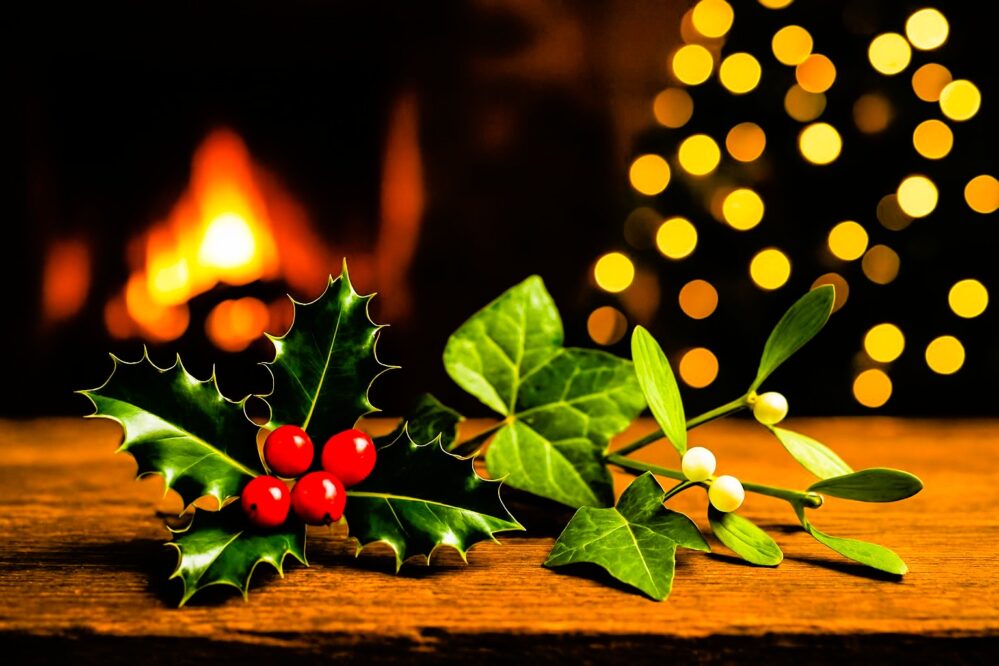
Ritual: Place sprigs of holly and ivy on your table. As you do, touch each one and say:
Dygnwch, amddiffyn, bywyd yng nghanol y gaeaf
DUG-nookh, am-THIV-in, BUH-idd ung HCHAN-ol uh GAI-av
Endurance, protection, life within winter
Then take a tiny cutting from each and leave it beside your front door, as a little blessing for all who call in.
And don’t forget the mistletoe! You’ve probably got a spray hanging in your doorway already, but it’s not just for snogging – it’s for safety. Each time you pass beneath, pause and whisper a wish for health and renewal, such as…
Bywyd tragwyddol, bendithia’r tŷ hwn
(Buh‑wid trag‑WITH‑ol, ben‑DITH‑ya’r tee hoon)
Everlasting life, bless this house
Cryfhau ein gwreiddiau
(KRUV‑high ayn g’RAY‑thee‑eye)
Strengthen our roots
Gwarchoda ein nosweithiau
(GWAHR‑khod‑a ayn nos‑WAY‑th’eye)
Guard our nights
(In the interests of keeping these rituals as stress-free as poss: if you’re a Welsh speaker, you’ll feel right at home. If not, but you’re feeling brave, give the Welsh a whirl. Prefer to keep it simple? The English works too. Whichever you choose, the blessing does its job.)
Tip: After Twelfth Night, take the foliage outside and return it to the earth – compost, burn, or bury. It shows respect for nature’s cycles and keeps the balance of ancient folk traditions. You have been warned!
Home alone? Dress your table and doorway just for you – every sprig you place links you to countless homes keeping watch this winter.
Tipple: After yesterday’s excesses, we’re giving our bodies a break with an elderflower cordial – or if you’re feeling daring, a sparkling pressé. Refreshing, floral, and symbolic of renewal and health, your liver will undoubtedly thank you.
December 27: Sacred Water Magic (Pagan/Celtic)
Origin: From earth to water – the next element in our midwinter journey. Wales is famously rich in holy wells – they spring up everywhere (titter). This tradition has deep pagan and Celtic roots: naturally rising water was seen as a portal to the Otherworld, inhabited by spirits of place and deities of healing.
Never ones to shy away from a little ritual bribery, our ancestors left valuable offerings when asking for good health and good fortune, so this modern tribute honours thousands of years of respect for water as a source of life and renewal.
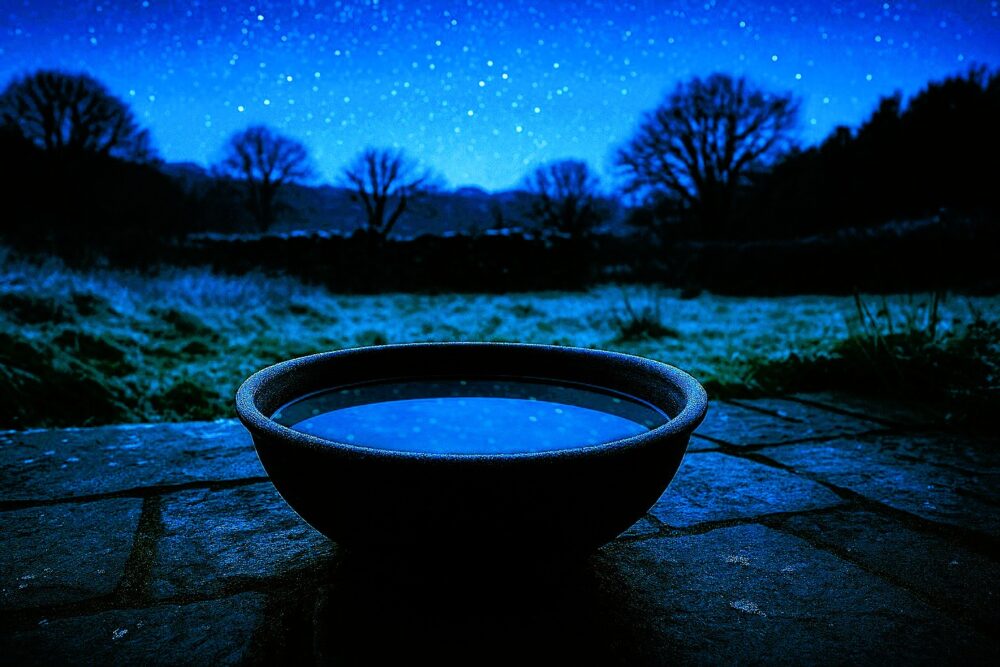
Ritual: If you’re miles from your nearest holy spring, this will work just as well. And it couldn’t be easier. Fill a bowl with fresh tap water and leave it outside overnight. Yep, that’s it… until morning, when you should sprinkle it over your doorstep and/or garden – whichever needs the most help. As you do, murmur a blessing for the year ahead. Here’s a lovely one…
Dŵr bywyd, bendithia’r trothwy hwn/yr ardd hon
(Door BUH‑wid, ben‑DITH‑ya’r TROTH‑oo‑ee hoon/ur ARTH hon)
Water of life, bless this threshold/garden
Glanhewch ein calonnau
(GLAHN‑hewch ayn ka‑LON‑eye)
Cleanse our hearts
Arwain ein dyddiau
(AR‑wine ayn DITH‑eye)
Guide our days
Tip: If you’re up for a bit more adventure and you’re close to the coast, grab the Tupperware, pull on the wellies, and pop to the beach for a bracing blast of sea air. Dodge the waves as you fill your container with seawater – easier said than done in December. Offer a diolch to the sea for its strength and purifying power, then use the seawater as above. (And a quick heads up: grab a few pebbles while you’re down there.)
Tipple: Well, you can probably guess. Sob.
December 28: Anchor Stone Meditation (Neolithic Deep‑Time Tradition)
Origin: And now, from flowing water to truly ancient stone. Neolithic sites across Wales (and beyond) align precisely with celestial light, and that was no accident; our stone‑raising ancestors were showing off their cromlech-calendars aeons before the pocket watch.
For them, these rocks were the original ‘anchors of memory’ – sturdy, silent witnesses to millennia of ceremony (and more than a few bold wardrobe choices). They embody what we now call deep time – the long, slow story of the land itself – and ultimately stand as its guardians.
Ritual: This is a straightforward way to tap into that deep time, and to find a few minutes of tranquillity amid the modern seasonal rush.
Light a candle, then hold a small stone or pebble in your palm. Close your eyes. Breathe slowly and deeply. Imagine the sun aligning with the ancient rocks of Bryn Celli Ddu or Pentre Ifan.
Next, place your stone beside the candle, and sit in silence for three minutes – exactly – to acknowledge past, present, and future. (These Neolithic clock-makers were sticklers for precision timing.)
Now, open your eyes, blow out your candle, and pick up your stone. Imbued with a little of that ancient stillness, keep it somewhere safe so you can borrow that calm again whenever life gets too shouty.
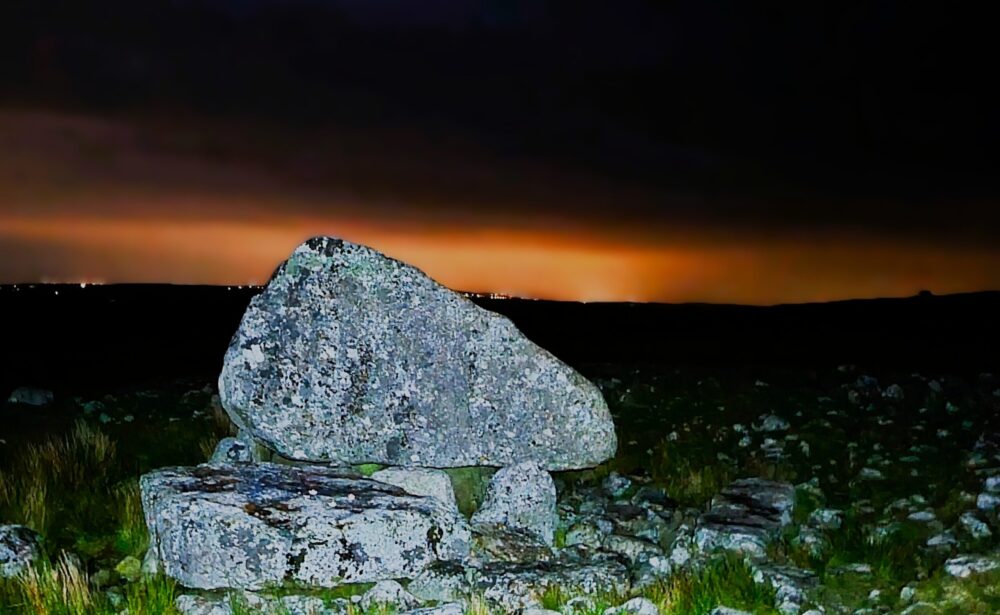
Tip: If you have a local cromlech, menhir, or even a burial tomb, consider meditating there. I’ll be visiting my favourite, Maen Catti, on Gower; with a capstone that, according to legend, is said to roll down the hill to drink nightly from a nearby pool, I bet he’d welcome a sip of whatever tipple we’re having tonight…
Tipple: …And he’s in luck because we’re back on the booze (huzzah!), with mead being the drink of choice. A hot, honeyed drink, brewed with winter spices, it offers a gentle, age-old comfort that aligns perfectly with the calm of your meditation, and anchors you to millennia of tradition. Wicked.
And that’s us done, until tomorrow, when we’ll complete our journey through Wales’ Yuletide and midwinter customs. There’s still plenty of magic to discover.
Oh, and if you’ve never tried homemade eggnog, here’s my top-secret recipe – and trust me, it’s worth making. While I usually leave mine to mature for a few weeks, it’s just as drinkable and delicious on the same day. You can thank me later. Triple yum!
Iechyd da i’r Nadolig sy’n dod!
Cheers to the coming Christmas!
Support our Nation today
For the price of a cup of coffee a month you can help us create an independent, not-for-profit, national news service for the people of Wales, by the people of Wales.



Diolch!
Nadolig llawen.