

Green Man Interview: MWSOG talk about their ceremonial performance at the biggest festival inspired by nature
Amelia Jones
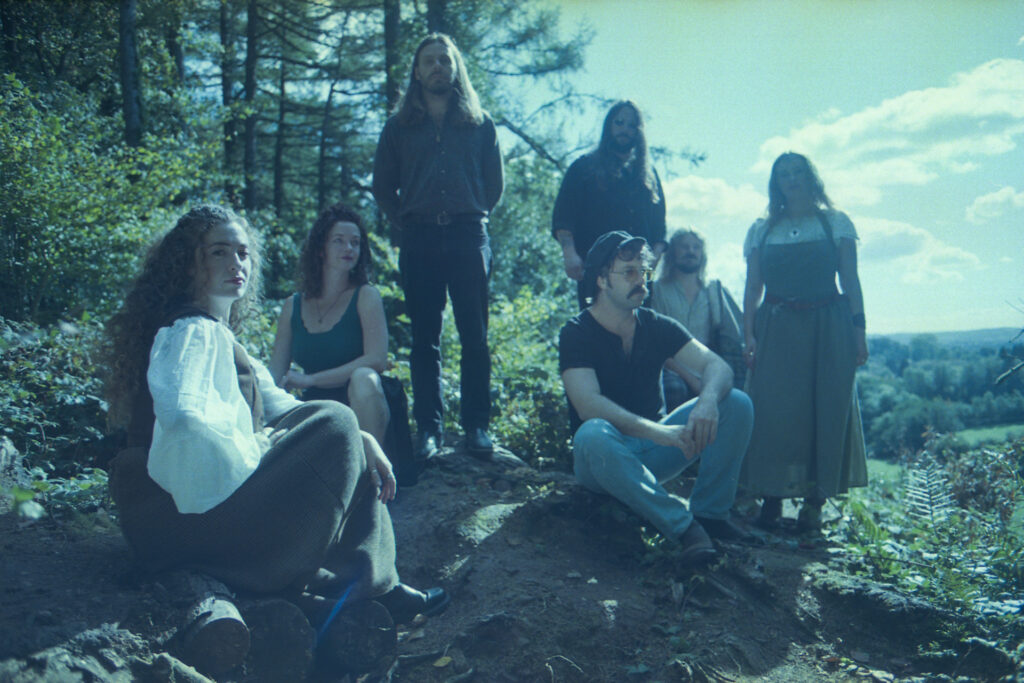
Self-described folk-rock sorcerers MSWOG, are less of a band and more of an ever-flowing collective summoned to stage a ceremony.
These south Wales sonic pilgrims wander through seventies acid folk and mystical traditions, turning every performance into a hypnotic, spellbinding ritual.
Their sound blends traditional Welsh music and centuries of local defiance with heavy psychedelia, raw distortion, and drone. It is a striking collision of ancient heritage and modern noise, equal parts enchanting and visceral.
Mari Mathias (lead vocals), Luke Huw Llewellyn (drums), Angharad Iris (flute and vocals), and Marcel (bass guitar) spoke with Nation.Cymru at Green Man. The collective shared how they channel ritual and resistance into their live shows. By fusing historical reverence with psychedelic power.
How did you all meet?
Angharad: There’s lots of tangenting stories.
I mean, how me and Mari met has felt like a bit of a love story, because Mari is obviously a solo folk musician as well, and we met through our drummer, Luke, who has been a good friend of mine for over a decade.
He kept on saying to me that I should meet Mari Mathias because not only will I love her music, but we’ll just get on. That has been a bit of a love story since.
Luke: Well, me and Marcel have known each other for thousands of years. Well, a very long time, 20-odd years.
Marcel: Then, we met Mari via Luke’s folk endeavours, where their sort of circles convened, and Mari said to Luke, I’ve always wanted to, like, front a rock band, that would be fun.
Luke: The funny thing was that we were in a three-piece psychedelic rock and roll band for 15 years, and we said if we only had, like, a couple of beautiful Welsh-language female singers up front. We’d make it.
Marcel: Mari’s been like a Trojan horse for us for a while, with her we could break into the upper echelon of the scene. Normally they wouldn’t trust us, because we have a slightly ice-age sort of demeanour.
You’ve called your live shows ‘a ceremony’ – what does that mean for you when you step out on stage?
Angharad: I’ve been very much influenced by a group of friends where we would go to the woods and we would sing just to the land.
It wouldn’t be about performance. It would be actually holding, a sense of secrecy and privacy associated with that experience. The ceremony aspect we like to bring into with the Bastwn (the act of reciting ancient rhythmic poetry with a staff).
Mari: So, we’ve got the ancient staffs, and we’re reciting in ancient Welsh, and that’s what our ancestors would have done to come together, maybe before war or maybe before a harvest. It’s a ceremony, and it’s bringing people together.
Angharad: I guess, for me personally, it’s this idea of an altered state, but it’s not through substance. It’s through, literally, sound and energy work.
You know, giving people permission to access those different states, and I think we really journey through that as musicians, but with the Bastwn, there’s the tradition associated with it.
There’s also the magical qualities associated with: What does it mean as a woman to scream on stage in front of people? Like, how do they feel? You don’t have to reserve yourself.
Luke: So a lot of the ritual comes from what we’re trying to present to people in the crowd and that’s usually through bringing in repetitive dance.
It’s a ritual that on stage we’re not performing, but there’s a difference between what the ritual is, then, to the people who are involved in the ritual from the other side of it. Dance is a big, big part of it.
Mari: I think the Welsh should dance a lot more.
Does playing at a festival surrounded by nature this change the way you perform?
Marcel: Oh, it’s huge. To be surrounded by the mountains, they’re almost like giants looking over to us.
I spend a lot of time outside, living from the land, and being a slightly undomesticated sort of person. I thrive on the ability to be able to drift off and melt away into your landscape.
Mari: It feels very connected to the land. Our name, MWSOG means mossy in Welsh, and that is related to the ancient Celtic rainforest that used to be covering these lands.
We’ve only got probably less than 5% of that land now, so it’s about celebrating that ancient landscape, which is, you know, where our ancestors would have been living and being inspired by for many millennia.
Luke: Even where we are now there are beautiful oak trees, there’s chestnut trees everywhere, and it’s just really lovely to be able to be a part of it.
Marcel: Yeah, and it’s very much an indicator that the season’s changing. All the chestnuts are starting to bloom. It’s very much a big close for the summer for all of us.
There’s a revolutionary edge to your music, is that something you set out before you start writing or does it just come out in the process?
Mari: Our first single that we released was Chwyldro, which means revolution. It’s about the Rebecca Rioters.
So, not far from where I was brought up in west Wales was the group of men who dressed up in Welsh lady costumes and traditional wear and went out to burn the tolls in protest for their land, for their language. We have a lot of quite political things that we sing about.
You know, Llef Hir is about the treachery of the blue books and how the Welsh were seen as evil.
So we’re singing about that to rebel, but also to remember where we’ve come from, the journey we’ve come from, from that time to now being one of the strongest Celtic languages ever surviving. I think that is a testament to us.
Luke: Mari’s the only fluent Welsh speaker in the band, but I think the fact that the chorus is a cry. We can all understand the cry that is being belted out. Even if we can’t speak Welsh, we still understand there’s a chorus of, there’s a loss.
The vibe of the band is also set by your clothing, what are your style influences?
Angharad: Well, I make all my clothes. So what I’m really interested in is resurrecting this idea of ancestral crafts.
Mari: I mean, I just really love the blend of traditional folk. I used to do club dancing, so we’ve got a lot of traditional clothes at home, which have always been just dance clothes.
But then actually, looking back at my pictures of my family, you know, back in the sort of 50s, 60s, 70s, and they were wearing, that was what they wore every day.
So I really love bringing the traditional folk elements. We’re very influenced by that, but then how do we bring in contemporary light as well, which is really interesting.
Luke: I’m just trying to dress like a post-apocalyptic Stevie Ray Vaughan. Medieval Stevie Ray Vaughan. I’ve noticed there’s quite a lot of duality in terms of the colours as well.
There’s quite a lot of dark and light being represented. It is also something that’s talked about.
Marcel: Mine’s very fixed.
Mari: You’ll see pops of fur. You’ll see a lot of leather. Some pouches with bones in. A lot of natural, organic elements. We want to celebrate the sort of natural, organic textures on stage, and then give them an electric guitar and see how that looks.
You can listen to them here.
Support our Nation today
For the price of a cup of coffee a month you can help us create an independent, not-for-profit, national news service for the people of Wales, by the people of Wales.
Get more trusted Welsh news
Choose Nation.Cymru as a preferred source in Google News to see more of our journalism.


