

How the Hal Robson-Kanu chant was born
Matt Redd
If you ask any die-hard Wales football fan what they consider to be the greatest moment of their life, after the obligatory disclaimers about wedding days and births of children, they usually begin to tell you about their experiences of Euro 2016.
There are countless standout memories of that hot, unexpectedly long summer – Ben Davies’ goal line clearance against Slovakia, the anthem in Bordeaux, the entire ninety minutes against Russia – but it’s fair to say that, when we think of the greatest moment of that tournament, most of us think back to the night of 1st July in Lille, when Cymru defeated tournament favourites Belgium with a blistering footballing performance for the ages.
I don’t have to tell you what happened that night as you already know, but I was lucky enough to be there in the stadium, and at every Wales match in the tournament, as I was one of the original members of the Barry Horns – the supporters band who’d formed a few years before.
The origins of the band have been well documented elsewhere, but I think what’s worth knowing is that, when the band formed, we had no real idea what to do apart from play some music to fill the dead air that circulated around the Cardiff City Stadium far too often during those tougher times following our national team.
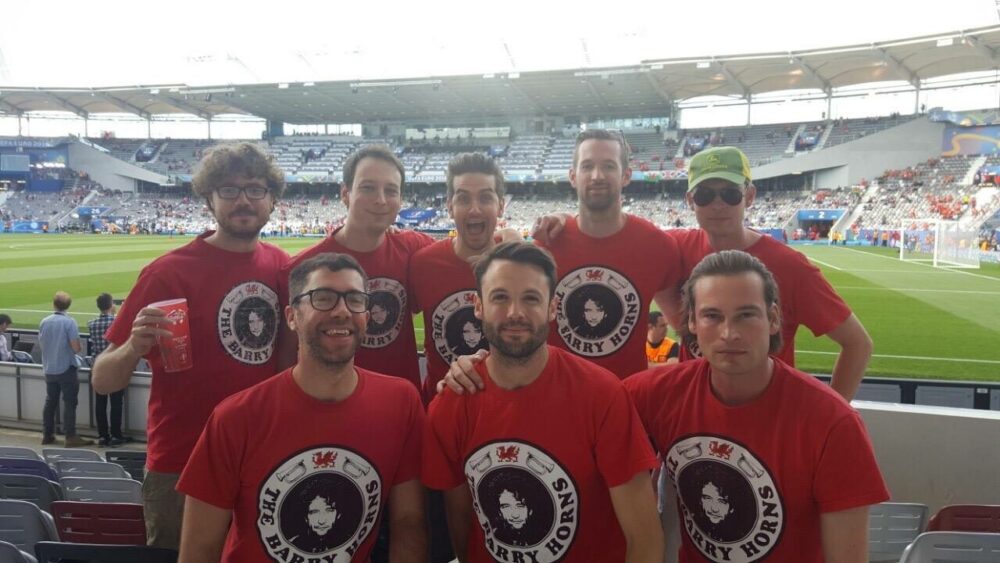
I played the bass drum and mostly just did what I was told by more musical members of the band, just not as well or as in time as they hoped.
Those more musical members would write arrangements of songs associated with either football or Wales – sometimes both – and we’d play them to try and generate some atmosphere.
In those early years, we had no idea what might work until we tried it, and it was often hard to tell what was working when the stadium was half-empty and the only song sung in serious numbers was the anthem at the beginning of the match.
But still, we persevered, slowly expanded our repertoire, and appreciated the occasional rounds of applause that came our way from the loyal supporters in the Canton Stand.
As we got the hang of things, we tried playing songs that could be more easily adopted as chants, usually based on tunes already familiar to football fans, and with this in mind, we were always looking to find something unique for the players in the national team.
One of the band members – a saxophonist we called Nick the Greek (who was in fact a Welsh schoolteacher living in London who made the journey down the M4 to each game) – turned up for a World Cup qualifier against Serbia with an arrangement of Salt N Pepa’s hip hop crossover hit Push It, and after a quick run through behind the Canton we were ready to give it a bash.
Up in the Tower of Power watching Cymru succumb to a 3-0 defeat by the physical, streetwise Serbs, we gave the tune a couple of blasts. Whilst most of the band had instruments to their lips, I had the luxury of being able to shout while playing the drum, and I decided to take it upon myself to use this opportunity to find a player’s name to replace the lyrics. Naturally, I chose one of my favourite players for the honour.
Aaron Ramsey
I gave it a couple of goes around in my head, but something wasn’t quite working. Even though “Ooh Aaron, Aaron Ramsey” scanned perfectly, there was something lacking in the delivery.
Maybe it was because his name began with a vowel, I don’t know, but whatever it was, it didn’t feel right, so I started looking down at the players on the pitch to find another whose name might fit.
At the time, Hal Robson-Kanu was a player who probably divided opinion amongst Wales fans. He’d scored only one goal for the national team at that point, and he was the subject of a terrace song in which he was described as being “as Welsh as a zebra”. While I got the joke – he qualified for Wales through a grandparent’s birthplace and had represented England at youth level – I always felt it was a bit unfair.
Hal had pledged for Wales and always gave his all in the shirt, and that night I watched him come off the bench when the game was already gone, chase down defenders and run after lost causes, doing his best for the badge on his chest and the supporters in the stands.
Hal Robson-Kanu was one of us.
I tried shouting Hal’s name over Push It instead. It seemed to work better than Aaron Ramsey, despite it not quite fitting in terms of number of syllables, and the boys in the band seemed to think it was worth giving it another go next time.
Wales failed to qualify for that World Cup, but there was a renewed optimism when we went into the qualifiers for Euro 2016 – a feeling amongst many supporters that this squad was about to come of age.
In the time since the defeat to Serbia, performances on the pitch had improved, as had the numbers through the turnstiles for each match. We now had a full stadium with full hearts in full voice.
You’d have thought that a 0-0 draw with Israel in Cardiff might have dampened spirits, but on that night, something special happened.
In the second half of the game, the crowd joined in with the Hal Robson-Kanu chant we’d first played two years before. After a couple of rounds we stopped playing, but the crowd kept on singing, so we joined back in. This went on for what was probably ten or fifteen minutes, but felt like forever.
It was incredible. Hal himself was suddenly a folk hero. But the best was, of course, to come.
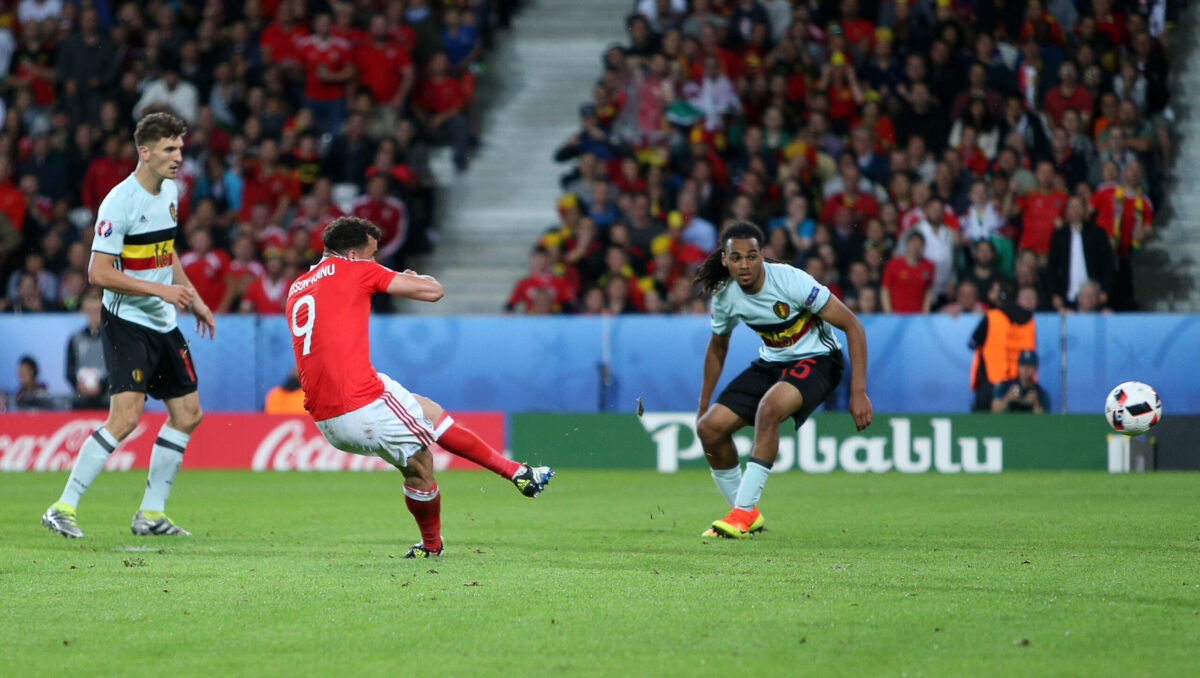
On that night in July, When Hal Cruyff-turned his way into space in the Belgian box in Lille, humiliating three of his opponents before placing the ball past one of the best goalkeepers in the world, I couldn’t quite believe what I was seeing.
The thousands of Welsh supporters in the stadium went ballistic, and after limbs were returned to their rightful owners, the chant of Hal, Robson, Hal Robson-Kanu went up, and the rest is history.
Two years later, I hung up my drumstick with the Barry Horns after seven years in the band. Maybe it was a case of ‘musical differences’ between me and some of the other band members – in fairness, I was playing at a different tempo to them half the time – but maybe it was also in part because I felt like the work was done. The atmosphere at Wales games was now unfailingly electric regardless of who was starting the chants.
A couple of weeks after that, Hal announced his retirement from international football with Cymru. A coincidence? Obviously so, but to me it felt somehow poetic.
That era of my life, and of Welsh football, was over. I’d played a small part in giving Hal that song, and in return he’d given me the greatest (maybe aside from my wedding day) moment of my life.
Matt Redd is a screenwriter, former amateur musician, and Wales football fan from Pembrokeshire. His feature film The Toll is available to stream on Amazon Prime Video, and his debut novel The Life & Death of Daniel Dee will be published in 2027.
Support our Nation today
For the price of a cup of coffee a month you can help us create an independent, not-for-profit, national news service for the people of Wales, by the people of Wales.
Get more trusted Welsh news
Choose Nation.Cymru as a preferred source in Google News to see more of our journalism.


