
Iaith Pawb: Reprise
Huw Williams
A phan ddaw’r gwanwyn i hebrwng yr haf, mewn dyffryn unig ar fore braf,
Mi glywaf swn y droed ar ras, yn dweud ffarwel i’r ddinas gas.
Mae’r plant yn mynd yn ôl i’r wlad. Mae’r plant yn mynd yn ôl i’r wlad.
Back in August I wrote a short essay on Welsh-medium schools, beginning with the lines from Dewi Pws’s famous song Nwy yn y Nen where he describes the haunted, empty presence of an abandoned village school, no longer with its song, shattered toys strewn everywhere.
This was in the context of the school closures slated for north Ceredigion, my old square mile, and the mirror image of this conundrum, namely the corresponding, criminally slow progress in Cardiff (the inspiration for the song, in its allure to those from other parts of Wales) in promoting Welsh-medium education.
In some ways this was a personal parting shot, for what I did not mention in that piece was that, in keeping with Dewi Pws’s words, I was saying farewell to the big bad city – returning if not to rural Wales, then at least semi-rural Wales.
We have moved to my wife’s territory, Cwm Gwendraeth, the most westerly of the old coalfield valleys and one of those places that registers only peripherally in the Welsh imaginary.
For as with old slate mining towns of the north, this is traditionally one of the predominantly working class Welsh-speaking communities that does not fit neatly into the ‘three-Wales’ narrative and that do not exist in the minds of the ignorant, metropolitan language-bashers who want to posit Welsh as some sort of elitist exercise for the urban middle classes (it is most particularly ironic in the context of Cwm Gwendraeth because this is actually the spiritual home of Pobol y Cwm, the long-standing Welsh-language soap opera).
Its class character has no doubt changed since the age of coal, and the presence of Welsh is not as vital as it once was, but it is still on most people’s lips and you can feel it everywhere.
All of the village schools are Welsh-medium, from Gorslas down to Carwe, and the old Grammar school that converted to an English medium secondary has now closed its doors (historically Carmarthenshire under Labour influence – as with Ceredigion under the Liberals – eschewed Gwynedd’s pursuit of Welsh-medium education, in order to deploy their own particularly insidious and indirect contribution to killing the language in its heartlands, by promoting English medium education).
As many will tell you who have moved from the north or the west to Cardiff, the spectre of moving back can be ever-present, even if it goes unarticulated for long periods. It presses upon you a complex mix of emotions and considerations, including for some of us a sense of guilt for leaving our home behind, and not doing our own bit to contribute to the place that made us.
This sense of guilt is only sharpened by the knowledge that many of these communities have been increasingly hollowed out by older, moneyed immigration that is, on the whole, damaging to their vitality and the Welsh language.
Common Sense
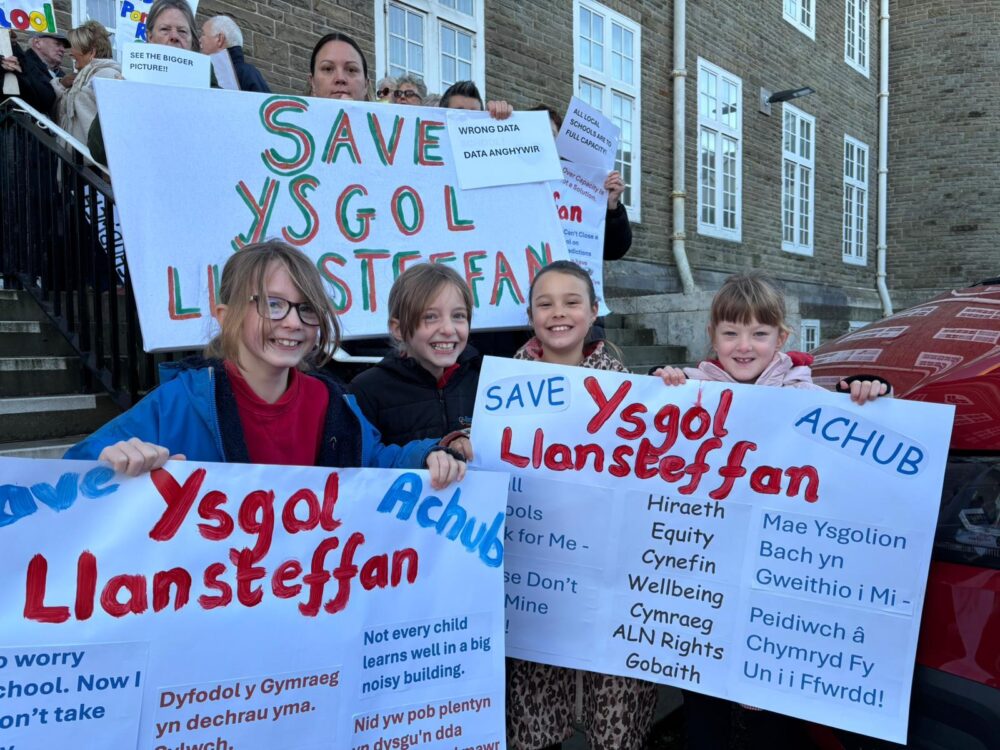
In this regard, an element of our decision revolved around some unarticulated notion of wanting to make our own contribution. We weren’t perhaps betting on the opportunity presenting itself quite so soon, but within a month of our daughter enrolling in the local primary school she brought a letter home explaining it was targeted for closure along with three others, and that the consultation would be commencing before Christmas.
It is difficult to comment on the situation without falling into fury, and in the context of what has happened to Welsh-medium education and Welsh-speaking communities over the last quarter of a century, perhaps it is time for us to put the niceties aside. Indeed, righteous anger has its place in politics.
The wider context is the disastrous decline in the number of Welsh speakers in Wales, with the figures in Carmarthenshire tantamount to the language slowly falling off a cliff. It is generations of Welsh children being denied their birth right of being taught their language properly.

It is kowtowing to the crowing of prejudicial, narrow minded troglodytes alienated from their own culture and heritage, who choose to force their alienation on others. It is a gradual, imperceptible folding to Anglo-American cultural imperialism.
It is a timid, toothless Senedd personified by the modern managerialism of decline that is anathema to everything that politics in Wales was previously about.
It is the dogma and tyranny of the bureaucrats and their criminal lack of ambition or imagination.
In the context of school closures, this bureaucratic machine is the banal killer of communities and the Welsh language, one that – as the old adage goes – knows the cost of everything but the value of nothing.
The kneejerk reaction to declining numbers and empty spaces is to demand that village schools must go, totting up the (often comparatively paltry) financial savings these closures will effect, as if that is the sum effect – ignoring its wider impact on the communities and the language that councils are employed to serve and promote.
And let’s not pretend this is a context where this is being “done” to the Welsh-language communities: in the case of Carmarthenshire, as it was in Gwynedd over a decade ago, these are often Welsh-speaking members of the Professional Managerial Class wielding the axe with an enthusiasm apparently wrought from being the purveyors of the necessary and rational. Where it is “common sense” to sacrifice children, their schools and their communities on the altar of austerity.
It is precisely the same soulless, lazy arrogance that informs the education department of Cardiff Council and their complete inability to provide any sort of enthusiasm let alone vision for Welsh-medium provision in the city.
They are currently being led kicking and screaming by a campaign in the south of the city for a Welsh-medium secondary school. Their disinterest could hardly be more striking.
Paltry Politics
Of course we can’t just lay the blame at the door of officers, because they are in principle meant to be working in tandem. It takes two to tango, as they say.
More often than not, of course, the dead hand of the bureaucracy, instead of being led by the politicians, takes them on a merry dance through consultations and planning that ultimately result in nothing.
This is where politicians need to behave as the leaders they suppose themselves to be.
Exhibit (or failure) A is Huw Thomas, so-called Labour leader of Cardiff Council but to many an observer within and outside the Council simply a lapdog to erstwhile leader and Cabinet Member for “Investment and Development”, Russell Goodway.
Thomas trades on the fact he is a Welsh-speaker in order to persuade others that he is a big supporter but his actions tell another story. While sympathisers may point to the fact he is swimming against a tide of language dinosaurs like Goodway who spout the same bile Jo Stevens – regarding Welsh as one minority language among others in the capital city – the fact remains he is the council leader and he has achieved little if nothing in terms of the Welsh language in the capital city.
Phil Bale, the previous Labour leader, in the teeth of his officers’ machinations drove through the establishment of Ysgol Hamadryad in Butetown. One can point further back to the establishment of numerous new primary schools under the previous leadership of the Lib Dem-led coalition as proof of what can be done.
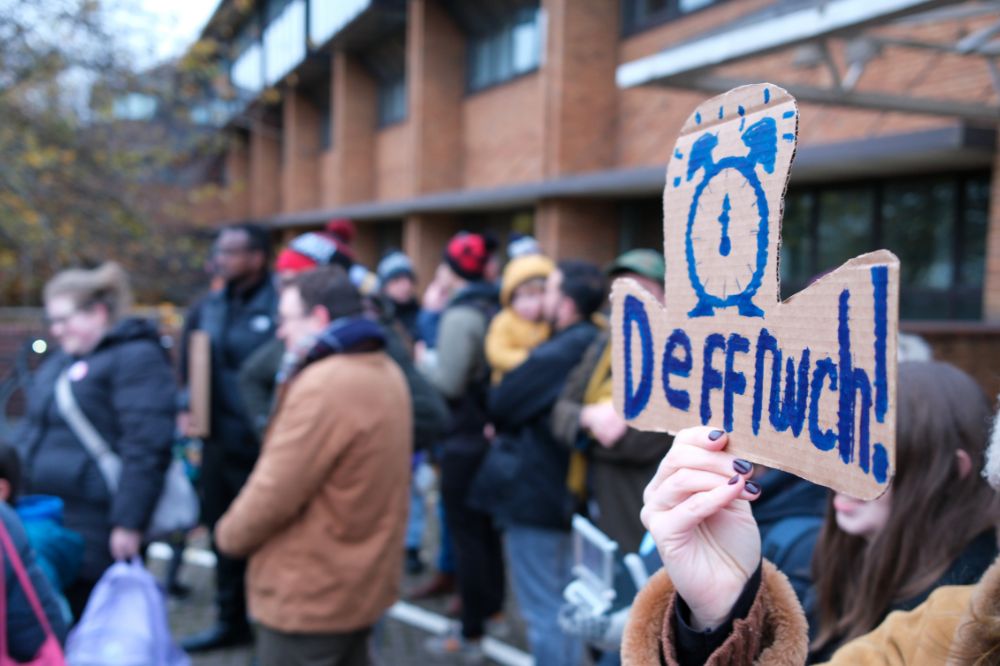
Let us not mince our words here. With the lack of action on a Welsh-medium secondary school, Cardiff Council are simply guilty of entrenching structural racism against the multi-ethnic communities of Grangetown, Butetown and surrounding areas with respect to access to the language. Jo Stevens’ disgusting attitude and attempt to cite other minority groupings as the reason for not communicating in Welsh with her constituents shows their true colours on this matter.
Welsh Labour’s fingerprints are all over the challenges faced in Carmarthenshire, and what appears to be years of inaction prior to the current Plaid-led administration. That said Plaid cannot be excused for their lack of leadership on the issue, and their folding to the agenda of the bureaucrats.
It beggars belief that in the context of a £9 million overspend by the county’s schools that the priority should be closing 4 primary schools that will save in the region of £200k and is less than the total overspend of some individual schools. This only serves to accentuate how closing village schools is now an entrenched, dogmatic response to current challenges when the problems are systemic.
Cull
One of the challenges the councillors like to cite in justifying the cull (for this will only be the first round of many if they get their way) is the fact that many families now take their children out of their villages to bigger neighbouring schools, as if they can themselves do nothing to stem the flow by promoting the small schools, pooling resources and services and providing more support for such services as wrap-around care.
It demonstrates also a complete capitulation to Thatcher’s neoliberalism and her legislation that promoted individual choice for parents between schools, rather than cleaving to the principle of universalism and ensuring equality of provision in its broadest sense.
Such is the unthinking dogmatism behind this ideology that councils these days don’t even bother trying to cite any evidence that all of this will be for the benefit of the children. The parents in my daughter’s school will all tell you that this can only be damaging for them, the majority of whom are families that are not in the privileged position of being able to drive their kids to whichever school takes their fancy.
To add insult to injury Plaid councillors refer to the ‘success’ in Ceredigion where they have been shutting village schools for years, citing how this has been a positive modernisation of their provision.
It is insulting because there is no modernisation promised in Carmarthenshire; at least in Ceredigion the council were building new facilities with their ‘area’ schools.
A fairer comparison is with the current situation in north Ceredigion where the council is trying to close schools with no promise of new facilities, but instead resorting to shipping children from one village to another. Those plans have been met with similar fury and have been shelved for the time being.
And to give Ceredigion their dues, this is also in the context of converting all foundation phase provision to Welsh-medium. As a child brought up there in the 1980s the idea that Plascrug, the major town primary in Aberystwyth, would be producing Welsh speakers would have seemed pure fantasy. So at least Ceredigion have a plan, you might say.
Reform
If you drive into Cwm Gwendraeth from Llanelli one thing that strikes any politically-informed observer is the preponderance of flags. Llanelli is a Reform target and it requires little imagination to conclude who has been tying the Red Dragon to the lampposts in a bid to claim the territory.
These flags spread outside of the town into neighbouring villages such as Burry Port and Five Roads. They have even crossed the lines into Cwm Gwendraeth in the odd village – but notably it has here elicited a response with the flag of Glyndwr raised in various places, inflecting the meaning and symbolism of the adjacent Draig Goch.
These flags are a reminder of what is at stake in May and the wider political climate within which Welsh-language politics is currently playing out. It frankly beggars belief that in an election year a Plaid council should be planning these closures.
This is in the superconstituency where former Plaid leader Adam Price is on the list, whilst the principal candidate is Cefin Campbell, party spokesperson as it happens for education and rural communities.
One wonders what he makes of the situation. This is the man, who when addressing the state of Welsh Universities (rightly) delights in channeling the history of Glyndwr and the Welsh hero’s ambition for higher education – yet his party is carrying out measures on his home patch that Reform itself would no doubt enthusiastically adopt.
Indeed an appreciation for local history is sorely missing on the part of his party in this context. For symbolically, one of the rural communities that will lose the source of its lifeblood is none other than Llangyndeyrn. This is a story that should, in fact, be national history, and in the words of Emyr Llew, one of the bombers of Tryweryn, it was more important than what happened in Capel Celyn.
For this was the story of the success of a Welsh-language community in defending itself against the threat of drowning, on this occasion issuing from the city of Swansea. Brwydr Llangyndeyrn is likely less remembered because it did not end in tragedy, but the determination of the local community, and the resistance of its farmers in particular should serve as an inspiration.
It is difficult to believe that little more than half a century later, with Welsh-language legislation, a Senedd, and a far more healthy language politics, this same community is going to see its school taken away by a party established to protect and promote our cultural inheritance. The abandonment of the school in Capel Celyn, in the face of its drowning by an English city, will echo in the abandonment of a different kind in Llangyndeyrn, a school slipping out of existence in the wake of the steady drip of that Welsh speciality: our own managed decline.
People will plead numbers and the issue of rural depopulation, but this is a denial of responsibility and the power which all politicians claim they will yield if given the chance. More than anything it is a complete betrayal of our language.
Baseness
At the height of the battle, the Welsh-language philosopher J.R. Jones – who would become the intellectual inspiration for Cymdeithas yr Iaith – wrote to the self-titled Defence Committee to offer words of encouragement. He emphasised the importance of such a community to the whole of Wales, as one of the diminishing number where life was lived wholly through Welsh – an interpenetration of land and language that was shrinking ‘like a cloth of snow before the sun’. ‘Don’t be afraid of the authorities of Swansea’ he told them, ‘for you have the ages behind you’.
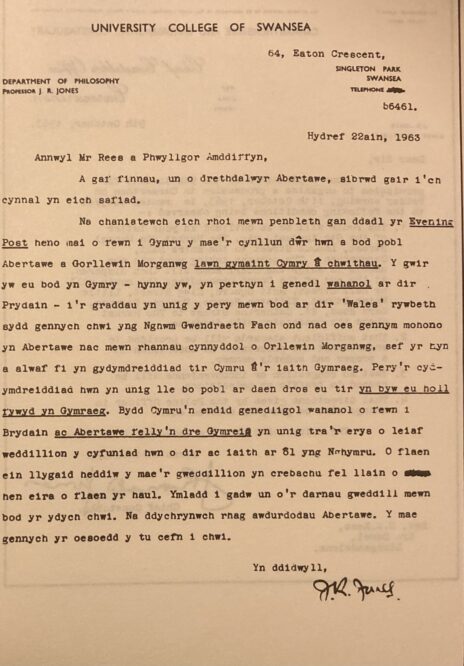
Our politics today is bereft of such language, such depth and emotion; we are left in fact, as he said in one of his famous pamphlets, with a politics reduced to the ‘art of the possible’ managed by technocrats and the spirit of rationalisation. ‘And it is base’ he said ‘such that it debases the human spirit and drowns civility in banality and superficial cleverness’.
This tendency partly accounts for the establishment parties’ fall from grace, and it is undoubtedly how one feels when listening to council officers and their lapdog politicians telling young children and their families to act with ‘common sense’ as they simultaneously crush their tiny little worlds in the name of the chimera of ‘modernisation’. It is how one feels when listening to a council responsible for promoting Welsh-language education citing their own failures in increasing numbers as a reason to deny a multiethnic community their own school.
These people have no appreciation of their own history or of their own role in the slow death of their language and people. They have no sense of the inner recesses of the human soul, the depths of which are afflicted by their petty indifference.
As I watched my daughter and her new friends in the village tell the story of Babushka to a packed room full of delighted families, I reflected on the fact that this time next year the nativity may be the last act in the school’s 150-year history.
We may have the force of the ages behind us and the many gifts it has bestowed upon us, but in the hands of the purveyors of vacuous so-called common sense, our future is brittle and uncertain.
Huw Williams is a Philosopher at Cardiff University where he was Dean for the Welsh Language for 6 years. He is Chair of Governors at Ysgol Hamadryad and was the secretary of the campaign to establish the school. He was a Director of Mudiad Meithrin for 10 years.
Support our Nation today
For the price of a cup of coffee a month you can help us create an independent, not-for-profit, national news service for the people of Wales, by the people of Wales.



Whether we like it or not the number of children is greatly declining. How we cope with this I don’t know but I think that some village schools must stay open. Worse still in urban areas primary/infants schools are being merged with secondary schools to become so-called run through facilities. This inevitably makes them remote from large areas of the communities they serve and I suspect will greatly reduce parent participation. I know of no serious evidence that this is superior. I can’t see that most of the facilities can be shared – yards and sports facilities for example. I… Read more »
Fantastic article Huw. Croeso i Sir Gar. Lle mae ein cabinets Llafur a Plaid wedi gwneud eu gorau glas i ladd neu glasdwreiddio yr iaith.
Erthygl ardderchog yn wir! Mae’r sefyllfa yn wirioneddol dorcalonnus.