


In praise of an inventive tiny nation
Martin Shipton
Since visiting the Faroe Islands for a few days over the summer, I’ve become quite fascinated by the place.
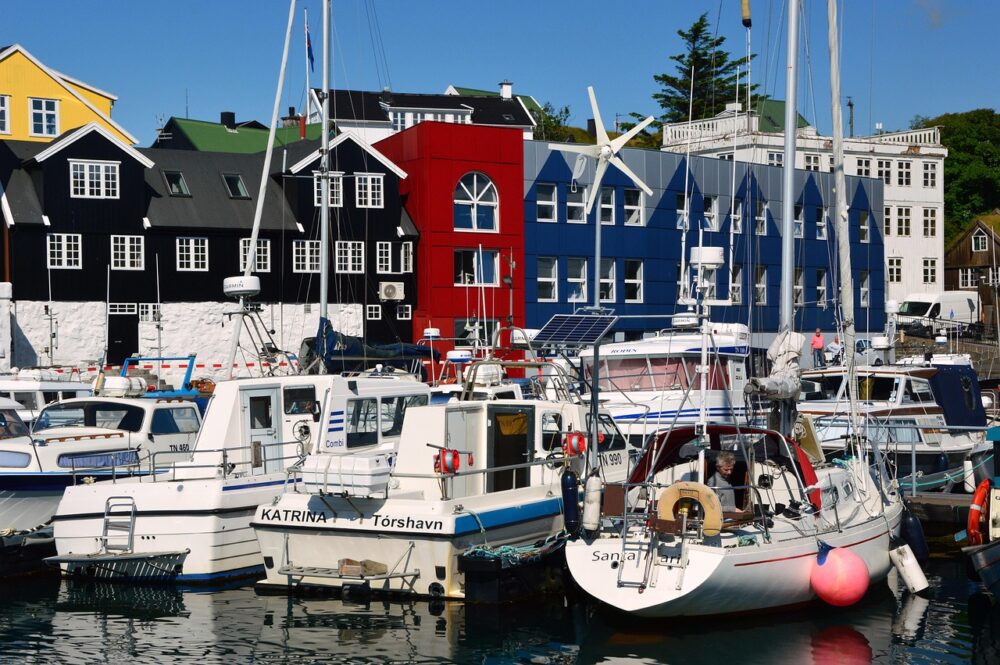
It’s scenically very beautiful, unspoilt and has a lot going on.
Constitutionally it’s also an antidote to those who claim Wales is too small to be an independent nation.
The Faroes have a population of just 55,000, already have substantial devolved powers and are in talks with Denmark about full independence, which is potentially on the cards. The GDP per head of the Faroes is now higher than that of Denmark, its “mother country”.
After I wrote a piece about my trip, I was contacted out of the blue by Stan Abbott, who I worked with many years ago in the same newspaper office in Darlington. It turns out that for years he was involved in organising trips for journalists to the Faroes, which are in the north Atlantic, around halfway between Shetland and Iceland.
He’s now written a splendid book called Faroese Days, in which he explores the cultural richness of the islands ranging from literature and the visual arts – the capital Torshavn hosts the superb national gallery, accessible via a delightful woodland walk – to music (both traditional folk and avant garde) and, clothing and food (predominantly fish and lamb).
The fishing industry is, of course, vastly important to the Faroese, and it has brought great prosperity.
Communications between the 18 islands have improved massively in recent decades, with the building of many tunnels and bridges. The Faroese have even built roundabouts in the tunnels, one being surrounded by impressive artwork.
Abbott has conducted many interviews for the book with creatives and entrepreneurs , who between them ensure that the islands are not the remote backwater they could have been.
‘Innovation’
He writes in the Introduction: “Underlying many of the transformative advances in the islands is the Faroese people’s own innovation and determination and it is their can-do attitude that is my inspiration for writing this book, after a ‘love affair’ with this eternally curious land and its people that has lasted more than a quarter of a century.
“Faroese inventiveness, however, extends far beyond anything as prosaic as mere innovation: the islands surely boast more recorded musicians per head of population than anywhere else on Earth; Faroese cuisine has lured Michelin judges far beyond both their geographic and psychological comfort zones: the islands’ salmon farmers also push the boundaries to achieve a more sustainable and healthier product; and Faroese people are among the most literate in the world, reading and conversing comfortably in three languages: Faroese, Danish and English.”
The islands were occupied benevolently by the British during World War Two, at a time when the colonial power Denmark suffered a brutal occupation by the Nazis.
Immediately after the War, the Faroes were granted a large measure of self-government – a move that has led, 80 years later, to a highly sophisticated political sphere, where politicians who represent what would be the population of a small town in British terms have negotiated international treaties that have been greatly to the advantage of the Faroes.
Opinion has been split over the years between those who want total independence and those who want self-government, but also to retain formal ties with Denmark. There’s a sense that President Trump’s aggressive posture towards Greenland may have tilted the pendulum in favour of outright independence.
Self-contained
It also has to be remembered that it’s more than 1,500 kilometres from Torshavn to Copenhagen. My sense is that the Faroese are pretty self-contained – and I certainly didn’t encounter any embarrassing sycophancy towards the Danish Royal Family of the kind that is all too common in Britain.
There’s one Faroese tradition that causes ongoing controversy: the grind or pilot whale hunt in which whole communities participate. Opponents say it is cruel and endangers the species. Defenders – Abbott included – claim that the whales are now humanely killed and that there is no danger to the survival of the species. Abbott does, however, express the view that the grind itself could become extinct as people become more reluctant to eat pilot whale meat because of the high level of mercury in it.
The book, which has many photographs to accompany the text, is no superficial coffee table publication, but a serious exploration of the islands in all their complexity. It will appeal to anyone interested in how a resilient and inventive tiny nation can make a success of itself.
Support our Nation today
For the price of a cup of coffee a month you can help us create an independent, not-for-profit, national news service for the people of Wales, by the people of Wales.



I was excited to read this article by Martin, but only got to read 4 lines – where is the rest of this interesting article>?
The brutal slaughter of whales and dolphins is the only reason I need to have to not visit.