

Interview: Director Jamie Adams on bringing Kylie Minogue and Quentin Tarantino to Porthcawl
Amelia Jones
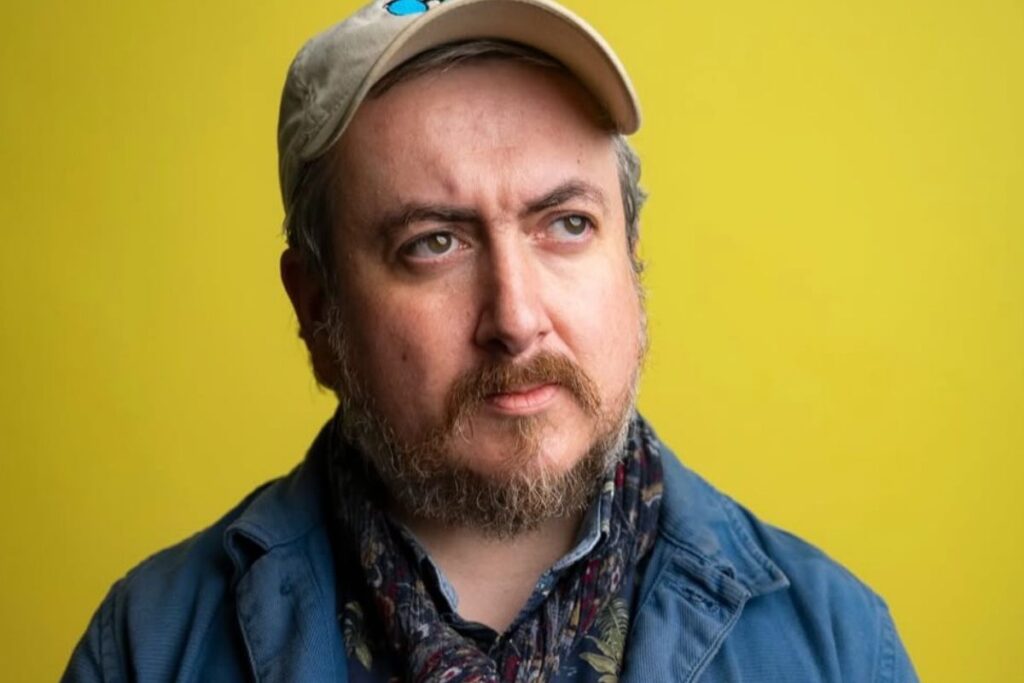
Independent filmmaker Jamie Adams has built a career doing things his own way. Known for his improvisation-led approach and character-driven stories, his films have attracted an impressive list of collaborators over the years, including Jennifer Grey, Brett Goldstein, Brittany Snow, Kylie Minogue and Quentin Tarantino.
Although born in Dorset, Adams has called Porthcawl home since childhood, with the town and wider Welsh landscape becoming recurring backdrops throughout his work. From its beaches and seaside streets to the support of the local community, Wales continues to play a central role in the stories he tells.
Speaking to Nation.Cymru, Adams discussed his approach to filmmaking, why he keeps returning to Wales, the international attention generated by his latest project, and his advice for the next generation of Welsh filmmakers.
For anyone who might be discovering your work for the first time, how would you describe yourself as a filmmaker, and what kind of stories do you love telling?
I’m an improv-led film maker, I’m interested in relationship dynamics and the major questions of life and love – character driven stories.
You’ve made a career in independent filmmaking, often doing things a little differently. Has that always been the plan, or has your approach evolved over the years?
I’m a pub landlords son, a career in film wasn’t available to me, still isn’t in many ways! I think the love of movies from childhood, that excitement of going to the video shop and spending hours taking in all the covers, the actors, the genre.
I think that combined with the discovery of auteur cinema at University (Royal Holloway) – the work of the French New Wave, Dogma 95’ – independent American cinema of Casavettes, Kevin Smith, Robert Rodriguez and Quentin Tarantino – that’s the dichotomy that creates the tension at the heart of my work.
Wales has featured throughout your work, even when it’s doubling for somewhere else. What keeps bringing you back to film here?
My parents are from the Rhonda Valleys, Bargoed and Cefn Forest. I was born in Weymouth, Dorset but we moved back to Wales, to Porthcawl when I was three years old in 1983 so it’s what I know, these are places I’ve grown up with, that Hiraeth is ever present in my films.
Porthcawl has become one of those places you return to. What is it about the town that makes it such a useful filming location?
It’s been my hometown for 43 years, it’s where I met my wife of twenty years, it’s where my three children have grown up/ continue to grow up. It has three very different beaches, two historical villages, an atypical, seen better days, British seaside town high street – so it’s a versatile place to shoot.
It’s a community that knows me and looks to support me and my work, which when you’re an independent film maker working with very low budgets you need, you need that community around you that wants to support. I guess the one place I wish I could’ve filmed in and didn’t get the chance to is the Fairground at Coney Beach which no longer exists.
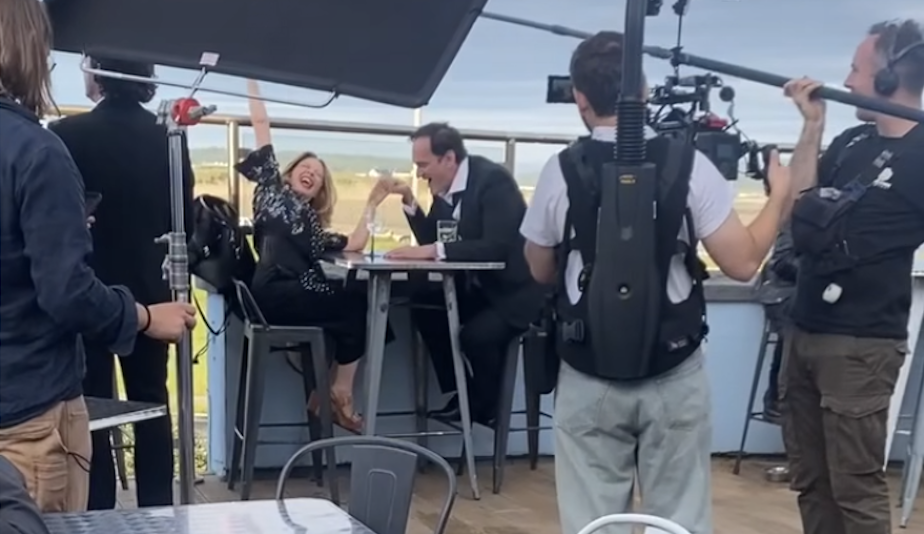
People were fascinated by reports linking Kylie Minogue and Quentin Tarantino to Porthcawl. What was it like seeing so much international attention suddenly focused on a film being made in south Wales?
I’m very fortunate that internationally renowned artists appreciate our endeavour and travel to my home country, my hometown in this particular case to be a part of our troupe, to explore our process of improv led indie film making – I loved seeing what it meant to the community of Porthcawl.
There was a great sense of fun and excitement around the town, it’s all part of what we do as storytellers to raise spirits, to provide an entertaining distraction. Of course the stories of us bringing such legends as Jennifer Grey, Brett Goldstein, Brittany Snow and now Kylie and Quentin to Porthcawl, and Cardiff, those town perpetuated stories – they take on a life of their own – and will become a part of the local folklore; stories that are told time and time again for years to come. It genuinely makes me proud of what we do.
Did that kind of international attention feel like a big moment for Welsh filmmaking, or did it all just feel a bit surreal while you were trying to make a film?
Fascinatingly the attention has been more international than Wales based, but then my work tends to be more appreciated and recognised by the international film community than here in my homeland, most of my films have been financed by American Production Companies, completely independent of any Cardiff or London centric film finance administrators / broadcasters.
So it didn’t feel like any kind of moment for Welsh film making because I’m not apart of that club or “movement” – but it felt fun for the people and places that mean a lot to me in Cardiff and Porthcawl.
You’ve spent much of your career forging your own path as an independent filmmaker. Do you think it’s becoming easier for the next generation of Welsh filmmakers, or are the same barriers still there?
Oasis said it best; “you’ve got to be yourself, you can’t be no one else.” The cavalry isn’t coming, you may be fortunate to be endearing to the film agency admins or the UK and/ or the broadcasters and that makes things much easier to earn a living and tell your stories with more resources , which can lead to feeling legitimised and more confident in your work.
However most of the time that’s not a possibility for those that don’t speak the same “language” as those institutions, those who aren’t confident in completing the paperwork that comes with a film agency application – those who don’t have the available resources to take time off work to attend a “masterclass” or administrator led “scheme” – the cavalry isn’t coming.
No one will back you as much as you need to back yourself, so while the barriers exist now more than ever (film festivals are over subscribed, film finance is at a premium, the whole distribution and sales market is in shock) the opportunity to make a film has never been more accessible.
You need to back yourself, communicate your passion for your movie to potential collaborators and continue to work on your craft any which way you can, whenever you can, with whatever resources you have available to you. Then make sure people get to see it. Keep doing that for the rest of your life, congratulations you’re a film maker.
You can follow Adams on Instagram here.
Support our Nation today
For the price of a cup of coffee a month you can help us create an independent, not-for-profit, national news service for the people of Wales, by the people of Wales.
Get more trusted Welsh news
Choose Nation.Cymru as a preferred source in Google News to see more of our journalism.



