

Interview: Iwan Bala discusses his new exhibition decolonising Welsh culture
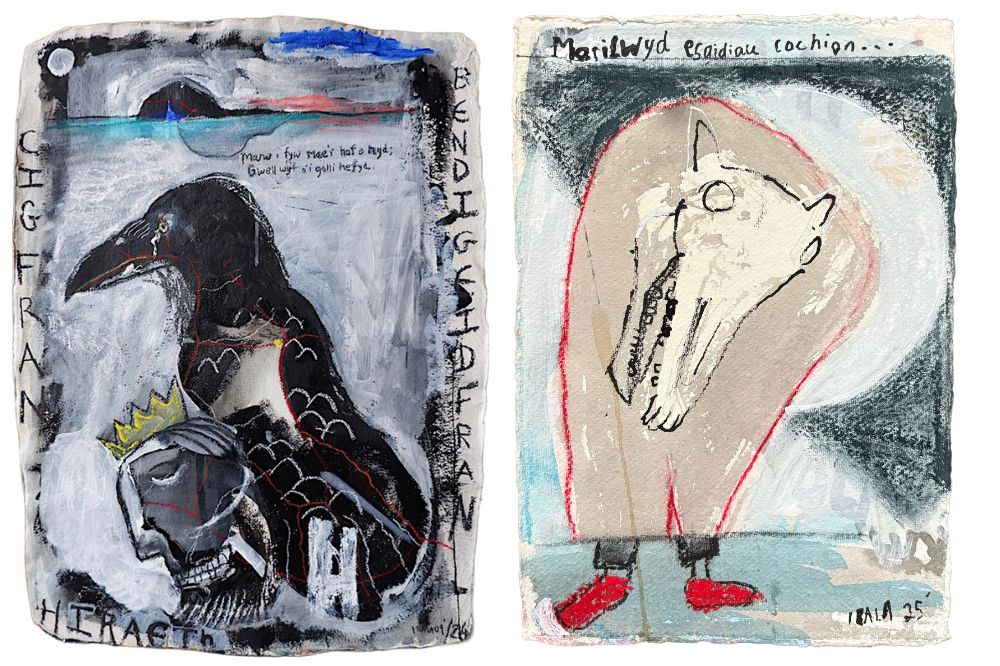
A Cardiff gallery is set to a major solo exhibition by Iwan Bala, one of Wales’ most influential and respected contemporary artists, as he celebrates his 70th birthday.
A pivotal figure in the exploration of cultural identity and the cultural cartography of Cymru, Iwan Bala’s work offers a visceral, intellectual journey through the landscapes of memory, language, and heritage.
His practice is a masterclass in duality; his pieces are simultaneously politically charged and deeply personal, spanning the monumental and the ancient while remaining firmly rooted in the contemporary present.
This exhibition of new and recent work at TEN showcases the enduring themes that define Iwan Bala’s career – most notably the preservation, evolution and decolonisation of Welsh culture.
In these works, language [Cymraeg, English, Catalan] is nearly always present.
Fragments of poetry, prose, and words woven into the Welsh subconscious act as anchors, supporting the message and context of his imagery.
His engagement with the political landscape is an unflinching, reoccurring theme – his views are clear and unquestionable, often placing political leaders and global injustices in his satirical line of fire.
The collection breathes with repeated motifs from Welsh lore. Present are symbolic archetypes such as Y Fari Lwyd and Tafod y Ddraig [The Dragon’s Tongue]; elements from the Mabinogi, including Ysbadadden and Pair y Dadeni [The Cauldron of Rebirth].
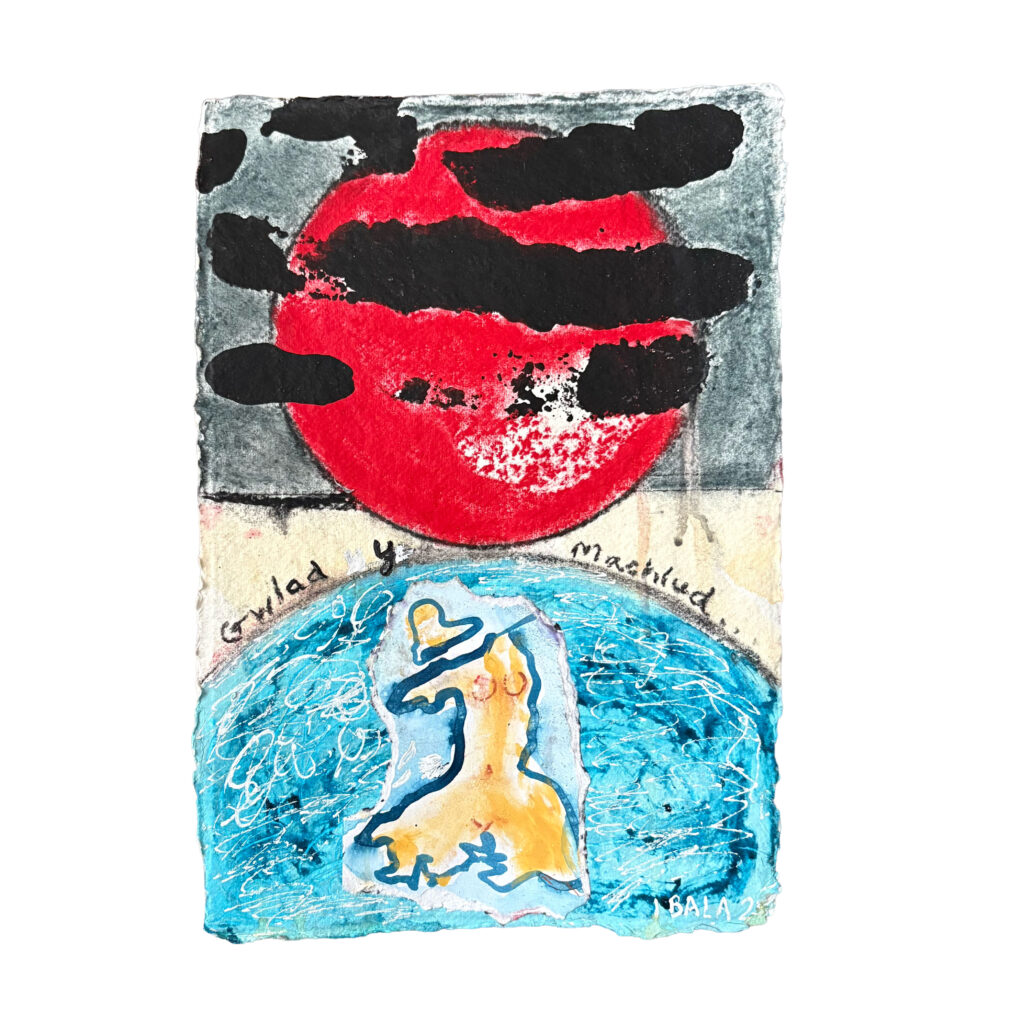
Iwan Bala’s iconic topographical maps, where the shape of Cymru takes on a female form has been a constant presence in his work over the years.
A mother, sister, lover – this intimate blending of person and place encapsulates his relationship with his country – his art practice is one deep, vast love letter to Cymru
Symbolism
Renowned for a deeply symbolic style, Iwan Bala seamlessly blends drawing, painting, and collage. He works on handmade cotton Indian Khadi paper, a surface tactile and tough, capable of withstanding heavy mark-making and the layers of ink and paint.
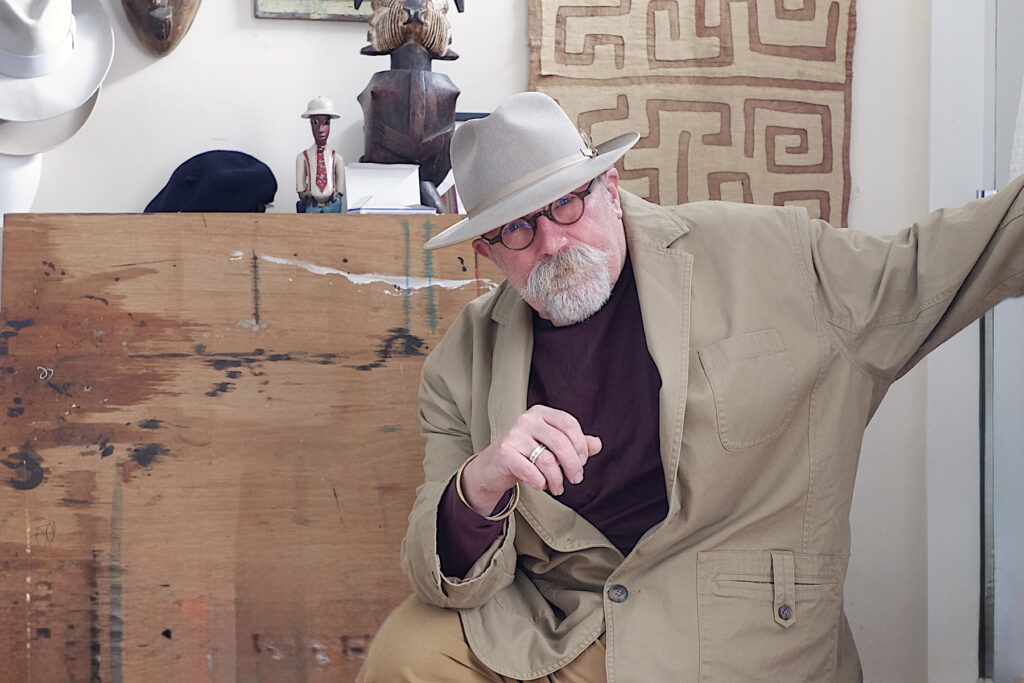
His choice of medium has taken on a further, serendipitous layer of meaning after recently learnt that cotton was worn in 19th and 20th Century India as a deliberate anti-English act of resistance. His work has always echoed the sentiment – now confirmed as the base carrier for his art.
Iwan Bala’s work serves as a vital bridge between a rich, historical past and a complex modern present. It is, in every sense, a celebration of Cymru’s land, language, and legend – and this exhibition celebrates the artist and his enormous contribution to the culture of his country.
Dylan Huw writes: “Iwan Bala’s images have a way of proposing metaphors so real that they exceed reality itself. A holiday home swallows a map of Wales, its driveways directed one-way; a “dictionary of longing” is a fiction actualised.
:In these latest works, Bala reflexively expands upon, and perhaps thematises, his status as one of the few contemporary artists working in this country whose visual lexicon feels woven into a national cultural fabric, insofar as such a thing exists.”
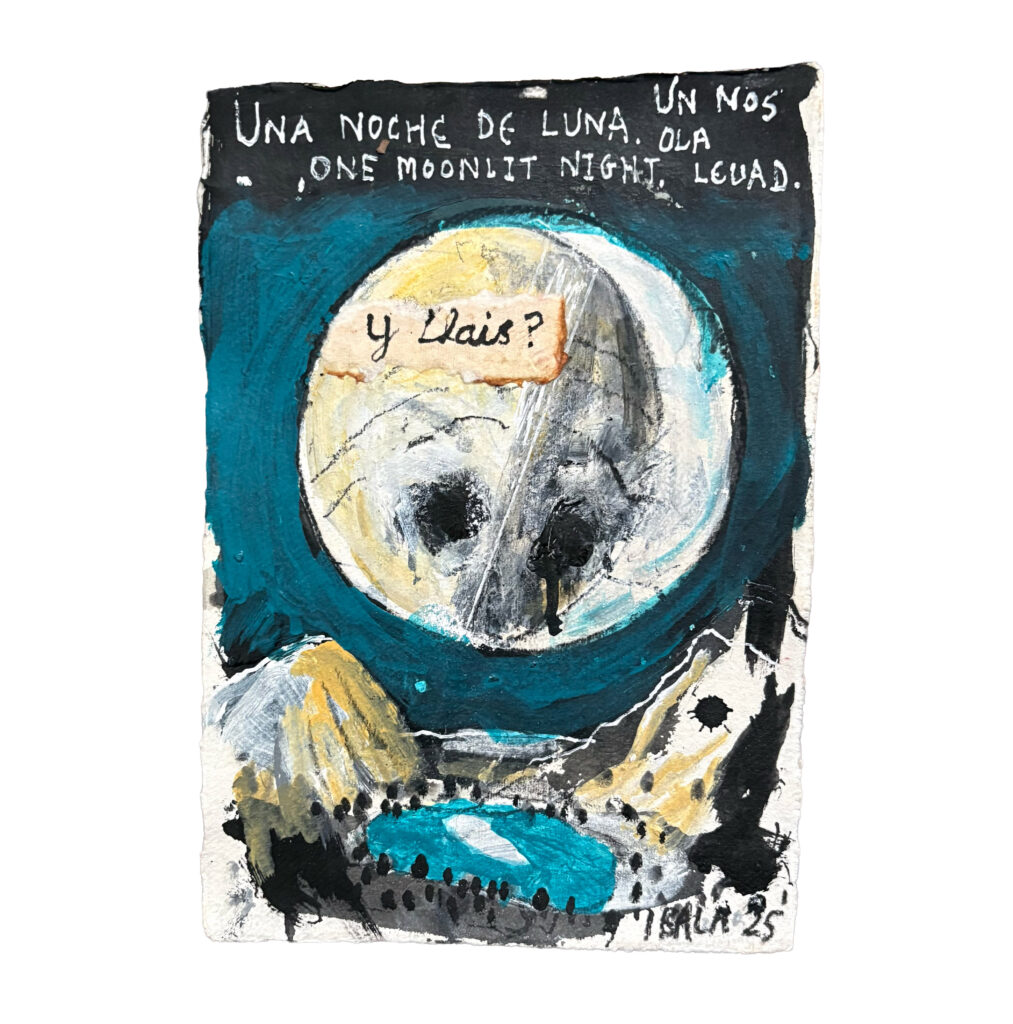
He added: “Signifiers of latter-twentieth-century Cymraeg iconography (perhaps its most famous novel, Caradog Pritchard’s Un Nos Ola Leuad; perhaps its most famous song, “Yma o Hyd”) are appropriated, and placed in dialogue with Bala’s long-term motifs of map-making and calligraphic provocation.
“Here as elsewhere, the paintings suggest new avenues in the artist’s exploration of the intertwinement not only of language and landscape, but of the very idea (the very possibility) of a Welsh culture, a Welsh history, a Welsh contemporary. His medium – muscular mark-making on Khadi paper, handmade – belies the simultaneous assertiveness and fragility of his evergreen subjects.
“Have we taken the earth and lost the sky, one painting asks, insistent; a characteristic Iwan Bala query, contextualising questions sometimes mistaken for being parochial on the global and cosmic scales they demand.
“These paintings offer cartographies of Welsh potentiality, totems to collective hope and despair alike, both fragile and rich in unending possibility. Look closely into their lines and marks and you might see a future you didn’t know was there.”
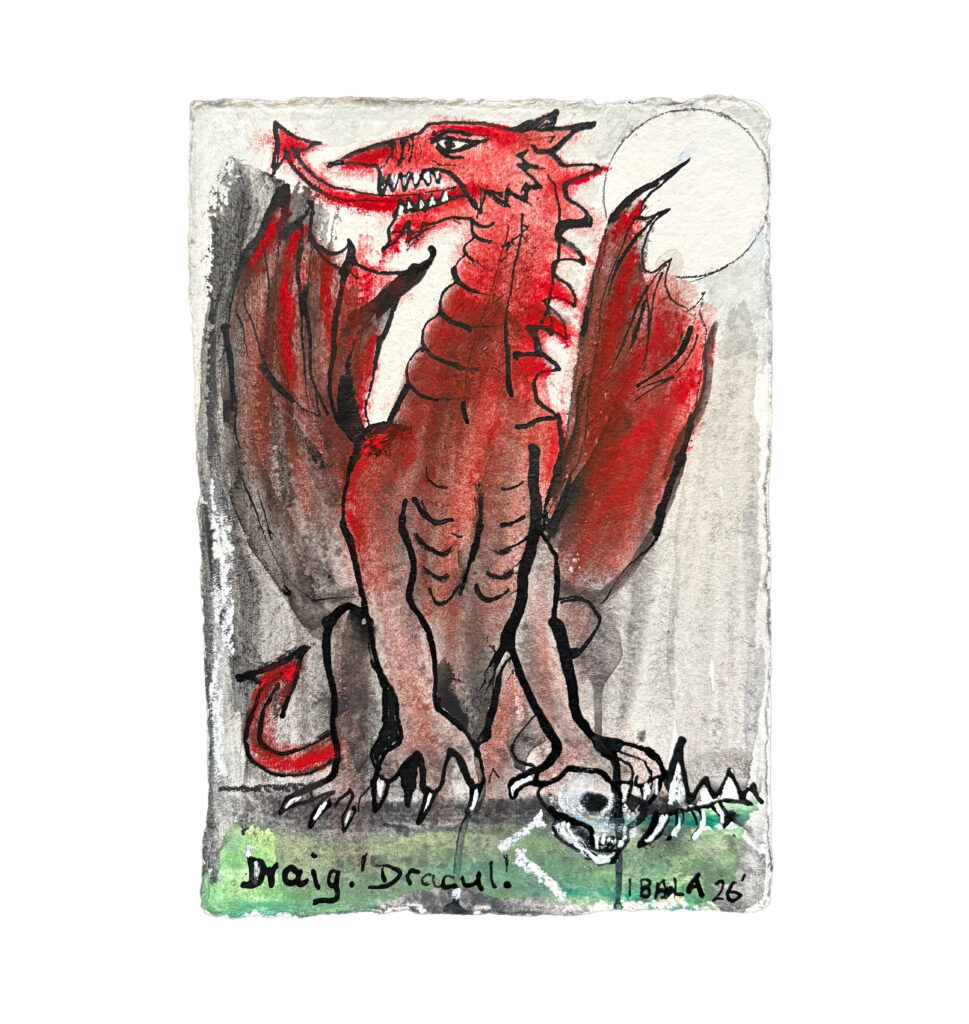
“The forms that were there before have either completely disappeared, or they leave traces that convey ideas towards the new work. I will start a drawing not really knowing what will appear at the end of the process, but marks on the paper guide my thoughts.
“The process is a combination of two things working in my head at the same time. The image is formal; balance, colour and marks, and the gathering of thoughts while working and looking at the work in a break. This is what gives the picture its meaning and message.
“These thoughts come from a wide background of ‘references’; mythology, places in memory, something I’ve read or seen, history, and world politics in its fragile present. An effort to decolonise would be a fairly comprehensive description of my work”
Collecting Thoughts – an interview
Welsh mythology plays a very important role in this new body of works, many more familiar like Bendigeidfran and Mari, but others less known – did you do much new research before getting into creation mode?
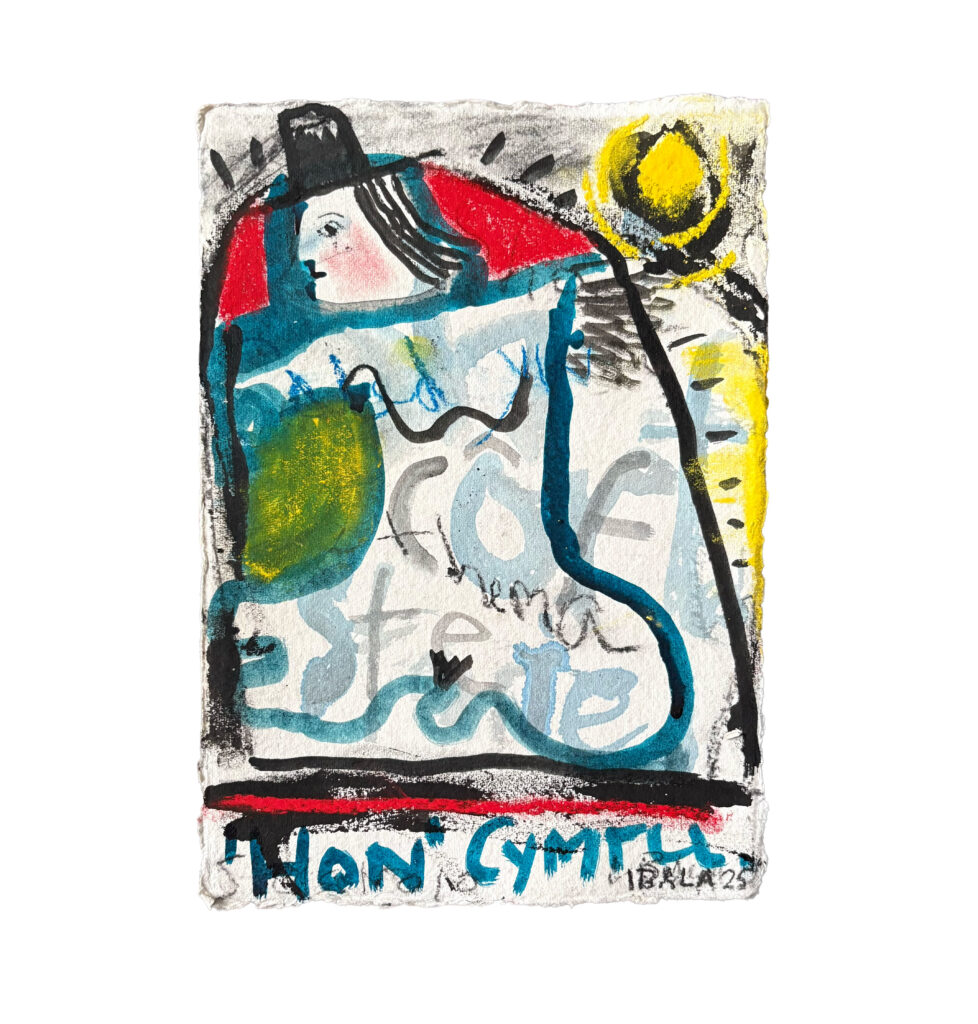
‘Creation mode’! I suppose that these mythical references have always been there in my work and in my sub-conscious, so no new research was really necessary. However, I became aware recently of the fact that Efnisien (in the story of Branwen in the Mabinogi) was a twin, with a brother called Nisien. It seemed to me this was a crucial psychological aspect to one of the Mabinogi’s most complex characters. A sense of duality that I have used for the most recent work; ‘Ef/Nisien (O nam I nam)’ which operates as a sort of raw self-portrait at 70!
The work is superimposed on an earlier work from 2011 which featured the words of poet Menna Elfyn. ‘Nid o gam I gam y rhedaf yr yrfa, ond o nam i nam’.(‘It is not from step to step that I run the race, but from slip to slide’) I have her permission to make a ‘mash-up’ of them, whilst the reference still makes sense in the finished work. It’s sort of meditative.
Politics is also another important narrative in your work, and we’re living in very strange times right now – times of impending change for Wales – has this informed much of the new work?
Absolutely. The dire political situation in the USA for example led to a series of works based on the (also) mythology of Captain America. Trump is making abhorrently visible, the everlasting war empire that the US has been (in cahoots with Israel) since at least 1945, but he is upfront and vicious about it in his infantile way.
Of course Cymru is riven by the contest between a left leaning nationalist movement and a far- right unionist ‘English’ movement. So, we are faced with ‘interesting’ times, which I hope we emerge from with strength and conviction.
What leads you to reject the usual approach of straight-up canvas and the like?
The Indian Khadi paper is sustainable cotton rag, and is a very adaptable medium to work on. I consider my work more as ‘drawings’ rather than ‘paintings’, although of course I use paint and inks in the mark-making process.
Many years ago I would stretch canvases and prepare them, and paint with oils, but I prefer the immediacy of direct mark-making on the paper.
Naturally, language is at the heart of your work along with all the other building blocks of Welsh identity. The press is awash with a focus on learning in particular, but ‘out in the wilds’, outside of the classroom, it’s still at threat from diaspora, inward migration and modern trends, despite the trendy, sunny tokenism and click-bait friendly pieces the press keeps on churning out. At your core, do you feel hopeful about the preservation of Welsh language and culture?
At my core, I fear a diminishing of the language and of identity that goes with it. And yet, it has survived huge detrimental attention and actions for centuries, and I hope it still will find a way to survive.
There is hope alongside the statistics of decline and the ‘plantation’ colonialism of towns and villages by English incomers. I feel that a growing awareness of the importance of Cymraeg is particularly evident in a younger generation.
On a similar note, the arts in Wales are also under enormous pressure – perceived cuts to funding, lack of focus in the Senedd etc. – what do you think can be done to ensure the arts remains embedded in who we are as a people?
In the past, I was more engaged in these cultural politics, and know that the arts were always under-valued here. Things changed institutionally due to protest and the writing of Peter Lord and of mine to a lesser extent.
We now see a return of funding deficit and threats to art organisations. I am not as engaged with that as much as I was, my concern is to keep on making art that has something to say, as I hope (and know) others do as well.
Back to the show – did any of the newer works take time to emerge into their current states?
Many works from the last eighteen months are re-animated from a pile of works on paper in my studio, that were shown but then forgotten, or did not ‘make the cut’ the first time around.
I find it a liberating process, to not feel I am adding too much ‘stuff’ to an overcrowded environment, but re-cycling! Old material, new ideas.
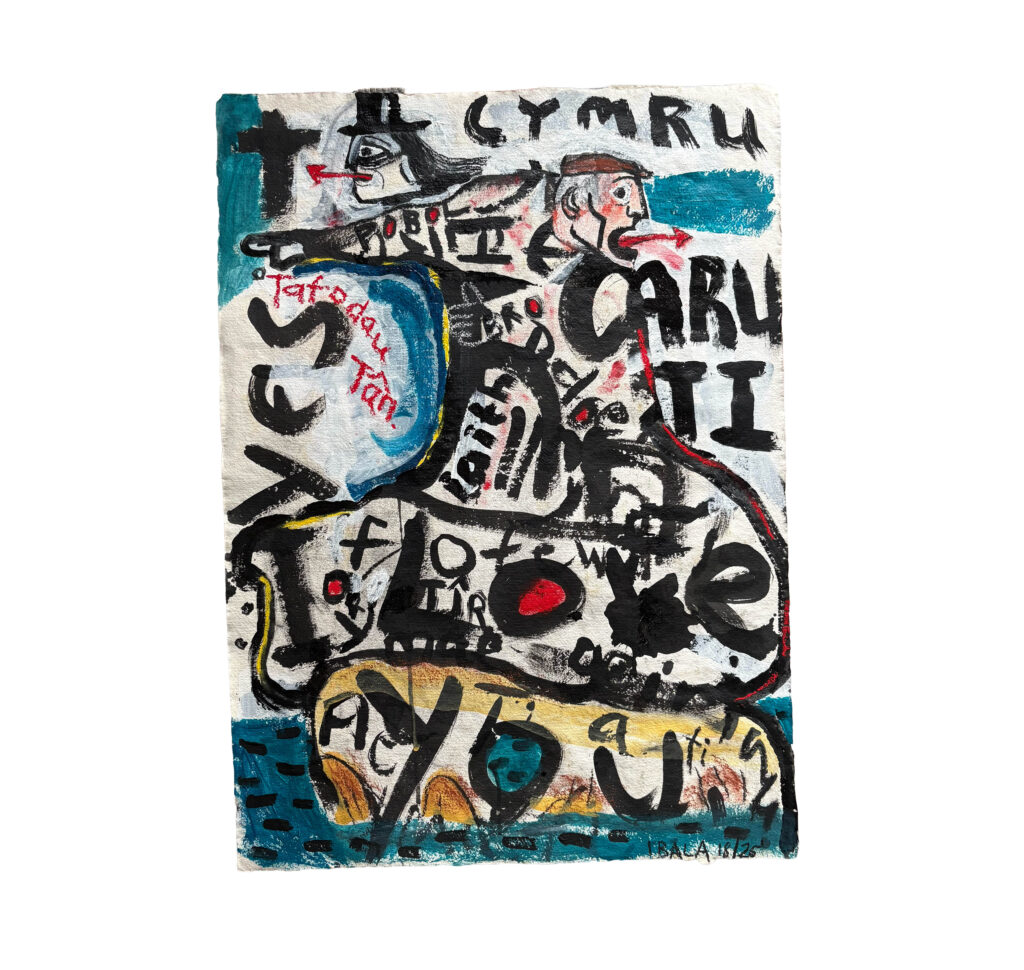
One of the most moving pieces in the collection for me was your simple worded one – I Love You Wales, Caru Ti… It feels like an encapsulation and simplifying, poetically, so much within this collection and ones before, the driving force behind it all. How is this ‘love story’ playing out now you’re closing in on another decade of life?
Haha, yes, that piece grew to encapsulate my feeling certainly. I say ‘grew’ because I seldom plan my work beforehand, it comes from a dual process of mark-making and thinking as I look at the result, then adjusting the image accordingly.
‘Hel Meddyliau’.. ‘Collecting Thoughts’ as this exhibition is called. That really is the driving force.
View Iwan Bala’s latest works at TEN, The Coachhouse r/o 143 Donald Street CF24 4TP. All paintings are also available to view and purchase online now.
Support our Nation today
For the price of a cup of coffee a month you can help us create an independent, not-for-profit, national news service for the people of Wales, by the people of Wales.
Get more trusted Welsh news
Choose Nation.Cymru as a preferred source in Google News to see more of our journalism.


