

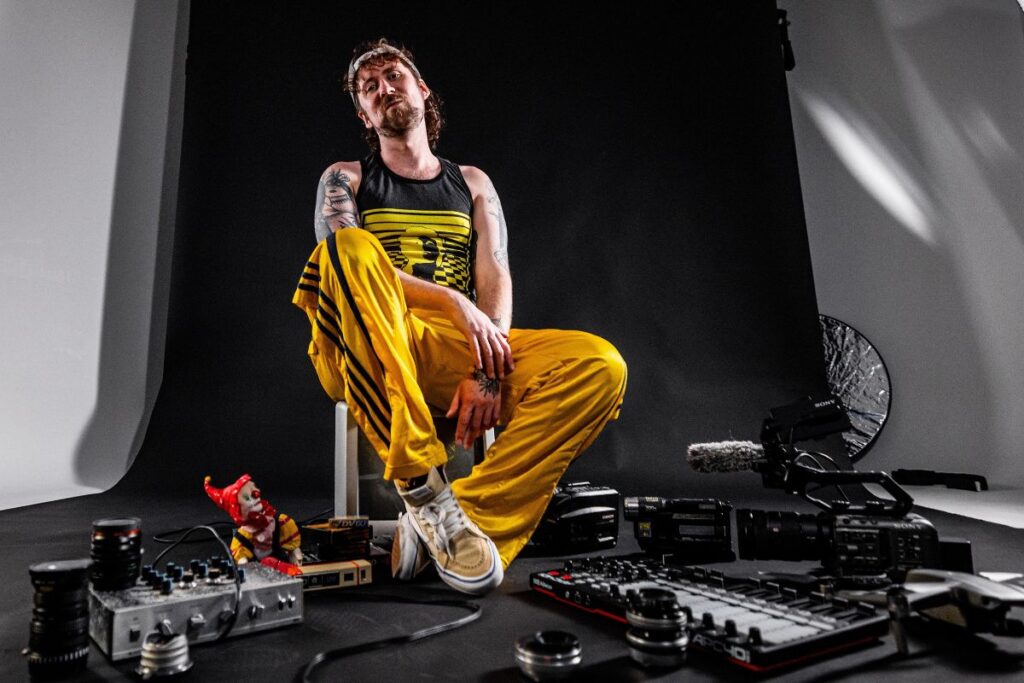
Interview: Welsh filmmaker Jamie Panton on his passion for storytelling and capturing the heart of Wales’ music scene
Amelia Jones
Raised in the rural village of Abermule in mid Wales, filmmaker Jamie Panton discovered his passion for storytelling by creating his own entertainment.
Fascinated by cameras from an early age, he got his first camcorder at 15 and began making homemade horror films and parody music videos with friends.
Determined to pursue filmmaking, he even made a three-hour round trip each day to pursue Film Studies at college, immersing himself in cinema, film theory and the visual storytelling techniques that would shape his career.
More than a decade later, Panton has built a career as a filmmaker and video producer whose work has taken him from London to Los Angeles and Tokyo. Drawing inspiration from avant-garde cinema, arthouse films and documentaries, he has developed a distinctive style that combines striking visuals with people-centred storytelling.
Panton spoke to Nation.Cymru about his passion for fly-on-the-wall documentaries, his work capturing the Swansea music scene, the importance of supporting local venues, and the creative journey that has taken him from a small Welsh village to productions around the world.
What first sparked your passion for creating cinematic videos and was there a particular project that made you think, “This is what I want to do full-time”?
I always had a fixation. I wanted a camcorder when I was a really young kid, but we couldn’t afford one. As soon as I did get one, I was just completely obsessed. I remember being in poetry lessons at GCSE, writing scripts to film at the weekend. My grades did take a dip at that point.
I started seriously thinking about it as a career after leaving sixth form and going to university. I did take a bit of a detour, I was in telesales for a while and then I went to Swansea Met (now University of Wales Trinity Saint David).
I made the most of every networking opportunity, every opportunity for work experience that came up. So, when I graduated, I was just able to go for it and I’ve been doing it full-time for 12 years now.
You describe your work as “character-driven storytelling.” What does that mean to you?
When it comes to art and making documentaries, I’m personally not a big fan of the documentaries you see on Netflix. We all enjoy them, they’re fine, but they’re not what I want to make. That kind of very formal, ‘sat in a chair’ interviewing is all about what, when, why, how. That doesn’t really excite me or interest me.
I’ve always been interested in what they call cinéma vérité or fly-on-the wall style documentaries, which to me feels more real and allows you to get to know a person. That’s what I love, is building portraits and taking deep dives into heavy topics. I want to make something people can resonate with.
You’ve created a lot of content for grassroots music venue Afan Ales. How did that partnership first come about?
So Gavin [John] messaged me and said he’d been a fan of my work on Instagram for a while. I think it was when they were costing up all of the renovations. They were on tight budget, but I was like this venue looks amazing.
It was for Independent Venue Week. I did all three nights back to back, and by day three I was pretty much dead on my feet, but I was just having so much fun.
For me, that’s exactly what you want from a commission like that because it’s a really intense space. For anyone that doesn’t know Afan Ales, your living room is probably bigger and you’ve got all these people crammed in and bands playing.
You’ve got drinks being passed from the bar around to people because you physically can’t move when it’s crazy busy, or at least before the renovation. It was a proper Baptism of Fire.
You’ve also built a reputation for creating budget-friendly music videos. Why was that important to you?
I think the hardest part of being a freelance artist is pricing up what you do. Most of my friends are musicians and I know how difficult it is trying to work out how you’re going to spend money on travel to gigs, merchandise, PR, photo campaigns on your social media, all that stuff adds up.
Some music video ideas I pitch to bands would cost around £700, or even £1000 to film. So, I was thinking about it for a few months earlier this year: How can I come up with something that’s accessible for bands and is still a fun product to have?
I’d been playing around with an old mini DV camera with a client Rachel Collier, we were meant to be just shooting some social media content but she was playing a track and I turned it into a little music video and it was really quick to smash together. It’s a little bit like how I used to shoot when I was a teenager.
Music video shoots usually go on from around nine in the morning until midnight or even over the course of a week for the larger ones, but this was just a five, six hour shoot, all shot on mini DV. I am doing it in a slightly more amateur way, but then the bands get good products and a product that I can turn around quicker and cheaper than a normal shoot.
You have become known for your intimate interview-style. A recent clip featured Trampolene’s Jack Jones talking about his sobriety. How did you create an environment where Jack felt comfortable opening up?
With Jack, I’ve done quite a lot of work with him so there’s already rapport there. He was part of a documentary I did for the BBC Wales Horizons project a few years back. He’s comfortable with me, and I’m comfortable to just go in and ask questions.
To speak more broadly, I’ve done a lot of heavy fly-on-the-wall style documentaries with people that I’ve only had one online meeting with beforehand. I’ve also done a lot of documentaries on mental health, from substance abuse to living with depression.
I’ve found that you’ve got to structure your day. I always go in with a plan of what I want from the narrative and divide it into three parts and then attach a location to each of those parts.
By the time we get to location two, that’s when I’ll normally dial into the more heavier topics and then when we move to the third location I’ll move onto questions that will frame things in a way that gives the audience a resolution on the plight of the person.
I think for me the best way to make someone feel comfortable is breaking down the day into chunks that are manageable. A lot of people watch documentaries and are like ‘Wow, that’s so intense’ but on everyone I’ve done, we’ve actually had a lot of fun.
If we’re having this conversation again in five years, what do you hope you’ll have achieved?
Honestly if I’m just doing what I’m doing now in five years, I’ll have gratitude. I do find one of the downsides of having a business is that you have to play things quite safe. I wish I could be like ‘I’ve got this idea and but it might not work,’ but you can’t do that when clients are paying.
I am toying with the idea of doing a masters degree and going back to education. So in five years if I’ve done that, it would be nice to have a few different aesthetic styles to pick from, but I’d happily do this till the day I die.
You can follow Panton on Instagram here. You can book a shoot with him through his website.
Support our Nation today
For the price of a cup of coffee a month you can help us create an independent, not-for-profit, national news service for the people of Wales, by the people of Wales.
Get more trusted Welsh news
Choose Nation.Cymru as a preferred source in Google News to see more of our journalism.


