


Is increased coverage of Reform fuelling the public’s preoccupation with migration and asylum?
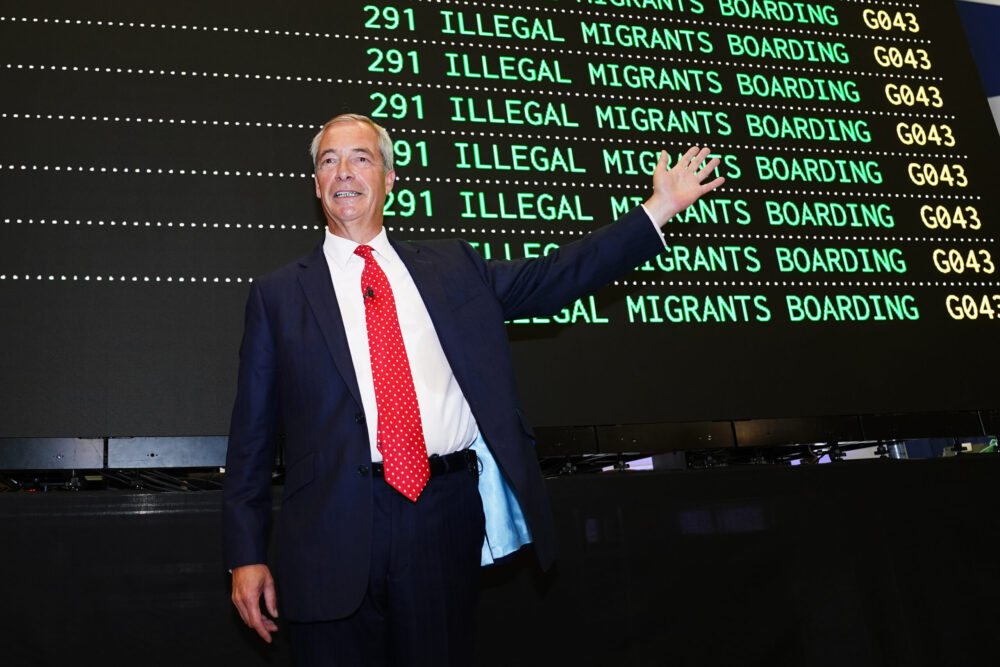
Martin Shipton
Increased coverage of Reform UK by Britain’s broadcast media appears to have fuelled the public’s rising preoccupation with the issues of immigration and asylum, according to research carried out in Wales.
Media academics led by Professor Stephen Cushion of Cardiff University have established that Reform overtook the Conservative Party as the most referenced opposition party (37) on both the BBC news at Ten and ITV News at Ten in September 2025.
The Conservative Party (25) had previously received more attention as the Official Opposition throughout 2025, but coverage of Reform in September increased with a focus on stories about immigration and asylum along with the party’s conference.
Reform UK’s Nigel Farage was the most referenced party leader on ITV News at Ten (49), followed by the Conservatives’ Kemi Badenoch (33), and the Liberal Democrats’ Ed Davey (10). On BBC News at Ten, Ms Badenoch (57) was the most referenced party leader, followed by Nigel Farage (47) and Ed Davey (20).
Reform UK was the dominant party in more than twice as many stories as the Conservatives and just under four times more stories than the Liberal Democrats. On the BBC News at Ten, Reform UK was the main focus in 26 items, compared to the Conservatives’ 14 items, and the Liberal Democrats’ 8 items. On ITV, Reform UK was the dominant party in 25 items, compared to the Conservatives’ 11 items, and the Liberal Democrats’ 5 items.
Between January and September 2025, on BBC News at Ten there were 338 references to opposition parties: 157 to the Conservatives (44.4%), 83 to Reform UK (24.6%), 61 to the Liberal Democrats (18%), 24 to the SNP (7.1%), 12 to the Greens (3.6%), and 1 to Plaid Cymru (0.3%).
Between January and September 2025, on ITV News at Ten there were 225 references to opposition parties: 101 to the Conservatives (44.9%), 74 to Reform UK (32.9%), 25 to the Liberal Democrats (11.1%), 14 to the SNP (6.2%), 10 to the Greens (4.4%) and 1 to Plaid Cymru (0.4%).
Reform received three times as many references as the Liberal Democrats on ITV News at Ten, and 1.36 times as many references as the Liberal Democrats on BBC News at Ten.
Immigration and asylum was the dominant context in which opposition parties were referenced, accounting for 56 (16.6%) references on BBC and 51 (22.7%) on ITV.
News at Ten
On BBC News at Ten, the Conservatives were the most referenced opposition party in relation to immigration and asylum with 26 (46.4%) references, then Reform UK with 20 (35.7%), and the Liberal Democrats with 8 (14.3%). On ITV, Reform UK was the most referenced opposition party in relation to immigration and asylum with 24 (47.1%) references, then the Conservatives 23 (45.1%), and the Liberal Democrats with 8 (15.7%).
The Greens, the Scottish National Party (SNP), and Plaid Cymru received very little airtime between January and September 2025.
The Greens were referenced in 12 items on BBC News at Ten and 10 items on ITV News at Ten. Over half of these appearances were during regional and local election campaign – a point in time when broadcasters’ balance coverage more evenly between parties. The Greens were covered nearly as often as Reform and the Liberal Democrats throughout April and early May. Another moment when the Greens received prominent coverage was after their leadership contest on 2 September 2025, with Zack Polanski elected leader of the party. However, both BBC News at Ten and ITV News did not cover the announcement or build-up to the leadership contest. Moreover, this change in leadership did not led to any sustained coverage of the party for the remainder of September.
Despite the fact that the SNP run the Scottish government and has nine MPs at Westminster, the party received just 24 references on BBC News at Ten and 14 on ITV News at Ten between January and September. However, the SNP was the dominant party when referenced in 6 items on the BBC News at Ten and 5 items on ITV News at Ten. On the BBC News at Ten, these items mostly related to Scottish government policy, such as a report on the 6 May 2025 reflecting on John Swinney’s first year as First Minister and future priorities. By contrast, on ITV News at Ten, in almost all items the SNP was the dominant party focused on Nicola Sturgeon and the previous leadership of the SNP, rather than the current SNP government or its MPs at Westminster.
Plaid Cymru
Plaid Cymru only received one (0.3%) reference on the BBC News at Ten and one reference (0.4%) on ITV News at Ten. On 12 April, Plaid Cymru MP Liz Saville Roberts featured on ITV News at Ten responding to the government’s Steel Industry (Special Measures) Bill to help save Scunthorpe Steel Works, questioning why equivalent measures were not being put in place for Port Talbot. On 11 June, Plaid Cymru MP Liz Saville Roberts appeared on the BBC News at Ten responding to Rachel Reeves’ spending review, questioning the provision for Welsh railways. If the sample had been extended through October, Plaid Cymru would have been referenced in the context of the Caerphilly by-election campaign. The party may have also received coverage during its annual conference in October.
While Plaid Cymru only has a handful of MPs and is not the governing at the Senedd, the party is leading most polls in Wales and could form the next government in Wales. The significance of Plaid Cymru’s limited coverage is exacerbated by the fact that in Wales UK-wide broadcast news is more widely consumed than Wales-only news, meaning many people who regularly watch network news will not learn about one of Wales’ major parties. Combined with the limited coverage of the SNP, this is further evidence of a long-term trend where UK-wide media tend to focus predominantly on Westminster politics, and the devolved governments receive minimal attention.
Following Reform UK’s success in May’s regional and local elections, its leader, Nigel Farage, claimed: “After tonight, there’s no question, in most of the country we are now the main opposition party to this government”.
Opposition
The UK Parliament still designates His Majesty’s Official Opposition as the party with the largest number of MPs, which remains the Conservatives. But unofficially, the UK Government and political commentators have begun viewing Reform rather than the Conservatives as the main opposition, as have public opinion polls. An Ipsos Mori survey in May 2025, for example concluded that: “Reform viewed as the opposition: The British public is now slightly more likely to consider Reform UK (37%) as the main opposition party (defined as the most likely party to lead a government in Westminster if Labour loses the next GE), ahead of the Conservatives (33%).”
Cardiff University’s analysis of TV news bulletins throughout 2025 revealed broadcasters have gradually elevated Reform UK’s opposition party status. Coverage of Reform UK has steadily increased over the past year, spiking after May’s election and peaking in September when it overtook the Conservatives as the most referenced political party. Even if coverage of Reform’s UK annual conference in September was excluded from coverage, the party still received more references than the Conservatives and led the agenda more.
Much of Reform’s coverage has been driven by the party leading debates about controlling immigration and asylum. The party’s rise in coverage on TV news coincides with when the public has most been concerned with immigration and asylum – the top rated issue according to You Gov tracker surveys.
At the beginning of 2025, 44% of people thought it was one of the most important issues facing the country at this time. By mid September – the peak of Reform UK’s coverage – this rose to a record 58% of people that year who believed it was the most important issue. This is despite the fact that net migration has fallen over the last year.
However, it is difficult to disentangle what comes first in surveys asking what issues most concern the public. On immigration and asylum, for example, how far is the public’s concerns fuelled by prominent media coverage or reflective of people’s direct experiences? While this is open to debate, YouGov polls examining what stories cut through to the public have consistently found people recall stories about immigration and asylum, especially from August into September 2025.
The prominent broadcast news coverage about Reform UK and its leader Nigel Farage has attracted critics. The BBC, for example, acknowledged it had received complaints from its audiences and issued a statement justifying its coverage of Reform UK. Meanwhile, the Liberal Democrats have complained to Ofcom that Reform UK was receiving undue prominence in broadcast news.
But have broadcasters broken any of the UK’s rules on due impartiality? The researchers say that in their view, they have not since broadcasters have a considerable degree of editorial flexibility in how they impartially allocate airtime to parties, rather than having to follow a strict mathematical formula to ensure balance.
Impartiality
However, the research does raise questions about how broadcasters have been interpreting impartiality in a new multi-party system. On objective measures used to allocate airtime to parties, the Cardiff Univerxity analysis suggested they have tended to favour total vote share over MPs elected at the last general election. For example, Reform UK– with 5 MPs – received far much coverage than the Liberal Democrats’ 72 MPs. And Reform UK received a 2% greater vote total share than the Liberal Democrats. On the latest trends in opinion polls, the research revealed this played a significant factor in allocating airtime to parties – evidenced by Reform UK’s prominent coverage – and because broadcasters have often referred to it to justify editorial decisions. On the performance of parties at the latest regional local elections, the analysis suggested this generated at least a short-term boost in coverage to those that won new council seats and mayoral campaigns.
On the more subjective judgement about allocating airtime to parties that set the political weather, the research raised some alarm bells about the impartial judgements influencing which parties and leaders should be allocated airtime. For example, we found Reform UK led many immigration stories because the party has championed radical proposals and led the agenda.
By contrast, the Liberal Democrats were largely absent from coverage discussing immigration and asylum issues despite having their own distinctive immigration perspectives. The party would likely promote policies that would either maintain or enhance immigration levels compared to Labour, the Conservatives or Reform UK, who would, to different degrees, radically reduce them.
In other words, because the Liberal Democrats have a moderate approach to policy-making on this issue they appear less likely to be allocated airtime. If this logic is applied to reporting policies and political issues more broadly, it would lead to promoting radical or extreme positions of competing political parties at the expense of covering sensible or pragmatic policy solutions. Or, put more bluntly, allocating airtime through the prism of news values or political agenda-setting risks undermining the impartiality of editorial judgements about which political parties and leaders should appear in political news.
Benchmark
Prof Cushion said: “While broadcasters have been accused of giving Reform UK a ‘disproportionate’ amount of airtime, within Ofcom’s impartiality rules there is no precise benchmark of what is proportionate. Broadcasters have considerable freedom to make editorial judgements about the airtime parties receive based on a range of criteria. At present they appear to be applying greater weight to trends in opinion poll data and which party is setting the political weather, rather than number of MPs a party has or its total vote share at the last general election.
“In a more multi-party system, the competition for airtime will only intensify. While it is not always easy to feature all parties in TV and radio programming, broadcasters need to be transparent to their audiences about how they allocate airtime. The public need to understand how broadcasters interpret the impartiality of political news. As the devolved elections in Scotland and Wales approach, broadcasters will again come under pressure to explain how they weight coverage in a crowded field of political parties.”
Support our Nation today
For the price of a cup of coffee a month you can help us create an independent, not-for-profit, national news service for the people of Wales, by the people of Wales.



‘Poster Boy’ some people can’t read…RIP Jo Cox…
RIP David Amess too of course. Although not sure of the relevance of either to this particular piece.
The language of hate and division has far more repercussions than we imagine.
Indeed. Witness Australia this morning.
True. Very sad. Despicable terrorist attack.
You think there is no connection between Farage and Jo Cox…ok…
Farage can pass wind in his face and it would smell of roses and perfume to this guy. To everyone else, his hot air just stinks.
Yes. The reason we have daily brain training in immigracism is to focus all minds on those of our fellow citizens who are being blamed for all our societal ills and to keep the focus off those who are actually responsible.
Hard to find farage on the BBC now since his gassing people thing.
I do hope the Beeb get him back on because every time he speaks, he shovels more soil down on his ‘political’ coffin.
What is happening here hidden in plain sight is overt political bias. The Cons and Reform share the same politics but this politics is now getting double the airtime. If broadcasters want more Reform this must come at the expense of Cons coverage to prevent the right-right double dipping their coverage allocation.
The right-wing media has a lot to answer for. It’s they who are giving oxygen of publicity to Nigel Farage and Reform UK. Brexit was a fine example where only those English extremeophiles in the ERG (European Research Group) who forced PM David Cameron to hold a EU referendum because he feared Ukip would impact the Tory vote. What concerned the public was the economy and NHS not leaving the EU or any migrant problem. There was none. The explosion small boats issue is a result of leaving the EU, where before France was compelled as a member state to… Read more »
Don’t ever forget Mr Straight Bananas, Piccaninnies, Letterboxes, Watermelon Smiles…
The Fat Shanks Effect from 17 years ago…
Schooled by Steve Bannon as he went from FS to PM, denied but on video…on testing the envelope for Twmp 2 is my guess…
‘They’ get away with mass manslaughter in the UK time after time…
So many politicians began in the legal profession yet they can do their best to bankrupt a country, oversee fraud to the tune of billions, commit an assault against the state and walk away as millionaires…such abuse of the commonwealth by individuals in power has to stop…off with their heads Mr King…
WHY is this narcissist and his racist views shoved down our throats every day? He is just one of 650 MPs most of which the public never get to know their views. It is disproportionate and undemocratic and l am, as others surely are too, sick of his racist rants.
First law of journalism…
People aren’t stupid. Every time someone smears or attacks Farage or Reform, ad hominem, rathwr than logic and argument – their numbers go up
Xmas innit
https://bylinetimes.com/2025/12/10/nigel-farages-russian-influence-advent-calendar/
Just been watching Fromage responding to the events in Sydney;
He says “The threat to the Jewish people is everywhere!” – right back to Dulwich College where he used to make gas sounds to a Jewish pupil.
Total hypocrite!
Come on Rev, speak out to alter the course of history for the betterment of the people of these islands…