


It’s official – Wales* is in England
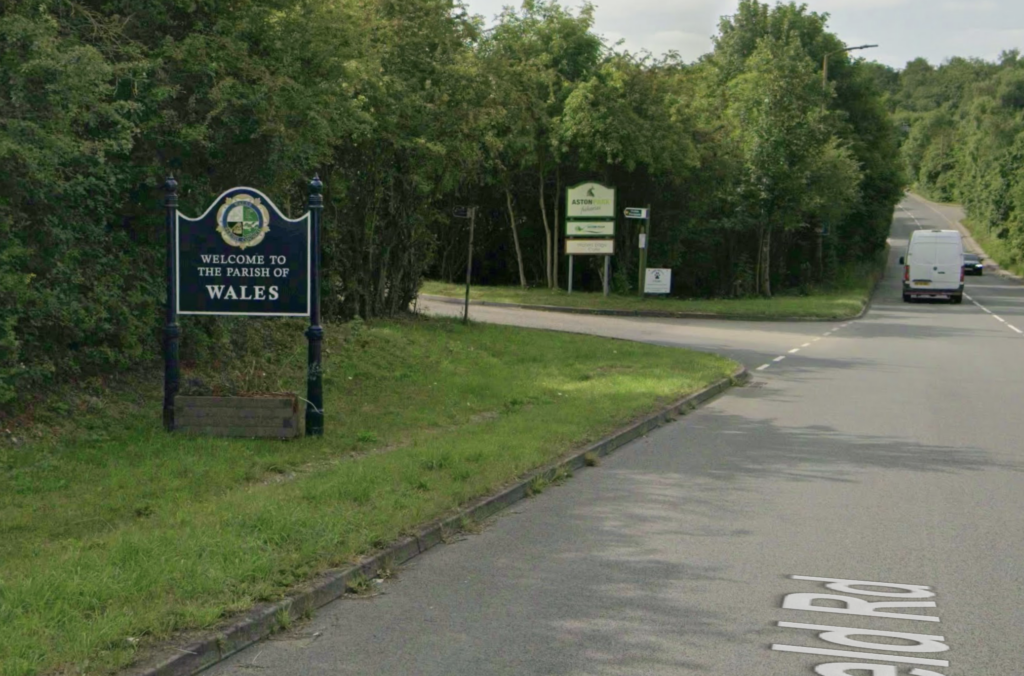
Nation Cymru staff
Despite years of fighting Wales’ corner when meeting people abroad, a little-known fact might mean that those claiming that Wales is a part of England might actually be correct after all.
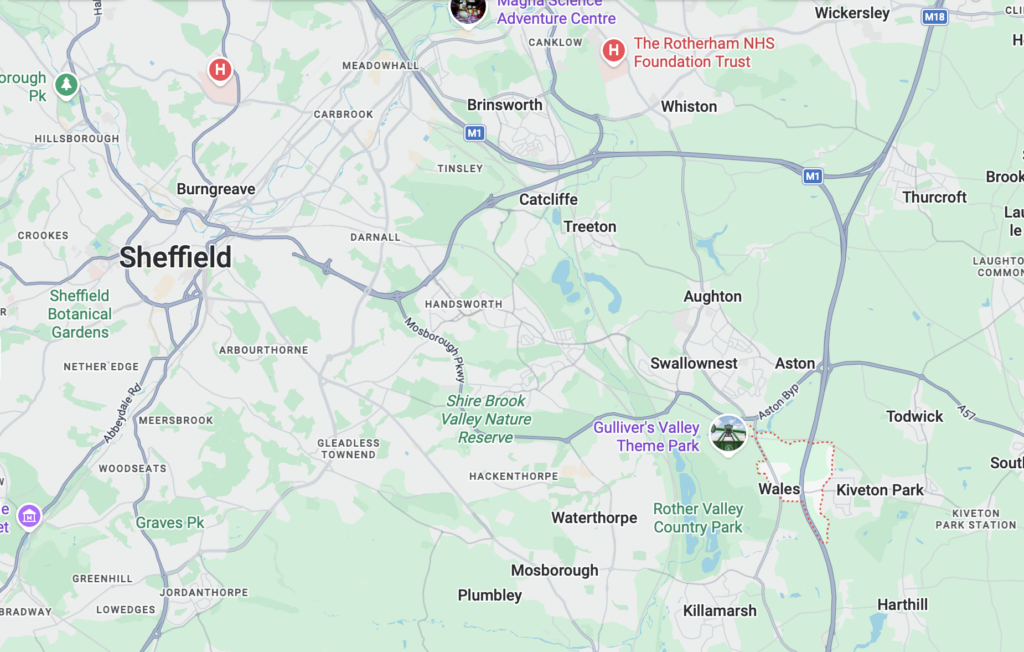
Wales, of course, is a nation with its own language, culture and people, but it also happens to be a village and a civil parish in Rotherham, South Yorkshire
Historically, *Wales was part of the West Riding of Yorkshire, and has a population of just over 7,000 people.
Historians are divided, but it is likely that Wales, the country, and Wales, the English parish have a shared etymology and origin story that speaks to England’s Celtic past.
Like the nation, the village name derives from the Germanic word ‘Walhaz’, a term used by Germanic people across Europe to refer to ‘foreigners’ or the Romanised inhabitants of the former Empire.
Many believe that this gives rise to the belief that the name records the continuation of a “British” population in this area, which survived the arrival of the Anglo-Saxons, and remained distinctively Romano-British in language and culture.
Another explanation suggests that the settlement’s name may be derived from the word Waelas, meaning “field of battle” – which, either way, would have likely been a battle between the ancient Britons and Anglo-Saxons.
Cumbric
Further support for the idea that Wales is, indeed, a hint to a Pre-Saxon Brittonic culture comes in the form of the Cumbric language, an extinct Celtic Brythonic language or dialect that was spoken during the Early Middle Ages in the Hen Ogledd or “Old North”, in what is now Northern England and the southern Scottish Lowlands.
Place-name evidence suggests Cumbric may also have been spoken as far south as Pendle and the Yorkshire Dales, but Brittonic/an early form of Welsh was spoken throughout what is now known as England. The prevailing view is that Cumbric became extinct in the 12th century, around the incorporation of the Kingdom of Strathclyde into the Kingdom of Scotland.
Linguists are undecided as to whether to classify Cumbric as a dialect of Old Welsh or as a separate language. Koch calls it a dialect but goes on to say that some of the place names in the Cumbric region “clearly reflect a developed medieval language, much like Welsh, Cornish or Breton”.
“You’ve got the wrong Wales”
One resident, Dan Schofield, who lives in the village of Wales, told the BBC back in 2018: “It was a couple of years ago, for the Euros, there was a coach of Belgium fans that came and the driver had just put Wales in the sat-nav and they ended up here when they meant to be in Welsh Wales.
“[My brother] Joe was having a party and one of them knocked on the door and asked for directions, so we said: ‘We think you’ve got the wrong Wales.'”
The Rev Gary Schofield, the Vicar of Wales, said at the time: “Wales means the land of the stranger, the land of the foreigner. In Saxon times I think the Celts retreated to the high ground and came here to defend themselves, so that’s where we’ve got our name from.”
Back in 2023, an online newspaper claimed that ‘Yorkshire is actually Wales’ in an article that even had their readers up in arms.
The story posted by Yorkshire live attempted to explain the links between a Rotherham village in south Yorkshire called Wales – and the actual country of Wales.
The writers of the piece referred to Wales as a “dragon loving British principality nation-state” and said the entire county of Yorkshire “owes a lot to the often-overlooked leek waving neighbours west of the border”.
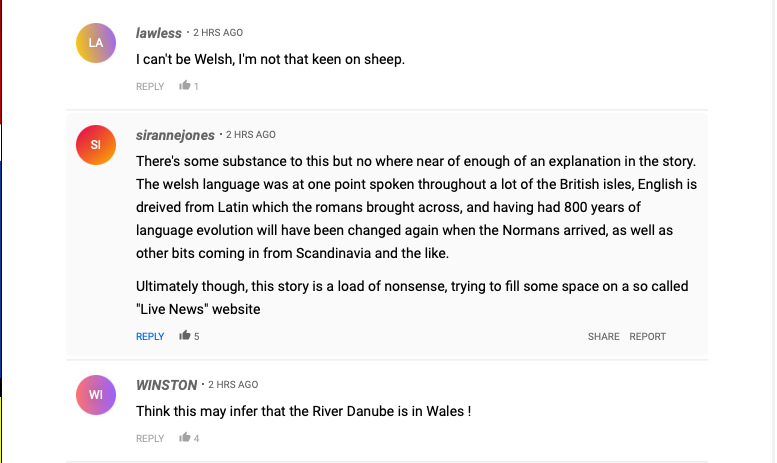
Yorkshiremen arrived in the comment section to blast the piece with one even saying “I can’t be Welsh, I’m not that keen on sheep’ and another calling the story “a load of nonsense and a way to fill some space on a so-called live news website”.
The article said: “Wales in Rotherham shares its name with the country because it comes from the same word, an Anglo-Saxon root meaning ‘Romanised foreigners’, which is a term used to refer to people in the western regions of the Roman Empire.
“What it means is that a Celtic presence was still strong in Wales, Yorkshire, just as it was in Wales, the country, and the two ended up with the same name – or so the theory goes.
“It’s not the only Celtic footprint left on God’s Own Country. In fact, Welsh language can be traced throughout Yorkshire.”
Although the article did draw on a mish mash of historical fact regarding the history of Celtic and Roman inhabitants in Britain, information on the links between Wales and Yorkshire didn’t quite hit the mark with some of Yorkshire Live’s readership.
One disgruntled reader commented: “There’s some substance to this but nowhere near of enough of an explanation in the story.
“The Welsh language was at one point spoken throughout a lot of the British Isles, English is derived from Latin which the Romans brought across, and having had 800 years of language evolution will have been changed again when the Normans arrived, as well as other bits coming in from Scandinavia and the like.”
The article explained the Celtic links of river names in Yorkshire but after the initial shock headline, the writers never really explained their theory that “Wales is actually Yorkshire” and one commenter even asked “Who is bothered boyo?”.
Wales isn’t just in England, either, with there thought to be at least 13 places in the world sharing the name – the majority of which come from homesick Welsh immigrants.
In the USA alone, Wales can be found in Wisconsin, Utah, Tennessee, North Dakota, Minnesota, Massachusetts, Kentucky, Iowa and Alaska.
In South Africa, there is a Wales in Mpumalanga, and there’s even a Wales in Guyana.
A Welsh Government spokesperson told Nation Cymru: “We can confirm that Wales, South Yorkshire, is in England.
“We can also confirm that New South Wales is in Australia and that whales are generally found in the ocean.
“Our Wales, meanwhile, remains in Wales.”
A Senedd petition is currently underway calling for Wales (the nation) to be referred to by its Cymraeg name. Check it out and sign here.
Support our Nation today
For the price of a cup of coffee a month you can help us create an independent, not-for-profit, national news service for the people of Wales, by the people of Wales.
Get more trusted Welsh news
Choose Nation.Cymru as a preferred source in Google News to see more of our journalism.



England is not unique. Although its name indicates where its native population lived among the Germanic Saxon incomers, but there are many other places around the world called Wales United States Alaska: The small traditional Iñupiat city of Wales, located on the western tip of the Seward Peninsula. Wisconsin: The village of Wales in Waukesha County, originally settled by Welsh immigrants. Maine: The town of Wales in Androscoggin County. Massachusetts: The town of Wales in Hampden County. Utah: The town of Wales in Sanpete County, founded during nineteenth-century coal-mining operations. North Dakota: The small city of Wales in Cavalier County.… Read more »
I am a resident and citizen of the United States of America. I have the familial surname Jones, and I have never yet physically crossed the Atlantic to Cymru. However… something explicable, not inexplicable, welled up in me when I first heard a song in Cymraeg. I knew no words in Cymraeg. Knew vanishingly little of the nation, history or culture. I did not understand the lead singer’s name. Why three d’s out of six letters in his given name? Why am I experiencing a strong physiological reaction to a song I do not understand? Ah. I learned. I possess… Read more »
You’ve been here before, a geneticaly received memory! Rejoice and embrace it, it’s a blessing!
Beth am gymryd y cam nesaf, a dysgu Cymraeg? (How about taking the next step, and learning Cymraeg)?
Students all over the world now speak yr iaith Gymraeg (the Welsh language) via a range of distance learning courses offered by https://learnwelsh.cymru
The courses are really affordable! A year’s course with weekly online sessions with a real tutor and access to online resources is as little as £50 ($66).
Ewch amdani (Go for it)!
I knew it! Born in Sheffield to a father from Swansea, where we returned when I was 4 and have lived since, I’ve always claimed to have been born on tour and truly Welsh but now I know I’m Welsh regardless – thank the Lord.
Staggered by the reference to the reader who stated ” English is derived from Latin”. Latin??? Dear god, the education system thereabouts needs to be improved..
Your education is lacking if you are asserting that a strong Latin influence on English is untrue. English is a mixture of Germanic, via the Anglo Saxons, and Latin, via the Norman French. There are often two words for the same thing in English, with the Latinate form sounding more academic and “posh”, and the Anglo Saxon more earthy and “common”. For example: mortality/death, deity/god, and masticate/chew. I will leave you to guess the Anglo Saxon for “copulate”, as I will be censored if I write it here! Unusually, there are relatively few Celtic words extant in English: normally the… Read more »
Anybody else remember the Belgian football fans who came over for an international match in Cardiff, set the car SatNav for “Wales” and ended up in Yorkshire?
What does that tell you? The satnav on my car can hardly pronounce Welsh town, village and road names. It’s absolutely pathetic.
Sais satnav!
It happened in 2015. They managed to turn the bus around and get to Caerdydd in time to see Cymru win 1-0!
[ Please scroll down for English – diolch ] Mae ‘na sawl ‘Fun Fact’ o’r fath i’w canfod hyd a lled Lloegr, wrth gwrs; gan mai cyndeidiau’r Cymry sef y Brythoniaid oedd yn arfer byw yno fel mwyafrif llethol o’i thrigolion – amser maeth yn ôl, hynny yw. Adwaenid nhw gan newydd ddyfodiaid y cyfnod ôl-Rufeinig sef y llwythi Eingl-sacsonaidd ‘Wealas’ ar frodorion Prydain. Enw a rhoddodd – tros dreiglad amser – y geiriau Wales a Welsh yn yr iaith Saesneg rydym yn gyfarwydd â hi heddiw. Ceir felly yn Lloegr llwyth o enwau llefydd sy’n cynnwys yr elfen ‘wel’… Read more »