


Journalist tests claims made about Welsh vs British identity

Stephen Price
A Welsh journalist has spoken with members of the public in Caerphilly to discuss recent findings that suggest those who identify as Welsh are more left-leaning, with those on the right more likely to call themselves British.
Novara Media’s Social Lead, Lloyd James shared: “It’s the single question that could decide who runs Cymru, come the Senedd elections.
“Do you call yourself Welsh or British?
“If you said you were Welsh, the data says you’re more likely to be left-wing.
“If you identify as British first, chances are you’re more likely to be on the right.
“That’s why Novara Media has come to Caerphilly, where Plaid beat Reform in a crucial by-election last year, to put this to the test.”
View this post on Instagram
Speaking to the first member of the public, he asks: “Do you call yourself more Welsh or British?”
The first respondent shares: “I’d say Welsh. I don’t really resonate with being British. It’s always been Welsh first, I think.
“I think, historically, I’ve always voted Labour just because it’s always been the main party at Caerphilly, really. But at the last election, I voted Plaid. A vote for Labour at the moment is probably a bit of a wasted vote.”
The next member of the public to answer the question shared: “I always go Welsh.
“I was always a staunch Labour voter all my life. I just don’t like the way they’re leaning or, you know, right in recent months since they came into power.
So I’m in Wales. I’m thinking Plaid.”
The third interviewee responded: “I’m Portuguese, but I have a stake in Wales.
“Wales welcomed me when I moved here. It’s the place where my wife was born and where she lives. And I’m not Welsh, but I consider myself part of Wales.
“In Pontypridd, Cynon Merthyr, I’m going to vote for Beth Winter.”
The next person to be asked shared: “Free childcare is a big one.
“I’m a lot more left-leaning, so it’s going to be between Plaid and Green.
“But I think for Welsh elections, kind of keep it Welsh and Plaid definitely.”
Returning to the first interviewee, he added: “I don’t want Reform winning Caerphilly, so Plaid seems to be the option to stop that happening.
Another adds: “I’m scared yeah. I’m a mother, I also am a woman as you can see.
“What really worries me is that the regressive side of that party are against all the things that we fought for, like women’s rights and trans rights and all the things that I’d like to think that come naturally to people that, you know, necessarily want to care about others in the community.”
“Hate will not win in the valleys”
The Portuguese interviewee added: “But most importantly, I think it’s a party of the billionaires.
“It’s not a party of the working class, of the Welsh working class, of the English working class, of none of the working class.
“I think that they will fight for the interests of those that take our rights, that take our services, that devastate our communities.
“On the 7th, we need to really send a strong message, like we sent in the Caerphilly by-election, that hate will not win in the Valleys and racism will not win in the Valleys.
“And the inclusive working class traditions of the Valleys are here, are healthy and are proud and will stay.”
Lloyd James concludes: “Today we were talking to people with a real diverse range of political identities and perspectives.
“We spoke to Reform voters and Labour voters who didn’t want to be on camera, and one woman who said that Reform was asset-stripping the country and Cymru was going to be next.
“Now the one thing that people had in common, undoubtedly, was this feeling of being left behind by the political elites in Westminster and beyond.
“And if Plaid and every other party have one challenge come the Senedd elections, it’s pushing the vote out to above the usual 50% turnout or less.
“If they can do that, then anything can happen.”
James’ most recent post about immigration in Wales looked at the immigration debate in Wales, which has been fuelled by misunderstandings about the Senedd’s powers and claims made by Reform in their election advertising and television appearances.
View this post on Instagram
Novara’s Instagram asked: “Does Wales have a problem with immigration? As Reform rolls out the usual rightwing talking points ahead of the Senedd election, @lloydjameshh asks if the problem in Cymru lies much deeper than the debate.”
Polling
Reform UK has moved slightly ahead of Plaid Cymru in the latest Senedd election polling, underlining how finely balanced the contest has become.
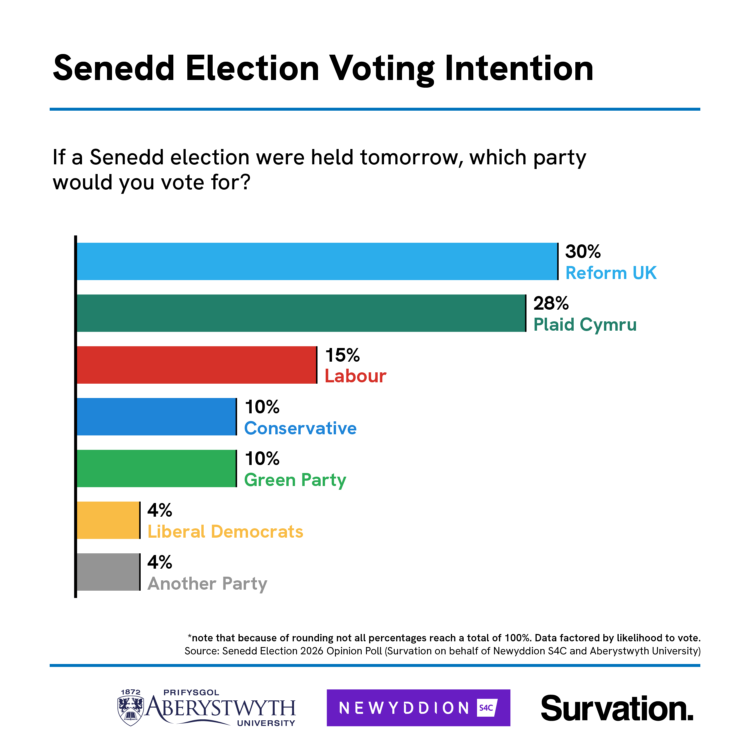
A survey conducted by Survation for Aberystwyth University and S4C puts Reform on 30%, with Plaid close behind on 28%.
Welsh Labour trails in third place on 15%, while the Conservatives and the Green Party are both on 10%. The Liberal Democrats stand on 4%, with a further 4% backing other parties.
Analysis of the poll suggests the election remains highly competitive, with small margins potentially decisive in determining the final outcome.
Dr Anwen Elias from Aberystwyth University, who led the analysis of the opinion poll, said: “These findings point to a highly competitive political landscape ahead of the Senedd election, with two parties currently leading in voting intention.
“While Reform UK are found to hold a slight lead over Plaid Cymru, it is clearly incredibly close between the two parties. On the basis of such close polling results, projecting which party will win the most seats in the Senedd is incredibly difficult.”
She added that the results indicate a significant shift in Welsh politics, with both Labour and the Conservatives trailing well behind the frontrunners.
“If these results are replicated on 7 May, they will constitute a historic change in our politics,” she said.
The poll also highlights the issues most likely to influence voters, with the cost of living cited by 67% of respondents and NHS and healthcare by 64%.
Immigration (39%) and the wider economy (31%) were also ranked as key concerns, while housing, climate change, crime and education were mentioned by smaller proportions.
Around 60% of respondents said they are generally interested in politics, with just over half saying they have been following the election campaign to some degree.
However, engagement varies sharply by age. More than two-thirds of those aged 65 and over said they had paid attention to the campaign, compared with fewer than half of those aged 16 to 24.
When asked which party is running the best campaign, 20% chose Plaid Cymru and 18% Reform UK, though 39% said they did not know.
Plaid Cymru was also seen as the party most likely to stand up for Wales’ interests, with 34% selecting it compared to 16% for Reform UK. More than a quarter of respondents said no party represented Wales’ interests or were unsure.
Complexity
Dr Elias said the findings underline the complexity of voter decision-making.
“The results highlight the importance of everyday concerns in shaping voter priorities, especially the cost of living and pressures on the NHS,” she said.
“At the same time, there is a notable gap between voting intention and perceptions of which party best represents Wales’ interests.”
The poll was based on a sample of 1,065 adults in Wales, surveyed online between 17 and 23 April, with results weighted to reflect the population and likelihood to vote.
Follow Lloyd James and Novara Media on Instagram.
Support our Nation today
For the price of a cup of coffee a month you can help us create an independent, not-for-profit, national news service for the people of Wales, by the people of Wales.
Get more trusted Welsh news
Choose Nation.Cymru as a preferred source in Google News to see more of our journalism.



This is very much the issue with second homes here; it essentially means that the landed gentry in England can buy a relatively cheap home in Cymru and also get to vote in the elections here. Of course, it’s a generalisation, but if you’re a multi-property-owning millionaire like Farage, Dan Thomas, etc., then realistically, you do not want the status quo, which currently protects the ruling class, to change because you are a multi-property-owning millionaire like Farage or Dan Thomas. I know it’s often presented as being “anti-English” and “racist”, but due to the empire, it is simply that people in… Read more »
Very few ‘landed gentry’ buy second homes in Cymru. Most are bought by middle class and working class people who have the money to do so.
There is also a significant minority of English people who move to Cymru as ‘white flight’ and of course those who are older, who retire here, but who have a right-wing political outlook. These are your Reform voters.
If you look at Jac Larner’s analysis Reform are most likely to win in the South Wales valleys. The highest polling was for Reform was in the Afan Ogwr Rhondda, at 36% support. So you are missing a lot that are disillusioned with Labour.
As if Reform will turn The South Wales Valleys into The Thames Valley!
That is where they are polling strongest in Wales. Come the day it may be different. But all the constituent constituencies were all labour in the last Senedd election some polling greater than 50%, and to quote Fermi ‘Where are they all?”. We do not have a Reform problem – the problem is with Labour they are the one’s currently driving up Reform’s numbers. And it is two pronged ‘Luned and Keir.
The irony is that, for centuries, the English referred to us Cymry as Welsh (Old English Wēalas) as strangers, foreigners, or even slaves, because we native Britihs were deemed Romanized. Later once the Germanic kingdoms were unified in 927AD, instead the English looked eastward to Germany, with which they shared a language, culture, and ancestral ties, although this abruptly ended after the First and Second World Wars, when the English increasingly adopted the label “British” to distance themselves from their motherland Germany—effectively appropriating an identity originally associated with us , the Celtic Britons. This helps explain why many in Wales… Read more »
We are British because (unlike the English) we are indigenous people of the British Isles.
We are not Welsh, but Cymru, as ‘Welsh’ is the English outsider insult for us.
The English have an ingrained ignorance of this, something way more important than petty politics.
I thought most of the English are descended from the Britons who lived in the Anglo Saxon ruled lands so to call the English not British because they have a bit of Saxon blood is misleading.