
Letter from Berlin
Amelia Jones
Spending years studying a place’s history can strip it of reality, turning streets and landmarks into ideas rather than places you can stand in.
For me, that place was Berlin. A city I knew through dates, diagrams and a history bent and twisted by repetition, long before I ever saw it.
The reality arrived quickly: the first thing Berlin asked of me wasn’t reverence or reflection but cash – withdrawn from a hole in the wall that charged an eye-watering fee for the privilege.
It was a small, mundane moment, but somehow it felt like an initiation. Here I was, a visitor armed with history books and dates, stepping into a city that demanded something more immediate, more real.
The flea market
One thing you must know about Berlin, is that cash is king. A lesson we were taught a few too many times during our four day stay.
Our first day began at Mauerpark flea market, already busy by the time we arrived. Stalls spilled into one another in loose rows, tables sagging under the weight of old records, chipped ceramics, scarves, boots, things no longer useful but too full of character to be discarded.
Somewhere between the watches and the bags, I found a stall filled to the brim with jackets. The stall holder looked at me with an expression I couldn’t quite place.
I entered the stall anyway, squeezing past customers twirling toward their own reflections in the rusty mirror that took pride of place at the centre of the white marquee.
The jackets were packed tightly together, leather brushing leather. Some were impossibly heavy, others worn almost paper thin.
I ran my fingers along them, half-expecting the stall holder to say something, but he didn’t. He just watched.
I pulled one from the rack. He observed me weigh it in my hands with the solemnity of someone considering a minor but irreversible life choice. The coat was long and heavy, creased in all the right places. It smelled faintly of history and damp. I fell in love with it immediately.
After a brief negotiation and the offer of a stool while I waited for my friend to get out more cash, yes, more cash, the jacket was mine.
In quiet victory, we retreated to a nearby coffee shop for hot chocolates and pastries, thawing out and watching the market continue without us.
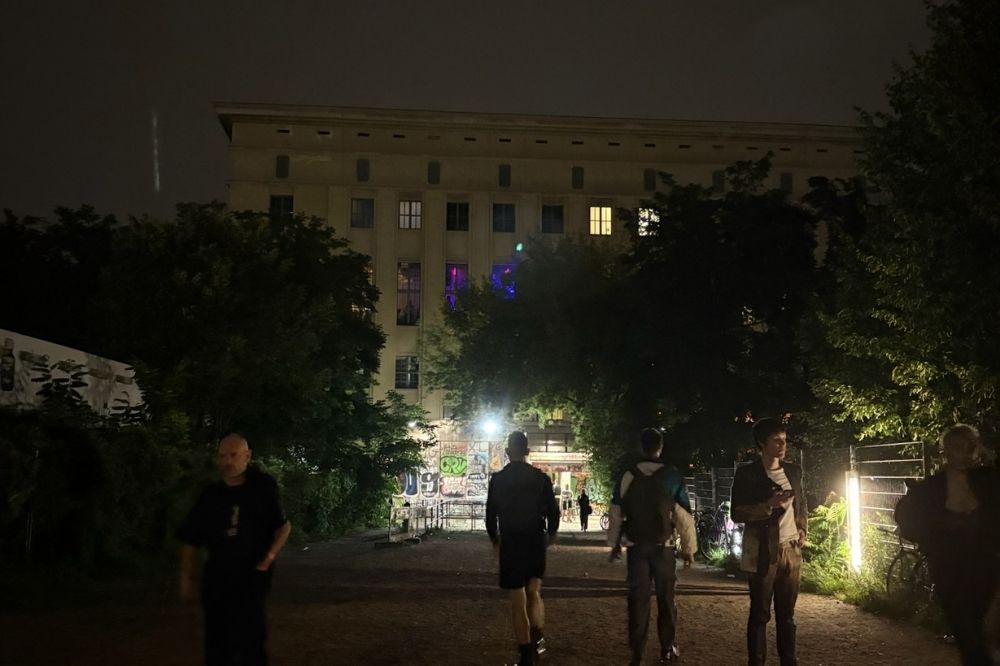
As night fell, we went to try our luck at Berghain, a club whose reputation rests largely on how difficult it is to enter, especially for tourists.
We queued quietly, attempting neutrality. Ahead of us stood a very small woman, completely sandwiched between two enormous bouncers who looked less like people and more like architectural features.
The verdict was swift. A simple shake of the head. She spoke to us in German though, which I’m choosing to count as a moral victory, and that was that.
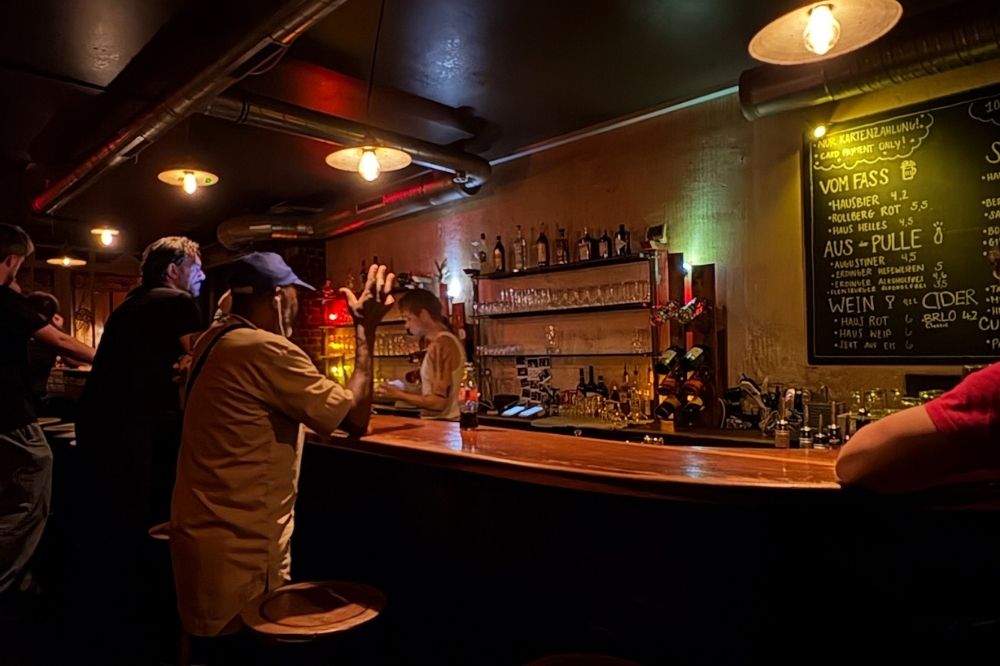
Rejected but not broken, we slipped into a bar instead. It was dark. Red-lit. Around us, people leaned close to be heard, laughing into their drinks. We stayed longer than planned, letting the disappointment dissolve.
An early lunch the next day took us to Nolle, tucked beneath the S-Bahn tracks. We ordered bratwurst and chips and sat waiting, elbows on the table, when the first train passed overhead.
The entire restaurant shuddered, glasses rattled, cutlery trembled, conversation paused for beat, before everything settled back into place as though nothing had happened.
Then the food arrived, bratwurst, thick and golden-skinned, releasing a smoky warmth with every bite. A generous pile of thin, salty chips sat beside a sharp and tangy mustard.
Between mouthfuls, more trains thundered overhead, the ceiling vibrating just long enough to feel theatrical. It reminded me of the scene in Mary Poppins where the room shakes itself into chaos and then snaps neatly back again, only no one else seemed to find it that remarkable.
Around us, people ate on without comment, completely accustomed to the interruptions. Berlin seems to specialise in this: history, infrastructure, and daily life were stacked neatly on top of one another, each refusing to make a fuss.
After lunch, we made our way to the Hackesche Höfe courtyard, a maze of interconnected courtyards tucked away in Berlin’s Mitte district. What struck me first was the raw, vibrant energy that coated every surface.
The walls were alive with graffiti, bold splashes of colour, sharp stencils, and sprawling murals that told stories of rebellion, art, and city life.
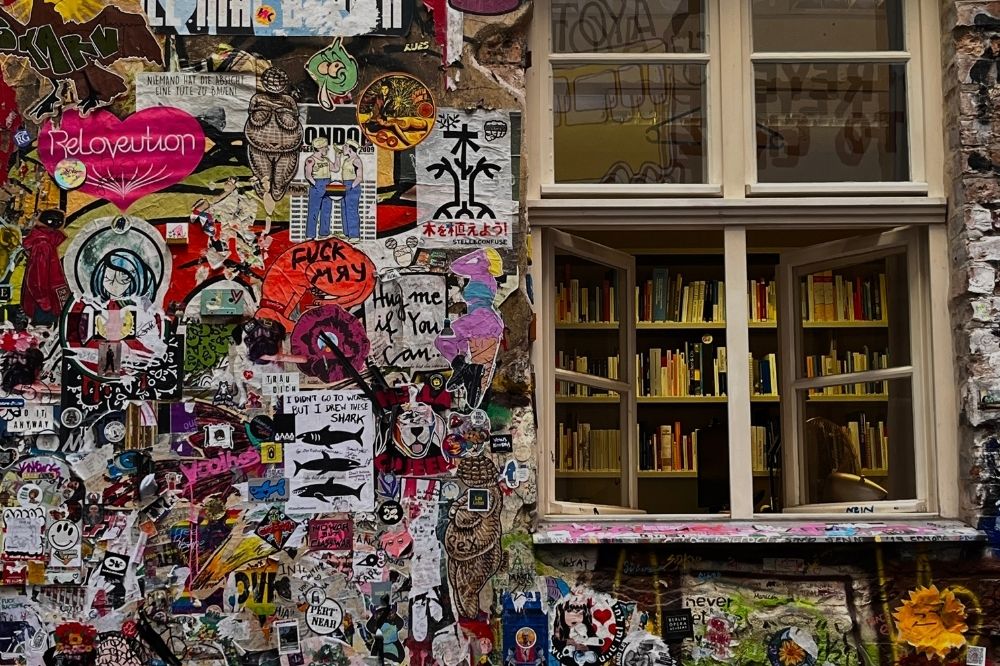
The cobbled stones beneath our feet felt worn but sturdy, guiding us through this urban gallery where every corner revealed something unexpected. Layers built up like the city’s own history written in spray cans.
Amidst the riot of colour and creativity, Café Cinema beckoned with its warm glow, a quiet sanctuary where we could pause and soak it all in.
The interior was cosy and eclectic, with mismatched chairs, wooden tables scarred by years of use, and walls plastered with vintage film posters that added a nostalgic charm.
We ordered cheap cocktails and settled into a corner where we could sit and take in the cafe’s atmosphere. Locals and tourists alike floated in and out, some hunched over laptops, others chatting in hushed tones, all wrapped up in the intimately quiet atmosphere.
Later, we made our way to Strandbar Mitte, a riverside oasis along the Spree. The warm air was filled with the hum of conversation and soft beats, while strings of lights flickered above the outdoor dance floor.
People moved with an effortless rhythm, with tango-like steps and spontaneous spins. Behind a curtain, an intimate show unfolded, punctuated by occasional applause.
We watched from the sidelines, hesitant to join until the unmistakable first notes of the Macarena sparked everyone to the dance floor, breaking the spell.
@travelld ..Paris vibes in Berlin 😮💨 📍Strandbar Mitte, Monbijoupark #berlinberlin #thingstodo #lowbudget #berlintipps #berlin #fallinloveberlin #lieblingsort #summervibes #berlincity
Moments like that, full of life and unexpected joy, remind you that beneath Berlin’s vibrant surface lies a complex past.
Berlin’s history is impossible to separate from its present. For much of the 20th century, Berlin was a city divided not just by walls of concrete and barbed wire, but by ideology and fear. Its streets tell stories of separation and reunion, conflict and creativity.
The Berlin Wall, erected in 1961, stood as a stark symbol of division, slicing through neighbourhoods and lives alike until its fall in 1989.
Sites like Checkpoint Charlie, once a tense crossing point between East and West, now serve as reminders of a turbulent past and the resilience of a reunified city.
The traces of history are everywhere, in the crumbing remnants of the wall, the cold concrete of the border zones, and even in the vibrant colours that blanket the streets today.
Yet Berlin has never been content to live in its past. Instead, it’s a city that breathes new life into old scars, blending memory with reinvention.
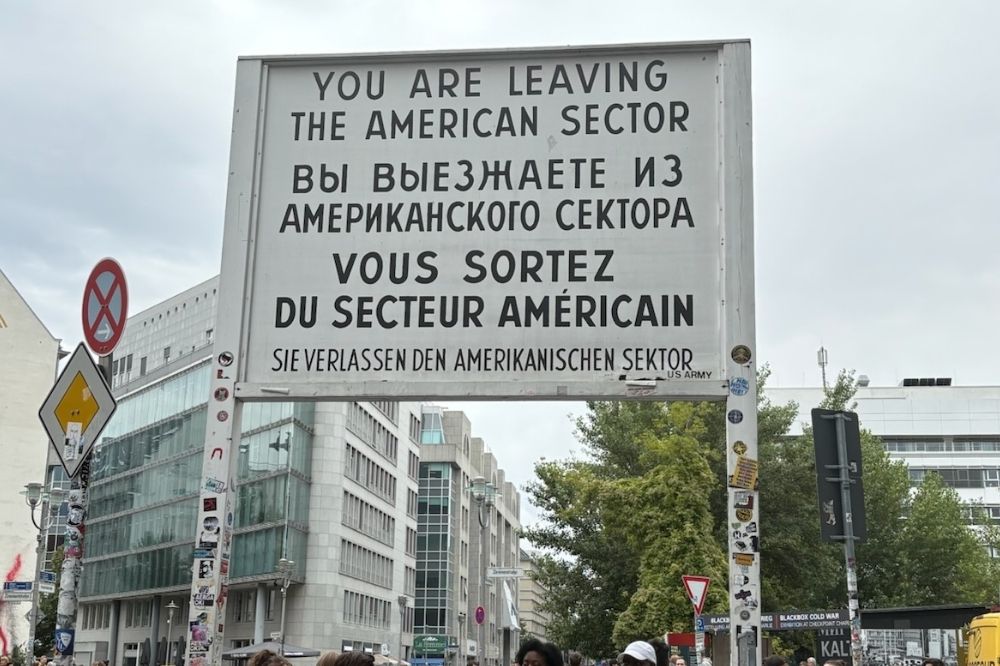
The scars of history are still visible, they’re what I came for after all, but they no longer define the city’s future.
Berlin pulses with a restless energy, constantly reshaping itself through art, culture, and community. It’s a place where the past and present collide, creating something raw, slightly grungy, and endlessly alive.
This is a story I could never have fully grasped from textbooks alone.
Standing in those places, feeling the echoes of what once was, I realised Berlin’s true essence isn’t just in its history – it’s in how it carries history forward, refusing to be frozen in time.
Support our Nation today
For the price of a cup of coffee a month you can help us create an independent, not-for-profit, national news service for the people of Wales, by the people of Wales.


