

Letter from Caerwys
Julie Brominicks
Not quite asleep nor quite awake. Yellow fields flickering beyond the windows. The early start and long bus ride home may be why, when I think of Caerwys, I imagine it ringed in corn.
It was auction day in Yr Wyddgrug (Mold). Livestock mooing behind the bus stops when I boarded the F14. As we passed fields of maize, driver Graeme said he started out on a farm where he was supposed to fix tractors but one was brand new and the other an old Ford that never left the barn, so he thought about shepherding, but there wasn’t much call for it. The maize fields turned to grazing then to wheat.
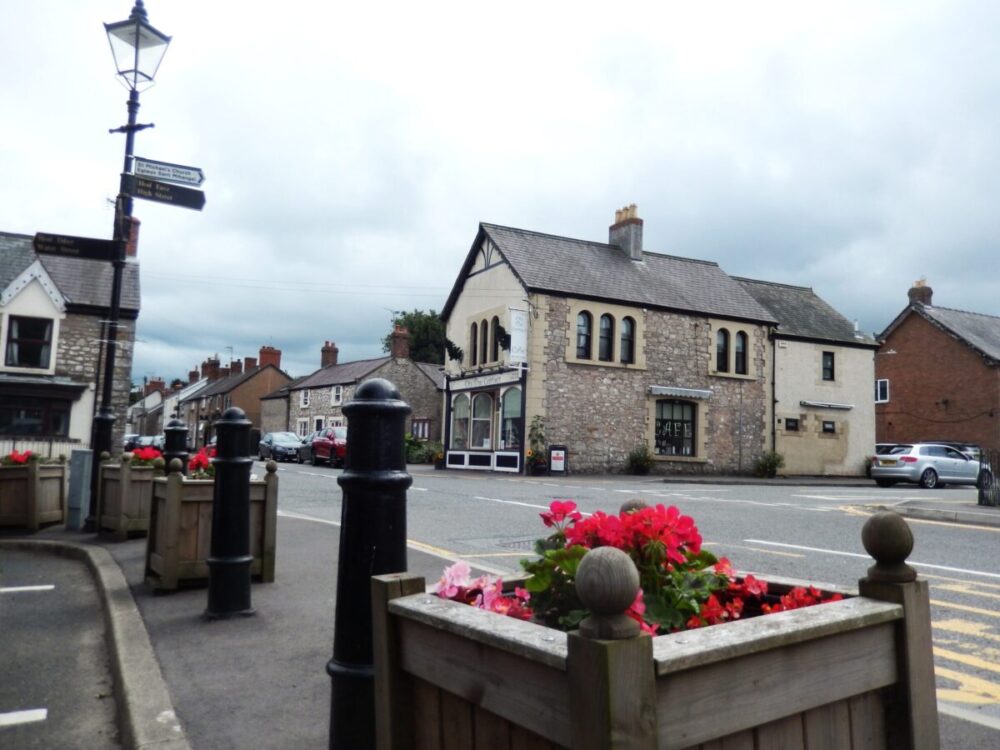
Caerwys; a small town between rivers. Bryniau Clwyd (Clwydian Hills) just west, Aber Dyfrdwy (Dee Estuary) a few miles east. Eight corn mills once ground grain on Afon Chwiler. Five minutes into my visit, Geraint and Sion, chatting in Cymraeg over breakfast in ‘On The Corner’, have told me that the first eisteddfod was held here (“ti’n gallu weld Cae Delyn ar y gornel”) and that the grid pattern on which Caerwys was designed in the Middle Ages was copied by American cities. But it’s the corn mills I’m here for, kind of.
Corn-dolly making
BBC Countryfile Magazine have asked me to write about corn-dolly making which has recently appeared on the Red List of Endangered Crafts. So I’ve come to meet Colette Hughes of Cornucopia Handmade, who teaches courses at the nearby Woodland Skills Centre (which is so excellent I’ll come back in autumn; watch this space). Colette, a Welsh learner from Merseyside who grew up on a farm, has offered to show me how to make a corn-dolly Welsh Border Fan.
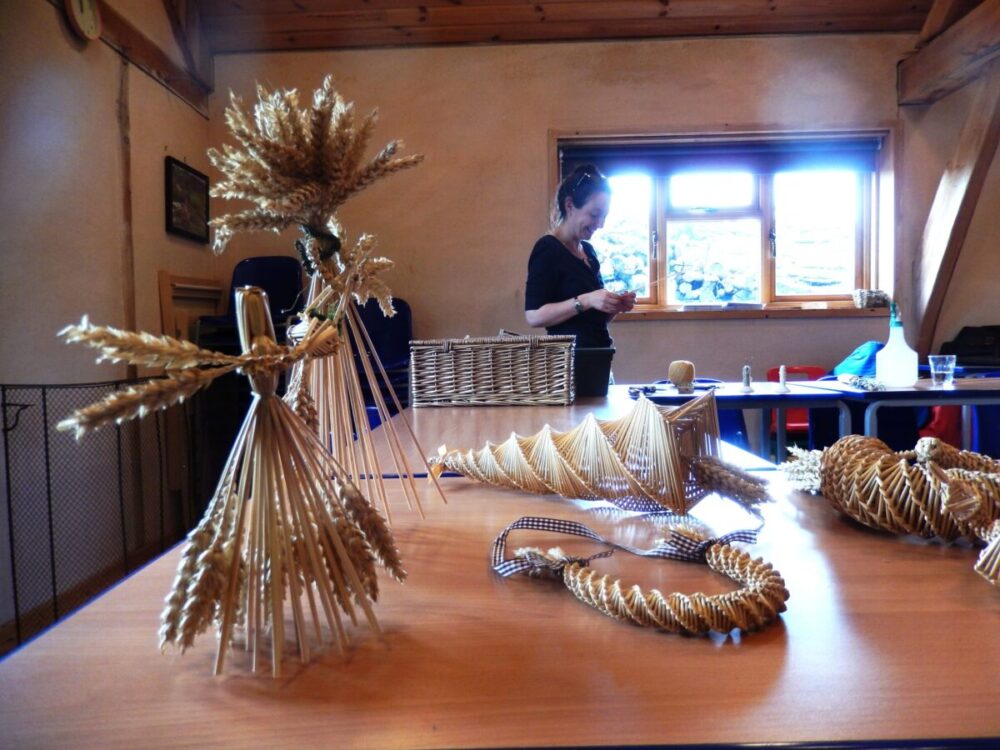
Do you know about corn dollies? Corn refers to all cereal crops. In simplest terms, the spirit of the corn was believed to live in the crop into which it retreated as it was harvested. The last of the corn was fashioned into a ‘dolly’ in which the spirit could reside over winter before being ploughed (or burned and scattered) back into the field in spring. Numerous regional designs and related customs evolved.
But the beliefs are long gone, and dollies now are made mainly as ornament. I wonder how much it matters that this skill is endangered. Then I meet Colette.
“After being hunter-gatherers for so long, the whole of settled societies – reading, writing, maths and arts comes as a result of having a surplus of food. None of it would have been possible without planting wheat, oats, barley. No matter how cold and hungry people were in winter, they said ‘we’re not going to eat this grain. We’re going to gamble against weather and pests. We’re going to plant it and hope it grows again.’”
Vulnerable
And we’re that fragile now! we agree. Our monocrops so vulnerable to climate change! “Everyone” says Colette.“Cobblers, tailors, itinerant workers, the whole community would have been getting involved in the harvest because everyone’s survival depended on it. Now it’s one person on a tractor, if that. Making corn dollies reminds me of that connection with our food source.”
Back in Caerwys, a man plugs in his car outside a house which doubles up as a gym. Russ Williams, the first person to teach Thai Kickboxing in Wales, got in with a bad crew when he was young. “I learned kickboxing to keep out of trouble. Now I do it to help people control their aggression and give people self-confidence. He grew up on a council farm.
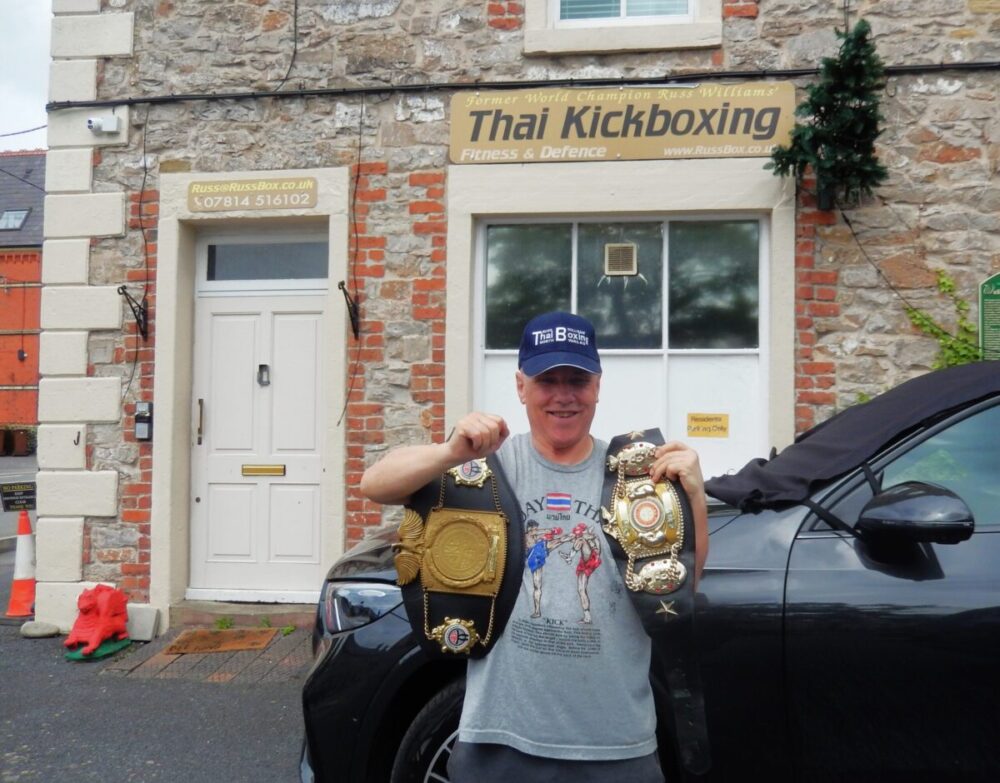
“It was a mixed farm, but my Dad invested so much in milking the council made it all dairy. When he got multiple sclerosis it was hard with the milk quotas and early starts and in winter having to defrost everything. We wanted to go out of milk production and back to arable, beef and sheep, but they wouldn’t let us so we sold up.
“But I feel so sorry for the farmers now with the 10% to nature thing. That’s alright but not putting it all on the farmers when all the plants in the industrial estates get razed right down, and the roadsides. It bugs me all the time.”
Golden fields
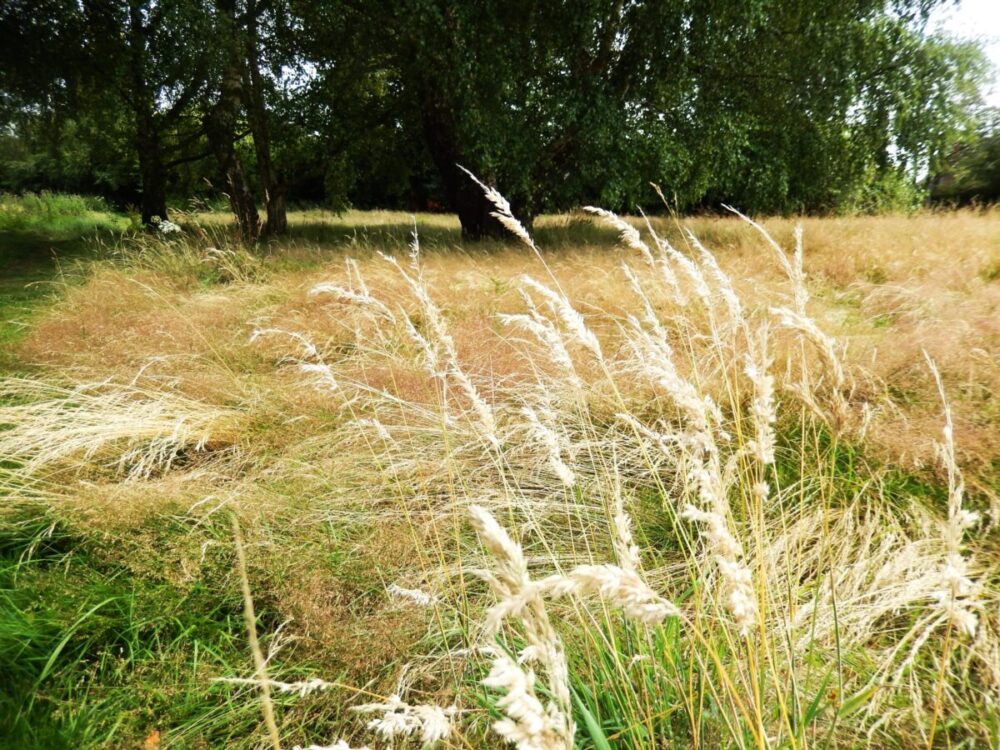
It’s not like that on the former golf course. I’ve not seen a lovelier park. Meadow browns and green-veined whites pulsing out of the bunkers. Self-seeded cherries, rowans and oaks, creeping away from the parent trees and a snap-crackle-pop as a squirrel scatters half-munched hawthorn berries. Paths are mown through billowing grasses. Look at their seed heads! Grass is how grains began. These are recognisably related to the crops around Caerwys. The windows of the Piccaddilly Inn, where Jitender and Mandeep from Birmingham are relaxing, open onto a golden field of oats.
“Until recently there were horses, they used to stick their heads through that window,” says Phoebe, drying glasses. “They’ve got potatoes down the road”. Dave, who keeps Dexters and pigs, will buy some of these oats grown by Dylan Hughes who also fixes tractors. They’ll go for bedding straw and fodder. Dave’s been a stone mason 37 years, but that skill’s endangered too. “It will keep on in walling, but houses aren’t built like that now. No one wants to be a stone mason they want to be influencers.” But, he thinks, people are going back to the idea of mixed farming.
Caerwys is a tiny pretty town. Hollyhocks grow up the walls of the medieval pinfold where stray animals were kept after Caerwys Fairs. There’s an art gallery and prescribing pharmacy for acute conditions. Like so many lycra butterflies, a group of cyclists have alighted on the cafe, where Victor tucks into Scotch eggs. “There’s someone farming up the road now” he says. “It’s blowing dust all over the place.” I think about Colette saying how settled communities are only possible because we started growing grain.
And that’s really how I remember Caerwys. As if every street ends in a tree-framed golden vignette.
Support our Nation today
For the price of a cup of coffee a month you can help us create an independent, not-for-profit, national news service for the people of Wales, by the people of Wales.



Lovely piece
Thank you Ben
Transported once again on the Julie B Omni Bus…
Aw MM you warm the cockles.
What about the traffic rat run through village to A55 and the horrendous street parking in High Street. Absolutely no mention of!
Absolutely no evidence of to be honest – but I was only there for one day. I was actually going to mention the lack of traffic and how tranquil it was waiting for the bus.