


Letter from Cemaes
Julie Brominicks
The wind whips the harbour to Guinness. Stout-black waves rebounding off the jetty colliding with swell that spews spindrift. White foam, white lamps, white moon.
Black water. Boat masts swinging like metronomes. Small craft heaving back and forth on their moorings like cattle at an auction. The noise of the surf! The wind-shriek. The din of the halyards clamouring like geese and the drowned melodic clang as the sea rings Patrick’s Bell. The bell was sculpted by Marcus Vergette to remind us of rising sea levels. This old harbour at the top of Ynys Môn is boiling like a pot.
Cymru-Cymraeg
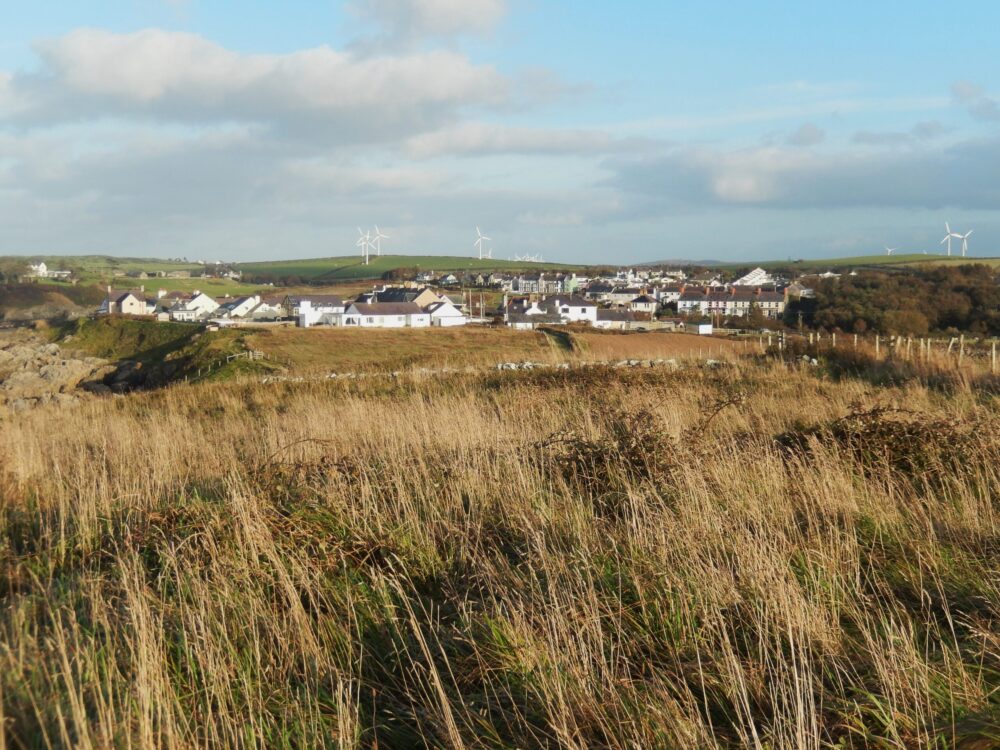
Cemaes is the most northerly village in Cymru. It sits in a bay with Yr Wylfa Nuclear Power station on one headland and Eglwys Llanbadrig on the other.
The population consists of holidaymakers (that’s us). Retired English incomers and their dogs (and at least one working-from-homer). Second-home owners. Labourers drifting to and from the mainland like bygone sailors, or ghosts from the brickworks. And the Cymry-Cymraeg.
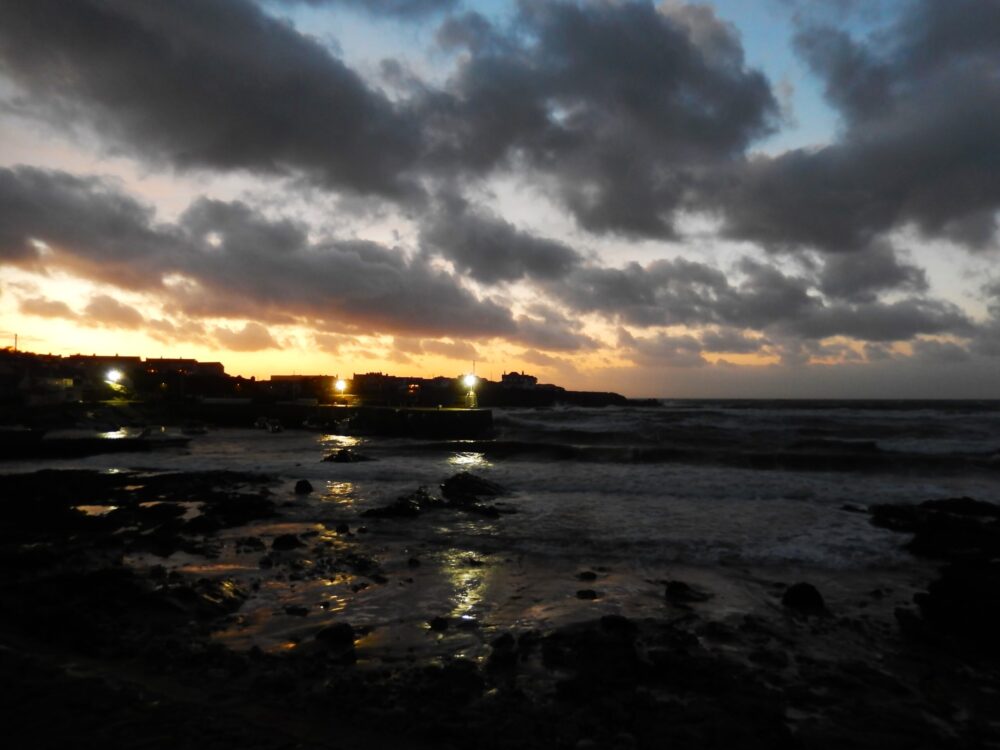
The hoodlum wind rampages all night. It assaults the trees, shrieks in the street and whistles through cracks. Come morning it is still spitting sand. Wind is formed when hot air rises, which cooler air rushes to replace. More global heating, more storms.
Yr Wylfa looks hellish fragile with its orange lights diffused by the mighty white surf. Nuclear power stations are vulnerable to storms and warming sea temperatures. Yr Wylfa is being decommissioned, its toxic waste waiting in coastal Cumbria for safe storage to be found, but Starmer, excited by trade deals with Trump, is talking about new nuclear.
We need it apparently, to satisfy the power-demands of AI, which we also need, apparently, which is funny because I thought we needed food and clean air and water.
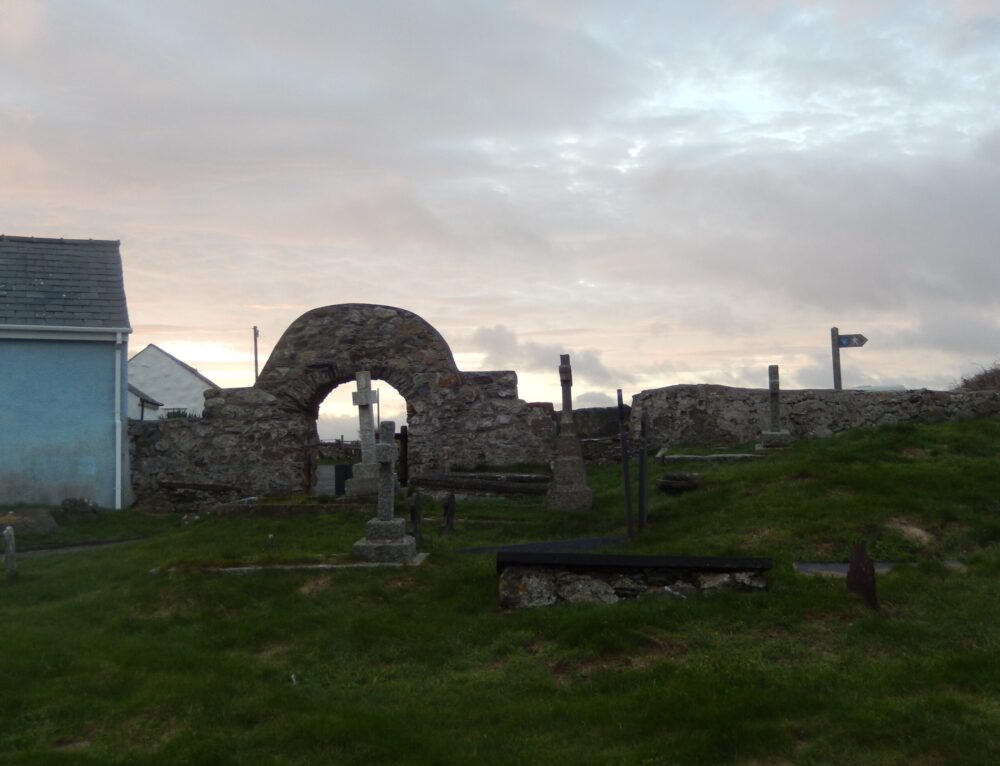
We watch Yr Wylfa from Eglwys Llanbadrig, the little church allegedly founded by Saint Patrick who was shipwrecked on Ynys Badrig. It has Moorish blue tiles and stained glass installed in 1884 by Lord Stanley who converted to Islam after marrying Fatima Santiago. Its timbers creak like a boat.
I find Cymraeg eventually. In The Old Vigour it is rippling around the labourers who are talking in English about scaffolding and the ceiling that collapsed in The Stag. And in Menter Y Pentre, the craft centre whose profits are given to charity (financially stricken Caergybi Hospice is the current recipient), Enid is playing Côr Meibion Goronwy. “Rydych chi’n yma o hyd” I say. “Only just” she replies.
Elfed in Oriel Cemaes shows me a photograph of his parents outside the shop they opened in 1925 to sell ice cream and cigarettes. “Pentre twristiaid ers erioed dwi’n cofio” he says. It’s always been a tourist destination but now every house for sale is bought by an English person.
Grief
My Welsh is clumsy, I’m English, but my guilt has shifted to grief. “Wy ti’n trist?” I ask Gwenda in Caffi Bach on the beach; are you sad that the language is vanishing? “Yndw” she replies, solemn. Yes. Her fag smoke is caught on the wind and a cormorant glides up a wave. Then she laughs and tosses her hair. “Mwynhewch eich wyliau!” she cries, and we do, enjoy our holiday. Me, my husband, mother and brother in a flat with plastic sunflowers on the door.
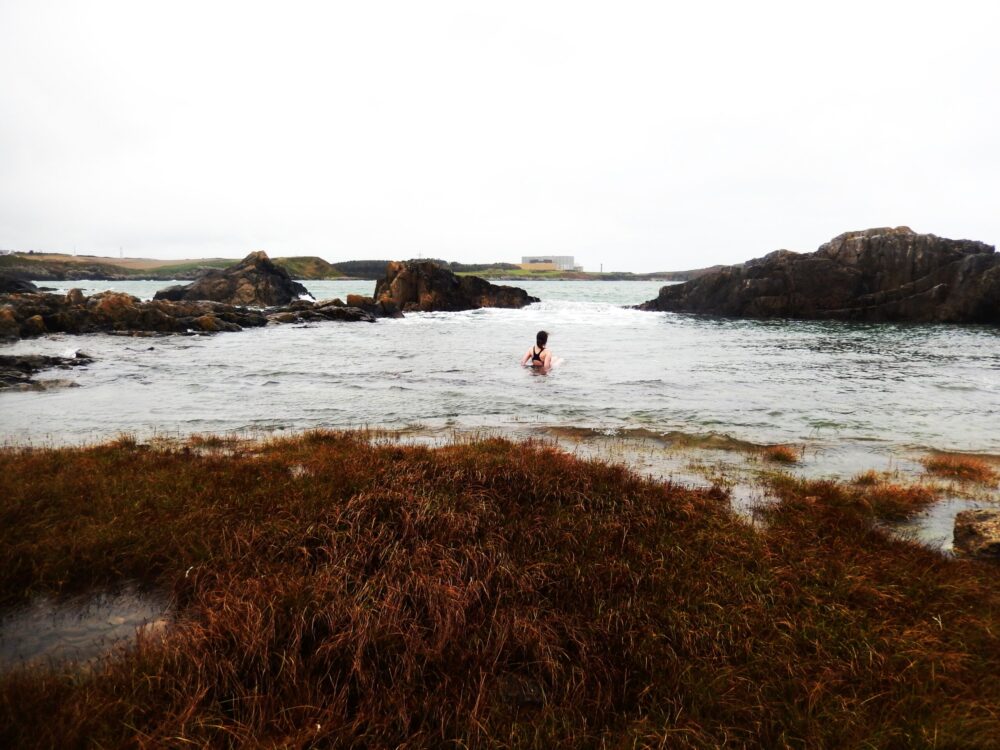
There are curlews and lapwings at Cemlyn, dolphins off the coast and a seal. Mum watches the sea and tells me that on windy days as a toddler I would stand up in the pushchair waving my arms about, and it pleases me no end, this proof of my wind-raising.
Rob makes arancini and remembers doing surveys for Rhyd-y-Groes windfarm back in the nineties. Mark hates nuclear, appreciates Brutalist architecture, takes photos of Yr Wylfa. I prowl about in the gloaming, when first light is a small blue square in Eglwys Llanbadrig. When herring gulls flicker like cine-film across the grainy sea. One morning the sky is all fire and bleeding roses. I hear what sounds like squeaky toys and look up to see thirteen whooper swans heading west.
Mid-week the wind is still scything the hedges and tormenting the telegraph wires into slack-bellied swinging. It forces a juvenile kestrel out of the sky to hunt from a fencepost. Waves disintegrate on the rocks into fine spume that is held for a while in the air. Patrick’s Bell clangs. In the heritage centre I learn that John Hywel Lewis made and exported whirligig wind dolls in the 1930s, and that windmills ground grain into flour.
There are plastic roses tangled in the seaweed. “They put them on the benches” explains Iggy, who is emptying rubbish bins with Ray (who is learning Welsh) “and the wind blows them around.”
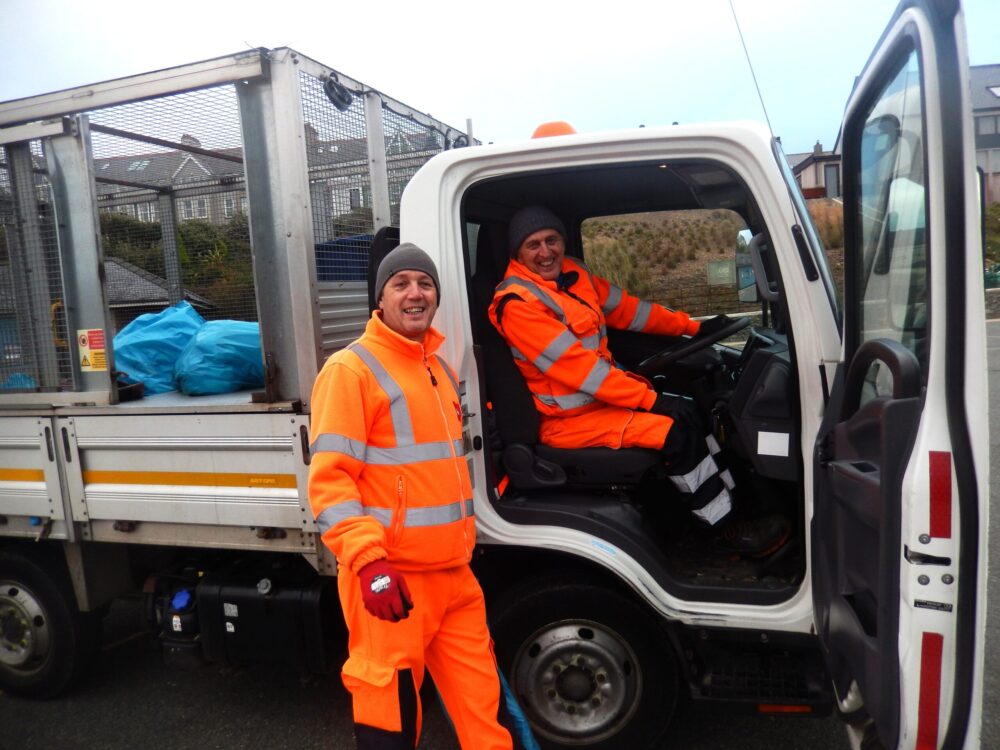
I ask them about new nuclear. “There’s support on Facebook” says Ray, “because people think it means jobs, but” he adds, “there won’t be anything in it for local people. They only invest in big projects and then they close down, like Yr Wylfa, and the aluminium, and the chicken place. I don’t want nuclear, if you ask me. It’s putting all your eggs in one basket, and then if you drop the basket.
“After Fukushima the prime minister of Japan came here and begged people not to go for it after everything they suffered.”
“And you should see the mess they made of the cliff-top” says Kath in Menter Y Pentre, “when they bought the site. They said they were landscaping. ‘Look about you!’ I told them. What do you think this is? Landscape!”
“A beth am y wast” scoffs Elfed in Oriel Cemaes. What indeed, about the waste. And what about the toxic mess of uranium mining, long before it even gets to a nuclear power plant.
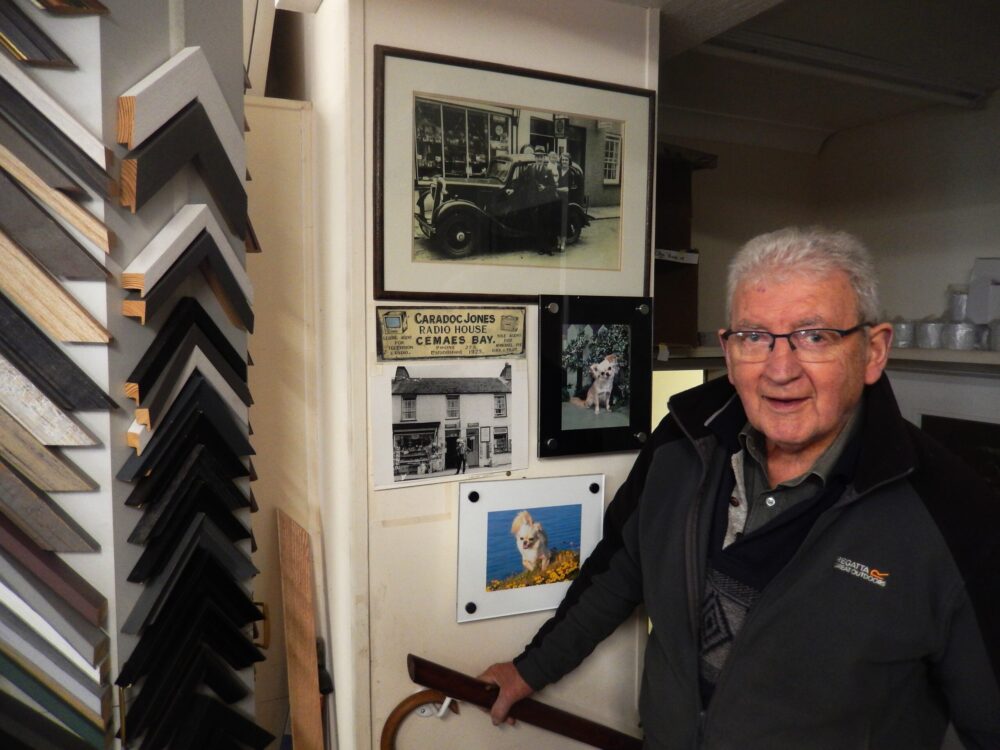
Could we not enrich lives and soil instead? Generate jobs in the NHS and Caergybi Hospice and mixed agriculture on the land where grain was once grown? “Syniad da” says Elfed, “and put the wind turbines in the sea. They’re fine there.”
That mischievous old wind.
Support our Nation today
For the price of a cup of coffee a month you can help us create an independent, not-for-profit, national news service for the people of Wales, by the people of Wales.



I could taste the salt and feel the sting of the spray, you would do justice to the story of the Sea School at the mouth of your river in Aberdyfi…
The rattle of halyards on aluminum masts, the rumble of shingle in the riptide, the chatter of feeding birds, our coast is one long symphony, to have been born on it a blessing…
The scent of burnt cheese coming up from Aberffraw mingles with the calls of the Shantyman and the beauty of TK Warspite in my mind…
A good read…
An evocative response, MM, glad you enjoyed.