

Letter from the Faroe Islands
Martin Shipton
As many in Wales continue to believe that, with a population of around 3.2m people, it is too small to survive as an independent country, a tiny territory with just 55,000 inhabitants is about to enter talks that could result in it becoming a wholly sovereign nation.
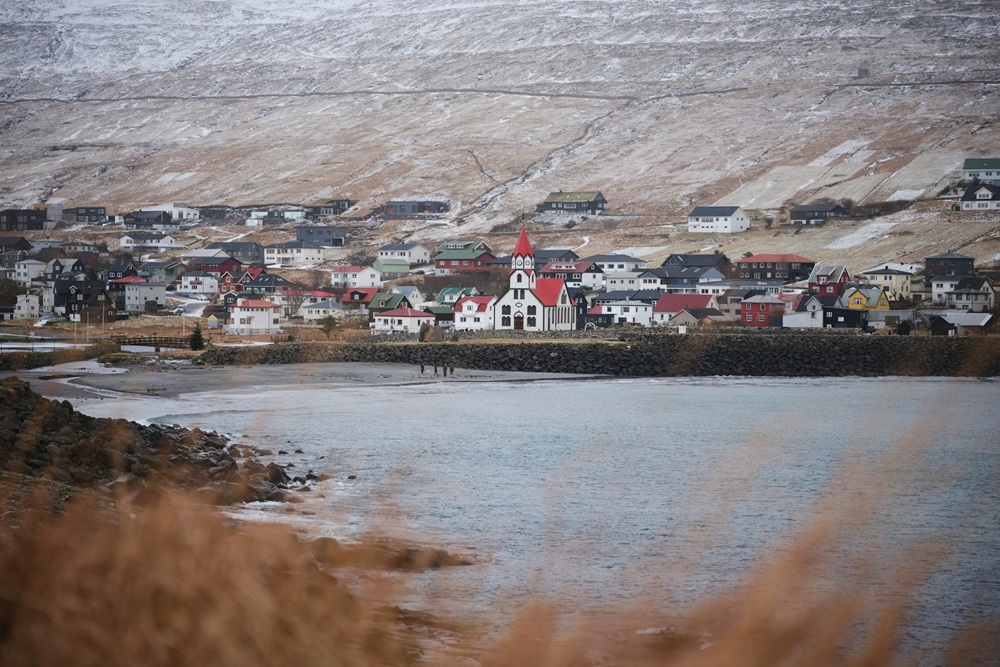
The Faroe Islands, wedged in the north Atlantic between Shetland and Iceland, hopes to negotiate a deal that will give it parity of status with its colonial power, Denmark.
In embarking on such a course, the Faroes have an enormous advantage: their economy is booming and their GDP per head has actually surged past that of Denmark itself.
Until 2024, Hogni Hoydal was Deputy Prime Minister of the Faroes and leader of the second largest party in the ruling coalition. He’s an historian as well as a politician, so when I met him in his party’s offices in the centre of Torshavn, the Faroese capital, I asked him to give me an overview of his country’s journey towards independence.
Norwegian kings
He said: “To cut a long story short, the Faroe Islands were originally a part of the Norwegian connection to Norwegian kings where we basically said, if you can provide us with so many ships per year, we will pledge loyalty to the Norwegian king. Then after all the Napoleonic wars and so on, by historical coincidence we ended up with Denmark as the main state.
“But the Faroe Islands were not at first an integrated part of the Danish state – it was a connection to the Danish king. But with modernisation, Denmark became a unitary state and the Faroe Islands became more and more integrated.
“So the first big conflict in the Faroe independence process came from the fact that in modern institutions like schools, the administration of the state and not least in the church, it was banned to speak Faroese. And we didn’t have a written language.
“So a movement arose that said, we will have to modernise on our own terms and in our own language and be part of the world with our own cultural basis, and that took a very long time. It started in the 1880s. At first there was broad support for preserving the Faroes’ language, but then it became political. With cultural rights, you also need political rights.
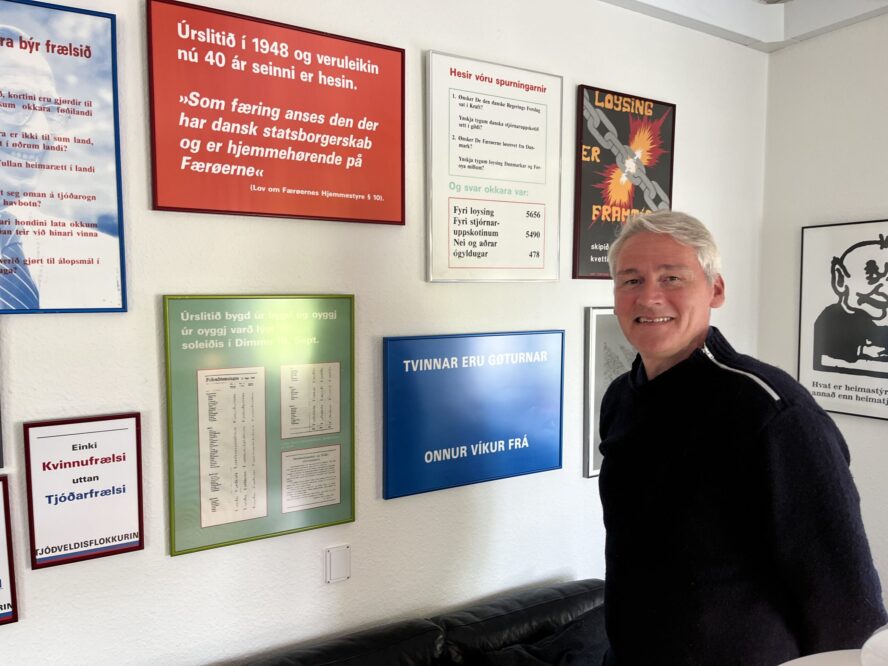
“So there became a huge gap in our politics where there was one independence party and one unionist party.
“By historical coincidence, when the Second World War broke out, Denmark was occupied by Germany and the Faroe Islands were occupied by Britain. And in the tragedy of the war, all bonds were cut to Denmark. The Brits had some kind of a pragmatic approach, so they allowed Faroese in schools and in fact everywhere, and the economy went from being a rural economy to a booming economy, also in the tragedy of war.
“After the Second World War, Denmark was a signatory to the United Nations charter, so it had to decolonise. But they tried to fly under the radar, by organising a referendum in the Faroe Islands in which people were asked whether they wanted to be totally independent – what they called secession – or whether they a]wanted to have some kind of autonomy within the Danish kingdom. To everyone’s surprise, there was a narrow majority for independence, basically because there was a new generation that had been isolated from Denmark during the war.
“They took the view that the new world was not about the old nationalism, but about creating a new order based on cooperation, with a small nation like the Faroe Islands being able to take part in the UN and so on. They managed to persuade a majority of the population to vote for independence.
“Denmark was in big trouble. They didn’t want to lose the Faroe Islands and maybe Greenland. So they disallowed the referendum, using an argument that there were more spoilt votes than a majority for independence. Instead they called new elections which the unionist party won.
“At that time my party was established with the sole aim of continuing the fight for independence and putting in force what we called the people’s power. That’s why my party is called Tjodveidi – it means people’s power.
“Ever since in Faroes’ politics, this has been the big issue: do you want independence or union with Denmark? Basically, Faroes politics has had four big parties, with two on the right and two on the left. My party is on the left and pro-independence. And we have another large party on the left, the Social Democrats, who have not been pro-independence. And on the right you have the same, with one party supporting independence and the other being unionist.
“And since 1948 we have lived under the so-called Home Rule Act, which has allowed us to take over almost all responsibilities in practice. We have responsibility for all taxation, for example. All powers are Faroese except for the police and the judicial system. Otherwise, we have everything: health care, social services, schools, universities, welfare? And during the 1960s and 1970s, we started to get subsidies from Denmark – to the point where the economy became based on Danish subsidies.
Collapsed
He added: “in the 1990s, the whole thing collapsed. We had got too used to Danish money and had an economy that couldn’t stand on its own. And we tried to say, this must never happen again – we have to take responsibility for ourselves. Now, in the second quarter of /2025, Danish subsidies in our economy represent only 1%. When I started in politics 25 years ago, it was 30%.
“That has been a huge game changer. How has that been possible? Every time we have taken over responsibility and said, we’ll pay for this ourselves, it has gone very well. At first the unionists said we would never be able to run our own schools or have Faroese television, Faroese media and so on – Faroese literature.
“But every step we have taken has been a huge success. So if we jump to today, we have the special situation that the Social Democratic Party which has always been unionist and which my party is in a government coalition with together with a small liberal party, has now said it will also go for independence. They agree, not in a bravado way, that the Faroe Islands need to take responsibility in the world and be members of international organisations.”
One important element has been the fact that while Denmark is an EU member state, the Faroe Islands are not. This has meant that the Faroe Islands has had to negotiate its own deals on issues like fishing rights, which is by far the most important element of the nation’s economy.
Economic exclusive zone
The Faroes Islands have had an economic exclusive zone of 200 kilometres around its territory. Hoydal said: “This has been the basis of our huge economic development where every year we make agreements with the EU, with Britain, with Iceland, with Norway where we fish all around the North Atlantic and have built a modern economy upon the sea. The Faroe Islands can seem small as a land mass, but our total territory is around 300,000 square kilometers, of which the land is only 0.5% and the rest is ocean. And this ocean is a very productive ocean where we have both fish farming and fisheries, and where we now hope to exploit the power of the current so we can produce all our energy ourselves.”
The talks due to take place this autumn will, says Hoydal, effectively result in two sovereign nations cooperating on issues like defence in a kind of free association. He said: “It’s no longer about money. We don’t need to be subsidised by Denmark – we think it’s immoral. Why should we take money from Denmark where the GDP is lower per capita than in the Faroe Islands? It will basically be two sovereign states working together for the benefit of their citizens.
“Iceland had the same system [with Denmark] from 1918 to 1944, and we can have cooperation on currency for instance and for defence agreements with NATO and so on. And I think this has huge public support.”
‘Resistance’
Putting the Faroe Islands’ independence into a wider geopolitical context, Hoydal said: “I think every party in the Faroe Islands agrees with this way forward even though there was huge resistance to taking this step. So I think we are in a new phase of Faroes’ independence, but are still experiencing the same tragic tendencies of world politics where international law is broken every day, where you have these upcoming populist movements.
“I think we see two tendencies at the moment. We think that if we really believe in national law and democracy, then of course we say to Denmark, ‘you should support Faroes’ independence because it’s all about democracy, and we will be a reliable partner that will comply with all international laws and so on’.
“And then you see the other tendency where international law is broken and you see the rise of populist movements.
“We see a tendency in Europe where there’s understandably a reluctance from the old colonial nation state to go along with Faroes’ independence out of fear that it will spread to the rest of Europe and create chaos.
“So it’s very important for us to stress that Faroes’ independence is about complying with international law and creating a world of greater democracy, as opposed to populism or negative nationalism.
“Is there much populism in the Faroes? Well, of course, like in Wales or Scotland or Catalonia or elsewhere in Europe, you see the same tendency. You see the ghosts of, should I call it fascism, arguing that when democracy has failed, you need a strong leader, someone to clean up the swamp. And you focus on public spending instead of on the very extreme division of wealth.
“In the Faroe Islands, we have the same tendency, that a very few people are on their way to owning a lot of the public wealth, especially the fish in the seas and so on. And we have seen in the Faroe Islands as well as elsewhere that all of a sudden the old kind or traditional class analysis is wrong, because you can see the poorest people joining with the most powerful and rich people to say, well, the problem is not the division of wealth, the problem is the public system where there are some politicians taking part in politics only for their own sake.
“We see this also in the Faroe Islands, but not to the same extent as we see it in the US and elsewhere, with large groups on social media supporting in my opinion very right wing views, including those of Trump and so on.
“And of course, I’m extremely afraid of these tendencies. I have just stepped down as leader of my party after 25 years also so we can have a new beginning because I felt young people were not engaging in the traditional democratic process, they were only engaging on social media. I think I’m too old to do anything good on social media.
“We are not nationalists who say we are better than other people; we are democrats who say we are internationalists who want all peoples to build upon the UN Charter so all nations should have the same right to self determination and that is the only way to create a better world. That connection that some people are trying to make between extreme nationalism and the independence processes in our countries is extremely wrong and very hurtful to the sole purpose of independence, which is democracy and people’s rights, always acknowledging that our rights cannot be put over the rights of others. So I think that’s still what the struggle is today – to get away from the point that in order to have a good life, you have to oppress others. We say the opposite: that in order for us to prosper, we have to let you prosper. That’s it.
“I think we must understand that when we negotiate with the Danes. We must see it from their side. I can understand their Prime Minister not wanting to be the one that loses part of the kingdom.But what if we flip it and look at it from another point of view? You’re not losing a part of the kingdom. You are perhaps the first Prime Minister that will support two new democratic members in the world – the Faroes and Greenland – that can stand on their own and with whom you can have all these agreements and we will still have a very tight cooperation.
“The worst scenario is what we are seeing elsewhere in the world, where international law and human rights are broken with the kind of atrocities we see in both Ukraine and Israel and Gaza and so on.
“If we don’t allow democratic movements to thrive, they will be taken over by populist movements – and that will be disastrous. We have to pursue the path we’re taking and we cannot wait too long.”
Support our Nation today
For the price of a cup of coffee a month you can help us create an independent, not-for-profit, national news service for the people of Wales, by the people of Wales.



Free clean air to breathe and free pure drinking water are to be enjoyed across the Faroe Islands far away in the North Atlantic Ocean. Beautiful landscapes, steep mountains and cliffs, countless puffins and several other seabird varieties – it’s a wonder-filled world. Man-made under water tunnels connecting islands and several tunnels through mountains are gorgeous. Small beautiful wooden churches with turf roofs and a few houses in every village. Amazing nature, filled with countless sheep grazing on hills and few but nice inhabitants ever busy with their maritime related activities. Mykines, Gasadalur, Runavik, Leirvik, Vestmanna, Sydradalur, Mikladalur, Trollanes, and… Read more »
Do you work for the tourist board?
For archeologists, socio-cultural anthropologists, and for church and maritime historians, the Faroe Islands have much to offer for their research. There are no trees growing on the Faroe Islands. But several of their churches are made from wood. Seaborne driftwood travelling from the regions of North America and floating about the Faroe Islands has been put to constructive use. Churches have wooden walls. All furniture in the church including the altar is carved from driftwood and wood that came to their shores from shipwrecks in the North Atlantic Ocean. A boat that saved the lives of sailors in the ocean… Read more »