

Letter from Trawsfynydd
Julie Brominicks
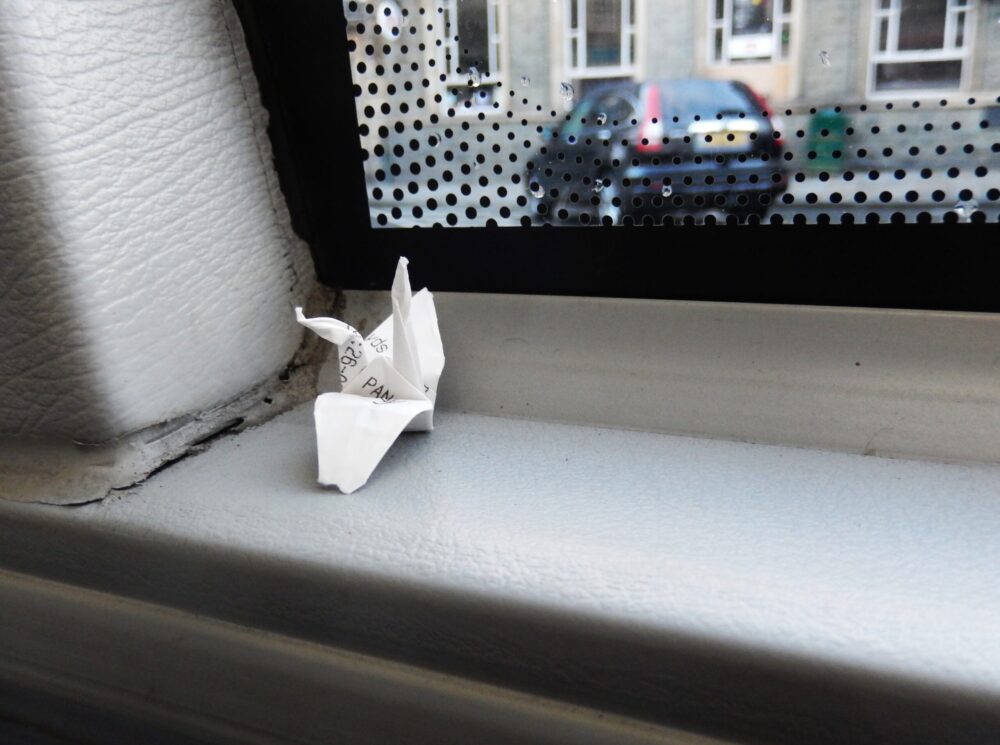
Last week I found a single tiny senbazuru on the T2. As if meant for me, it was folded from a bus ticket, and I decided to visit Trawsfynydd.
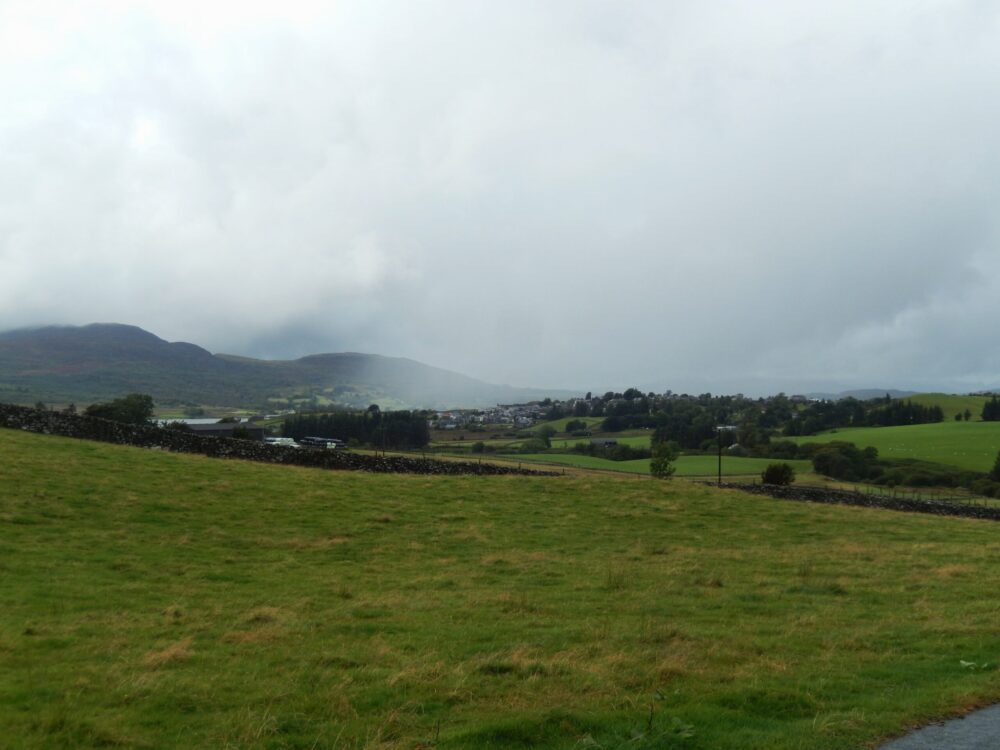
I get off the bus in a downpour. A man in a cagoule is saying something I can’t decipher due to rain drumming my hood. ‘Dwi yma efo’r ci’ he shouts, releasing his dog from the boot. It’s like ball bearings, the rain, and the lake comes in small purposeful waves. Rain runs into my boots, but there’s serenity here next to the nuclear power station. Peace has been on my mind. Of course it has.
Senbazuru are Japanese origami cranes and symbols of peace. I pocket the one I find, remembering that when living in Tokyo on my first stay in Japan, I’d volunteered at Greenpeace, helping the staff understand English-language engineering reports that described how concrete in nuclear power stations was degrading. The Fukushima disaster surprised none of them, but no-one had listened.
Shine
The lakeside café has opened. I’m first in, there’s a thrill to the gloom. The dark lake has developed a silver horizon. I hear people laughing as they purchase fishing permits and it’s someone I know; Wayne, with a friend. ‘Mae’r tywydd’ says the woman bringing tea, and we watch it through rain-wobbled glass.
When I catch up with Wayne he’s wrestling an umbrella. I ask what he likes about fishing, and he says not much, he’s just snapped a hook. But no, his Dad took him, it’s memories really and it keeps him away from the drink. They had two trout and twenty little perch last week, and put them back. It’s a peaceful place.
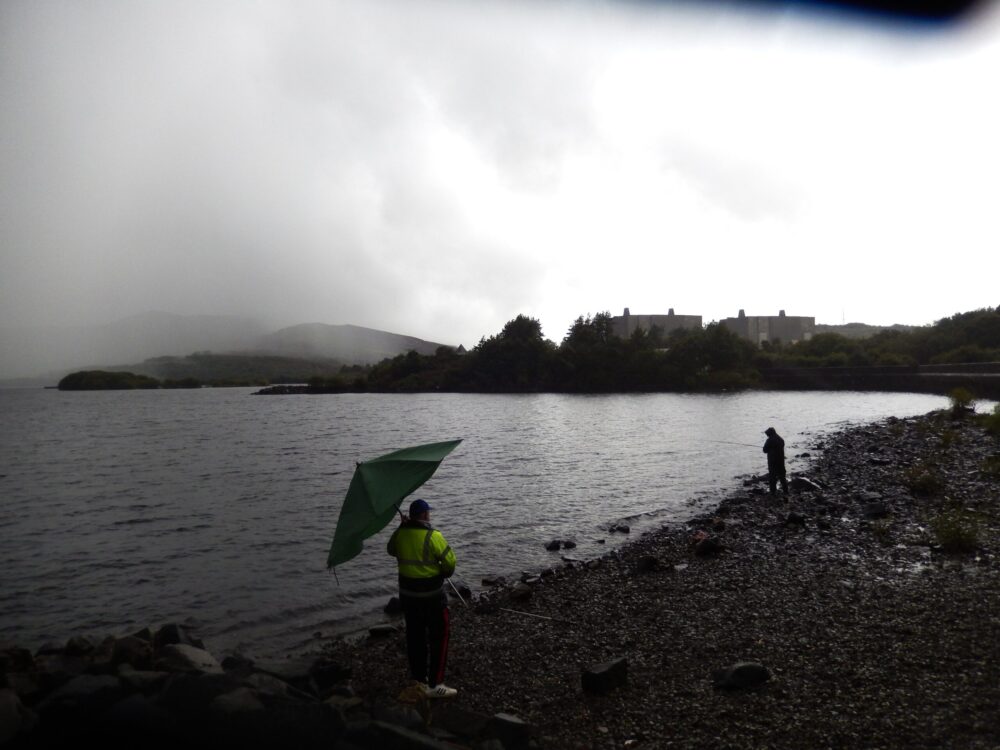
I walk around the shining reservoir that wasn’t even here before Afon Prysor was dammed in the 1920s (drowning several farms) to create Maentwrog Hydro Electric Power Station, which still powers 12,000 homes. Meanwhile, decommissioning at the Magnox Nuclear Power Station began in 1990 (just thirty years after being built) and will continue till at least 2060. Cars are parked outside it, visible through a crimson fireweed fringe.
The rain is so heavy! It ceases and starts. Ceases. Starts. A black-backed gull on a rock shakes its wings, and grey wagtails air-fish for insects under the oak canopies. There is a wind.
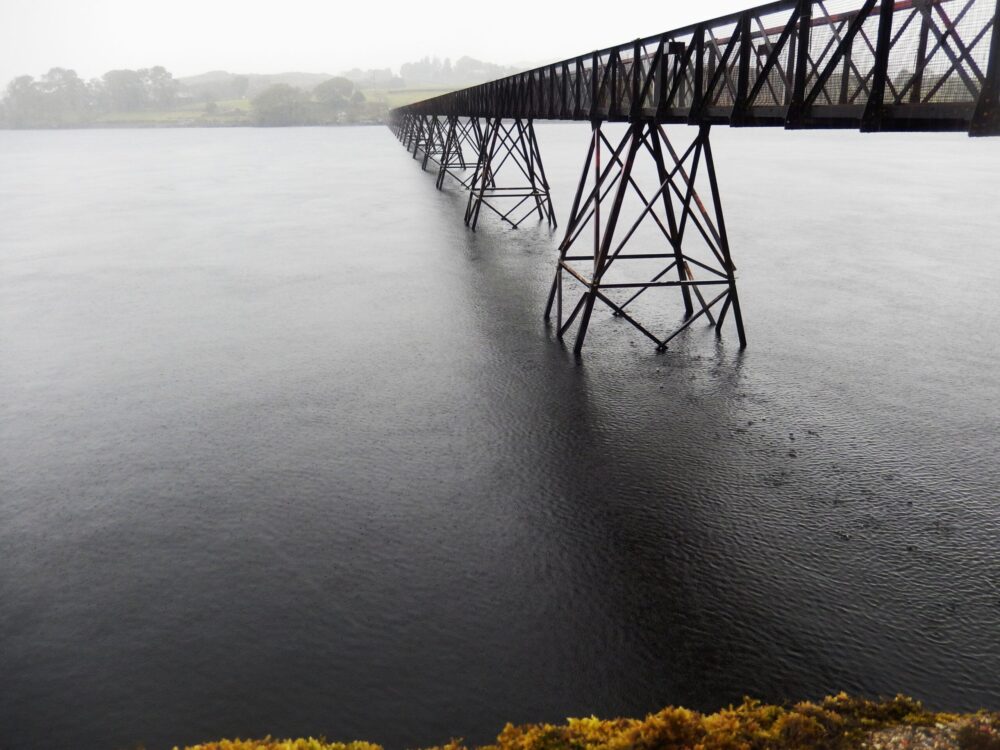
There is dark cloud against black cloud and a white-crimped inky wash. Pale light falls on birch leaves, then the oak-woods give to heather and bog myrtle, and an orange windsock troubling a grey sky. Just by the footbridge (currently closed), swallows overshoot the reservoir wall, swooping in spite of the rain, close enough to clearly see the ring of white in their tails.
Heddwch
A oes heddwch? Is there peace? The question begins each National Eisteddfod. This year I was moved by Cian Ciarán’s powerful reflection on the Hiroshima bombing; a six-hour long audio installation representing the time it took the bomb to be flown to Japan. I listened while watching the clouds. Senbazuru were distributed to those present.
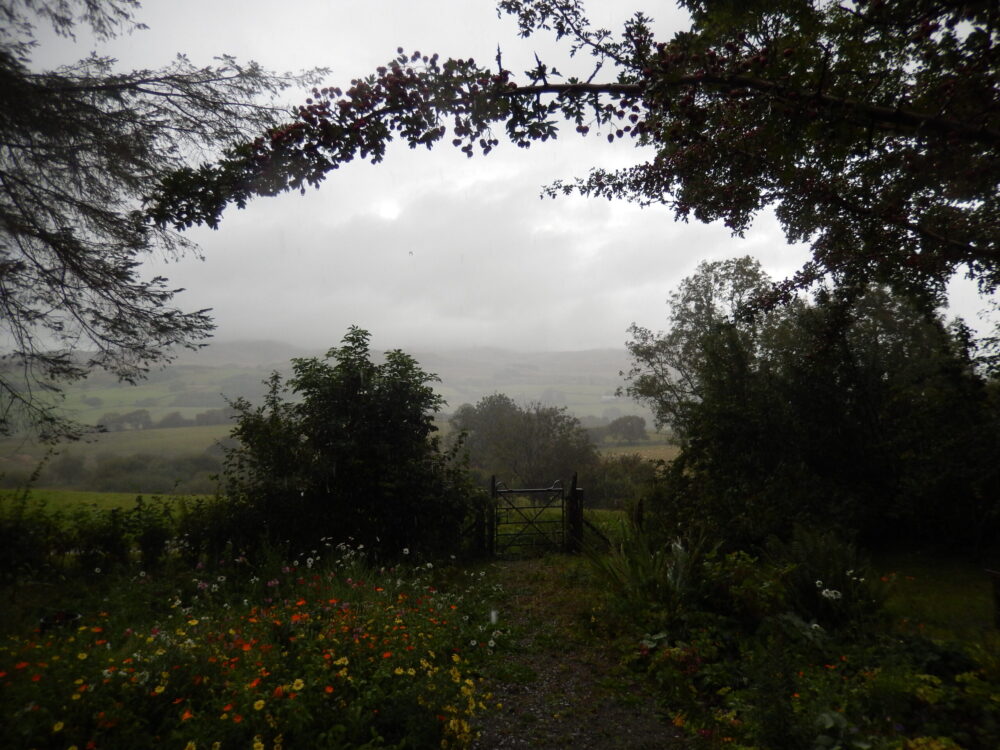
Across the A470, and up the lane to Yr Ysgwrn. The landscape is veiled in soft showers. Yr Ysgwrn was home to Ellis Evans, the poet whose bardic name was Hedd Wyn, meaning ‘Blessed Peace.’ Hedd Wyn posthumously won the bard’s chair at the 1917 National Eisteddfod.
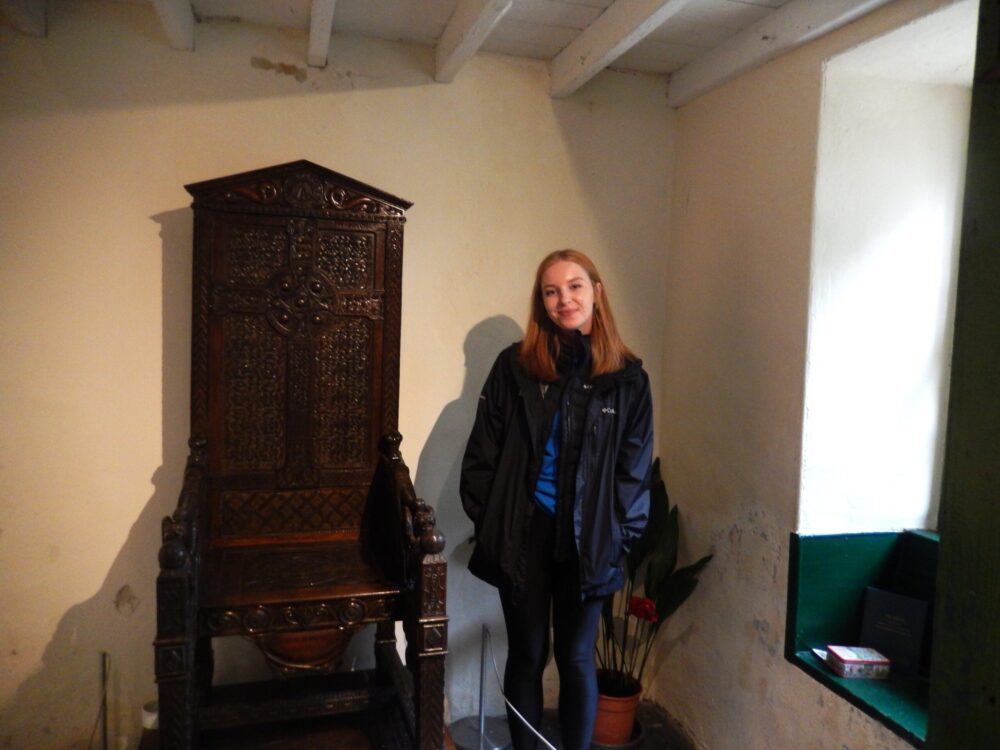
‘It’s exactly as it was when he lived here’ says Elain, my guide. ‘They’d have kept cows, chickens, sheep, pigs. He was an absolute useless farmer. He’d write better at night. The young men would go out and swear a lot but he didn’t get crazy. He was a pacifist. Now we see war on TV, no-one would want it, but people then didn’t understand. Thirty-five men were killed from Traws. Hedd Wyn read a lot so he had something to back up his beliefs. He didn’t want to kill anyone. He didn’t want anything to disturb his peace.’
Hedd Wyn signed up to keep his younger brother safe on the farm, and was killed in the Battle of Passchendaele. A rich silence settles around the kitchen table where he wrote his poetry, disturbed only by the soft click of clock, flames in the range, and the garden drinking the rain.
I’m weather-battered by the time I reach Traws village proper, but get a warm welcome. ‘Agos cymuned,’ beams Iwan Jones in Costcutter. We’re a close community. He says Hedd Wyn put Traws on the map. ‘Fel fi,’ he says, ‘jest content yn y bywyd, fel y boi. Dim conflict.’
Clean
Opinions about the nuclear power station are less enthusiastic. ‘It went down like a lump of lead.’ ‘A massive
scandal.’ ‘Dim yn seff.’ ‘My brother and sister have cancer, I don’t know that they live too close.’ ‘Gwaith,’ people
gloomily concede, eyes agitated like the lake. ‘Work. Clean energy is what they’re saying now.’
Clean energy is an odd claim, nuclear power having sprouted from the nuclear weapons industry. The toxic spent fuel rods have been transported to Sellafield where safe geological storage solutions have yet to be found. In 2006, claims of a cancer cluster at Trawsfynydd were made, but remain un-investigated. In 2014, Magnox admitted in a Strategic Environmental Assessment that due to leakage from the ponds in the seventies and eighties, ‘extensive (9500m3) sub-surface low level radioactive land contamination has resulted.’
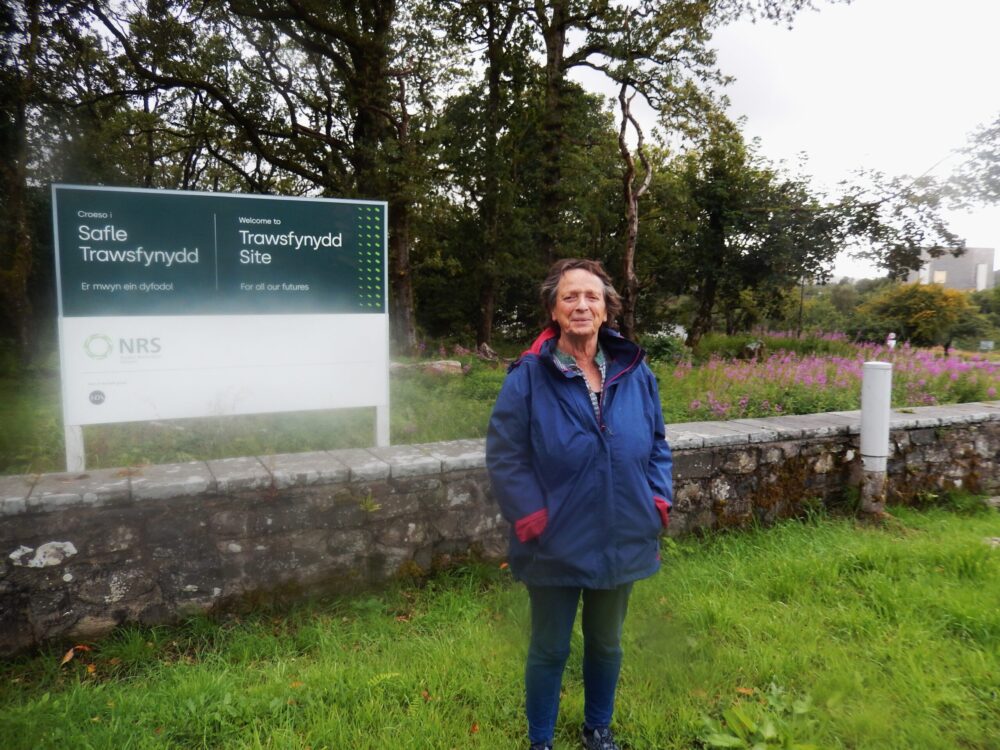
My friend Awel Irene, who’s been protesting nuclear energy for decades, meets me in The Cross Foxes. ‘Lots of farming people were concerned. RS Thomas the poet. It was a mix of people, cross-cultural, a lot of incomers felt they had a place within the peace movement. A local farmer was the treasurer. There was a near accident in Traws, a raising of the temperature.’ Chernobyl surprised none of them. Who would listen?
We return to the roadside where Awel has so often stood with placards and banners, including earlier this year. ‘We get support from the vast majority of drivers’ she says. The rain has stopped and sunlight washes the lake. My senbazuru is safe in my pocket.
A oes heddwch? Yes and no.
Support our Nation today
For the price of a cup of coffee a month you can help us create an independent, not-for-profit, national news service for the people of Wales, by the people of Wales.


That was nice Julie, the power station and I have previous as they say, a late friend’s folks kept a pub during the boom years and my father had a ‘market day shop’ there round the same time…
The ponds gave off a ghostly green glow that illuminated the reactor buildings in the dead of night when the 1960’s version of the Tylwyth Teg danced their jig out on the hydro pipes…
A rare place Traws…Heddwch dros y byd…
Thank you MM, that’s strange and lovely.
Re. ‘Market Day Shops’ in Wales, the most famous must be ‘Cheap Charlie’s’ now known as Charlie’s and a successful chain. 60 years ago if one needed a tank spanner or ex-mess carpet and white wool arctic underwear Charlie was your man…I suppose they would be called pop-up shops but ‘Market Day’ was spread across the week and all day drinking was a great attraction. Not sure if this was just Wales, the Spring and Autumn fairs in Dol were outrageous. I noticed the other day the old tap for filling up water pistols had been capped…sums it up really…Safe… Read more »
Another wonderful anecdote! My dyslexic ex-boyfriend would get his words mixed up and used to call Cheapy Charlies ‘Harry Cheap Bloke’
Diolch yn fawr iawn for writing this poetic piece, Julie. Nuclear was never clean, green, or cheap, will not solve the climate crisis and remains linked to nuclear weapons, despite what the industry spin doctors would tell you. There are meetings this week on the future of the Traws site if anyone is interested: Heol y Park in Porthmadog on 10 September between 10am and 4pm; Coleg Meirion-Dwyfor in Dolgellau on 11 September between 10am and 3pm and Trawsfynydd Agricultural Show on 13 September between 9am and 5pm.
Thank you Andy and for the information
Will Liz and Mabon be there do you think Andy?
Mend the bridge!!
The power station ceased generation in 1991 when micro cracks were discovered in the reactor. A safety case was put forward to allow for an extension but Nuclear Electric took the decision in 1993 to close down and make Trawsfynydd the first Magnox station to enter full decommissioning.