


Locals fight for 4th time to save a Welsh valley
Penny Owen
Controversial proposals for extensive areas of wind turbines and overhead power lines in mid Wales are being raised in the 2026 Senedd election campaign
Recent opposition to these proposals includes the Campaign for the Protection of Rural Wales (CPRW) response to the Nant Mithil application for 30 wind turbines up to 220m high and associated infrastructure.
CPRW highlighted the major adverse effects this Proposal would have on the Radnorshire Forest, and its concerns about effects on the landscape, local homes, the historic environment, ecology and ornithology, access, traffic and transport, hydrology and geology, shadow flicker, climate change and carbon balance, and cumulative effects.
In addition CPRW stated “it is evident that this Proposal is not needed to achieve net zero and the two Governments’ policy objectives.”
The Radnorshire Wildlife Trust (RWT) has also submitted a response to the Nant Mithil Energy Park, objecting to the Proposal due to “its significant risks to protected species, sensitive habitats, and climate commitments.”
RWT added it is concerned “about the cumulative effect of the Nant Mithil project alongside multiple other proposed wind farms in the region. Collectively, these developments risk overwhelming the local environment and causing significant harm to wildlife and habitats.”
Hundreds of people recently gathered outside the Senedd to protest against the effect these plans will have on the landscape and people of Wales.
At the rally there were no speakers from Plaid Cymru, Welsh Labour or the Green Party.
Mrs Elen Gough, a resident of the Tywi Valley who attended the protest, said “It is arrant discourtesy for political parties not to attend such events when there are plans for the wanton destruction of such perfection and beauty as we have here.”
“I am devastated to have to be fighting for the second time to protect the beautiful Tywi valley. In 1995 I was part of the Blaenau Tywi Defence Committee formed by local residents to stop 11 miles of overhead power lines.”
“Even before our Blaenau Tywi Defence Committee campaign, local people in the face of overwhelming threats to our beloved homes and land have needed to unite and fight to preserve what they valued. The destruction and vandalism of such perfection and beauty has always been seen as scandalous and too horrendous to contemplate.”
“Each and every one of these campaigns are such an important part of the history of rural Wales and necessitates being recorded for posterity. All our elected and aspiring politicians at the Senedd should know about these campaigns.”
I implore them to think very carefully before destroying for evermore Wales’ green and pleasant land. We and our forefathers regard ourselves privileged to live in such an area of outstanding beauty, and to pursue such destruction will be regarded as an act of a brutal Philistine. Future generations will hold these politicians accountable if this heinous destruction of our homelands comes to pass.”
Campaigns to save the Tywi valley
For nearly one hundred years local people have had to repeatedly organise to protect the beautiful Tywi valley. The ‘Farmers’ Fight of 1949 – 1952 was organised to prevent the compulsory purchase of 46 farms to grow trees for pit props. In 1966 – 1967 a campaign against the construction of the Llyn Brianne reservoir took place.
This was followed in 1995 by the campaign against overhead power lines. In 2023 the campaign group Our Tywi Valley was established in response to proposals for over 60 miles of electricity pylons connecting the Nant Mithil Energy Park in Radnor Forest to a new National Grid substation near Carmarthen. The Welsh Government has designated a third of Carmarthenshire as an industrial wind zone, with an additional solar zone in the south of the county.
The campaign group Cofiwch Ddyffryn Tywi has also been formed to protect the Tywi valley.
Farmers’ Fight 1949 – 1952
On November 18th 1949 the tenants and owners of 46 sheep farms in and adjacent to the Upper Tywi Valley received a letter from the Minister of Agriculture stating he intended to take their land by Compulsory Purchase should they not be willing to surrender it voluntarily.
The following brief summary of the Farmers’ Fight is taken from a contemporaneous record of events. This record sets the scene by highlighting how one of the chief Government officials “gave a Press interview and falsely described the district in which the farms are situated as “The Welsh Desert”.
Thus was the attack launched. Later certain facts came to light which displayed even more clearly the unscrupulous ruthlessness with which the Forestry Commission plan had been prepared.”
A Farmers’ Defence Committee was set up, and the National Farmers’ Union (NFU) undertook to meet all the expenses of the fight. All the farmers concerned gave a written promise not to sell their land to the Forestry Commission. In July 1950 a deputation from the NFU met with the Minister of Agriculture and asked either for the matter to be referred for further consideration by the then County Agricultural Committees or for a Public Inquiry to be held. The Minister rejected both requests.
On September 30th 1950 a mass demonstration was organised by Plaid Cymru at the junction of the Tywi and Doethie rivers, with Gwynfor Evans one of the speakers.
As the objections of the farmers to the Compulsory Purchase Order were not withdrawn, the Minister was compelled by the 1945 Forestry Act to order a Local Inquiry. Two local MPs, Hopkin Morris KC and Roderic Bowen, volunteered to represent the farmers at the Inquiry without any fee.
At the first session of the Inquiry in December 1950 it was made clear from the outset that, by will of the Minister, no Officials would give evidence nor would the the Official attitude to the matter be examined in any way. Hopkin Morris KC devoted himself to the blatant injustice of the Minister. The Chairman of the Inquiry, Sir Wyn Weldon, stated he was convinced by these arguments and would refer the matter to the Minister for his decision.
At the second session of the Inquiry the Minister rejected the points raised by the farmers. The Inquiry was therefore continued as a completely one-sided affair with the farmers hopelessly frustrated by not being allowed to know the grounds upon which their opponents case was based.
In August 1951 Sir Wyn Weldon visited a number of farms, interviewing tenants and farmers. In November 1951 came the event which saved the 22,000 acres of these 46 farms, when the Labour Government was defeated in the General Election by the Conservatives. Sir Thomas Dugdale became the new Minister of Agriculture, and on 31st January 1952 he announced his decision not to make the Compulsory Purchase Order.
The Lynne Brianne reservoir campaign 1966 – 1967
The following summary of this campaign is taken from the record written by Dafydd Dafis, the local headmaster and keen naturalist who was the secretary for the campaign.
Dafydd Dafis sets the scene by writing “The first great controversy in the heads of the Tywi Valley was caused by a proposal to appropriate land in order to plant conifers; the bone of contention in the second campaign was the drowning of the land in order to build a reservoir.”
The first two sites chosen by West Glamorgan Water Board for a reservoir were in the Gwendraith Fach valley. There was fierce opposition to the first site which would have drowned the village of Porthyrhyd. The second site would submerge eight homes and a thousand acres of agricultural land. The opposition to this site was very determined, with the church bell being rung to warn local people when surveyors were arriving in the area. The surveyors would then be faced with locked gates and blocked entrances. Despite court injunctions being obtained making their actions illegal with the possibility of imprisonment, local people continued their opposition.
The authorities realised the only way to gain possession of the land was by force, they withdrew from this scheme and turned their attention instead to the high land north of the village of Rhandirmwyn.
Planning permission
In 1966 the West Glamorgan Water Board applied for planning permission, water licences and the Llyn Brianne Water Scheme Order. However because of strong opposition to the scheme there needed to be a Public Inquiry.
Local people formed a Defence Committee to protest about the effect the scheme would have on the ecology of the area and the loss of agricultural land. The reservoir would be built in the middle of an area designated in 1954 as a Site of Special Scientific Interest. Within three miles of the reservoir there were seven National and local nature reserves. As Dafydd Dafis wrote; “It would be difficult to find any other area in Britain which has so many nature reserves encompassed in such a small area.”
The Defence Committee suggested an alternative site for a reservoir five miles north of Llyn Brianne, which would be less damaging to the ecology and natural beauty of the area with less agricultural land being lost.
However, in December 1967 the Secretary of State for Wales, Cledwyn Hughes, announced his decision to grant permission for the Llyn Brianne Water Scheme to go ahead.
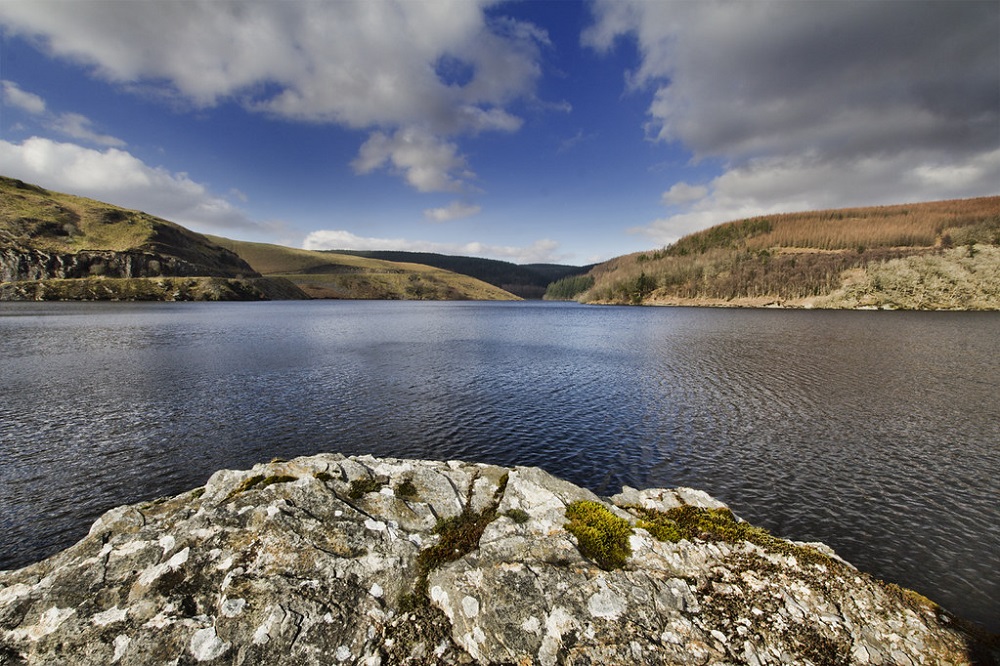
Although this fight was lost, the campaign had been successful in preventing a main road being built through the neighbouring Doethie valley sometimes described as one of the most beautiful places in Wales. Also, Dafydd Dafis had gained invaluable experience in campaigning, which stood him in good stead when he became the chair of the next fight to protect the Tywi valley.
Blaenau Tywi Defence Committee 1995
The following summary is taken from the diary entries of the Committee’s press officer, and over 150 press cuttings of the campaign.
In 1995 residents of the Upper Tywi valley crowded into the Royal Oak in Rhandirmwyn to begin their campaign against plans by Swalec to install 11 miles of overhead power lines through the valley. The Blaenau Tywi Defence Committee was formed at that meeting with its main demand that the power lines be put underground.
Welsh Water had been awarded the contract to build a new hydro-electric power station at the Llyn Brianne reservoir, as part of the UK Government’s plan to increase the amount of electricity generated by renewable energy schemes. Swalec announced it would be building 35ft high poles to carry the power lines from the Llyn Brianne reservoir to the National Grid at Llandovery through the Upper Tywi valley.
The Blaenau Tywi Defence Committee got off to a very quick start with letters and articles in local newspapers, S4C news items, leaflet distribution, and meeting people face to face to sign a petition. Dafydd Davies wrote “We are adamant that the classic beauty of the upper Towy Valley, which rivals any of our National Parks, should remain intact. Rhandirmwyn was included in proposals for a new Cambrian Mountain National Park. That scheme is still on hold and could be resurrected at any time.”
Special Landscape Area
The area was designated as a Special Landscape Area by Dyfed County Council. It included a Site of Special Scientific Interest, a Special Protection Area, and six Nature Reserves within a four mile radius of Llyn Brianne. This remote valley was the last place in the UK where the iconic raptor, the Red Kite, clung on with just half a dozen pairs left. The saving of the Red Kite is one of the most successful campaigns ever organised by the RSPB, local farmers and naturalists.
At the time of the campaign Eluned Morgan was the MEP for the area. She asked Swalec to reconsider its plans to carry electricity along overhead lines. She wrote ‘I find it difficult to understand the logic of building an environmentally sound hydro-electric plant and then constructing an 18 km overhead line.’
However Swalec insisted the cables could not go underground as this would add £4m to the cost of the scheme. The Defence Committee disputed this figure and said the additional cost would be £2.8m which “is a very small price to pay for the protection of a valley of great natural beauty. Underground cables are cheaper to maintain than overhead lines and are not likely to be damaged by high winds and falling trees.” They also pointed out that Swalec had been nationalised and was making many millions of pounds in profits annually.
Overhead power cables
In March 1995 the local Council, Dinefwr Borough Council (DBC), made a site visit and voted in favour of Swalec’s plans for overhead power cables. However, three Councillors raised concerns about the validity of the site meeting, saying Councillors were unaware a decision would be made at the site meeting and incorrect information was given that the hydroelectric scheme would save 6 million tonnes of coal a year when the correct figure was 6,500 tonnes.
At the next meeting of DBC, Councillors were unable to approve minutes of the site visit because of doubts about the validity of the meeting. Councillors then voted to overturn their previous decision and proposed that Swalec should put the power cables underground. This advice was sent to Michael Heseltine, the Industry Secretary, to make the final decision on the siting of the power cables went underground or overground.
A local farmer put up 35ft high double poles and banners to draw attention to the size of the proposed poles, this was filmed for TV news.
Farmers said they had been given the impression by Swalec that if they did not give permission for the pylons on their land, then the land would be subject to a Compulsory Purchase Order. Over time 8 farmers withdrew their consent, joining the 3 farmers who had refused their consent from the beginning.
In December 1995 Swalec and Welsh Water stepped back from the conflict and announced a plan to raise the level of Llyn Brianne reservoir by one metre, enabling additional electricity to be generated which would pay for the cost of putting the power cables underground.
In January 1996, one year after their inaugural meeting, the Blaenau Tywi Defence Committee met to celebrate their victory. As one newspaper headline ran, they were the ‘Residents who beat Goliath’.
Support our Nation today
For the price of a cup of coffee a month you can help us create an independent, not-for-profit, national news service for the people of Wales, by the people of Wales.
Get more trusted Welsh news
Choose Nation.Cymru as a preferred source in Google News to see more of our journalism.



Insane narrative ‘saving the valley’. We are four weeks from an enormous fuel shock, inflation of food is going to be 10% regardless of if strait is open today. Do they prefer each and every household to have 2or 3k price hikes every time there is a problem in the Middle East? I live near a wind farm in Anglesey and I’m not fussed by the wind farm half a mile away. We all need to do our bit for country as a whole.
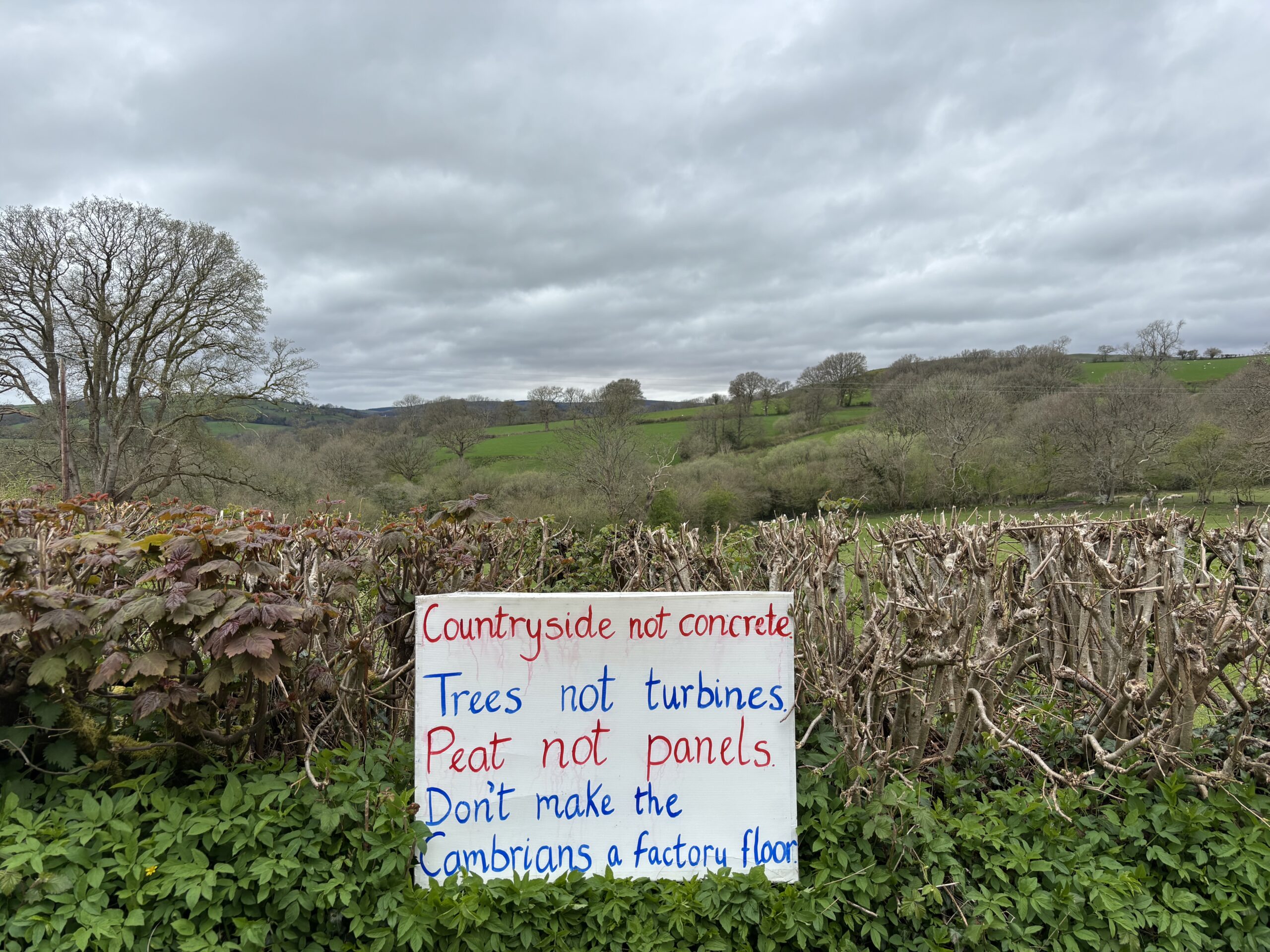
Look at the poster in the photo which says “TREES NOT TURBINES”. Well, let me tell you that in last week’s news it was reported an English-based company is planning to start planting Giant Redwood Trees here in Cymru. Not ordinary trees but giant ones!! So, we’ll have both turbines and giant trees.
Foreign corporations exploiting Welsh resources for their own benefit at the expense of local Welsh communities and landscapes.
Another Tryweryn
I am all for green energy but not by destroying the environment. Why not build to turbines in the Cotswolds or the Lake District instead, Wales is already bristling with them.
Exactly. The vast majority of these schemes are being built to power English cities, they should be built near those cities yet if you drive through the Cotswolds or Chilterns you will not see a single turbine.
Yet again Cymru is being exploited for the benefit of others.
If you do an online search you will find that the Cotswolds are exempt from large turbines because it is deemed an area of natural beauty and there are no large-scale turbines in the Lake District only small ones for individual properties. Cymru, obviously, is not deemed the same. One law exists for England and it’s a free-for-all in Cymru.
Looks like a few over the border.
Select Onshore.
https://data.barbour-abi.com/smart-map/repd/desnz/?type=repd
Farmers want my coin to help them out, it’s a two way street.