

Making Tracks: A Ukrainian Christmas in Caerphilly
Jon Gower enjoys a sweet taste of Ukrainian culture at the station.
When the Ukrainian war broke out in 2022 NHS employee Sian Lewis sponsored sisters Hanna and Ludmilla Famtsova and their daughters to come to Wales from Ukraine.
“They lived in my flat and they’ve been there every since,” she explained. Sian subsequently retired from a testing job helping to organise organ transplants and the like in 2024: “I knew Hanna and Luda would like to open a bakery shop, so I said I’ve got time if you want some help setting up a business, so we did.”
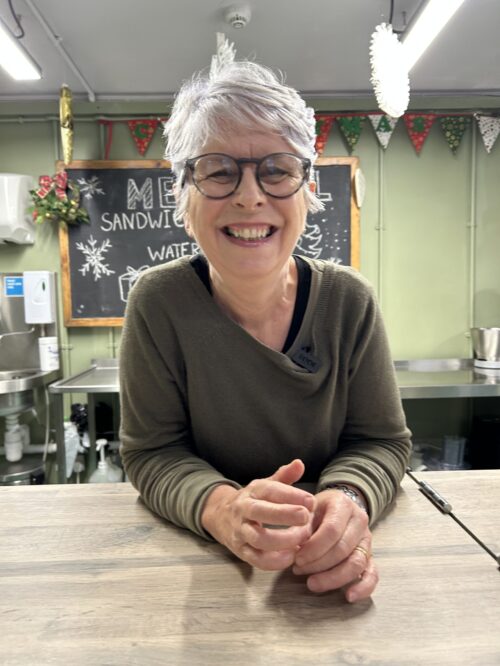
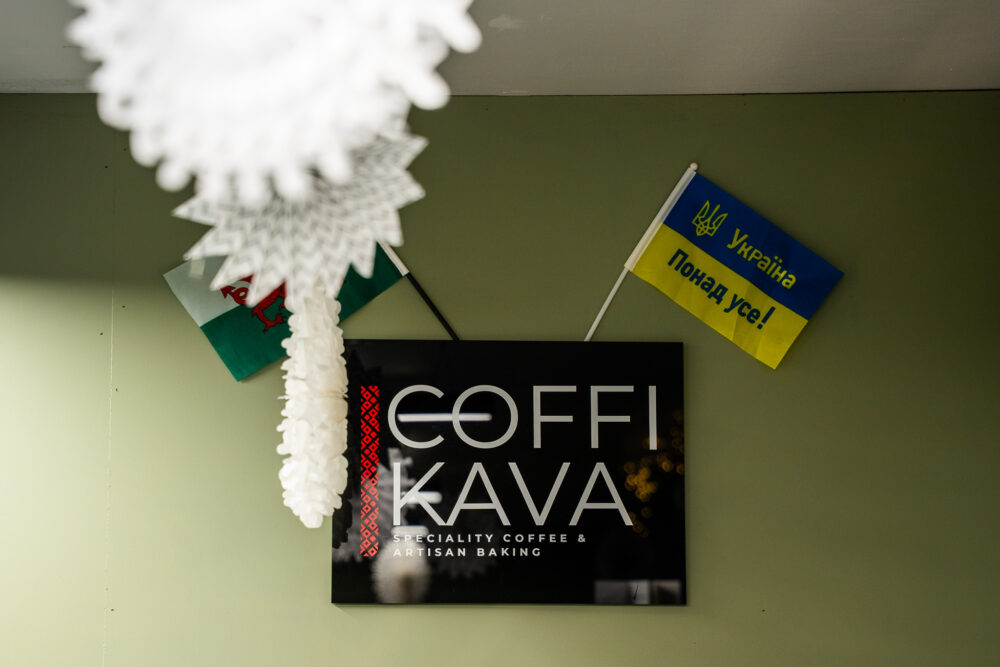
Which led to the creation of Coffi Kava on Caerphilly station, where travellers can source coffee and pastries and Ukrainian desserts. The business name, that of coffee in Welsh and Ukrainian, underlines how two cultures meld and meet here, next door to the ticket office.
Ludmilla, known familiarly as Luda, is obviously happy in her work: “I really enjoy it: my job now is exactly what I want to do.” Luda guides me through the mouthwatering selection of Ukrainian cakes on display. “There is raspberry cloud cake, which is fluffy sponge with raspberry jam, sour cream and cream cheese – it’s not very sweet but nice.”
I’m reminded of “Naughty but nice,” which used to be used as slogan for fresh cream cakes. Not many people know that it was written by the novelist Salman Rushdie.
Another of his marketing masterworks was ‘Irresistibubble’ for Aero milk chocolate bars. But I digress.
Luda continues her tour of the display cabinet: “Here is carrot cake. I know carrot cake is everywhere but we have our own recipe.” I ask if it’s a secret ingredient and Luda chuckles as she confirms that “It is a secret ingredient, a business secret.
And here we have a traditional Ukrainian caramel cake. It’s something from childhood, often served on New Year’s Day, very caramel, very crusty.” It’s made of sugar, butter, eggs, flour, walnuts and is decorated with poppy seeds.
In Ukraine such cakes are known as “muraveinik” which translates as ant hills, because they’re served in a pile, each shaped like a little hill and the decorative poppy seeds resemble tiny ants.
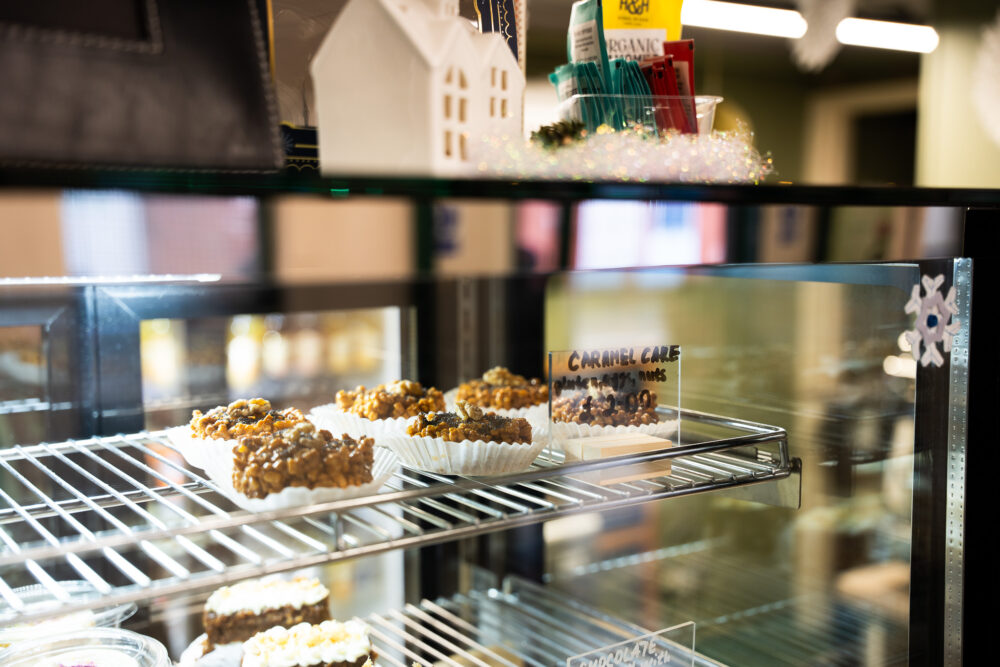
Does the caramel cake also have a secret ingredient, I ask Luda, teasingly. “Of course. It contains our soul and love.”
An Ukrainian Christmas is very special, as Luda explains, with Christmas Eve having an especial importance: “We have a special dinner called sviat vechir made up of twelve dishes. Around the table should be the whole family and when the first star appears in the sky we start to eat.
The main dish, eaten first, is kutya, made of wheat porridge, honey, dried fruits such as raisins or prunes and poppy seeds.” The grain represents eternal life and prosperity, the honey symbolises heavenly bliss and good health, while poppy is a symbol of protection against evil forces.
The family then sing one of the traditional Ukrainian carols or koliadky and Luda jauntily launches into lovely, spirited rendition of one of them, “The Carol of the Bells” as she stands behind the café counter. It was originally a folk song, “Shchedryk” – sung to greet the New Year – which was adapted by Ukrainian composer Mykola Leontovych in the early twentieth century. Many people will know it from the soundtrack of the movie about festive bungling burglars, “Home Alone.”
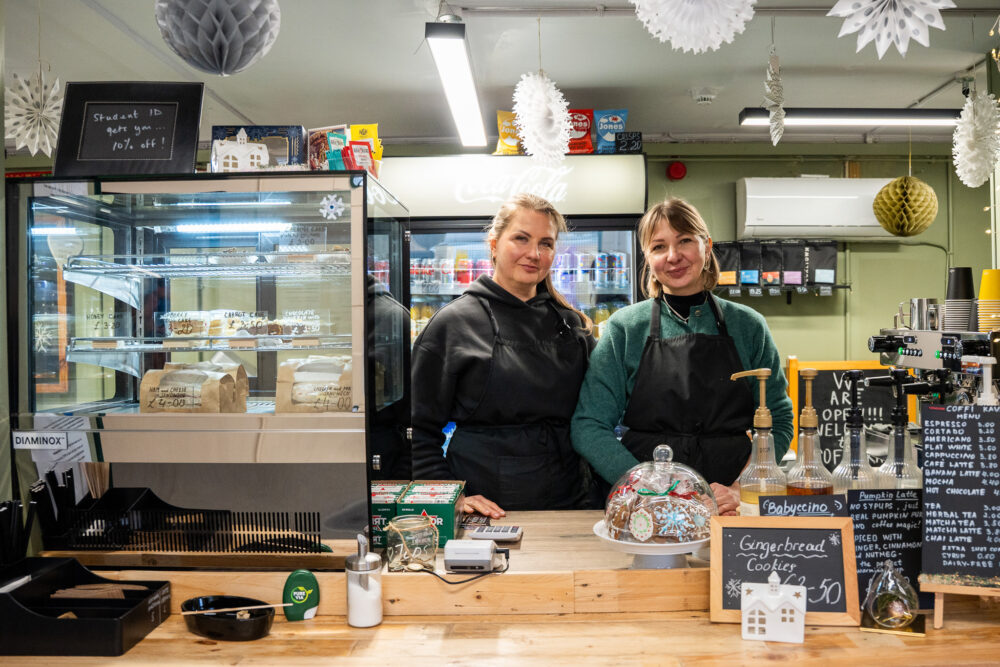
Luda’s sister Hanna started baking when she was about 13 years old, and later happily communicated the passion to her sister.
The pair of them had been considering turning that delight into a career in their home city of Dnipro, in central Ukraine, where they both worked in senior positions at a dietetics service, before they had to evacuate.
Working with her sister is perfect, explains Hanna: “Because we know each other very well, we help each other very well, so I get big help from my sister and from my daughter who also works with us. We’ve had great support from people in Caerphilly, we’ve enjoyed it. There are people who come to the station especially because they’ve heard about us and Transport for Wales have been really supportive so we’re really pleased with our reception here.”
One customer, called Robert Murphy turns up en route for Haverfordwest in west Wales. He has a large corgi dog on a lead, an enormous fishing net like you would use for hoiking substantial salmon out of a river and a particular penchant for a pumpkin latte. “I’d rather miss my train than miss my coffee. I didn’t have one with breakast so I could have a coffee here. The pumpkin spiced latte at Coffi Kava is actually made with pumpkin. That’s why I love it so much. Everywhere else is just some cheap syrup.”
As he enthuses about the drink I can see the orange coloured puree being scooped into the cup. The coffee itself comes from Coaltown Coffee, a roastery and family business in Ammanford. It helps underline the Welsh side of the venture.
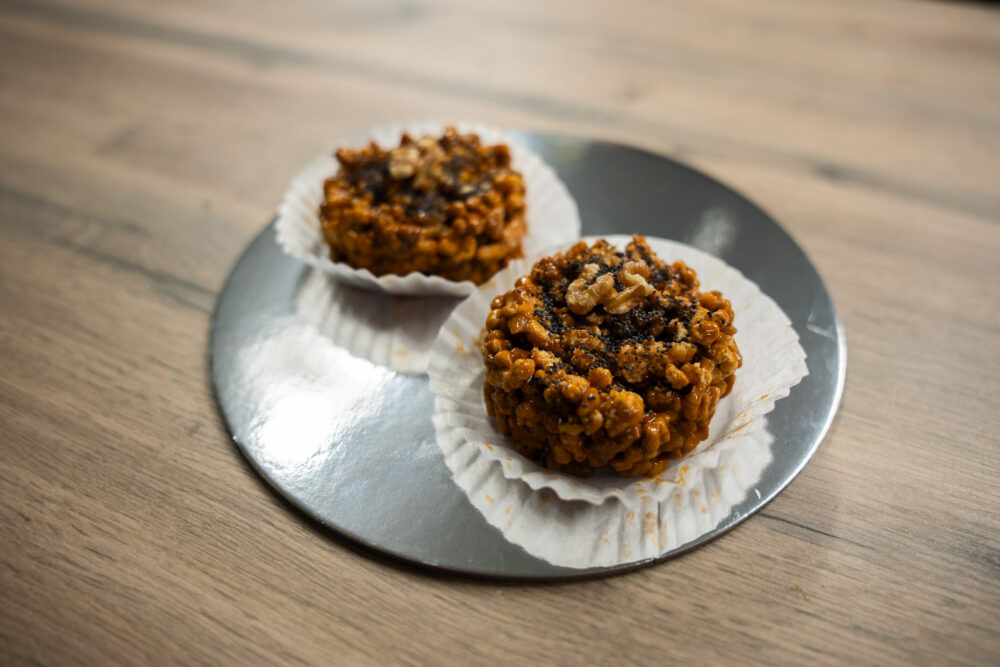
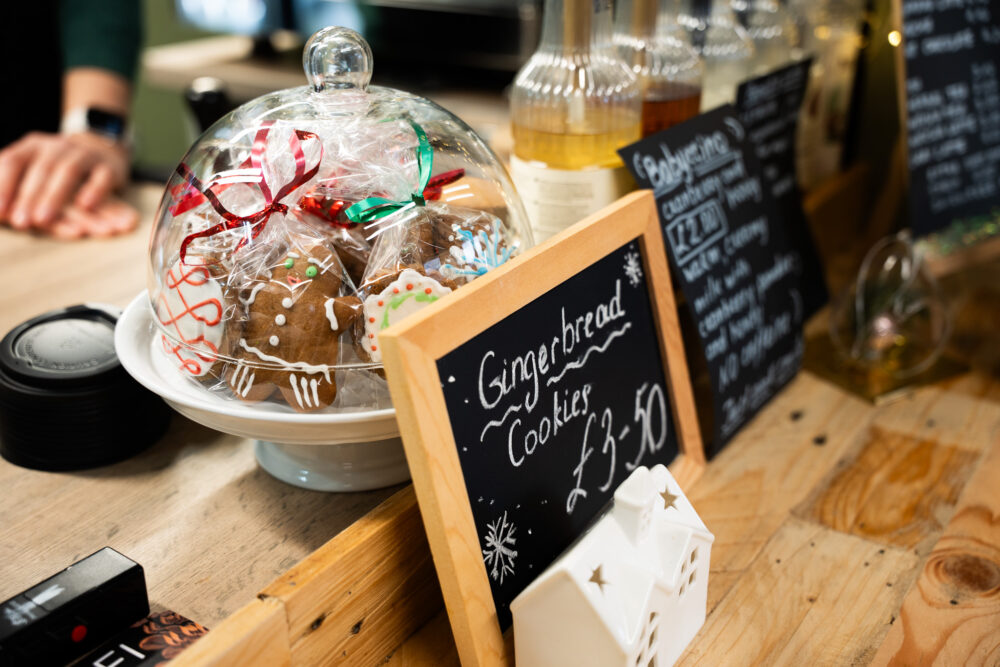
As I leave the cafe Hanna and Luda give me some gingerbread cakes to follow the utterly delicious sample of caramel cake. Washed down with some of Ammanford’s finest Americano it’s a Christmas feast fit for three kings.
Community
To find out more about the wider Ukrainian community in Caerphilly I meet Yuliia Bond. Her hometown in Ukraine is just 6 kilometres away from the Zaporizhzhia nuclear power plant, the largest in Europe “which was occupied on the second week of the large scale invasion of the country in 2022. When it was occupied many people, about sixty per cent of the population left the place and I’m one of them. I now live in Wales with my two children, a daughter and son. At home I was involved in a lot of civic and political engagement as I was the head of a regional environmental political party. Most of my work was in social justice and environmental justice.”
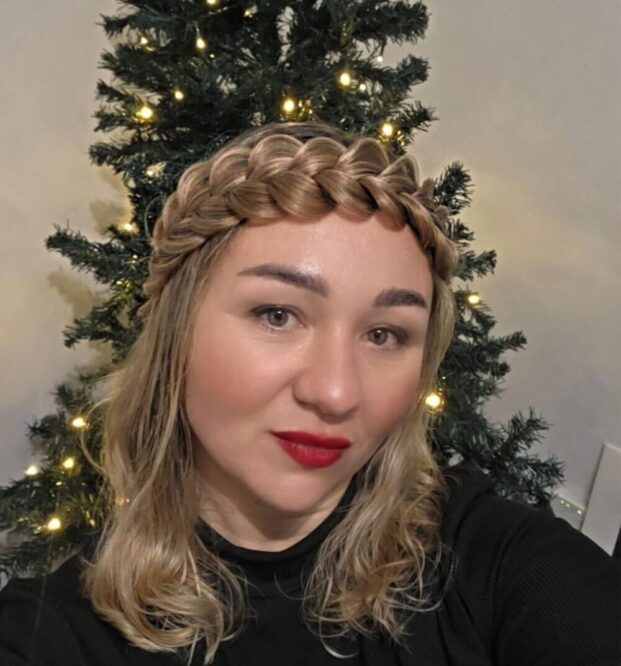
Yuliia explains that the local Ukrainian population is not large, maybe about 160 altogether in Caerphilly County Borough. “When I first moved here I started to meet other Ukrainian refugees and that’s how we started to form a community. Since July 2022 I’ve been organising community meetings on Saturdays, an English-speaking club and visits by various speakers to help people with integration. ‘
We are very happy with the help, support and welcome we’ve received in Wales which has been really huge, from local residents who not only opened their homes but also their hearts. Ukrainians who stayed with hosts here basically became a part of their families.”
Traditionally Yuliia’s family, back home in Ukraine, always celebrated Christmas on the 7th January, following the pattern of the Gregorian calendar. “Officially it was only two years ago that they moved it to the 25th December. It still feels strange to celebrate it on the 25th when for all of my life it used to be the 7th January.”
Family
“But it’s not really about the date, it’s about gathering the family together, that’s what matters the most. For Ukrainians who are displaced it’s not generally such a positive day. According to recent statistics thirty per cent of Ukrainians in the UK lost family members in the war.
“Many people here had to leave their family behind, so these days can feel a bit lonely and sad. When Ukrainians gather with their friends and families who hosted them it makes a difference, makes them feel happier and better.”
Yuliia and her family now celebrate Christmas on the 25th of December: “Setting up a tree, arranging the food and everything. I try my best to pass on all my family traditions to my kids. But there are differences when it comes to men with white beards delivering gifts. “Our St Nicholas doesn’t come on Christmas Day and he puts his gifts under the pillows.”
Yuliia’s mother still lives in Ukraine and for the past two Christmases they have been apart and so Yuliia felt a bit alone, being separated from her family. But this year will be different. After celebrating Xmas with her children she is going to celebrate New Year with her mother.
“It’s a long journey to Eastern Ukraine. I start travelling on the 29th just to arrive on the 31st, travelling by bus to begin with to Bristol airport and then on to Krakow. Then by overnight bus to Lviv in Ukraine, train from Lviv to Kiev – which is around ten hours, then another ten-hour journey by train from Kiev. And then there is a bus journey, which is difficult because my home location is a war zone so it’s even more difficult to get there by public transport. Ukraine is a huge country so it literally takes me three days to get there and another three days to get back.”
Is it Yuliia’s ultimate aim to return to Ukraine? “It’s difficult. If you’d asked me this question last year I would have said yes, without any doubt, I’m just waiting, But now I feel my kids are very well integrated here, I feel that it will take quite a lot of time to rebuild Ukraine even if the war stops now, which is not the case. Definitely I will return to Ukraine on the day my youngest child turns eighteen.”
What has Yuliia discovered about Wales during her time living here? “I like nature a lot so I like the hills here. Some places look a bit like the Carpathian mountains in western Ukraine. It feels a bit familiar even though I’m not from western Ukraine.
“I like the people here and feel that Wales and Ukraine have a lot in common in that for centuries we have been oppressed, culturally and in terms of language by a larger, more powerful neighbour. Since I came here I’ve organised groups to learn Welsh and Welsh history, inviting historians and arranging Welsh classes for Ukrainians in Caerphilly, an integrational effort and went to see the rugby in the Six Nations – we were kindly given tickets for almost all of the community. I would like to see more of Wales but since I got here in 2022 it’s been about survival, integration, about supporting other Ukrainians.”

Jon Gower is Transport for Wales’ writer-in-residence. He will be travelling the breadth and length of the country over the course of a year, reporting on his travels and gathering material for The Great Book of Wales, to be published by the H’mm Foundation in late 2026.
Support our Nation today
For the price of a cup of coffee a month you can help us create an independent, not-for-profit, national news service for the people of Wales, by the people of Wales.


