

Making Tracks: Cardiff Central
Jon Gower charts the history of Wales’ busiest railway station and searches for its invisible platforms.
I’m a Great Engineer and no end of a swell
And my name it is Isambard Kingdom Brunel
My hat is a stove pipe my seegar puffs steam
And I’m driven along by the quest of a dream.
From ‘The Engineer’ by Harri Webb
Eleven million passengers use Cardiff Central each year: that’s equivalent to over three times the whole population of Wales passing through the ticket gates.
Family reunions, journeys to work, lovers’ trysts, holidays, visits to Vladivostok, Gobowen or Dingle Road can start or finish here.
Most of the journeys for this book, indeed, do just that, after a ten-minute cycle ride from Canton in all weathers, before travelling on to all points in a small country which has often felt more like a multiverse, with almost too much to see.
There will be times when the entire Welsh population seems to arrive at Central at once, such as big concert occasions when Bruce Springsteen or Ed Sheeran is in town, or on match days, when football fans wear their beanies, bobbles and Peruvian hats before walking over to Ninian Park. T
here’ll be dragon motifs galore and the words ‘Yma o Hyd’ duly emblazoned in red, white or green or, indeed, etched indelibly on the heart. Days of dedicated rugby fans wearing team kit along with outsize leeks and daffodils.
On days like this, Central Square will fill with railings to marshal folk onto the correct departing trains. There’ll be the carousing, celebratory air should the home team win, or the slumped shoulders and resigned silence should they not. And of course there’ll be the weekend cavalcade of colour when the hen parties mix with the stag dos and the costumes announce a one-night carnival of celebrations.
Women in heels and dazzling dresses and comical men masquerading as characters from the Marvel Universe or ones with coconut bras or horned Viking helmets made of plastic.
Then there are the Prosecco-swigging, up-all-night revellers who spill out veeringly into the drinking clinics of St Mary’s Street and the late-night feeding stations of Caroline Street, a.k.a Chippy Lane. Chicken curry-off-the-bone is always much in demand.
Pulsing with life
From the time when the first train of the day is shunted in from the Canton Yards under dawn or pre-dawn light to the late trains arriving in the wee small hours, such as the red-eye from Chester which gets in just before two, the station pulses and pumps with life, people thithering and hithering or dawdling idly with one eye fixed on the arrivals board.
There’ll be hugs and cwtches or tearful farewells. It’s a grand parade and a truly fabulous spot for people watching, that’s for sure.
The Welsh poet Edward Thomas charmingly described the nature of station encounters in the age before mobile telephony and personal headphones in his Beautiful Wales, published in 1905. ‘They converse readily in trains; they are all of one family, and indeed if you are Welsh, not only can you not avoid meeting relatives, but you do not wish to. Small news about the coming and going of people, and I have never got out of a train in Wales without feeling that I shall meet some one whom I should like to meet, on the platform or on the first street. They like their own land in the same way.’
When the journalist Ian Parri arrived here during his train trip around Wales, chronicled in the very funny Cyffordd i Gyffordd, he found the station to be one wild frenzy of humanity, folk rushing here and there with their possessions dragged squeakingly behind them.
He had the uncomfortable feeling that every single one of them was somehow coming to meet him. It would have been a discombobulating moment, one to set the pulse racing.
Spectacular
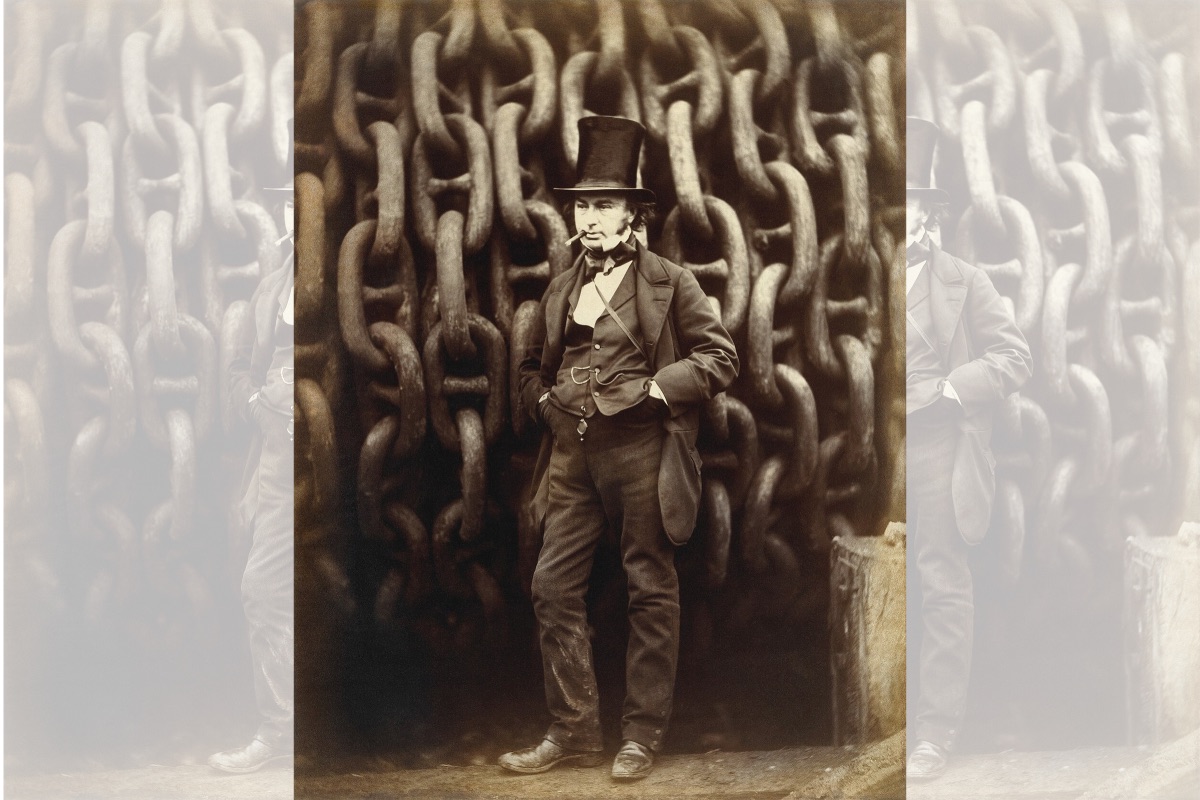
Isambard Kingdom Brunel, born in 1806, is perhaps the best known of all British engineers, who had a career both spectacular and creative. People can easily imagine him, not least the passengers who pass the statue of him as they board trains at London Paddington.
His popularity is in part explained by the success of a brilliant but informal public relations exercise, as Stephen K. Jones, author of an authoritative trilogy of books about him, explains. ‘Brunel managed to get himself photographed, in the infancy of photographic portraiture, standing in a confident posture in front of the giant chains used to restrain the launch of the PSS Great Eastern.’ Brunel is the very poster boy for the ambitious Victorian engineering spirit.
Brunel was the sort of engineer who would think nothing of changing the course of a river if it was in the way. Which is precisely what he did in Cardiff in the 1840s.
The South Wales Railway had surveyed an area with a view to creating a station site in central Cardiff, but their plans were thwarted when they found out that the land was flood-prone. Brunel proposed and carried out a major rerouting of the River Taff to the west to create a long, dry site for an east-west station in 1849.
The new embankment made the site viable and moved the course of the river away from what became known as Cardiff Arms Park, thus helping cure some of the drainage problems from which the area always suffered.
It also paved the way for a mainline terminus. Brunel’s mid nineteenth-century realignment of the River Taff was a transformative engineering feat that reshaped Cardiff forever and laid the groundwork for its evolution from industrial port to capital city.
The station evolved in step with the city. On 19th June 1850, it opened simply as ‘Cardiff’ on the South Wales Railway, providing a purpose‑built principal station on the new Gloucester-Swansea route. Later in the same century the station’s footprint grew, claiming more space alongside the old Glamorganshire Canal and the burgeoning dockside infrastructure that had helped shape and accelerate Cardiff’s industrial growth. In 1924 the station was renamed Cardiff General, as part of a more general rebranding exercise.
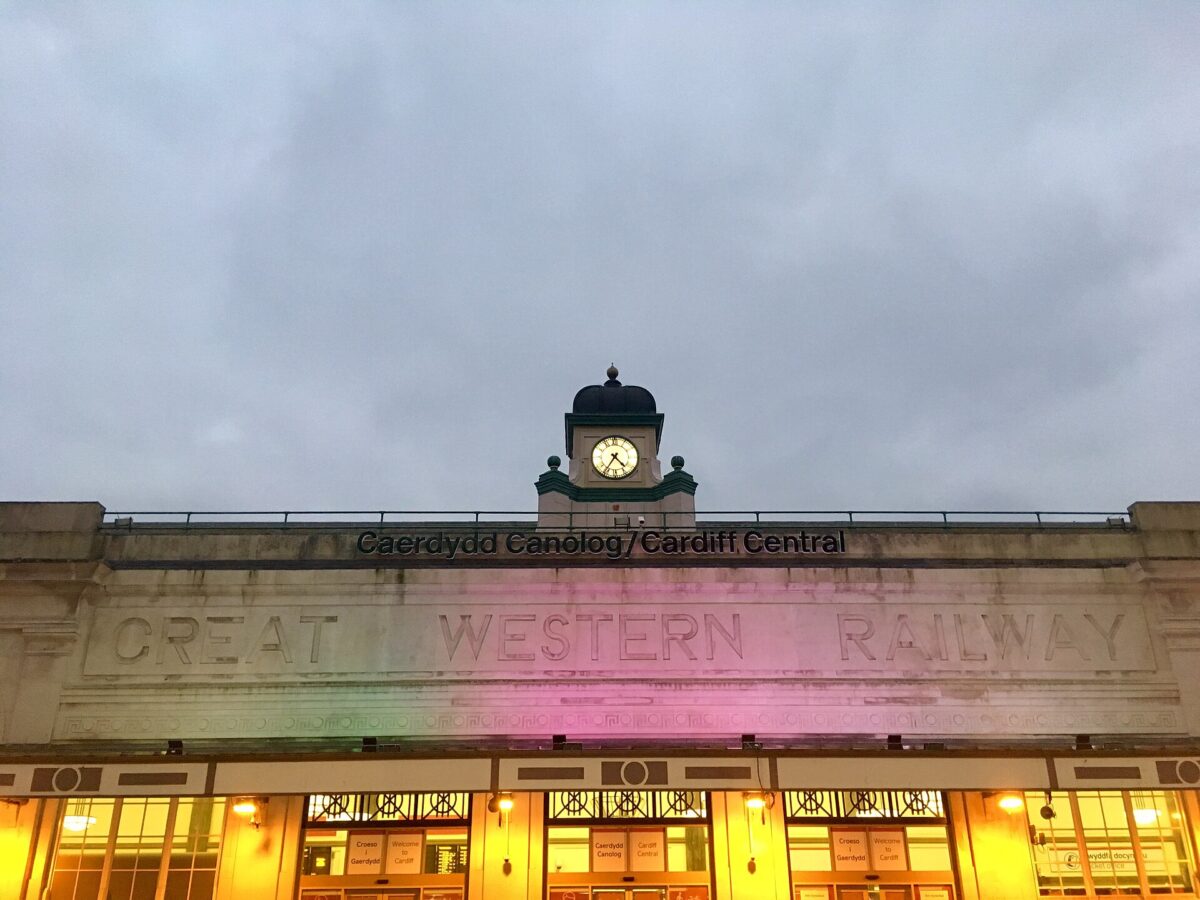
More substantial change was wrought between 1931 and 1934 when there was a major rebuild of the station by the Great Western Railway. This produced the present concourse and frontage, the cupola for the clock, along with Art Deco interior fittings.
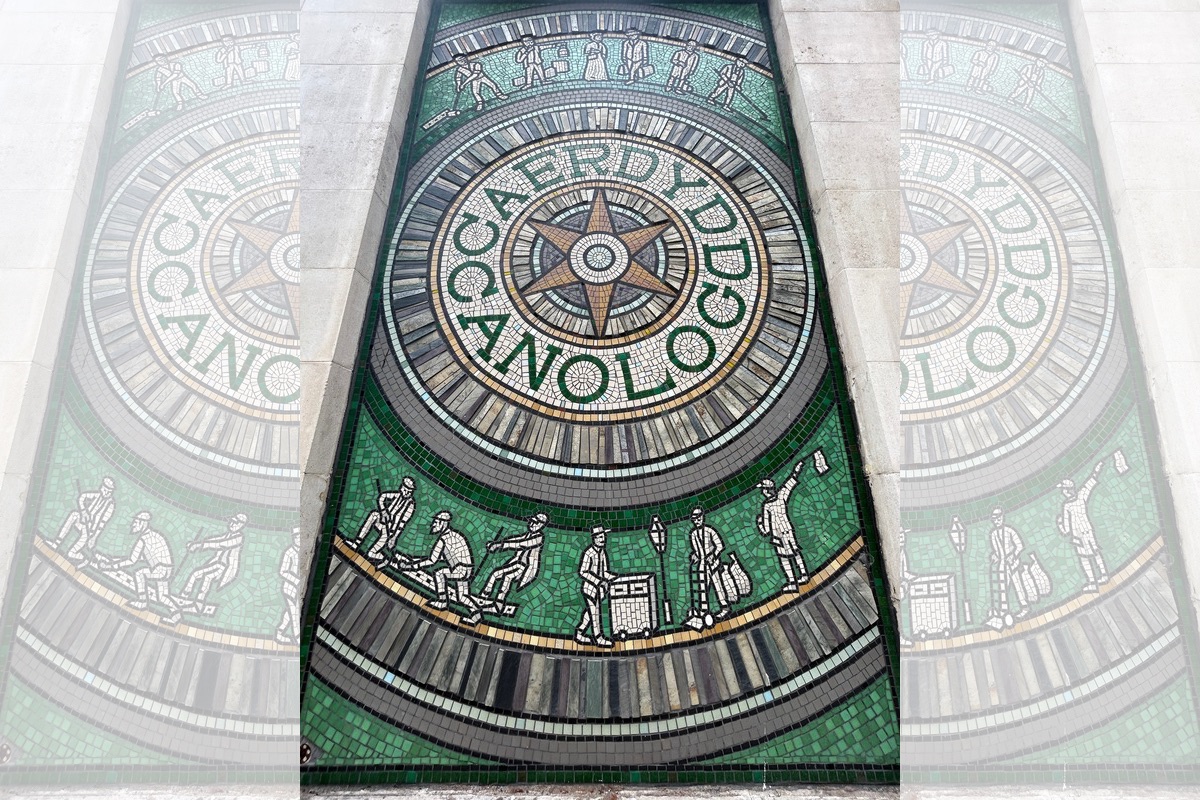
The GWR’s works also involved significant townscape change north of the station. The architectural expert John Newman considered the resulting station buildings ‘quite an ambitious ensemble, which survives remarkably complete’.
With time to stand and stare, Newman notices things rail passengers in a rush might not do, such as single-storey platform blocks faced with ‘cream-glazed Doulton Carrara-ware’ while the island platforms ‘are in stone with canopies supported by cast iron Tuscan columns and corbels’.
The nearby working-class district, Temperance Town, was cleared during the late 1930s in order to improve the outlook of the rebuilt station changing the physical and social landscape of Cardiff and the area around the station.
The Great Western Railway has its full name carved on to the façade – larger than the name of the station. The rebuild also saw a number of other improvements including the lengthening of the platforms, the widening of the Taff River railway bridge to allow the approach lines to the station to be quadrupled, and the installation of colour-light signalling.
The rebuild of the station cost the GWR £820,000 (equivalent to £50,740,000 today) and was formally opened by the Minister of Transport Oliver Stanley on 26th February 1934.
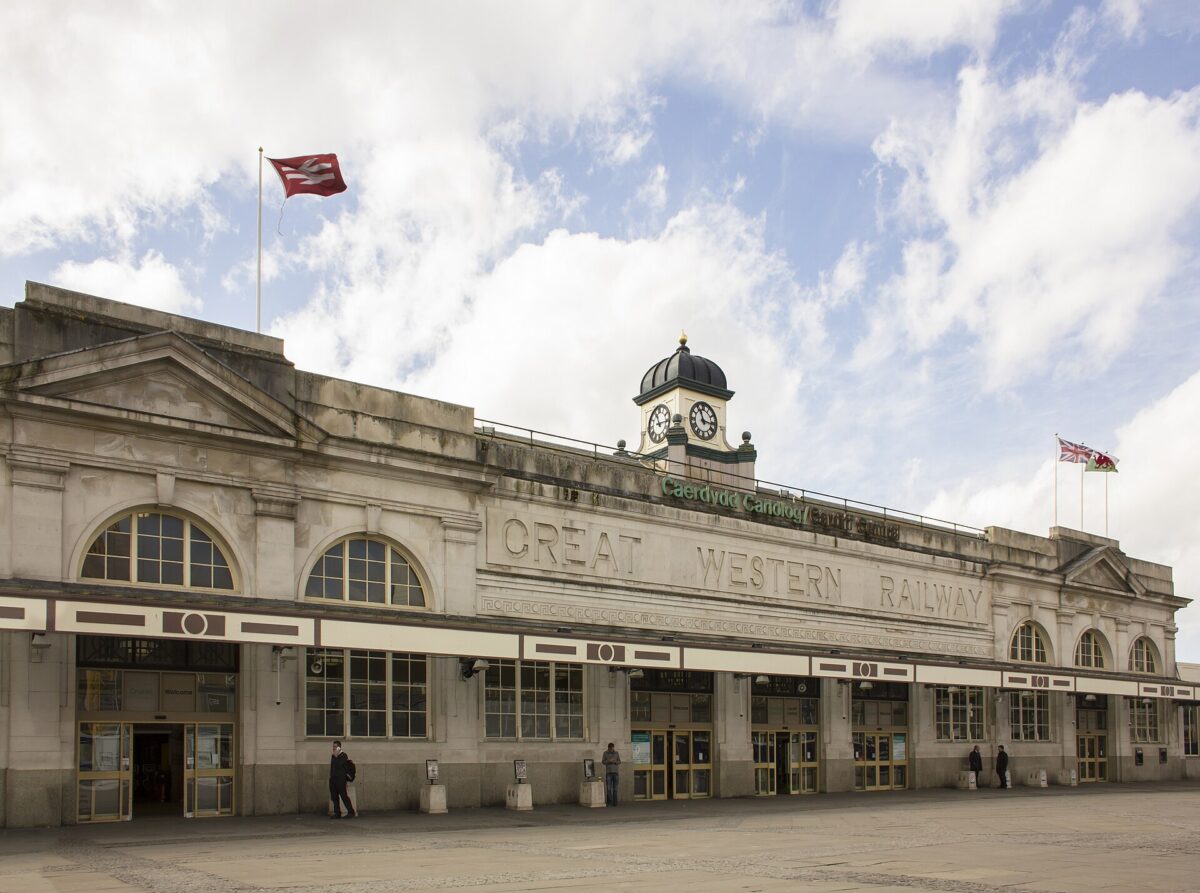
Cardiff Central’s iconic 1930s Art Deco façade is clad in Portland stone – a fine, pale limestone quarried exclusively from the the Isle of Portland in Dorset, which hangs like a pendant on England’s Jurassic Coast.
Great Western Railway often used Portland stone in its major city stations and it was used by Percy Culverhouse – the architect of the station – to create a consistent architectural identity.
The current Art Deco lamps in the booking hall are replicas of the originals, installed in 1999, having been funded by the Railway Heritage Trust. Which helps explain why the entire booking hall is Grade II listed, carrying over the glowing elegance of a bygone age.
Wartime
World War II, fought between 1939 and 1945, brought both turmoil and drama to Cardiff Central as bombers emptied their payloads of munitions over the city. The station was a key strategic target due to its importance in moving troops, coal and munitions. During 1940 the Luftwaffe targeted Cardiff on 3rd, 10th and 12th July and 7th August. This was followed in 1941 with raids on 2nd, 3rd and 10th January.
Over 100 bombers attacked the city over a ten-hour period, beginning at 6.37 p.m. on the night of 2nd January 1941. Dropping high-explosive bombs, incendiary bombs and parachute mines, the Riverside area was the first to be hit. In Grangetown, the Hollyman Brothers Bakery was hit by a parachute mine and 32 people who were using the basement as a shelter were killed.
When the raid was over, 165 people had been killed and 427 more injured, while nearly 350 homes were destroyed or had to be demolished. During that Cardiff Blitz of 1941, the area surrounding the station was heavily bombed, but the main building miraculously survived with only minor damage.
In 1942, a raid on 17th May hit the railway station, and a 1,200-pound (540 kg) unexploded bomb threatened to stop rail traffic.
One of my favourite stories from the war is local to the Canton area. During a German bombing sortie an Air Raid Precaution warden was moving an old lady to the air raid shelter when she said she had to go back to get her false teeth. At which point the ARP man said, ‘Madam, Hitler’s dropping bombs not sandwiches.’
Key role
Although Cardiff was officially named the capital of Wales on 20th December 1955, the station wasn’t renamed Cardiff Central until May 1973, reflecting its key role as the capital and the city’s main transport hub.
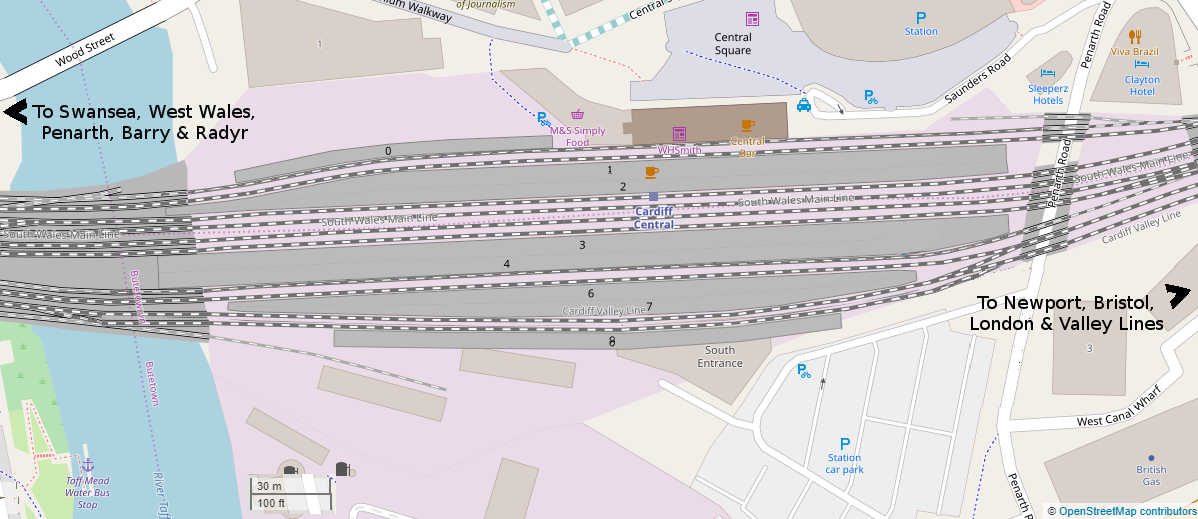
If you look at the platform numbers at Cardiff Central Railway Station, something doesn’t quite add up. There’s Platform 0 to begin with, like something out of a Doctor Who episode about a planet in a far-off galaxy that doesn’t exist. In reality it was the solution to a problem, increasing the number of available platforms without having to renumber the whole station.
The passengers waiting for, say, the 12.03 to Ebbw Vale have both the Mayans in central America and the early mathematicians of India to thank for that 0.
The Mayans first developed a symbol for zero in the fourth century AD. By managing to indicate an absence they were able to create complex timekeeping systems and make astronomical predictions.
At roughly the same time, Indian mathematicians also defined zero and embedded it into their system of numbers, with one called Brahmagupta in the seventh century introducing rules for arithmetic involving zero, dramatically impacting subsequent mathematical thought in the region.
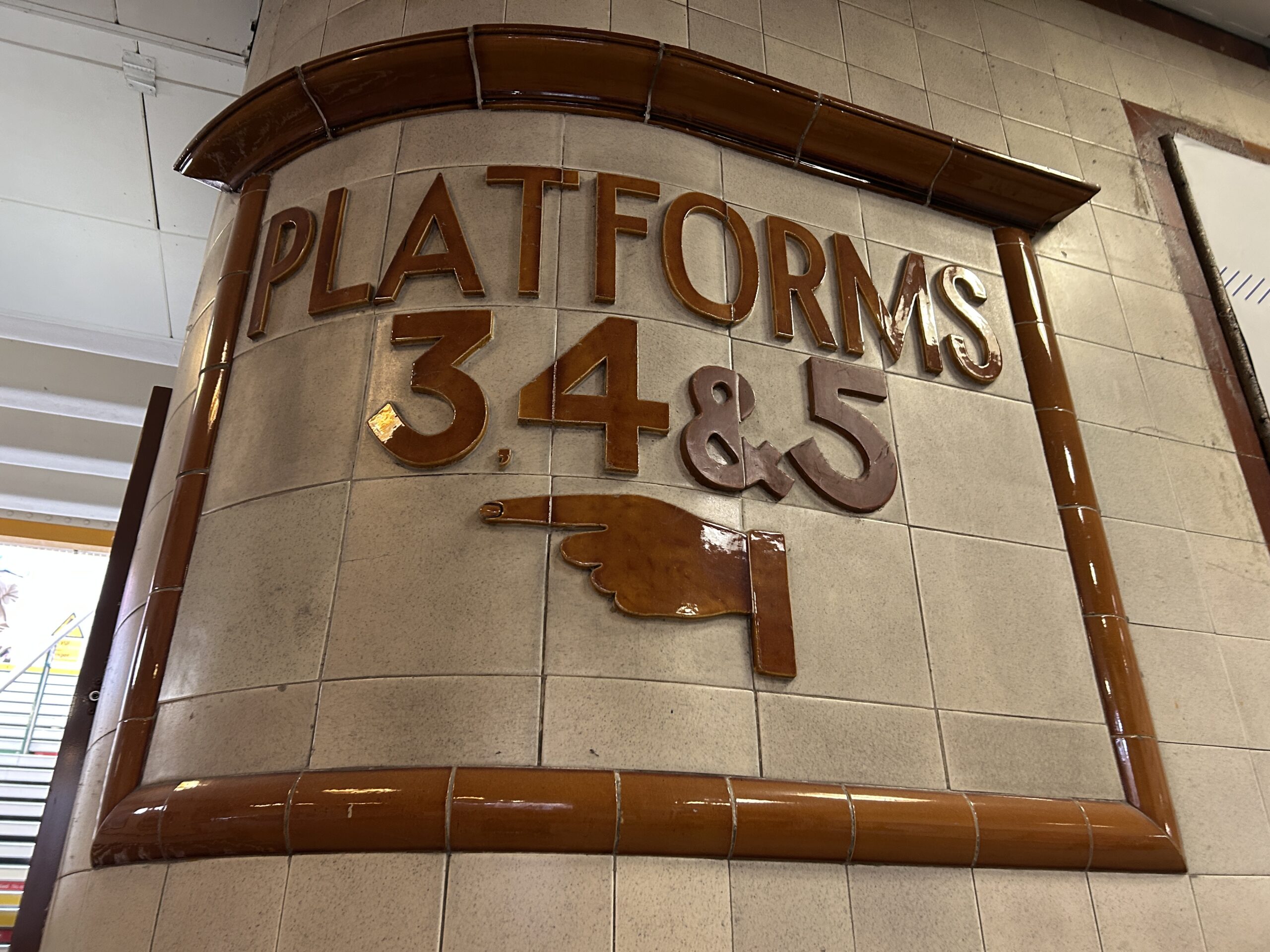
Cardiff isn’t alone in having a Platform 0. There’s one in London King’s Cross, which of course has the Platform 9 and three quarters featured in the Harry Potter books, while other Platform 0s are to be found in another half a dozen British stations including Bradford Forster Square, Doncaster, Edinburgh Haymarket, Gravesend and Leeds.
You could go mad trying to find Platform 5 in Cardiff Central, though. You’ll find signs for it but it’s long gone and, perhaps even more confusingly, used to be located between Platforms 3 and 4.
The Art Deco signage for it is lovely, though.
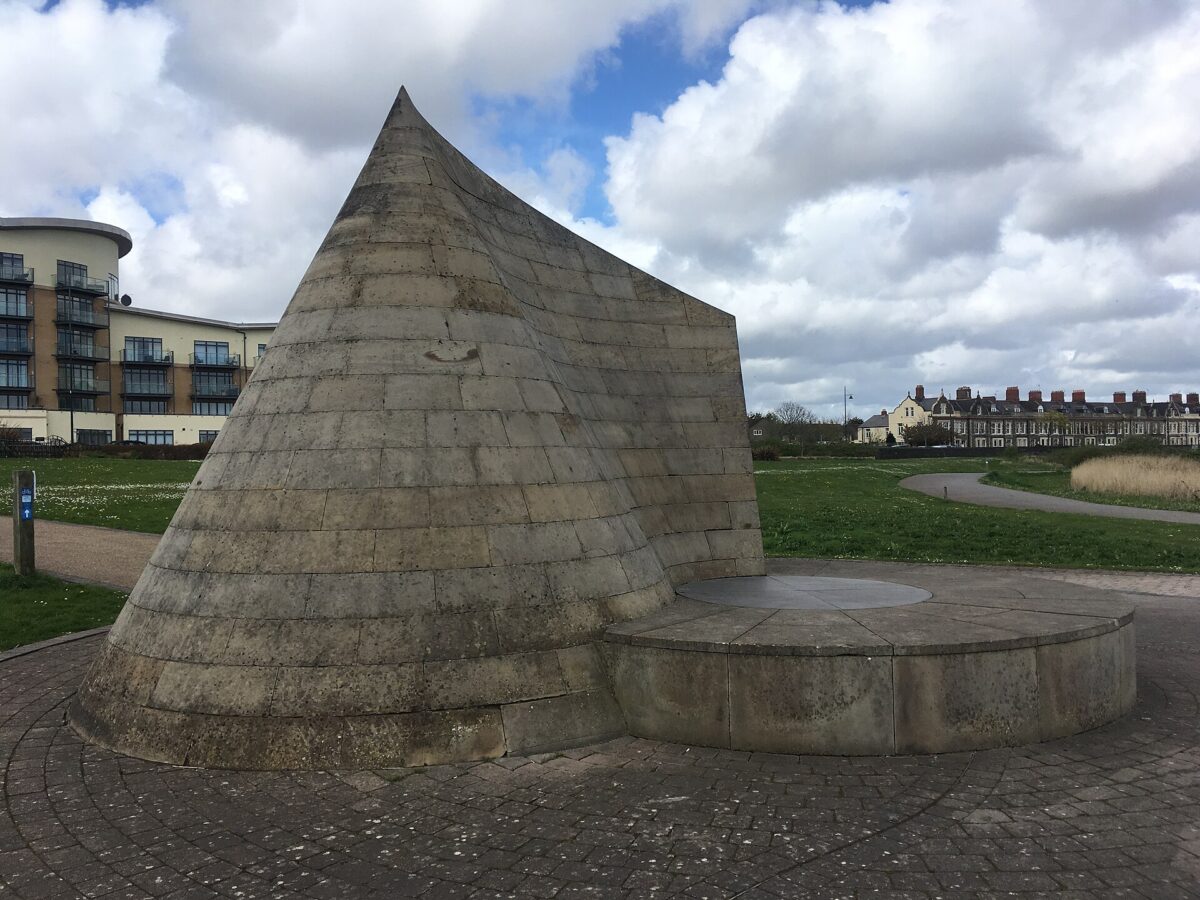
There used to be a mountain outside the main entrance of Cardiff Central, or at least a representation of one.
The sculptor William Pye’s Cader Idris is a tall, conical and waved representation of Wales’ second highest mountain, complete with steps and seating. It was originally unveiled in 1999 when the work, made of wood kirk sandstone, blue pennant slate and bronze, formed a central feature of the pedestrianised area adjoining the station.
It had to be moved to a new site when the old bus station was redeveloped. It now sits on a grassy knoll overlooking the Cardiff Wetlands Reserve with its rafts of coot, nesting great crested grebes and chattering Cetti’s warblers: a small mountain, commanding vistas over the bay and its barrage.
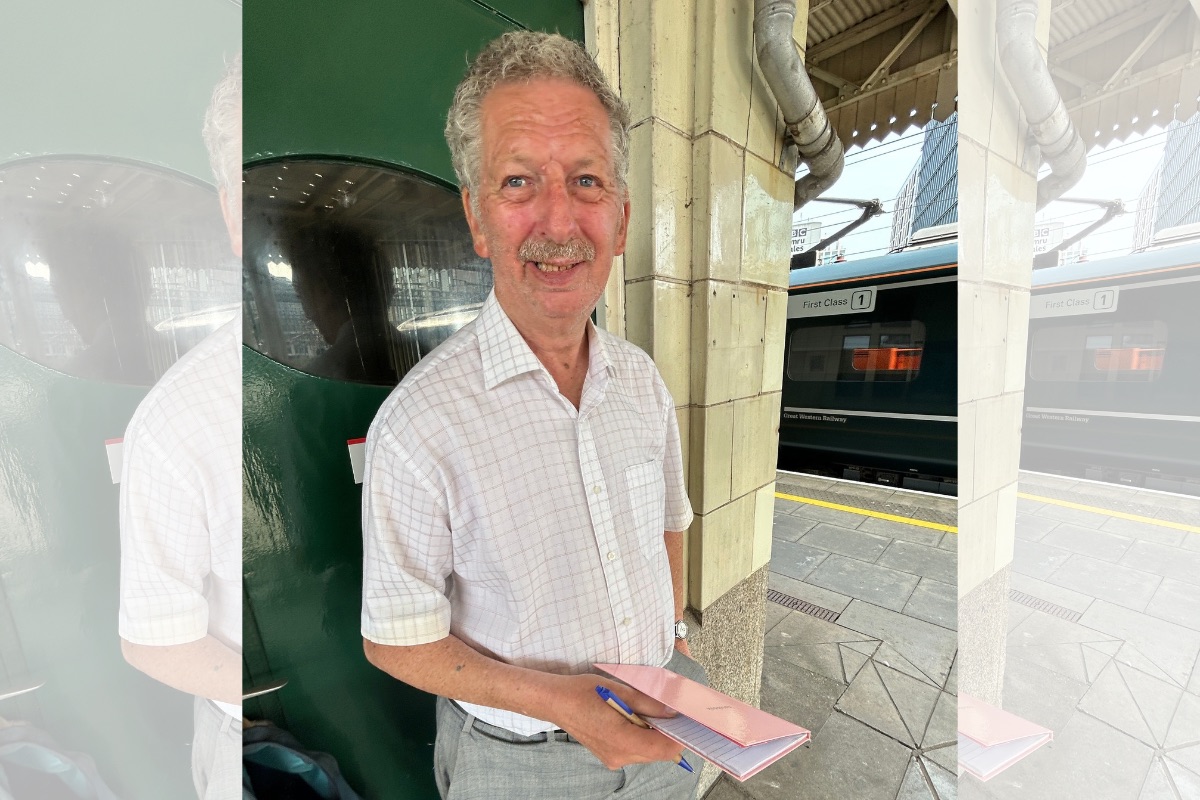
Train spotter Paul Saville lives in the Heath area of Cardiff and travels down to Central four or five days a week.
Originally from Devon, Paul’s father worked on the railways. Paul became interested in trains and thus train spotting when he was a young man and particularly appreciated having free railway tickets taking him to places such as Exeter and Plymouth.
A retired civil servant who did 45 years, he has a bright pink notebook to hand to jot down today’s train numbers: he has stacks of such notebooks.
As he chats with me, Paul keeps one eye on the signals, the green one alerting him that a train is on the way. ‘That one, 028, has been through every morning. That’s your Carmarthen train. I can tell you exactly what they’re going to do. It’ll go to Swansea and come back as the 11.18.’
Paul prides himself on knowing pretty much all the trains using the station, a sort of human timetable standing on Platform 3. ‘If I was home I’d be bored to tears, but all the staff know me and I know them. I know the chargemen. I know one over there, I’m going to have a chat with him in a minute if he’s free. And I meet train spotters from all over the country.’
One of those is Peter Smith, who travelled down on an early morning train from Hereford to spend the day at Cardiff Central. ‘I take down the fleet numbers. I have a full list at home, published by the Intercity Railway Society. The last time I came here was 12 months ago. I’m looking for local stuff – the new 756s and the 231s. I’ll be travelling home on the 197, which I like.’
Peter’s interest in trains started in childhood as his home was by the side of the railway in Hereford. ‘I left school, got into work as a heavy goods vehicle driver and that was the end of it. I’ve been doing it again for about 20 years now. I don’t get the chance to go out much because my wife is disabled so I look after her.’
Paul recalls times when train spotting was much more popular. ‘Absolutely, in the steam days. There was an awful lot of spotters who packed it in when the diesels came along.’
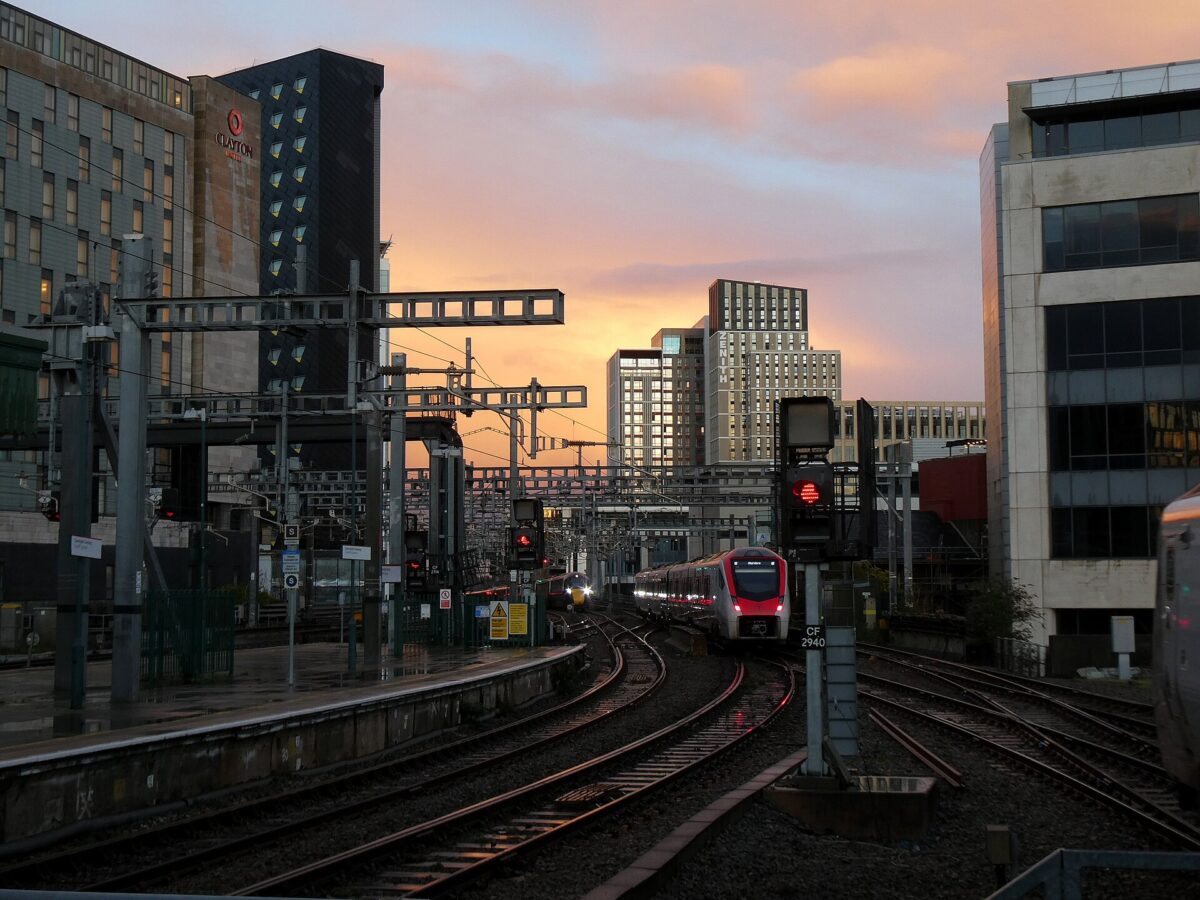
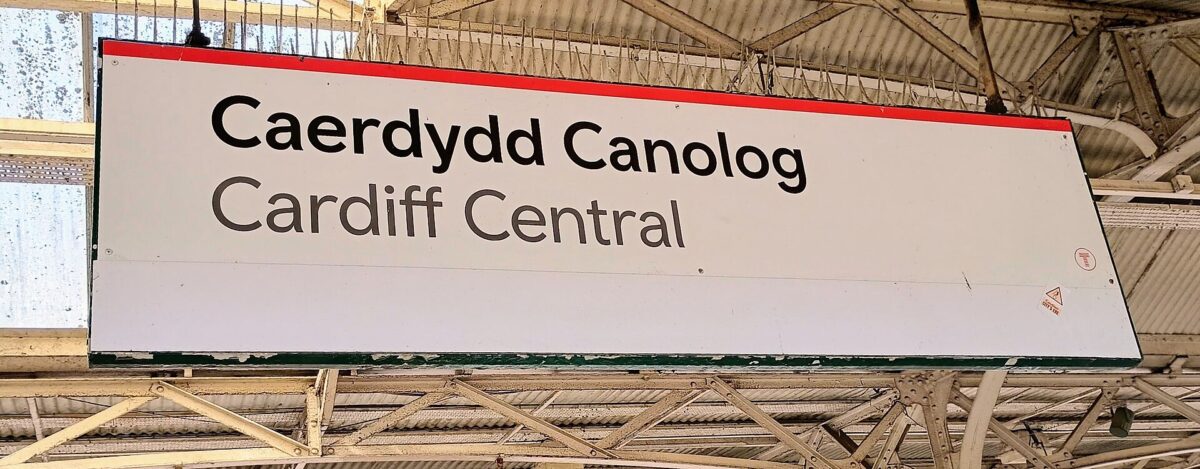
Cardiff Central. Caerdydd Canolog. All the bustle and hustle of hurrying humanity. Destination and departure point. The ozone smell of brakes. The green and red signal lights winking as the city darkens.

Jon Gower is Transport for Wales’ writer-in-residence. He will be travelling the breadth and length of the country over the course of a year, reporting on his travels and gathering material for The Great Book of Wales, to be published by the H’mm Foundation in November.
Support our Nation today
For the price of a cup of coffee a month you can help us create an independent, not-for-profit, national news service for the people of Wales, by the people of Wales.
Get more trusted Welsh news
Choose Nation.Cymru as a preferred source in Google News to see more of our journalism.


