


Making Tracks: Chirk
Jon Gower finds out about an international playboy who set up the first Welsh National Theatre and explores a borderlands village where history runs very deep.
Chirk is a fascinating, well-manicured village perched on high ground commanding long views towards the Berwyn mountains.
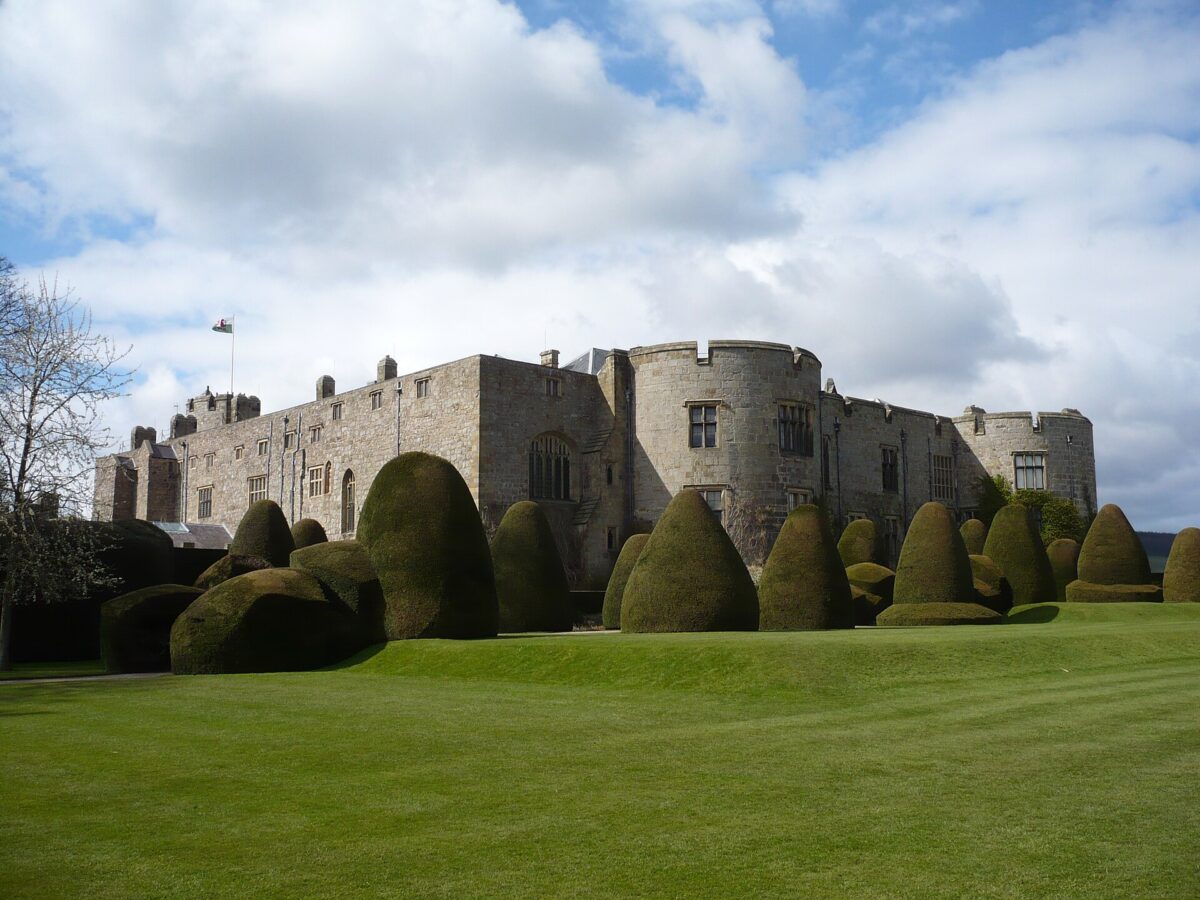
It also overlooks both river and roads, guarding the entrance to the Ceiriog Valley. This accounts for not one but two castles. Castell y Waun is a simple, Norman motte and bailey, erected in 1135 by Lord William Peveral of Dover. The other, far more substantial pile is Chirk Castle; an implacable Marcher fortress built by Roger Mortimer as a contribution to Edward I’s campaigns in Wales, complete with an elegant, later hall designed by Pugin.
Its squat, round towers give the impression of a building hunkering down in the face of attackers: architecture as solid defence.
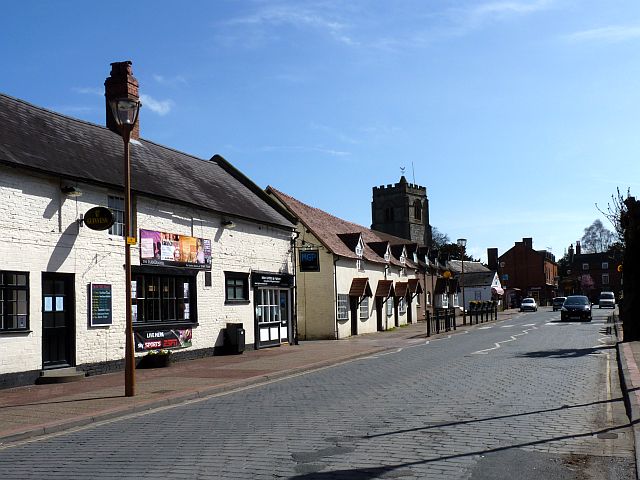
I meet Graham Greasley, a deeply knowledgeable guide to this borderlands village. Born and bred here, he’s a bona fide Chirker, as such residents are known.
As for the name of the place itself the etymological jury’s out: it may be an Anglicization of the river Ceiriog, which seems a bit of linguistic stretch while it may also derive from the Old English cirice or church which leads to Chirchelande and thus to Chirkland.
The Welsh name, Y Waun refers to moorland near the castle – presumably a bit wilder in the past – which appears in the local lordship, Swydd y Waun.
Chirk sits on a border which has changed and shifted over the centuries. As Graham points out, it’s a bit like the river Ceiriog, which it overlooks – changing shape over centuries of meandering.
‘When Offa built his dyke Chirk was England, it wasn’t Wales and of course in the 1300s this was Marcherland, so again it was English, it wasn’t Welsh.’
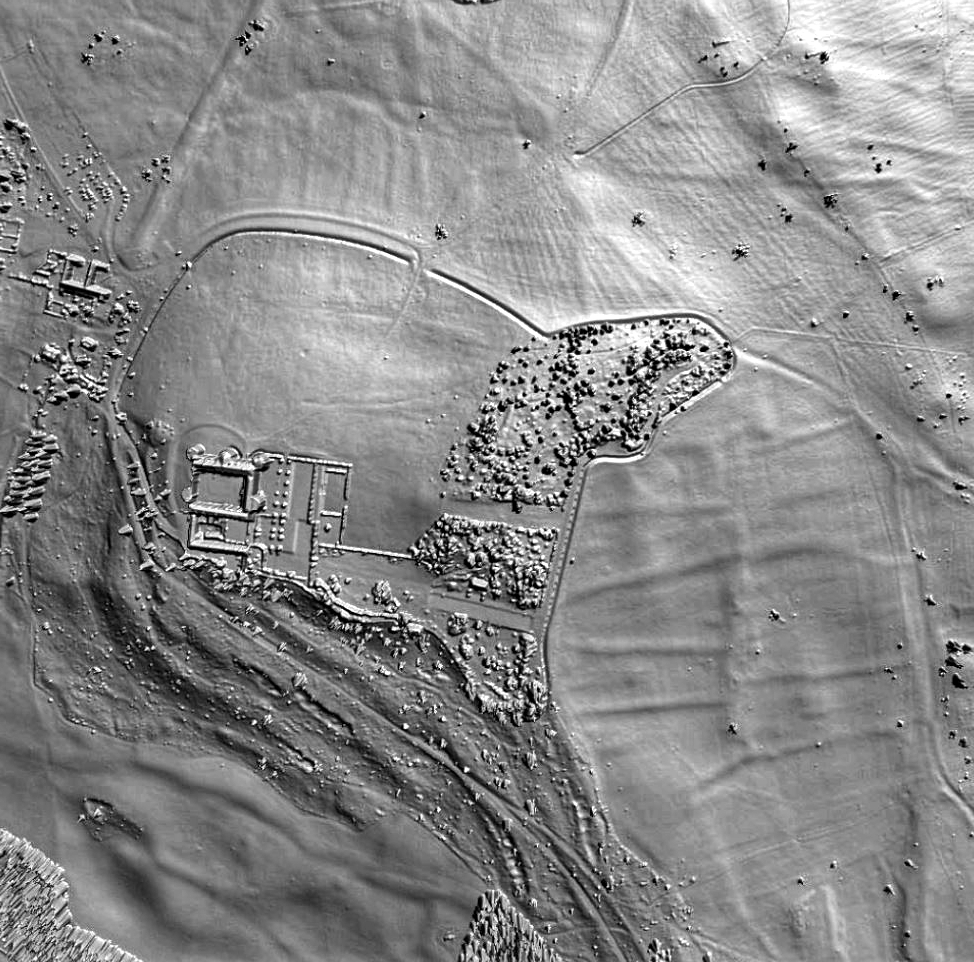
The stretch of Offa’s Dyke near Chirk castle is one of the best preserved, a case of a Mercian king hedging monumentally against his neighbours.
Our whistle-stop tour begins with venerable, 400 year-old oak trees which stand along the castle drive. When George Borrow similarly admired them in the company of his trusty servant, John, he remarked: ‘They would make fine chests for the dead, sir.’
We then walk down a steep incline to scout around Chirk Aqueduct. This was built by William Jessop and Thomas Telford and opened in 1801 and – in a double-decker arrangement – 35 feet above it is the Chirk Viaduct, carried atop twelve arches.
These support the railway line that still carries trains bound for Chester and Holyhead. Travellers will know the sudden drama of the peer down the valley, where the land drops away towards the thin silver snake of river below.
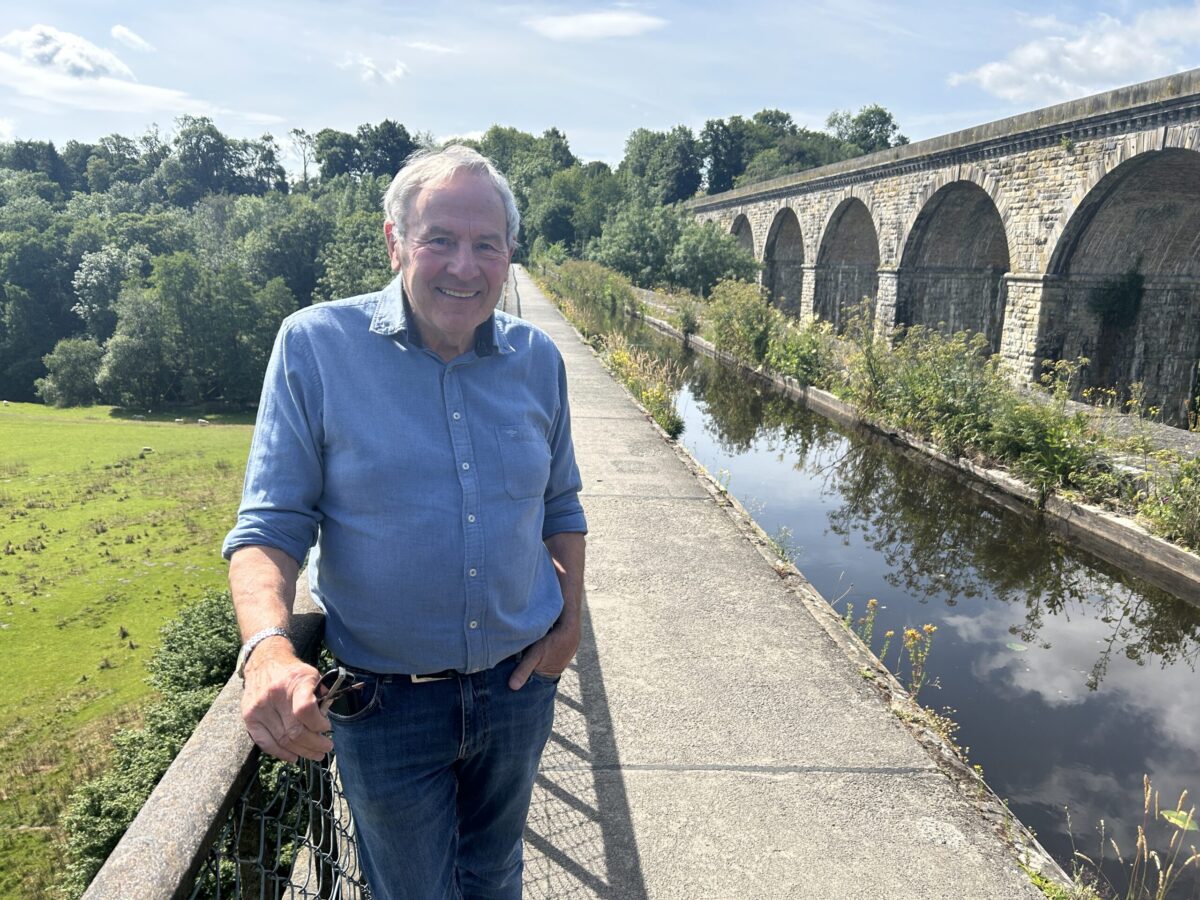
You do need a good head for heights to stand on the edge of the aqueduct, with its vertiginous sheer drop.
A brightly coloured boat putters along this, the Llangollen Canal at the most leisurely pace: its relaxed navigator lifts one hand as he guides it dreamily on.
I’m reminded of one of Trevor Fishlock’s elegant sentences where he suggested ‘Life on the canal-side is slow: the day unwinds before you like pizza dough.’
Graham and I admire not only the feat of engineering that allows the boat to travel as if high in the air but also the fact that both the aqueduct and viaduct aren’t just functional: there are touches of decoration too, reflecting the swaggering confidence of Victorian engineers.
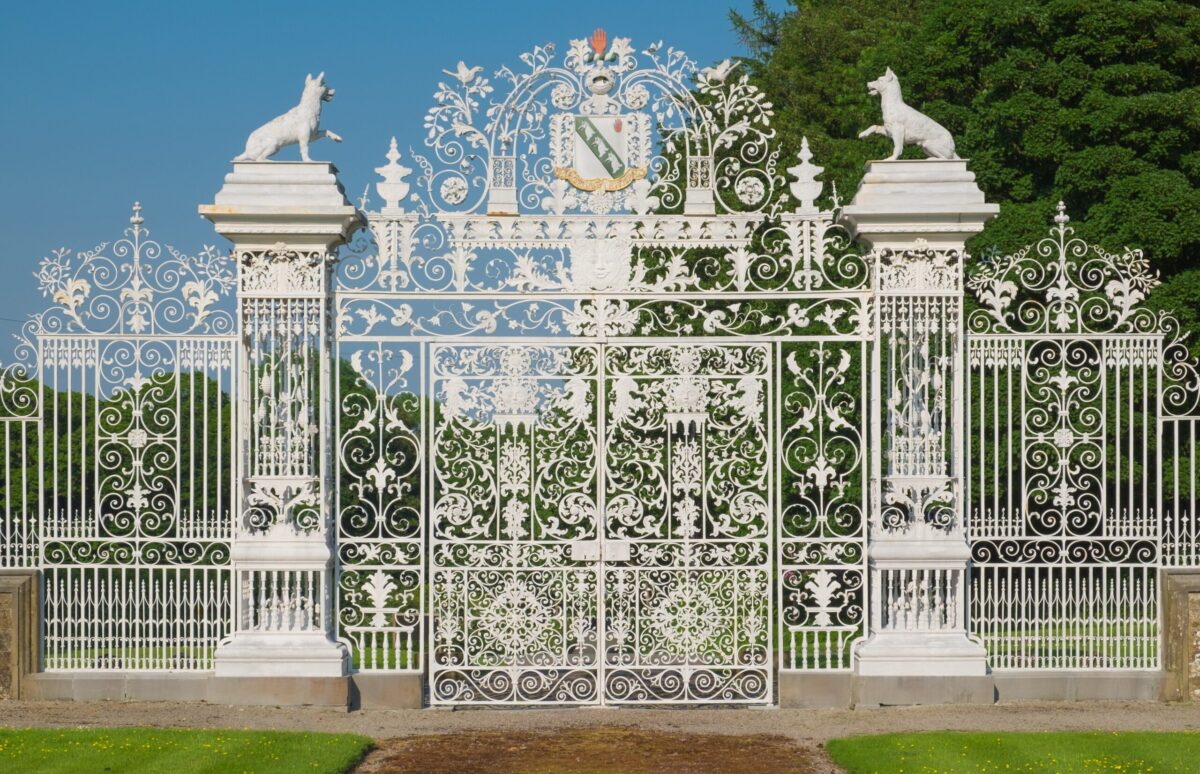
In the unlikely event of there being a competition to find the best castle gates in Wales then Chirk Castle would probaby be the hands-down winner.
The magnificent wrought-iron gates and gate screen are nothing short of masterpieces, each component featuring a delight of swirls and loops and flowers forming a delicate filigree in which hard metal is seemingly spun like spider threads.
They were made in 1711, to a commission by the owner of the castle, Richard Myddelton, who entrusted the work to the Davies family whose Croes Foel foundry was located not far from the centre of Bersham.
Bersham was itself a busy centre of metalmaking and working in the Welsh north- east. Two members of the family, Robert and John fashioned some of the best examples of ornamental ironwork anywhere in Europe, a wild Welsh rococco which takes its cue from those designed by Jean Tijou at Hampton Court.
All this was achieved for a rate of pay of two shillings a day, as well as the occasional ‘expenses for drinks for the forge men,’ – working hot iron often involved slaking a raging thirst. A pint or four were often very much in order.
The coat-of-arms of the Myddelton family is the crowning point of the design of the “overthrow” – the section of ornamental wrought ironwork which forms a decorative crest above the gates.
This incorporates the red “bloody” hand associated with the Myddelton family which features three wolves’ heads and an eagles head. These features are then incorporated further into the design features; eagles heads springing from acanthus scrolls in each of the gates.
Graham explains that red hand motif over coffee in The Hand Hotel, one of a few hostelries bearing the same name in the wider area. This one used to be the town house for the Chirk Castle estate and was also a coaching inn on Thomas Telford’s A5, which connected the port at Holyhead, and thus Ireland with the city of London.
The pub takes its name directly from The Red Hand of Chirk. Graham explains, ‘The official explanation is that a supporter of the king, who had been in battle, got a bloody, red hand. Another is that there was a race from the village to get to the castle, the two sons on their horses, trying to be the first one to get to the old man lying on the bed.
One chopped his hand off, threw it on the bed, so he technically won the race. Of course, if you chopped your hand off, you’re going to be dead within 30 seconds from loss of blood, aren’t you? But it’s a good story to tell the kids.’
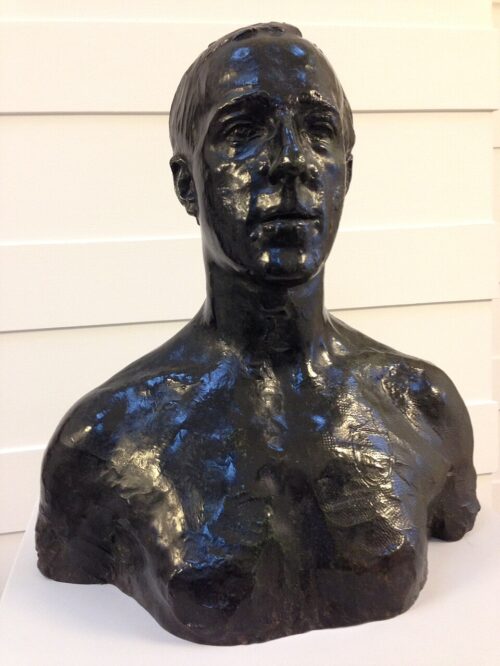
Playboy Philanthropist
Howard de Walden was a simply extraordinary character, a mixture of international playboy and cultural philanthropist. A national fencing champion, rally car driver, wild animal hunter, theatre owner and billionaire, Walden was also devotedly concerned with Wales, which he described as ‘the country of my heart.’
Dashing and debonaire, he was a driving force in the creation of a Welsh National Theatre, much like actor Michael Sheen, who formed a company with the same name in 2025.
De Walden busily supported eisteddfodau and philanthropically commissioned new plays, being ‘in effect a one-man Arts Council of Wales.’
He also learned Welsh to the extent that he could write as well as read the language – quite a life journey for the eighth Lord Howard de Walden, owner of much of London’s Marylebone and therefore not short of a bob or two.
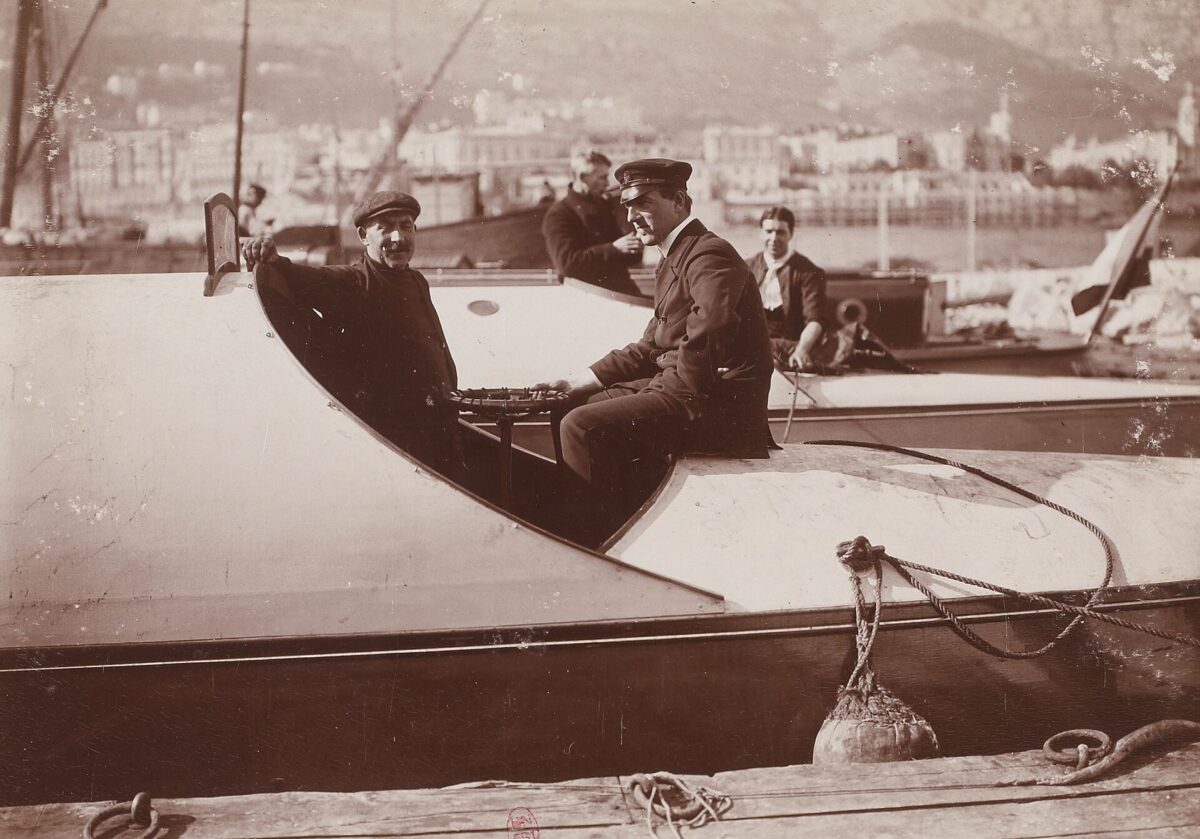
His was a lonely childhood. His father was a luxury version of a recluse, living onboard ocean-going liners, while his mother chose an independent life in the south of France.
So, in the absence of both parents an introspective, lonely child sought solace in the pages of books, especially colourful tales of chivalry in the Middle Ages.
In 1910 he visited Wales, prompted by his reading of Lady Charlotte Guest’s translation of The Mabinogion. A year later he took the lease on Chirk Castle, where he imagined himself flying hawks, staging medieval tournaments and wearing period costumes to match.
Indeed, when the painter Augustus John visited the castle he found De Walden lying back in a chair wearing a bespoke suit of armour while reading The Times.
Lord Howard also possessed a marvellous dragon suit, created by dress designer Bruce Winston, which he wore when he performed in castle pantomimes. Oh yes he did.
De Walden turned Chirk Castle into his very own version of Camelot, much as President John F. Kennedy did the White House in Washington D.C., throwing open the doors to visitors including Queen Mary, the composer Delius and a long list of writers including W.B.Yeats, T.Gwynn Jones, Hillaire Belloc, J.M.Barrie, Saunders Lewis, Kate Roberts and the poet R.S.Thomas.
Thomas was briefly curate at Chirk but wasn’t much of a partygoer, one imagines. Graham suggests, ‘it’s hard to imagine what it would have been like here because he Waldenso many visitors from London that would come here. They would be away from prying eyes and could go about incognito.’
We get a glimpse into that world via a view from the kitchens, courtesy of a lady called Hilda Wright who worked as a kitchen maid in the 1930s and eventually became Second Cook. In an interview for Country Quest magazine she described a kitchen whose floors were sanded twice a day to prevent slipping on water or grease and all the cooking, in days pre-electricity or gas, was conducted on three large coal fires.
Cooking ingredients were dutifully collected from local shops by Gilbert the chauffeur, while fancier items were sourced from grander London shops – such things as fish, live lobsters and crabs which were not available locally.
These would arrive all carefully packed in boxes of ice, which was a precious commodity at the time. The castle kitchens also ordered ‘snipe, quail, woodcock and duck and also out of season fruit and vegetables of every kind.
As the interview has it, ‘These were ordered about twice a week by telegram. On each order we would specify the exact time of the train leaving Paddington on which the order must be despatched. The train took four hours to reach Chirk station and they would be collected by Gilbert in his van and brought back to the kitchens – the same day as ordered!’
It was like the Ocado of its day, also underlining the efficiency of train services in the 1930s.
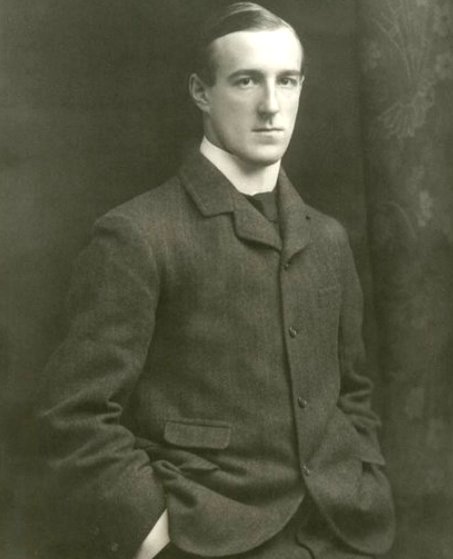
Howard De Walden turned eccentricity into the everyday. During the First World War, he presented all the members of his regiment, the 10th Hussars – with whom he had served in the Boer War – with swords based on those wielded by Welsh soldiers at the Battle of Crecy.
De Walden later joined the Royal Welsh Fusiliers in Passchendaele, from where he sent word to his tailor to send new breeches, having spilt marmalade over his current pair. He gave his yacht The Rhiannon, named after the Mabinogi character, to the Navy to sweep mines. And he funded one of the earliest cowboy films, in which De Walden arrayed himself in cowboy chaps, appearing alongside playwright George Bernard Shaw and an overweight G.K.Chesterton. A Clint Eastwood spaghetti western it was not.
De Walden was a writer and dramatist too, under the nom de plume T.E.Ellis. His was a trilogy called The Cauldron of Annwn, which comprised The Children of Don, Bronwen and Dylan, Son of the Waves.
The last of these became an opera and one of those who would have read the reviews of the opera was D.J.Thomas, Senior English Master at Swansea Grammar School.
Three months after the production his son was born and he called him Dylan, or, in full, Dylan Marlais Thomas, who would, by dint of ink and drink, become the world famous poet.
Grave Stories
Graham Greasley is the sort of enthusiastic, knowledgeable historian who can bring a churchyard to life.
We stroll around St Mary’s and pause to consider some of those interred, including two war graves. One belongs to Private Collins of The Irish Rifles, who died in Brynkinalt Hospital in November 1915. He must have hoped he’d be able to return home for Christmas but his life was cut short by tetanus, for which there was no cure at the time.
The other headstone marks the grave of Leading Aircraftman D M Williams, who died in March 1946. Another grave belongs to Lucie Knollys, who was organist at the church. ‘In World War One she worked at the local Brynkinallt colliery weighbridge. weighing the coal trucks coming up.’
It’s a reminder of the fact that there were coal mines, both sides of the border in the Chirk area going back to Elizabethan times, right up until 1968 when the nearby Ifton pit in Shropshire shut.
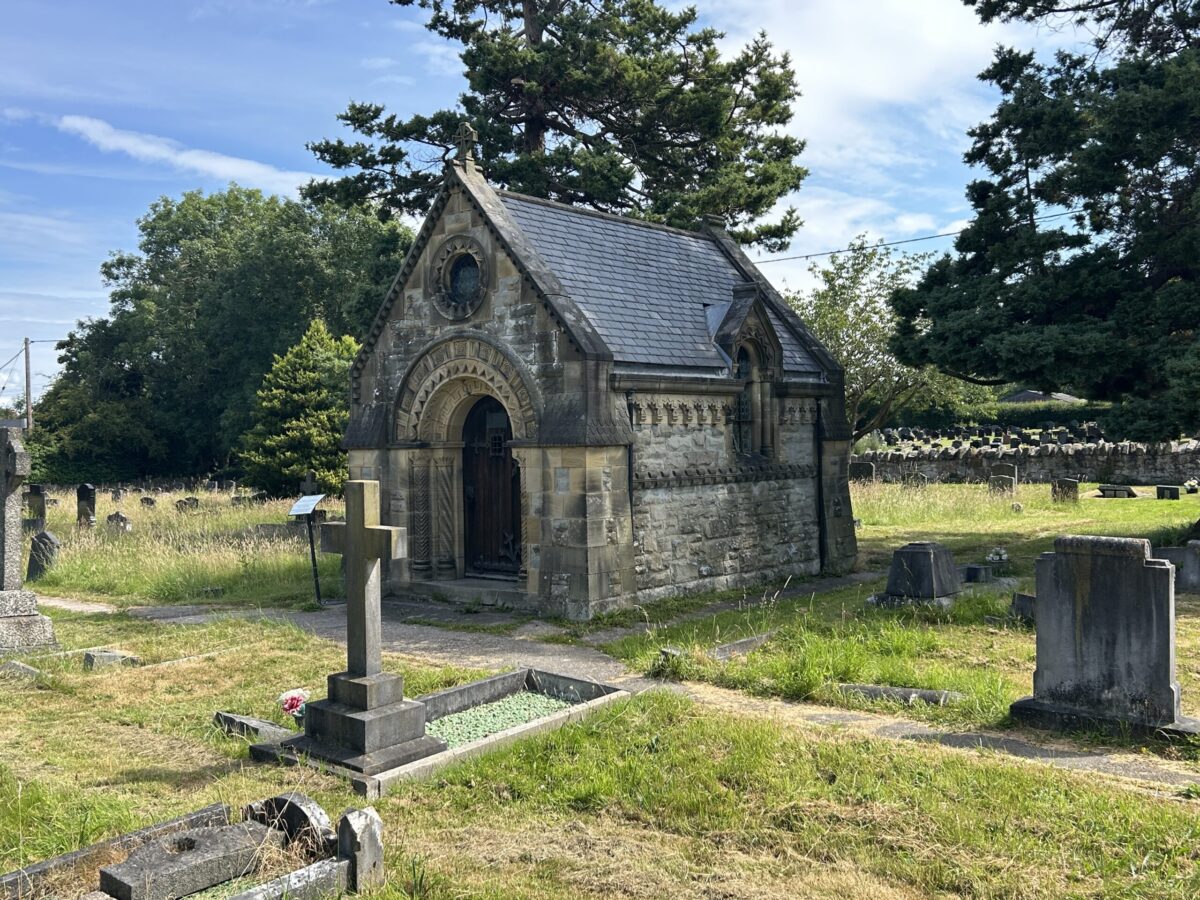
In the grounds of the church Graham also shows me the Trevor Mausoleum, erected by Arthur William Hill-Trevor and his wife Rosamund in memory of their only daughter Mary Rosamund, who died at the age of five.
Inside the mausoleum is a white marble sculpture by the Roman sculptor Ernesto Gazzeri of a winged angel tenderly bearing the child. Another sculpture in the village is the war memorial, created by Eric Gill, who often visited the castle in De Walden’s days.
Everybody from that era spoke with fondness about the De Waldens and about what they did for the village. Graham’s father remembers him arriving in the village of an evening. ‘It would be a regular feature that Lord Howard would come down to the drill hall on a motorbike and sit outside with us having a fag, talking about all sorts of stuff, and he said, you wouldn’t think he was one of the richest men in the country, the way he was dressed. He was just like one of us, you know?’
Chirk. A village where a billionaire playboy might bike down to shoot the breeze with the locals on a summer’s evening. Where early cowboy movies were shot. And where the castle stands as if to defy time itself. Yes, it’s that sort of place.

Jon Gower is Transport for Wales’ writer-in-residence. He will be travelling the breadth and length of the country over the course of a year, reporting on his travels and gathering material for The Great Book of Wales, to be published by the H’mm Foundation in late 2026.
Support our Nation today
For the price of a cup of coffee a month you can help us create an independent, not-for-profit, national news service for the people of Wales, by the people of Wales.
Get more trusted Welsh news
Choose Nation.Cymru as a preferred source in Google News to see more of our journalism.



That was a fantastic read. Diolch!