


Making Tracks: Criccieth
Jon Gower finds out about mermaids, meteorites and marine commandos in a fascinating seaside town.
But that was nothing to what things came out
From the sea-caves of Criccieth yonder.’
‘What were they? Mermaids? dragons? ghosts?’
‘Nothing at all of any things like that.’
‘What were they, then?’
‘All sorts of queer things…’
“Welsh Incident” by Robert Graves
As the train slows down into Dyffryn Ardudwy station you might notice marvellous dry-stone walls – person-high ramparts of rounded white stones. Such walls are distinctive of the Harlech area, just as gorse-topped ones burn sulphur bright on the approach across Llŷn to Pwllheli. Known as consumption walls, they are often very wide, double-sided embankments built by farmers from stones they found as they cleared the land. It’s inspiring to imagine the backbreaking toil and skill of placing big stones – left over glacial deposits – firmly in place before carefully infilling with smaller ones. They were building structures to weather all the south westerlies time can hurl at them. And should you alight at Dyffryn Ardudwy you can easily walk to the pair of chambered burial tombs, reminding us that Neolithic man also used big stones, although for very different and time-lost reasons.
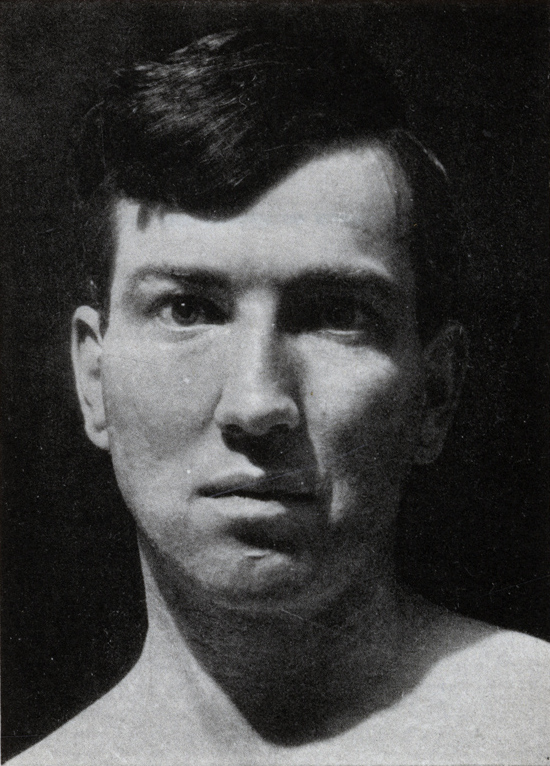
The poet Robert Graves found a quite different source of inspiration as he travelled by train in the area. It led to his composing the delightfully quirky poem “Welsh Incident” in which a traveller on a train (the poem was originally entitled “The Railway Carriage”) drip feeds an absorbing story from Criccieth to his companion. He revels in the description of strange, amorphous creatures which appeared from a cave, “moving seawards silently at a snail’s pace.” People excitedly flocked to the scene from all points, from Pwllheli and Borth, Penrhyndeudraeth and Tremadoc. The mysterious visitors received a bilingual welcome on the sands, courtesy of the Mayor of Criccieth, nervously “twisting his fingers on his chain of office” and accompanied by the pomp of the Harlech Silver Band. The poem ends cliff-hangingly with an explanation of the sounds the creatures made. “I was coming to that…”
Graves recalled exactly where he was when the seed of this playful poem, written in what he said was “a Welsh accent,” was planted. “It started when my father and I were in a train compartment of the old Cambrian Railway. The train was going around that curve from Barmouth, through Llanbedr, round into Harlech where you see the sea stretched out; and there was a policeman aboard, a Welsh policeman. He got very excited and started telling my father how he had recently seen a mermaid. He wasn’t joking either: it was in perfect seriousness and made a very powerful impression on us all. Mermaids come into that poem, you may remember. And, of course, I’d been to those sea caves – I’d been taken there by Professor Lloyd Williams, a botanist by profession, who was also one of the great Welsh mythologists. You could go there only at low tide about once a year. The caves had a very great fascination for me.”
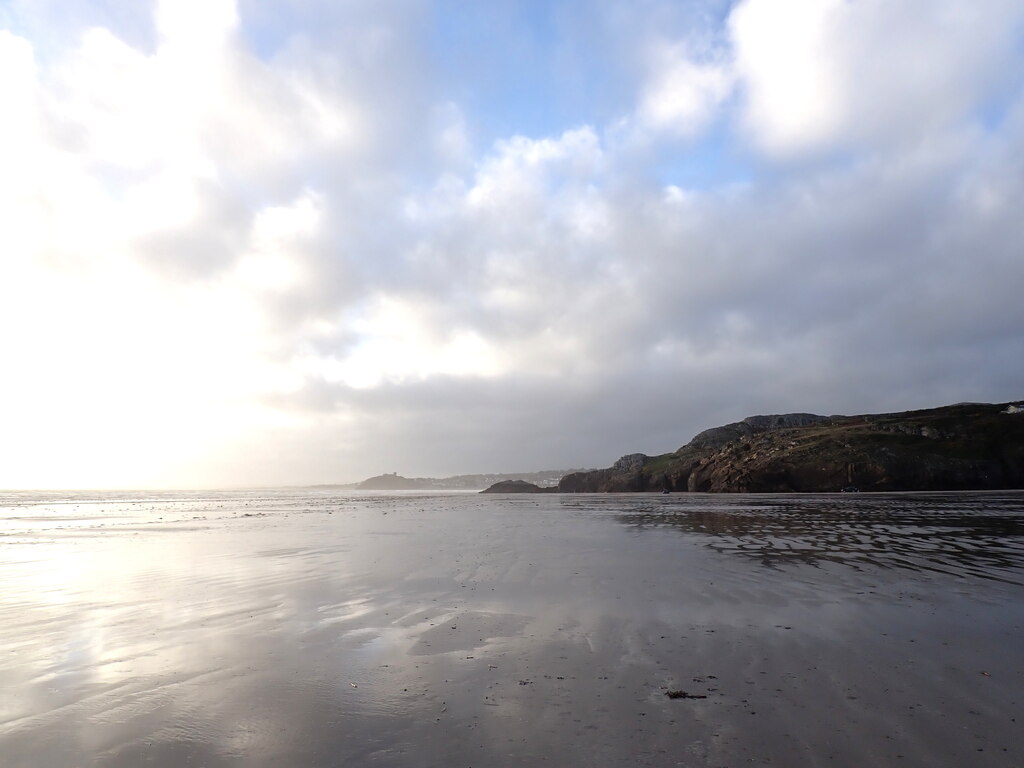
The caves at Black Rock are a fecund source of stories such as the one about three musicians who wanted to visit the Land of the Fairies to seek their fortune and ventured into the Black Cave. There the three – a fiddler, a crwth player and a piper – played charming melodies to the Tylwyth Teg, tunes that can still heard at the mouth of the cave, mixing with the sea-winds. Listen carefully.
Professor John Lloyd Williams would have been the perfect guide for Graves in the caves. Chair of Botany at Aberystwyth until 1925, he was a pioneering researcher into brown seaweeds. He also had a passion for music and was a founder member of the Welsh Folk Song Society, established in 1906. It is not that fanciful to imagine Williams telling Graves the local legend about the Criccieth mermaid…
It’s a story about a poor and lonely man, lobsterman Guto Tyddyn Morris. One morning he chanced on a mermaid sitting on a rock who told him she came out of the sea when the moon was full and this was the first of many such full moon meetings.
Guto and Morwen eventually married and had ten children, all sons, who became sailors on little ships plying in and out of Criccieth. But mermaids live longer than humans and eventually Morwen was left all alone, returning to the sea. But every low tide she would sit on a rock and watch the humanfolk of Criccieth go about their business. And if ever there was a storm brewing and there was a danger of ships wrecking on the castle rocks she would swim out to siren her warning to the mariners.
There have been various sightings of mermaids in Wales over the years. One was often sighted near Carreg Ina at New Quay, Ceredigion while one at Aberbach in Pembrokeshire was kept by a farmer in a bath of salt water. Another, washed ashore at Conwy, appealed to local fishermen to return her to the safety of the brine. They refused to help and were consequently cursed. On the other hand, meeting a mermaid could bring good luck in its wake, as it did for a fisherman at Llandrillo yn Rhos, who caught one in his nets. He cut her loose but she returned some years later to warn him about an imminent storm, presumably saving his life.
Sometimes the sea creatures were of a more terrifying ilk, such as the one that appeared to one John Granville. In a letter to the Dublin Evening Post, published on 17th October 1850, Granville explained how he and a companion set out from Holyhead to do a spot of fishing. When they cast their lines they both felt electric shocks. They then saw the “Head of a most terrific looking animal, such as we had never seen before and hope never to see again. It was more like the head of a horse without ears than anything else, but about four times larger; its eyes were filthy looking things, about nine inches diameter, and of a dark brown colour. It had a long mane on the top of its back, and a greasy matter floated about wherever it went, which had a most nauseous colour.”
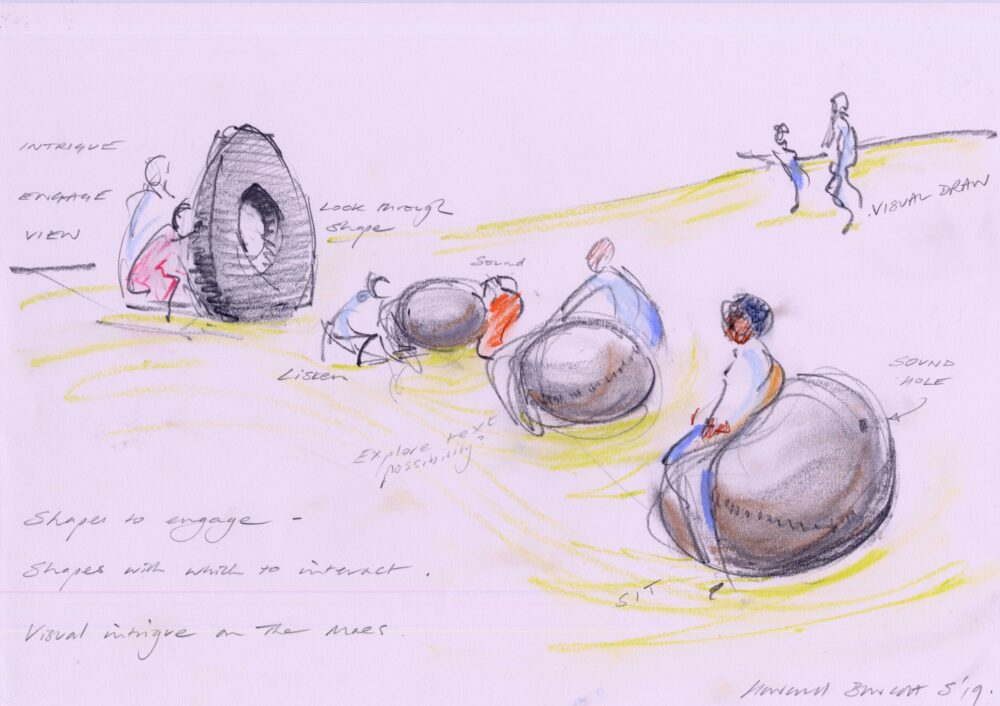
In light of such ghastly apparitions it’s perhaps a little easier to imagine the creatures Robert Graves conjured up. The Penrhyndeudraeth-based artist Howard Bowcott created his own intriguing version of Welsh incident as a commission for Criccieth Town Council. In his converted cow shed studio he told me: “I homed in on the location, which is everything for me – so context, which is culture, as well as history, location, site, topography, geology, all these things come in.” Bowcott duly went to his drawing board, sketching out early ideas in charcoal and pastel. A swirl of the hand conjured up an amorphous blob of a creature walking across the beach in Graves’ poem. A pragmatic thought followed, namely casting it in concrete, an affordable medium, especially as Howard is an artist with his own cement mixer. “Oh yeah, I mix lots of different bespoke mixes. I do a lot of polished white concrete.”
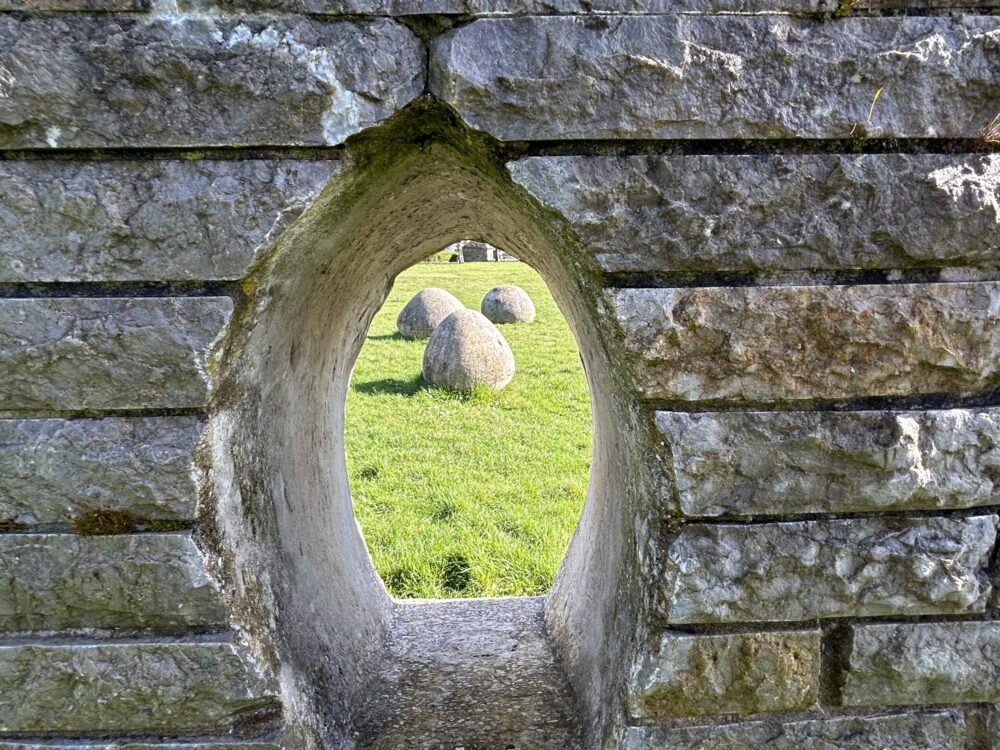
The resulting work runs downhill, as Bowcott explains: “There is an axis down through the whole piece of sculpture, which comprises of four pieces. You’ve got the standing stone element. When you stand on the uphill side of that, you look down through this window, this cave shape, onto the three amorphous blobs that are the whatevers coming out of the sea cave. They get slightly bigger as they go down the hill. That way, it actually creates a much bigger piece of sculpture.”
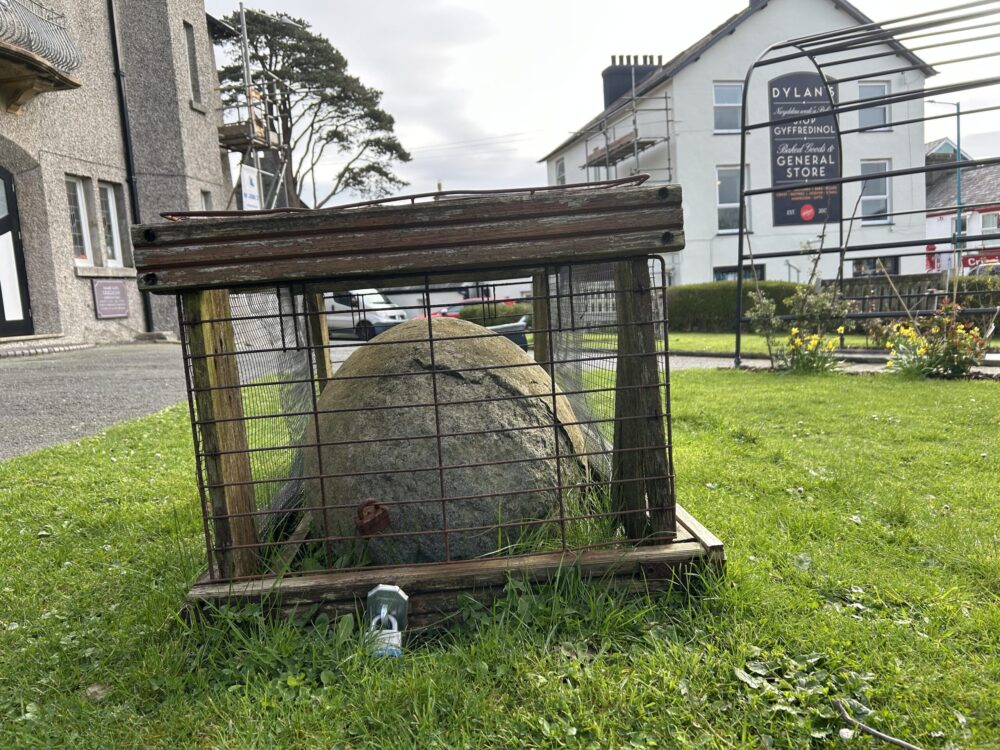
Outside the memorial hall there’s another fascinating stone, the egg-shaped Carreg Orchest, (Feat Stone) weighing about 170 kgs and contained within a padlocked cage. It used to be known as Carreg Cam, suggesting it was possibly used in mounting a horse. Competitions to lift it are held every so often, with a fixed set of rules. According to liftingstones.org, “Stonelifting was a common practice performed by young boys as a rite of passage into manhood, similar to the Scottish stonelifting culture. Once a young boy could lift the stone to his waist he was considered a man.” Julie Fisher, secretary of Criccieth Memorial Hall tells me the men who take part in such competitions are physically very much up to the task. “Oh my gosh, yes, they’re beasts of men – big, bulky men who lift weights. There hasn’t been a competition for a couple of years but you get people from all over the place coming to lift it.”
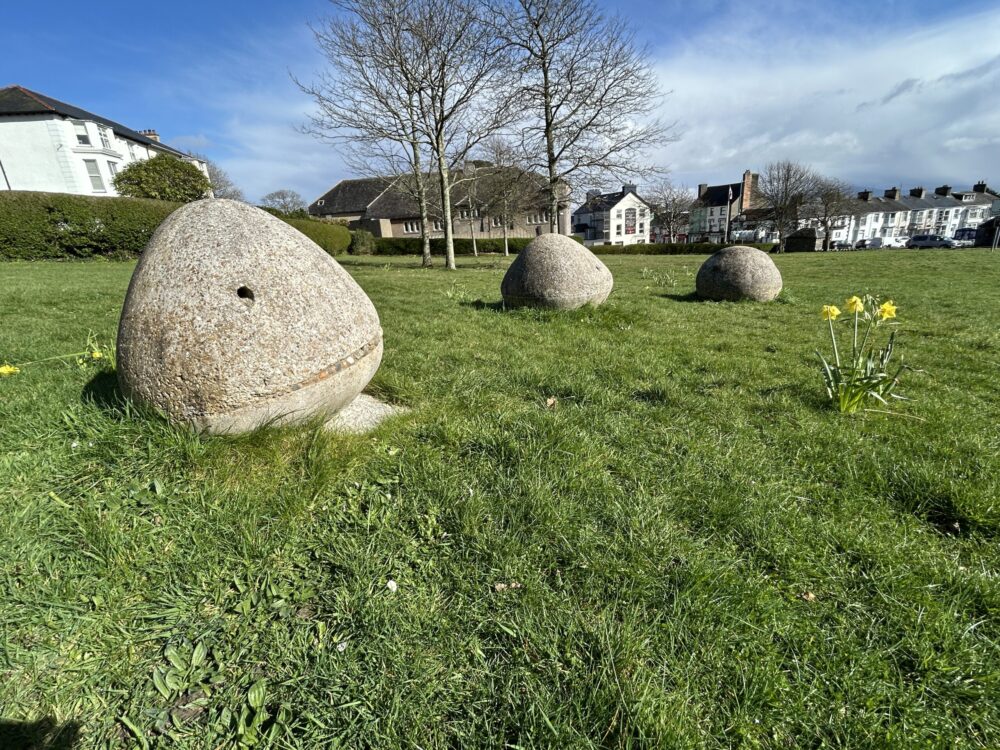
Catrin Jones, secretary of Criccieth Town Council met me at Y Maes, which preserves some of the original medieval common land. It abuts the Memorial Hall, a Grade II listed building, built in 1922, where its design echoes that of the facing castle, first built by Llywelyn Fawr in 1230.
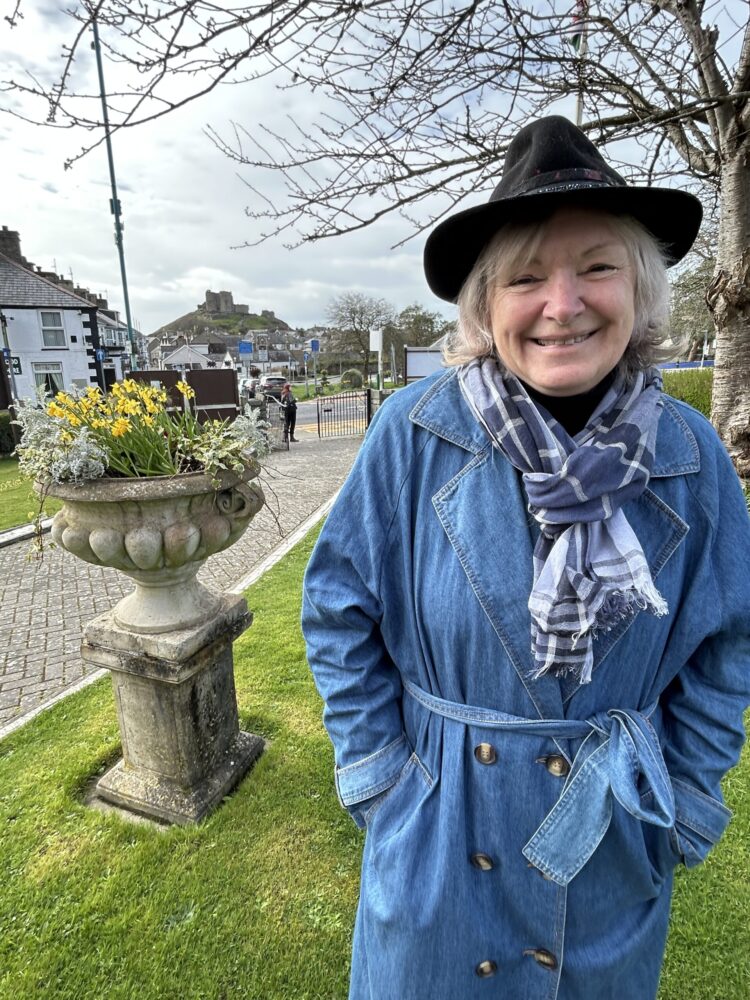
Catrin enthusiastically explains the history of the council’s engagement with Graves’ poem. “We applied for a Unique Streets grant from Arloesi Gwynedd Wledig back in 2018. The whole idea was to support the high street and re-enliven it. So we had a meeting with the community and the Criccieth Business Forum and it was decided it would be great to have a theme based on “Welsh Incident.”’ That decision in itself perhaps tells you a lot about the character of Criccieth. Catrin herself loves the poem. “I think it’s just so quirky and tongue-in-cheek and fun and hearing Richard Burton read the poem is a fantastic experience which always brings a smile.”
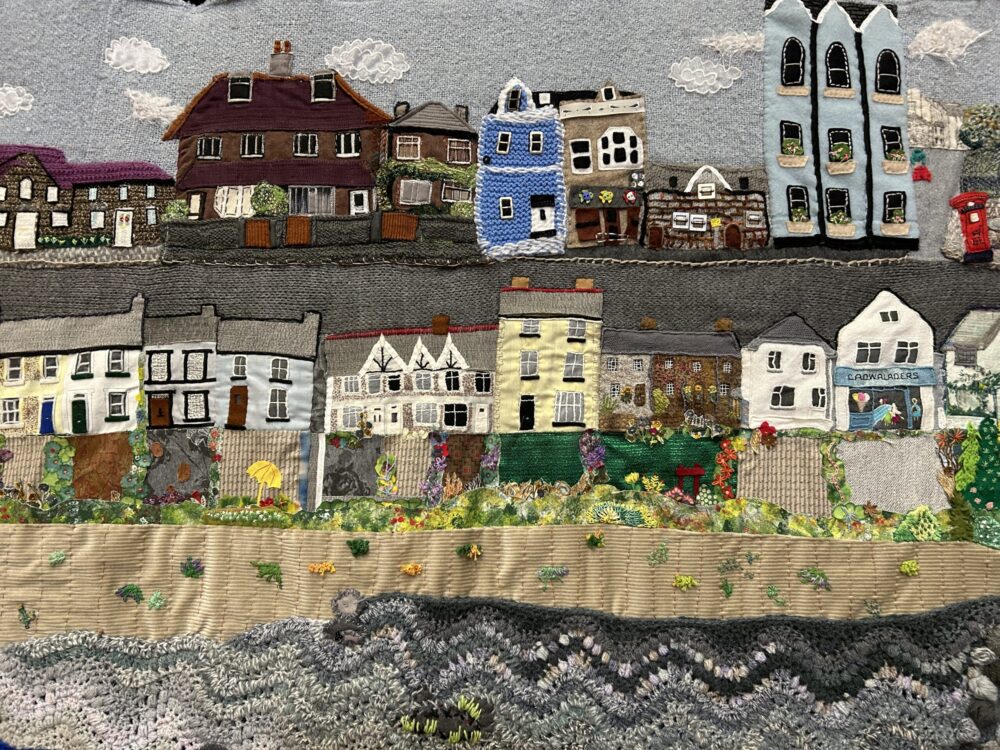
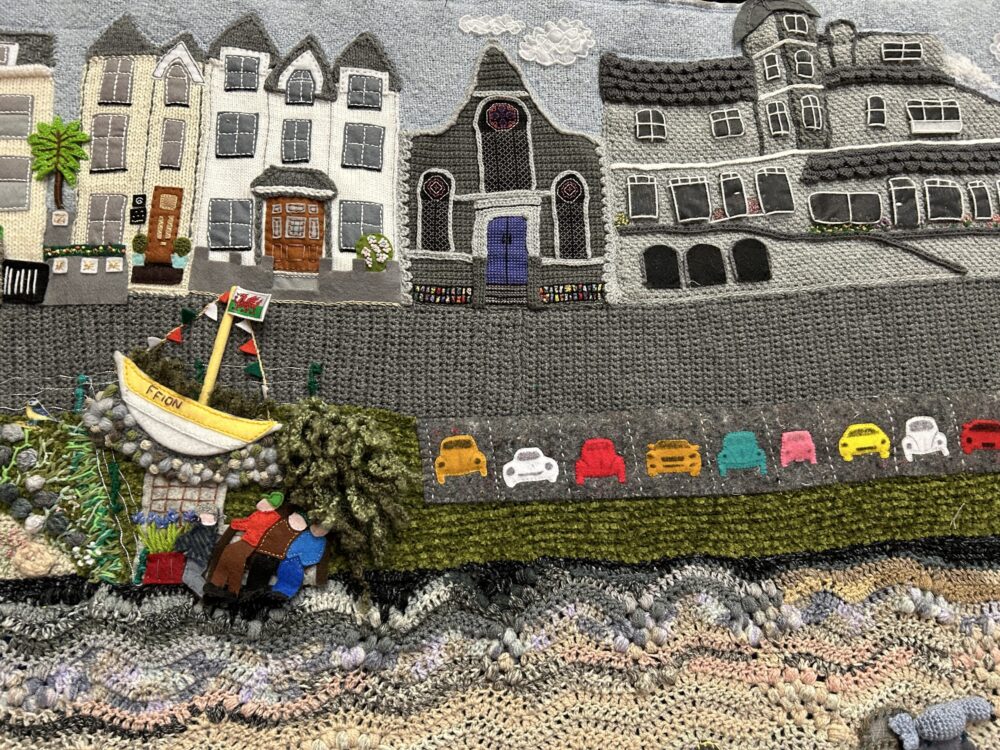
Inside the Memorial Hall are some very striking tapestries in which the town’s architecture is rendered by rugging and knitting techniques in a range of vivid seaside hues. There’s the Victorian Marine Terrace, plus Mill Street and Castle Street; there’s the sweet sight of Cadwaladers ice-cream shop and the obligatory seagulls set amid a crocheted pattern of waves. There’s the castle, of course, described by Jan Morris as one of the friendliest in Wales, standing on “A sea promontory in the middle of the little resort as though it was put there for ornamental purposes.”
I join some of the members of the Cricieth Creadigol group, who made the tapestries, in their High Street headquarters, a small factory of bright colours. There’s a purple peacock, standing proud on a plinth and a Cambrian Line train, a splendid crochet work in ten colours laid over a wooden frame, which will eventually steam along to the station.
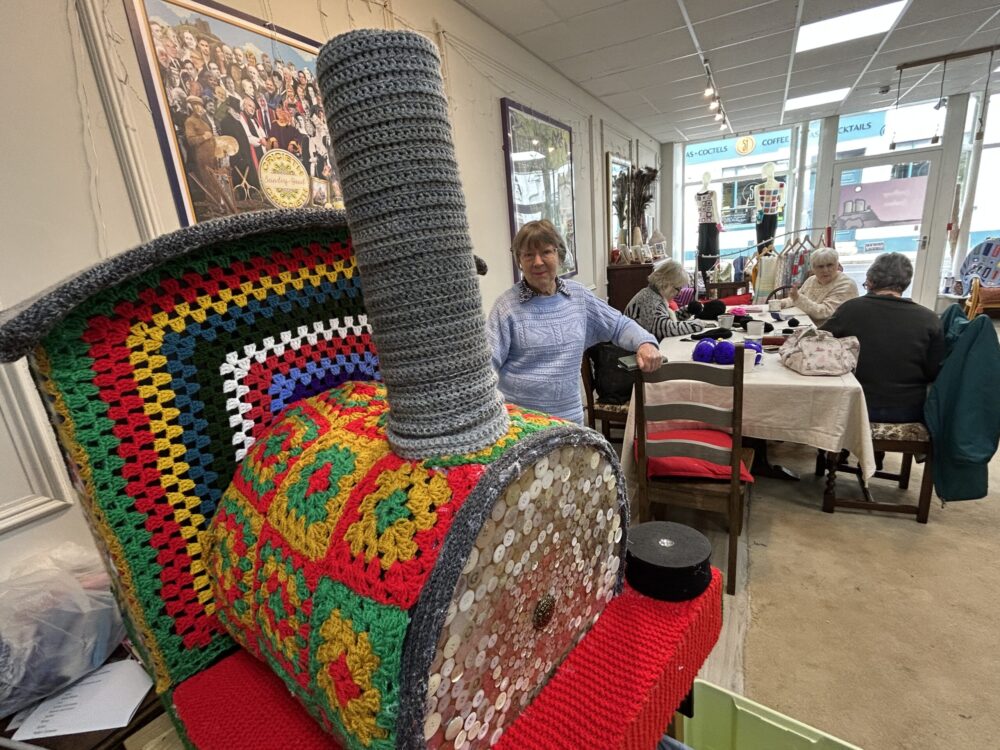
Margaret Rees tells me about the history of the group. “We have over 20 people that regularly come here. We’ve earned quite a lot of money selling our crafts even though that wasn’t the intention.”
Enjoying my cuppa among the busy chitter of conversation I’m reminded of a poem about the Icelandic language which suggests that “Old ladies can wind their long hair in this language/And can hum and knit and make pancakes…” There is something about the quiet clack of needles which sounds like punctuation marks.
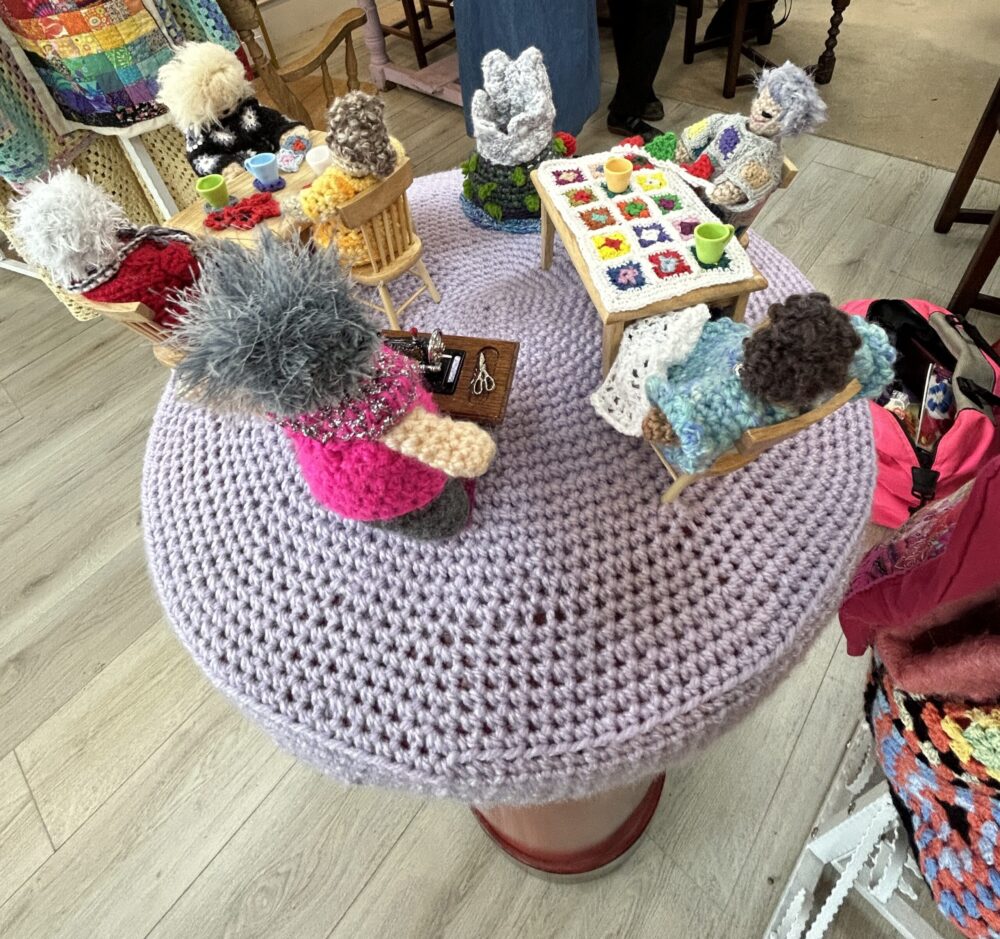
Here, as throughout the town, you hear Cymraeg and English freely intermingling in daily life. One of the members, Gwennan Williams tells me about the way in which Welsh and English speakers meld well in Cricieth Creadigol, and more generally in what is clearly a creative and crafty community. “Capel y Traeth down the road is the only chapel now open in Criccieth, and there are English services, Welsh services and we mix things. And there are literary groups in Welsh and in English. There’s a good mixture of people. There are art classes, there are book clubs, there’s yoga with a bilingual teacher and there’s keep fit.”
Cricieth Creadigol are currently busy creating a new tapestry to be hung under the dome of the Italianate village of Portmeirion. Here the visionary architect Clough Williams-Ellis, with an architectural magpie’s eye, assembled a village on the bank of the river Dwyryd, on the former estate of Aber Iâ. I suggest its varied shapes and Mediterranean colours make it a gift for a tapestry designer such as Marian Whitestaff. “It’s a gift to everybody,” she readily agrees. “Lots of people just come to see it and I just think it’s wonderful.” Roz Bissell explains the division of knitting labour. Roz did Clough, holding a dog. “I clothed him, Lorraine knitted his socks and Buddug did his head. It’s been a real joint effort. I found out for sure yesterday he did actually have a dog. So now I’ve got a week to make one from wool.” The pressure’s on.
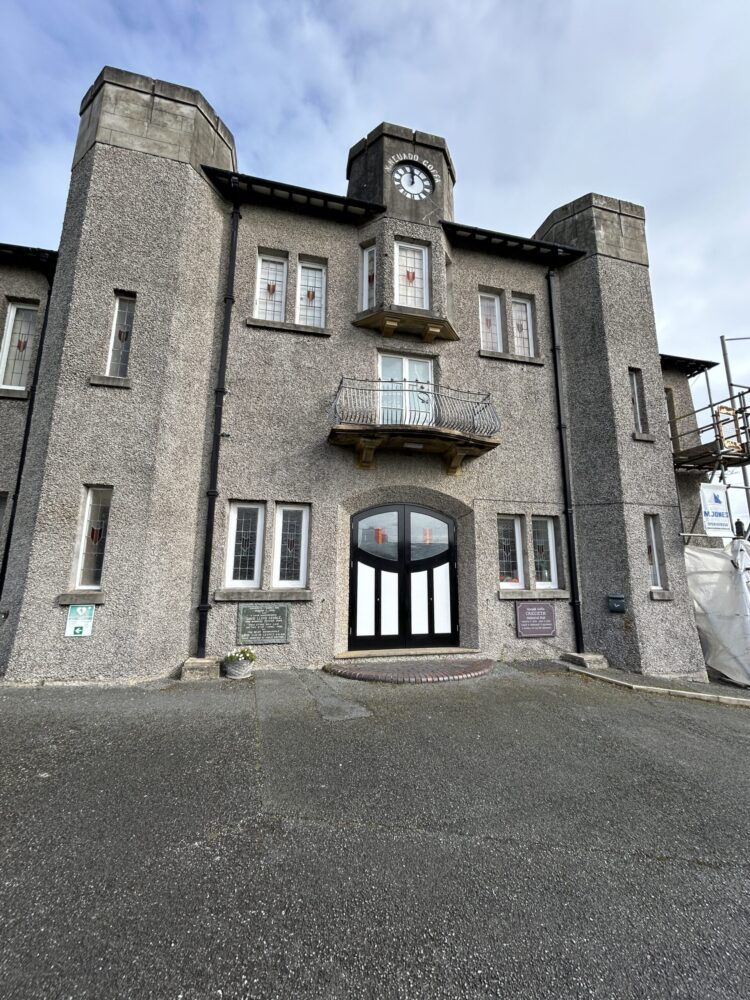
There’s more to see in the Memorial Hall than just the tapestries. The hall itself, completed in 1924, is “A fusion of Arts and Crafts in its attention to expressive planning and massing, and Art Nouveau in its fluid forms.” During the Second World War the Kieffer Commandos – the only French soldiers to take part in the D-Day landings – were stationed in the area and would scale down the front of the Memorial Hall.
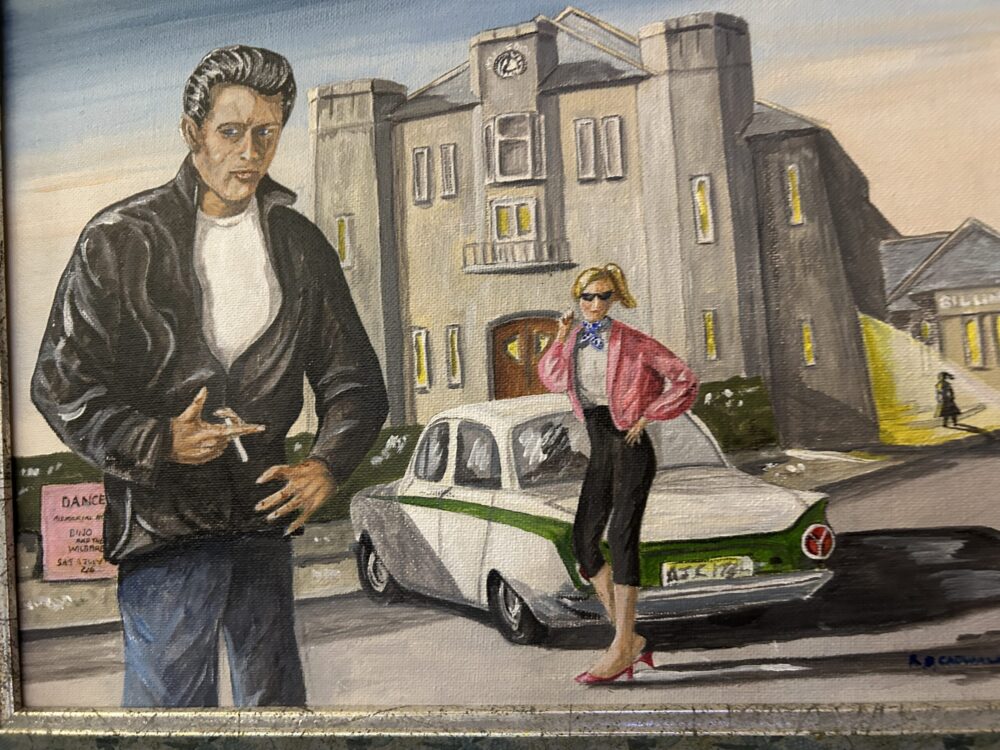
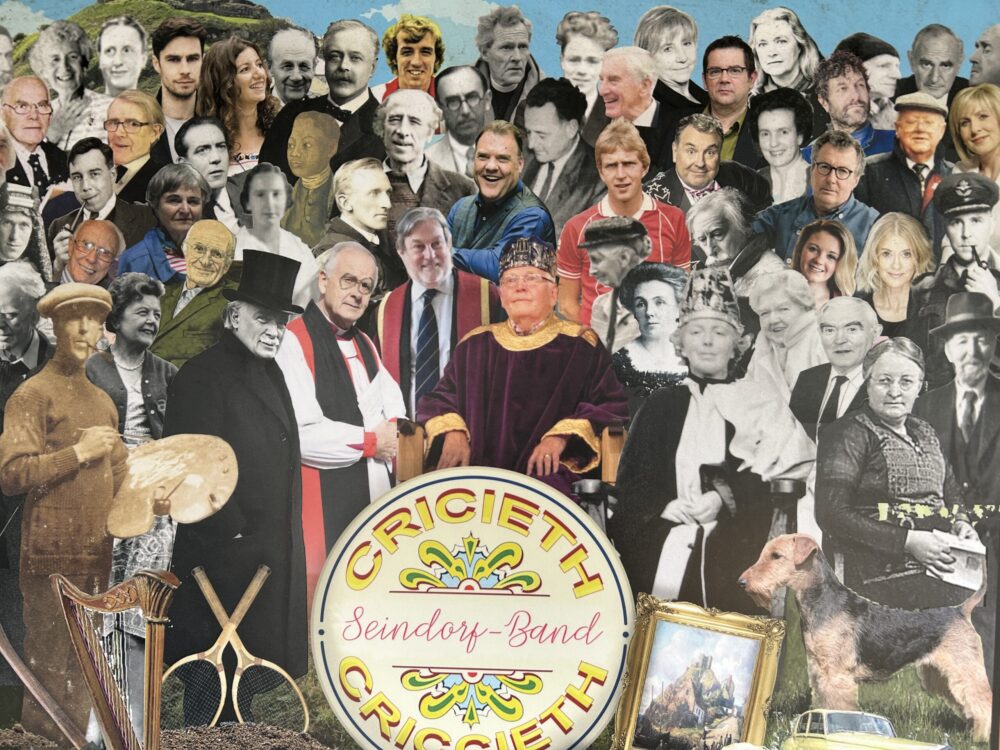
Inside there’s a painting of local artist and historian Robert Cadwalader looking like James Dean in a poster for Rebel Without a Cause. It turns out that Robert had, in turn, painted a portrait of rock star Robert Plant of Led Zeppelin. Criccieth has been home to so many famous folk they’ve created their own pastiche of Peter Blake’s cover art for the Beatles’ Sergeant Pepper album. Some of the paler yellow colour comes courtesy of a Rolls Royce belonging to the owner of the Birds Custard empire, who owned a fleet of them and lived in a house called Foinavon in the town. Other Criccieth luminaries include David Lloyd George, historian Merfyn Jones, poets and musicians Gwyneth Glyn and Twm Morys, actors Dyfan Dwyfor and Grey Evans, footballer Joe Mayo and mathematician Edward Ince.
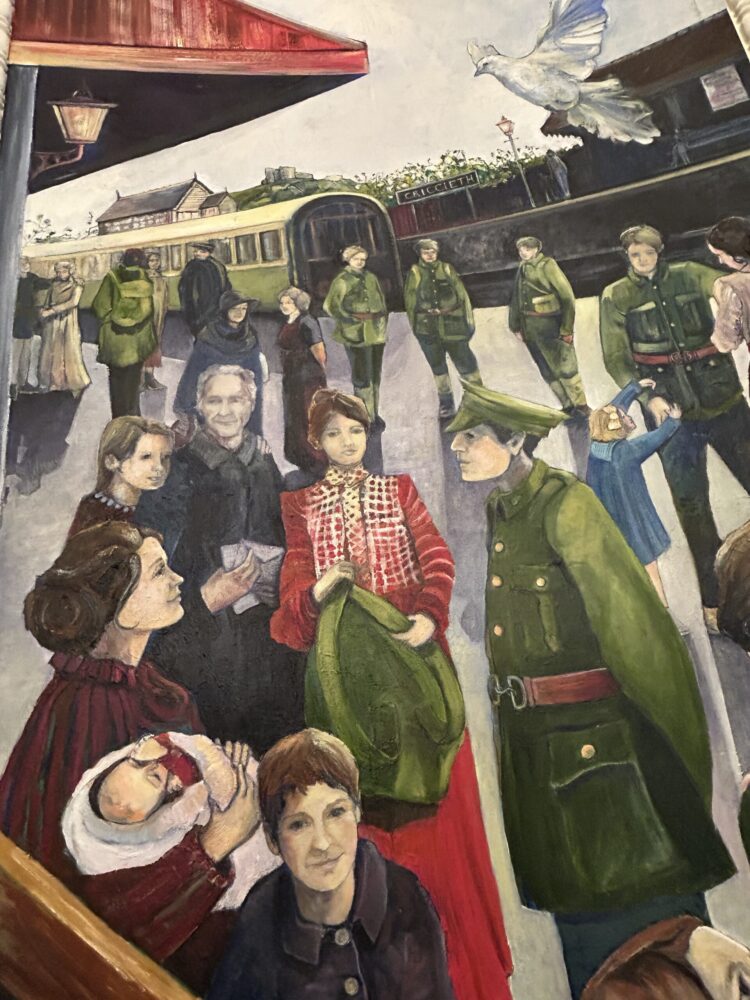
You enter Criccieth Memorial Hall through The Hall of Memory, dedicated to fallen soldiers, which contains a painting called “Peace” by local artist Ffion Gwyn. This shows men in uniform returning home at war’s end to Criccieth station, reminding us that stations are often places of emotional departure and homecoming. And also, in Criccieth’s case, the train happily brings in tourists, 40,000 of them each year.
Delyth Lloyd is chair of Criccieth Town Council and loves travelling by rail. “Especially now I’m over 60 and have discounted rates which is a bit of an incentive. But it is a beautiful line through one of the beautiful parts of the world.” Delyth happily shares her favourite view on the train.
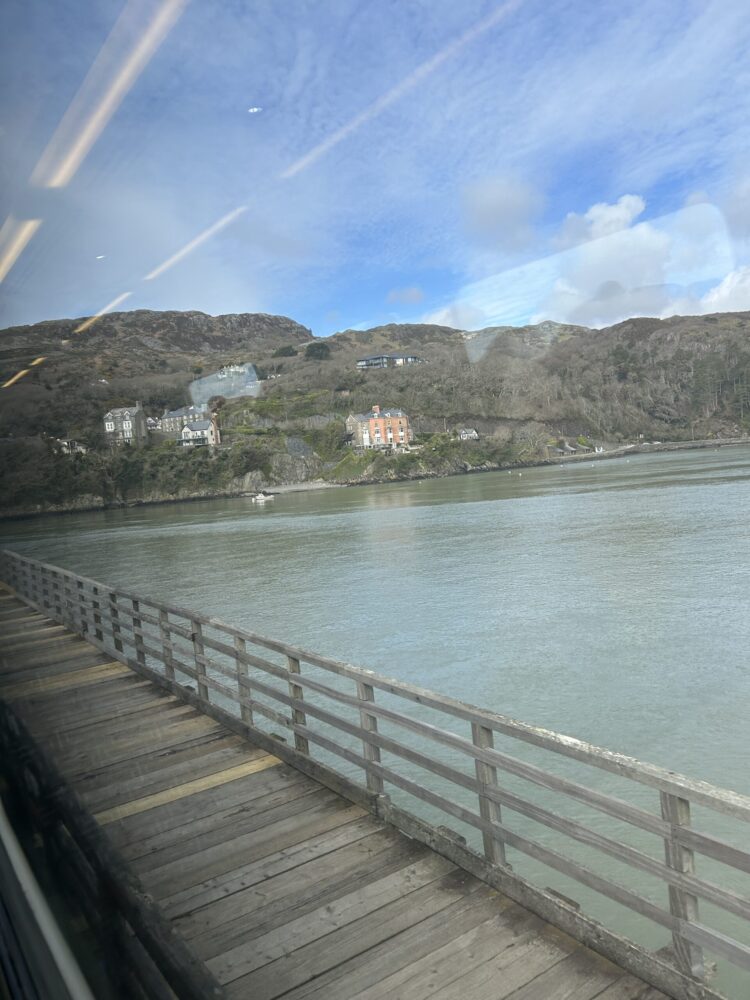
“It’s going over Pont Bermo, Barmouth Bridge because it’s almost as if the train is flying. You don’t see the edge of the structure of the bridge. I always just look at both sides simultaneously and you just feel like you’re slightly suspended above the water and the view always changes. It’s absolutely amazing.”
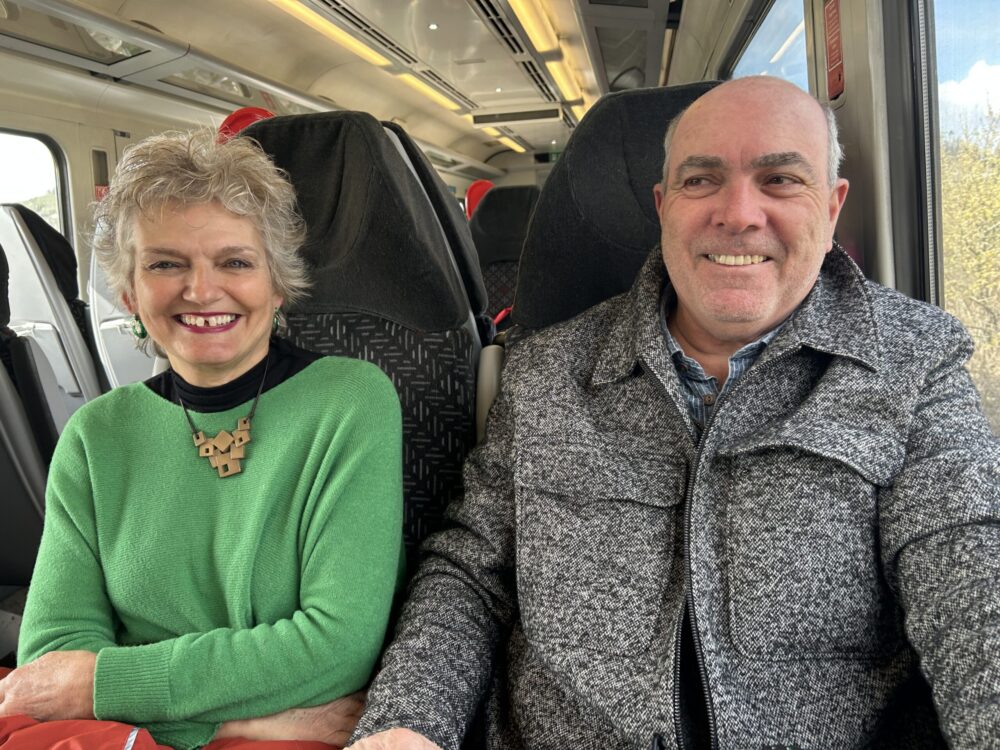
On the train between Criccieth and Barmouth Marian Evans and Emyr Evans, from Llanystumdwy are off to enjoy an anniversary lunch to celebrate 43 years of marriage. It’s a good way to travel for a special occasion as Marian confirms. “Oh, it’s a very special line. The views, I suppose, are some of the best you can get on a train. On the way back, that’s when it’s at its best. If you travel on this train in June, when the days are long and when it’s a nice sunset, there’s nothing better – the Llŷn Peninsula with the sun setting behind it.”
Emyr was brought up in Pencaenewydd, a little village in the middle of Eifionydd, which grew up around the Caernarfonshire Railway line. Before the Beeching cuts of 1963 he remembers his journalist father taking his copy to the nearby station at Chwilog. “He’d written his copy and he’d drop it in the station, putting it in a brown envelope, a big wad of the whole week’s news, going to Oswestry on the train.”
Emyr’s father, Dyfed Evans was a distinguished Welsh journalist who worked for Y Cymro for some 20 years. “He travelled all over Wales really, chasing stories. I remember him staying up all night on a Saturday night in order to write up his weekly copy.”
Emyr regales me with a story about one of his late father’s literally stellar scoops in September 1949. “He was sitting in a cafe in Porthmadog having a cup of tea when a bus driver came in and said he’d just come from Beddgelert where there was a big yahoo because a meteorite has gone through the roof of the Goat Hotel. Being an opportunistic journalist, but with no car, no motorbike or anything, he got on the first service bus and was the first journalist on the scene. He tells the story of touching the meteorite which was still warm. Talk about being in the right place at the right time.”
On one very special occasion Marian’s parents were also in the right place at the right time: “My parents, John and Mary met on a train during the war. My mother did relief work in the post office. She was travelling from Pwllheli and my father, who was in the RAF, was travelling on the same train and they happened to meet up and started talking. He was supposed to alight before her, but because he fancied her, he stayed on the train to travel as far as her destination. And the rest is history.”
Two passengers. Love arriving like a meteorite. All change.

Jon Gower is Transport for Wales’ writer-in-residence. He will be travelling the breadth and length of the country over the course of a year, reporting on his travels and gathering material for The Great Book of Wales, to be published by the H’mm Foundation in late 2026.
Support our Nation today
For the price of a cup of coffee a month you can help us create an independent, not-for-profit, national news service for the people of Wales, by the people of Wales.


