

Making Tracks: Cyffordd Dyfi
Jon Gower finds out about extreme wealth and Europe’s rarest goose
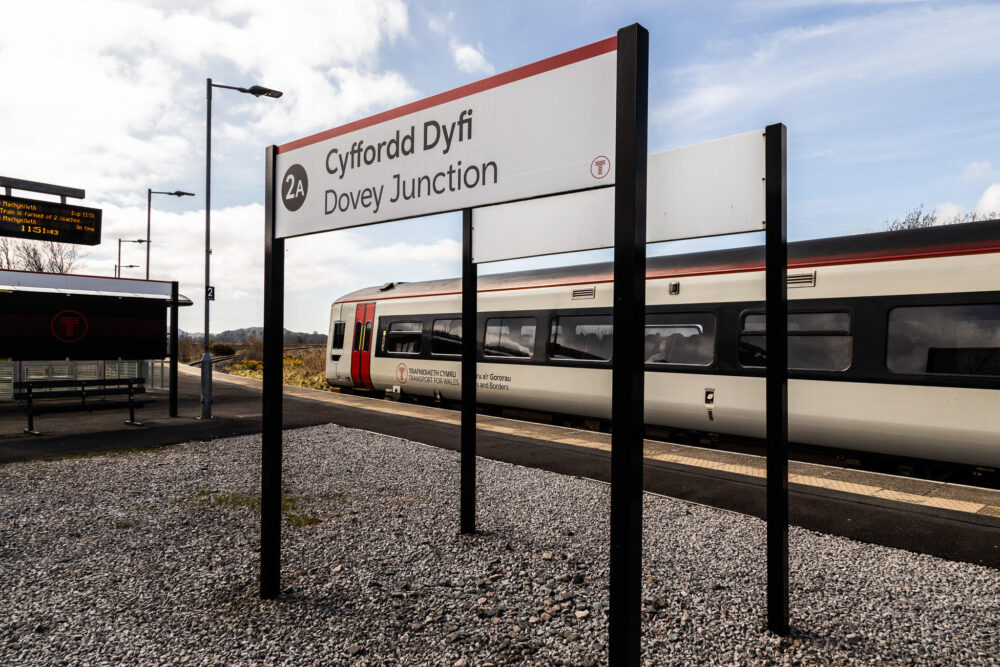
If you held a competition to find the most desolate station then Cyffordd Dyfi or Dovey Junction, near Derwenlas would most certainly be a contender.
On a winter’s day, when the wind whips in from Cardigan Bay and threatens to flense the skin off your cheeks you will stand on the platform and thank all the Celtic gods for the plastic shelter.
The award-winning novelist Niall Griffiths – author of Stump, Broken Ghost and Grits – would probably add his vote.
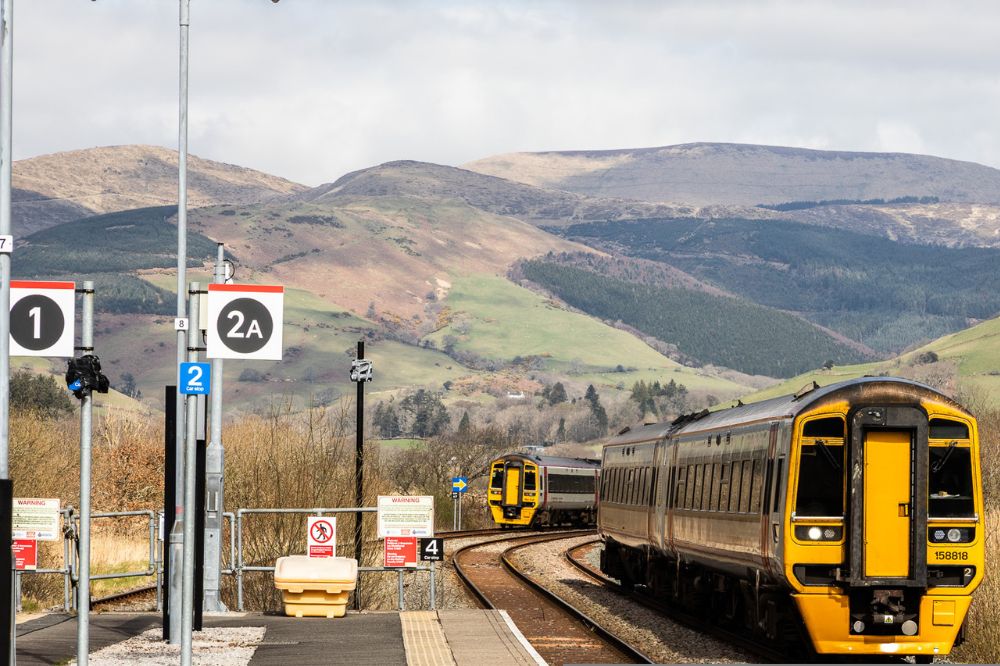
As he wrote in his Letter from Dyfi Junction for Nation.Cymru: ‘There must be more remote stations in Scotland, say, or England’s far north, but it feels terminal here, an endpoint, exposed and isolated.
The mountains across the marsh are blue in the haze, furred at the flanks, as if in the process of creation. The far sea sparkles. You step off the train and stand and stare. The locomotive boggles and rattles for a minute then clanks and chugs away and you watch it shrink as it moves along the track away from you. Silence and aloneness.’
The word “junction” might puzzle many a passenger. Clapham Junction it is not.
The two- platform station sits on what used to be known as the Aberystwyth and Welsh Coast Railway (rebaptized as the Cambrian Railways from 1865 and nowadays known as the Cambrian Coast Line.)
Here the line between Machynlleth and Aberystwyth creates a simple “Y” shape as it connects with northern coast section of the Cambrian Coast Line as it curves away towards Pwllheli.
The section between Machynlleth and Borth opened in 1863 and the section between Aberdovey and Glandovey Junction opened in 1867 while the simple station was renamed Dovey Junction in 1904.
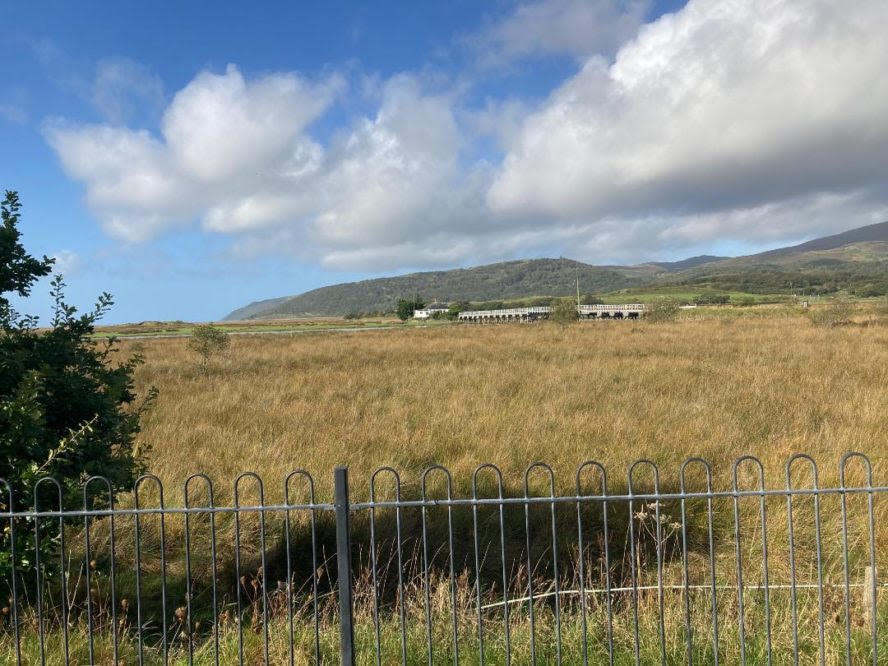
The view from Dovey Junction. Image: Jon GowerNow called Cyffordd Dyfi/Dovey Junction it can definitely feel like the last-but-one stop before Nowheresville, yet in truth it’s an access point for some of the most wildlife-rich countryside in Wales.
The UNESCO designated Dyfi Biosphere covers the whole of the Dyfi river catchment and extends along the coast of Cardigan Bay as far as Tywyn to the north and Aberystwyth to the south.
Pied flycatchers, in their tuxedo black-and-white plumage and wood warblers spend the summer in its oakwoods. Beautiful orchids such as pyramidal and bee orchids grow in the dunes, while on the saltmarshes, colourful flowers like sea pink, sea aster and sea spurrey as well as the strange green fleshy marsh samphire add their bouquet of colours to the salt-resistant plants and grasses.
In winter the Dyfi Biosphere is home to the rarest goose in Europe, being the Greenland white-fronted goose, a sub-species which breeds in western Greenland, discovered as recently as the late 1940s by Sir Peter Scott, son of the polar explorer Robert Falcon Scott.
They wing in from their breeding grounds on the western edge of Greenland. Moving to the upland tundra of Eqalungmiut Nunât, “Land of the Fisherfolk” on the edge of the Greenland Ice Sheet and the lichen-encrusted lands around Kûp Akua, “where the waters meet and mix.” They fly on, via staging posts in Iceland to places such as the salt marshes of the RSPB’s Ynys-hir reserve near Dovey Junction where they winter, sadly in ever decreasing numbers.
Until recently, and perplexingly, they were legal quarry in Wales but since 2020 they are firmly protected and cannot be shot. But even that moratorium hasn’t managed to stem the decline, so they are now red listed, on account of the birds being mainly confined to a single site and thus very much exposed in conservation terms.
Many people will know about life on the reserve and in the area hereabouts from reading the Ynys-hir warden William Condry in the Guardian. The author of The Natural History of Wales contributed to the newspaper’s Country Diary for well over thirty years and when that long stint was coming to an end I asked him to keep a diary for a book I was editing called A Year in a Small Country.
Bill duly wrote some lovely entries, including one about his encounter with the year’s first adders, which he found coming out of hibernation on a patch of dry raised ground in the heart of a reed bed on the reserve.
Most people would have left Britain’s only poisonous snake well alone. But Bill Condry wasn’t most people: he was a quiet observer, a very patient man and superb naturalist. He went up to a female snake and very softly stroked her head and then caressed her throat.
The adder showed no sign of being aware of his presence and, as he wrote: “It was not until I stroked her back all the way from head to tail that she decided it was time for her to go, which she did slowly as if in a dream, leaving me grateful to have experienced such a rare encounter with the wild.”

There are many other rare encounters to be had in the Dyfi Biosphere: Cyffordd Dyfi is the only station in Wales which offers views of nesting ospreys as the train slows down.
There’s even a visitor centre dedicated to these rare, fish-eating eagles, although the best place to get off for this is Machynlleth, where you can take the bus or bike to Morben Isaf Caravan Park.
On a visit in summer you can have a nice cup of tea and learn about this truly global raptor, one of the few species to be found on every continent except Antarctica.
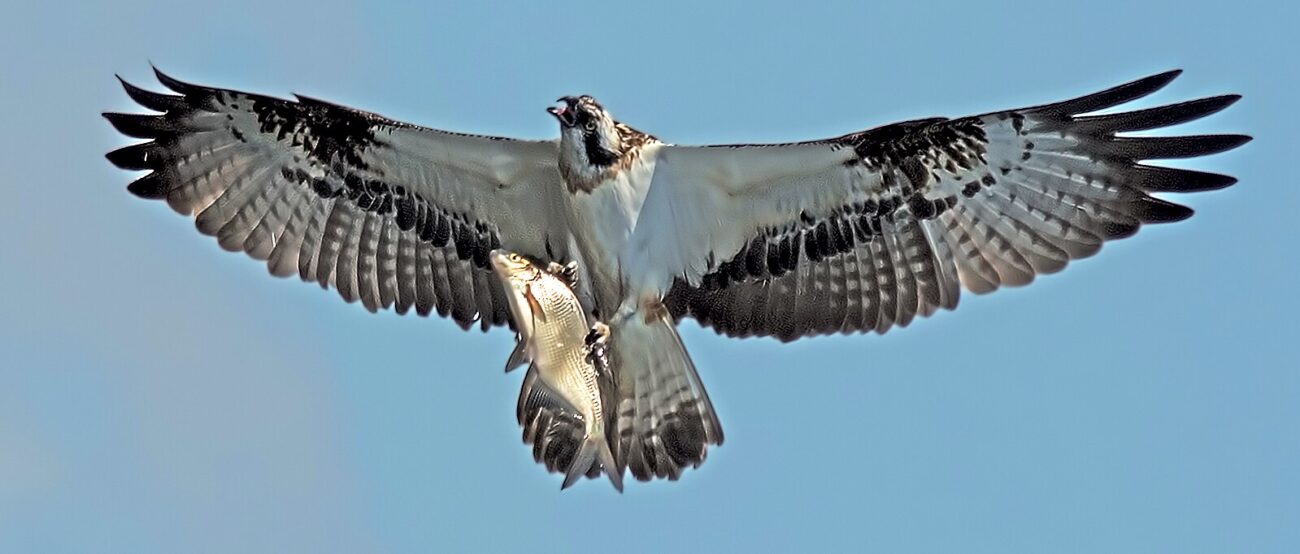
A hunting osprey is easy to identify, with its brown upperparts contrasting with the white underneath and its long wings distinctly angled.
The bird can seem quite lumbering in flight until it spots its piscine prey and plunges swiftly towards the surface of a river or lake to snatch a trout or pike in its talons, making a bit of a splash.
But when the male bird first arrives in spring it can perform a spectacular mating-flight display, climbing up to 1000 feet to a point where it will hover and spread out its tail before plunging earthwards, or, in the case of ospreys, waterwards. It’s his way of saying “here I am” in its springtime search for a mate.
Ospreys were heavily persecuted in Britain during the 18th and 19th centuries due to their taking fish from stew ponds where they were stored for human consumption.
Even though the bird appears on the coat of arms of Swansea and there are references to ‘fishey-hawkes’ breeding close together at the Dyfi in 1604 there was no categorical proof that they bred here until 2004.
By 2020 over 100 chicks had been fledged from Welsh nests. Some from the Dyfi were tagged, allowing scientists to trace their long aerial trek to West African countries such as Senegal and Gambia, leaving Wales in summer to cross the Sahara. Like some of the trains of Wales, many of its bird species make international connections.
The historian Howell Harris’s memories of Dovey Junction would be of a rather different halt and go back more than 60 years ago, to a time before Dr Beeching recommended closing many small railway stations in the UK. ‘I was probably ten or eleven and my uncle, an absolute killer bus & railway timetable-reader, had heard that the Carmarthen to Aberystwyth and Afonwen Junction to Bangor lines were not long for this world, so he decided that at the end of the summer holiday in Pembrokeshire he would take me home by the “direct route” (joke) rather than our usual Mid-Wales route (before the Carmarthen – Llandeilo section was abandoned). All I recall of what should have been a memorable trip was waiting at Dyfi Junction. Nothing much more than the fact, or act, of waiting as a bored child, a complete vacancy of thought and perception that I can’t manage now. No idea how long it was for, just a memory of waiting. So whenever I am waiting anywhere now, for anything, in a sense I am always at Dyfi Junction, because it’s where I really learned to wait. I was better at waiting then than I ever have been since. It was an idealised form of waiting, the best place and time for it.’
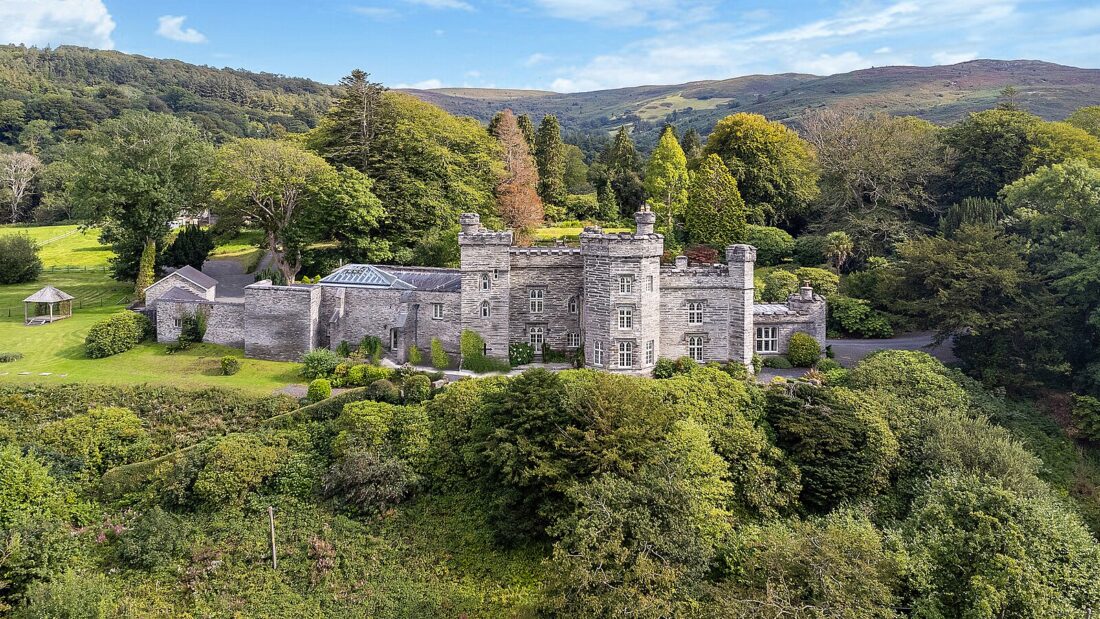
Nearby Glandyfi has its own castle, albeit a fake one, a Regency Gothic confection with turrets you can glimpse over the trees.
Now renovated as a luxurious place to stay, or get married, it was erected between 1814 and 1818 and paid for by the industrialist George Jeffreys. The poets Keats and Shelley would visit him here in the early part of the nineteenth century.
In the 1950s, when it was owned by Sir Bernard Docker and Norah, his socialite wife, the place attracted more materialistic folk, hordes of them. English industrialist Sir Bernard, was chairman of Daimler and became noted during the 1950s for producing show cars, such as the “Golden Daimler” (1952), “Blue Clover” (1953) and the “Silver Flash” and “Stardust” in 1954. Flashy doesn’t come close.
Here was a couple who simply adored showing off their wealth. Just to give you an idea of how moneyed they were, some jewellery belonging to former dance club hostess Lady Docker was stolen from a flat near Claridges’ hotel in London, including a pink diamond ring worth £ 52,000 in those days.
This was an audacious crime that consequently inspired the Pink Panther films. Five years later she was sporting gems worth £ 200,000 at a party and the comedian Frankie Howard would refer to any woman who was wildly ostentatious in her behaviour or costume ‘as a bit of a Lady Docker.’ But you’d have to work hard to show off more than the actual Lady, who commissioned a series of unique Daimlers for her use, one covered with 7000 stars made of actual gold and another equipped with built-in luggage decorated with crocodile skin.
A later model of vehicle came upholstered with zebra skin seat covers. When she was questioned about the choice of material she averred “It’s the best skin, because mink is too hot to sit on.”
Dyfi Junction to Borth
As the train heads south from Dyfi Junction the county of Montgomeryshire melds with Ceredigion and the bed of the river widens: assorted ducks such as red-breasted mergansers and wigeon bob on its waters like corks. On the right of the train, as it heads towards Borth are the dunes of Ynyslas National Nature reserve.
One of its sandy beaches is called Traeth Maelgwyn. Tradition has it that here Maelgwyn was elected as King of North Wales in 517, seated on a remarkable chair with waxen wings on which he floated after all of the rest of the assembly had retreated. It’s a bit like the story of King Canute but with extra furniture.
On the left of the train is Cors Fochno, known locally as Borth Bog, which is one of largest and finest remaining examples of a peat bog in the UK. Here peat has been quietly accumulating for 6000 years, lying six feet deep in some places in places while the surface of the bog is covered in a green, gold and red tapestry of squelchy sphagnum mosses.
It’s a place of rare invertebrates such as rosy marsh moth, large heath butterfly, bog bush-cricket, small red damselfly and bog raft spider as well as carnivorous plants such as sundews, whose sticky leaves entrap flies, gluing them so they cannot escape.
Amazingly, in the winter of 2014 the bog caught fire although the cause was uncertain. It might have been a lightning strike or the elusive “will o’ the wisps” which are less fairy beings than spontaneous combustions of gases such as methane produced in the peat. The sight of a line of flame and smoke creeping towards the village of Borth was no doubt unsettling, almost Biblical, until local fire crews allowed the blaze to burn out under their control.
The village glimpsed over the flatlands of Cors Fochno is Bedd Taliesin, the last resting place of the poet of the same name. He was a great northern star of Welsh literature, a shape-shifter who sang in Rheged, the lost Brythonic kingdom which is now south-west Scotland and parts of Cumbria.
Indeed, the whole landscape around here sings a quiet poetry, complementing the mechanical clack of the train as it follows the contours of the coast. As you pass by Pont Llyfnant and Eglwys Fach, Ynys Fergi and Ynys Greigiog, Caer Allt Goch and Pant y Dwn. The rhythmic place names quietly announcing themselves on the map.

Jon Gower is Transport for Wales’ writer-in-residence. He will be travelling the breadth and length of the country over the course of a year, reporting on his travels and gathering material for The Great Book of Wales, to be published by the H’mm Foundation in late 2026.
Support our Nation today
For the price of a cup of coffee a month you can help us create an independent, not-for-profit, national news service for the people of Wales, by the people of Wales.



It’s true, the stretch from Borth to Machynlleth has a feeling of remoteness and distinctness all its own, despite being just “up the road” from Aber. Stunning scenery, and a wildness that almost seems inaccessible when viewed from a car motoring by. It almost feels a relief to make it to Machynlleth – civilisation at last!
I think that TfW have forgotten it!
Jon, I worked on the http://www.ertms.net trial of digital trains and visited Machynlleth around 2006 for the tendering exercise. Easter 2024 I returned with my children and noticed the economic decline of Machynlleth.
The Osprey Centre should have a direct bus to Machynlleth train station; plus be opened 52 week a year with school trips November to March.
The town should not be overly commercialized, but TfW could have a small museum showing the ertms project and the improvements to the network/ cost savings.
Astonishing there are still no direct services to the capital. Surely some of those terminating at Shrewsbury could reverse and head south.
As a child, Sir Peter Scott was an inspiration to me. The son of a Gamekeeper, I have always found it confusing and upsetting that less informed persons would assume my father was all about indiscriminately killing wildlife. Peter Scott was a man who bridged those gaps. Once a keen wildfowler himself, his shift to bird and habit conservation, while understanding that could only happen while working with land managers, was ahead of its time. The likes of Chris Peckham, RSPB et al (the former who was ironically given his first access to wild Britain by a Hampshire gamekeeper) would… Read more »