

Making Tracks: Harlech
Historian David Craik guides Jon Gower through the rich history of this Gwynedd town which includes iconic painting, religious mania and very formidable architecture.
In 1966 one of the oldest creatures on earth was found in Harlech. A microfossil with the catchy Latin name Kakabekia barghoorniana was discovered in soil samples near the town and this 2 billion-year old, so-called “oldest living fossil” was then cultivated in a laboratory.
Such an astonishing timeframe makes the castle there seem like somewhat of a recent build.
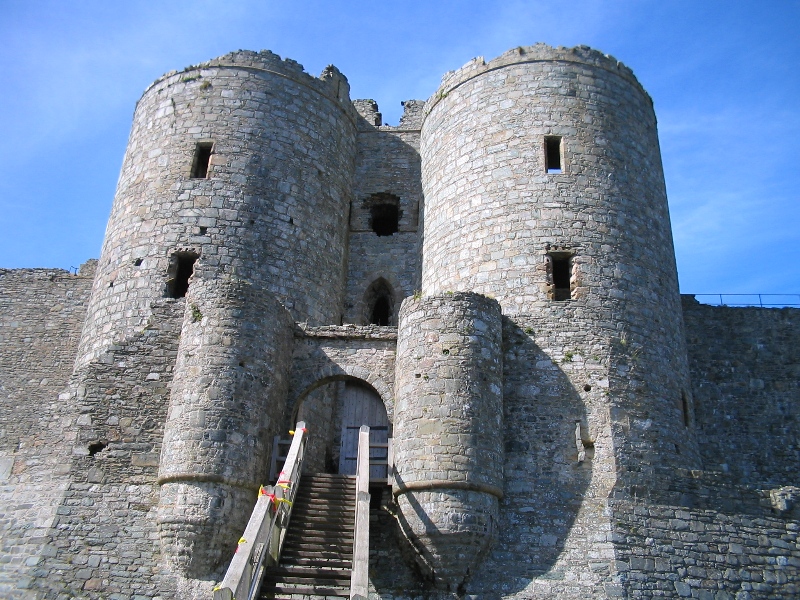
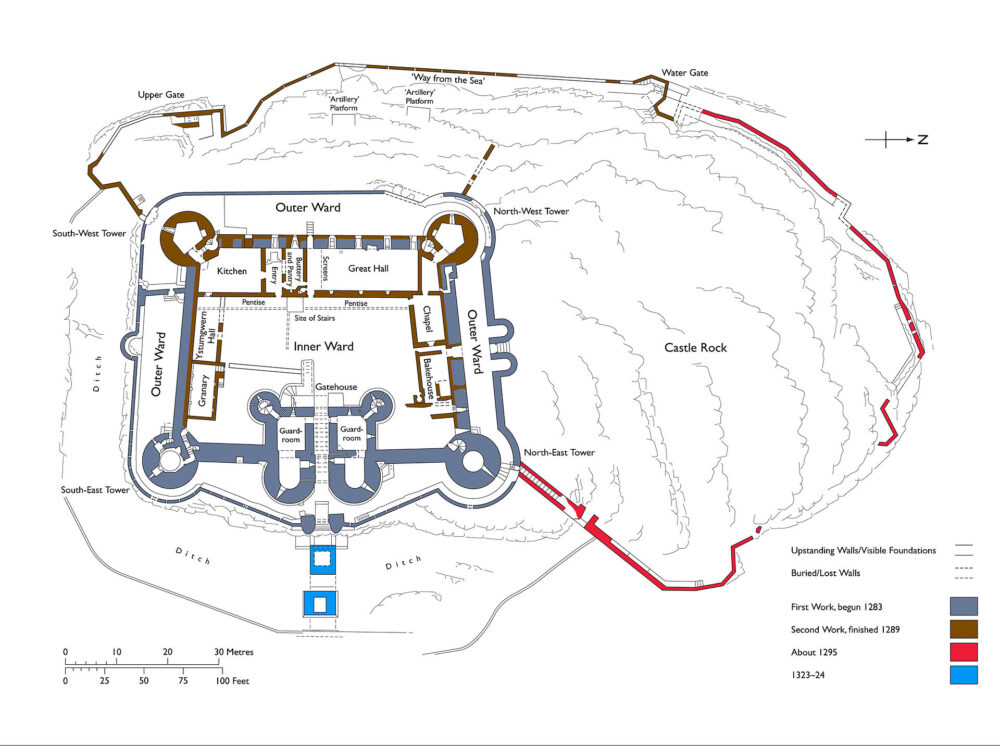
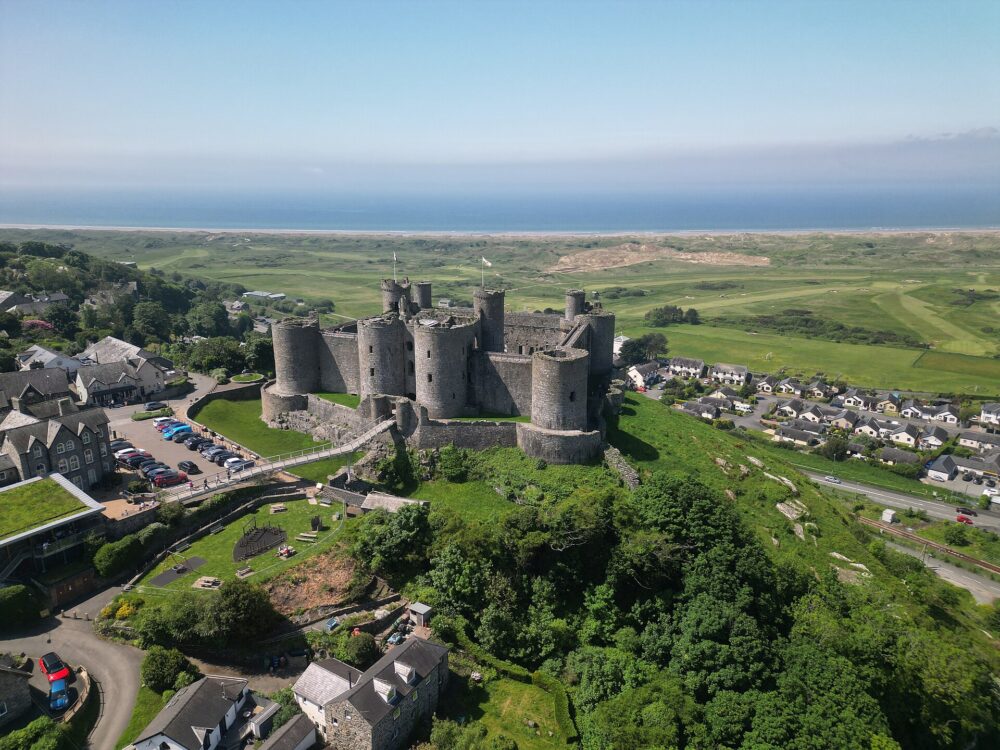
Built on a dramatic crag between 1283 and 1289, its massive round corner towers and invader-denying gatehouse were the work of the gifted architect James of St George from Savoy, who also designed Conwy and Caernarfon castles for Edward I.
Dr David Craig much admires Harlech as an engineering feat. ‘It was designed on the basis of castles that were found in places like Constantinople and medieval Turkey, with a very, very defensive structure and was also meant to be highly visible and foreboding as well against the local Welsh population.’
Its substantial defences were not sufficient, however, to deny Owain Glyndŵr entry. He and his retinue made it his main base after capturing it in 1404 and it remained so until he was forced to yield it five years later.
David explains that ‘Castles such as Harlech were seen as a huge challenge for people like Glyndŵr with his rebellion but in the end these great, big, foreboding castles were a great sort of inspiration to come and attack them and that’s why for four years Glyndwr’s rebellion was very successful.
He was last seen in public at Harlech.’ The castle was also held by the Lancastrians in the Wars of the Roses, when it withstood a siege lasting eight long years, a military attrition captured in the verses of the popular song “Men of Harlech.”
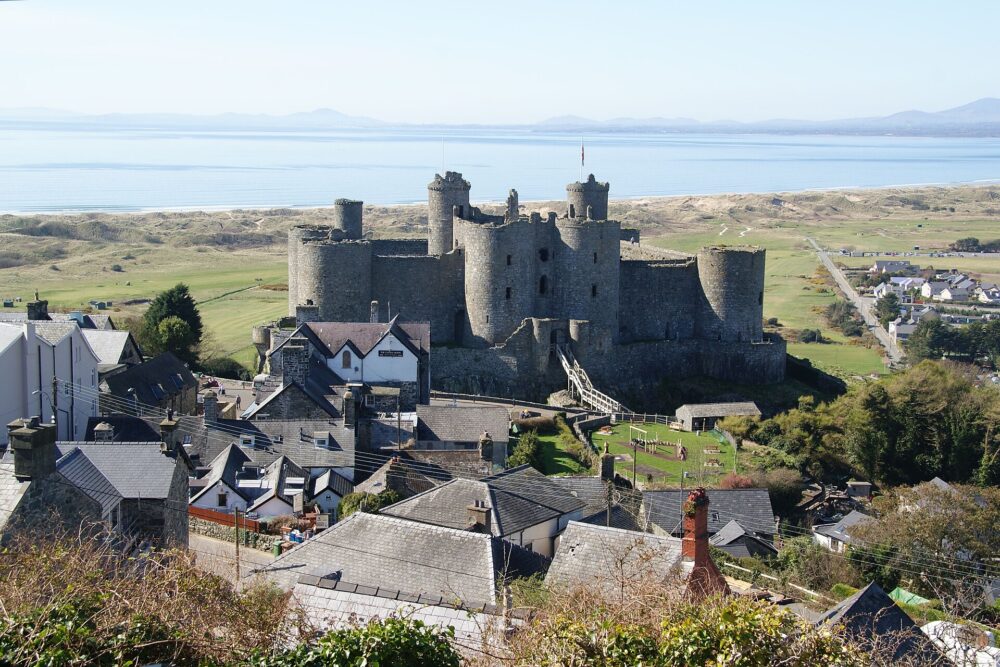
Simon Jenkins in his book Wales: Churches, Houses, Castles describes the castle’s setting, standing ‘200 feet high on an outcrop of the Rhinogs above Tremadog Bay, long painted and photographed with the bay and Snowdon in the distance’ and deriving much of its raw power, he suggests, from being ‘crammed tight on to a crag.’ The writer and broadcaster Wynford Vaughan-Thomas, meanwhile, thought it ‘the romantic image of the castle personified.’
This masterpiece of medieval military architecture has had many other admirers over the years. One of those was the English Romantic painter J.M.W. Turner who was fascinated with Harlech Castle, depicting it over and over again.
Dr David Craik informs me that ‘He painted three pictures of Harlech Castle, and I’ve got two prints of those. Sadly, I don’t have the originals. I’d love to have those. I’d be a lot richer than I am now.
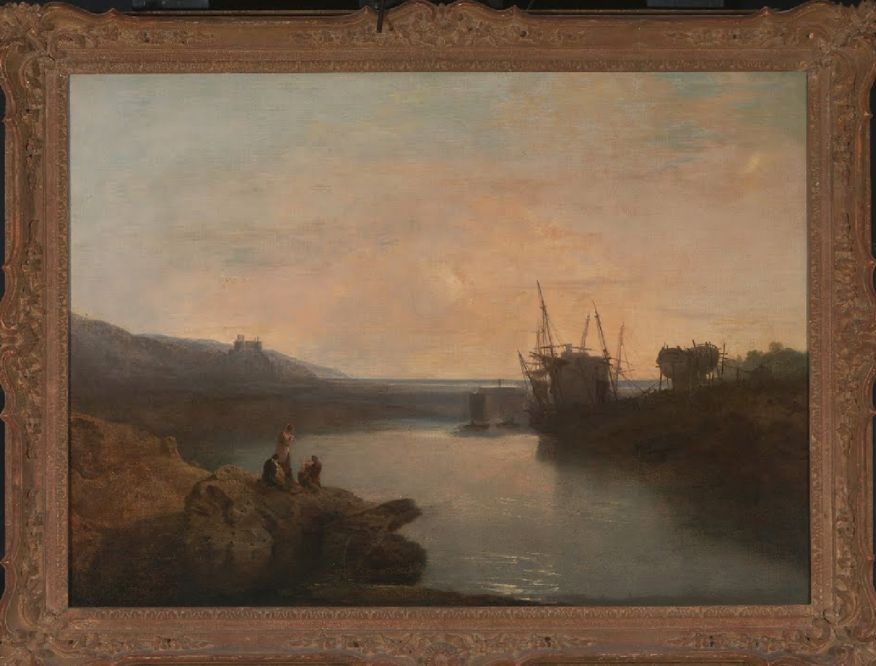
‘I’ve got his first picture, which is just brilliant, painted about a mile below Harlech Castle, which is of the ships at the Tygwyn crossing, and that’s a fantastic sunset picture. There’s also another picture of sort of working-class life in Harlech in the 1820s showing some millworks and there are some general sketches that he did, which are just absolutely wonderful. I think it’s a really fantastic indication of how the post-Impressionist movement was born in landscape art, where basically light became more important than form, and Turner did it fantastically. Turner said once that the sun was God, he was quite right about that, and he made a great application of that when he visited Harlech.’
J.M.W. Turner visited Harlech on three occasions, each time staying for just a few days as David explains. ‘We know that he stayed at the Red Lion, which is now part of the Castle Cottage Hotel, and he stayed in what was then the Red Lion, which was a very sort of rough, tough country inn at the time. But that was the kind of person that Turner was. He was a kind of very rough, tough individual but he was a brilliant artist.’
Another brilliant artist, albeit in a totally different medium, lived just down the road from Harlech, in a house called Y Lasynys Fawr, which has been preserved in his honour.
Here the poet and clergyman Ellis Wynne (1671-1734) wrote the visionary Gweledigaetheu y Bardd Cwsc (Visions of the Sleeping Bard) which vividly depicts places such as an allegorical city whose streets are full of sinners and a ghastly underground court where Death presides.
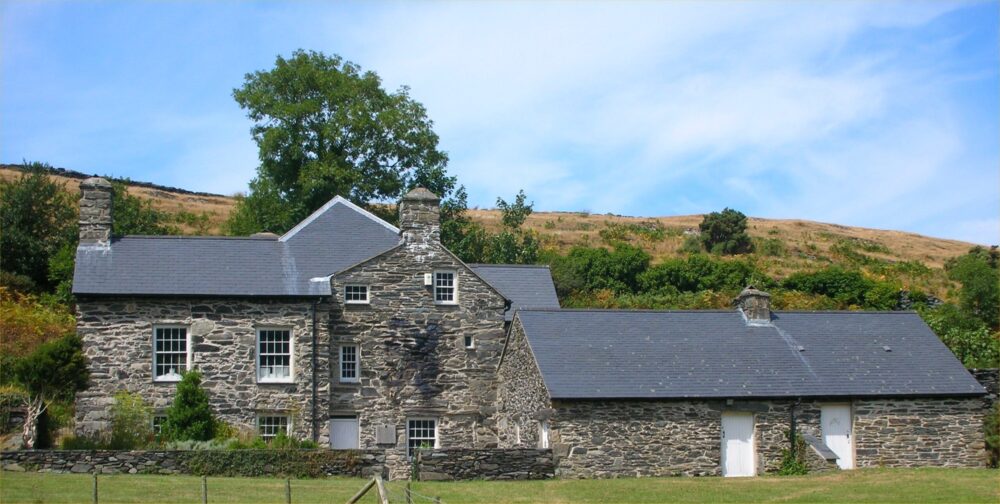
David Craik explains that some of the inspiration for the leaping flames in the phantasmagoria of the Sleeping Bard was a natural phenomenon which once occurred near Ellis Wynne’s home. ‘In the 1780s there was what seemed to be a marsh gas fire on the Morfa in Lower Harlech. Ellis Wynne found the fields around his home engulfed by this methane fire it would seem.
“He was also the rector of nearby Llanfair and had just read the newly published Dante’s Inferno. He was criticised later for basically making it a Welsh translation of Dante. But it’s still a fantastic book to read whether you read it in Cymraeg or whether you read the English translation. It presents different visions of heaven and hell and I think offers an insight into the religious mind of the 18th century.’
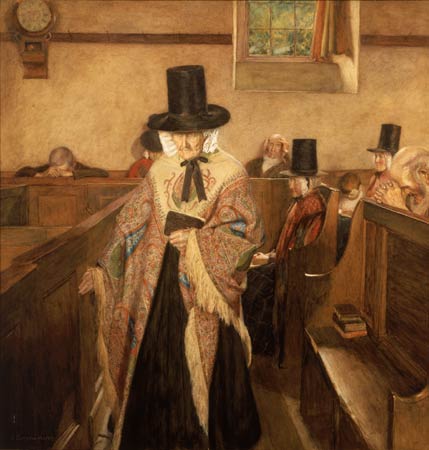
One of the most resonant images of Welsh religious life depicts chapelgoers in nearby Salem Baptist chapel in Pentre Gwynfryn in the famous painting by Sydney Curnow Vosper. It became enormously popular by dint of the manufacturers of Sunlight Soap giving away a free print of Vosper’s work if you bought seven pounds of soap.
It shows Siân Owen, an old woman who lived in a house called Tŷ’n y Fawnog, wearing a tall black hat. Part of the painting’s appeal was the suggestion that you could see the devil hiding in the tight patterns of the folds of her shawl.
One thing’s for certain. Poor Sîan would have been very uncomfortable in her traditional costume as she had to stand for hours modelling for the painting, later reappearing in Curnow Vosper’s “Market Day in Old Wales.” Vosper later complained that she twitched and moved so much that it became impossible for him to accurately reproduce the shawl’s pattern and colour.
Eventually Vosper decided to paint the final stages without Siân, pinning the shawl to a borrowed tailor’s dummy instead. The image of Salem gained yet more popularity when Sir Ifan ab Owen Edwards sold thousands of prints to supporters to raise money for Urdd Gobaith Cymru.
For David Craik the painting ‘Brings back earlier stories about things like religious imposters, like Mary Evans, known as Mari Fantell Wen, who was basically a person who adopted a messianic persona, saying that she was the bride of Christ, and went down the villages of the Vale of Ffestiniog, like Maentwrog and Llanfrothen, and also wandering down towards Harlech, walking around in a white dress.’
There is some uncertainty about the facts of Mari Fantell Wen’s life. The Dictionary of Welsh Biography suggests that ‘She is generally believed to have reached Merioneth from Anglesey c. 1780 – some have it that she came as a maidservant to Maentwrog rectory, others that she lived at Breichiau, on the Maentwrog border of Llandecwyn parish; there are suggestions that she hailed from Cardiganshire.’
There is a little more certainty about her marriages, one conventional and one very much not so: ‘She had left her husband (probably before leaving Anglesey), and cohabited with another man.’ But she asserted that she was betrothed to Christ; arrayed in a red mantle she led a long procession to her ‘marriage’ in Ffestiniog church, after which there was a ‘marriage-feast’ in a tavern in that village, and Mary received many bridal gifts.’
David confirms that she did have some followers, and some people were definitely taken in by her, sufficient to describe this as a cult.
On Sundays, she and her devotees wore white mantles, and held ceremonies on Manod mountain and on other hills. ‘But her grave in Llanfihangel-y-Traethau actually faces the other way to the other graves so perhaps there was some kind of a verdict by the church on her imposturing after she had died.’
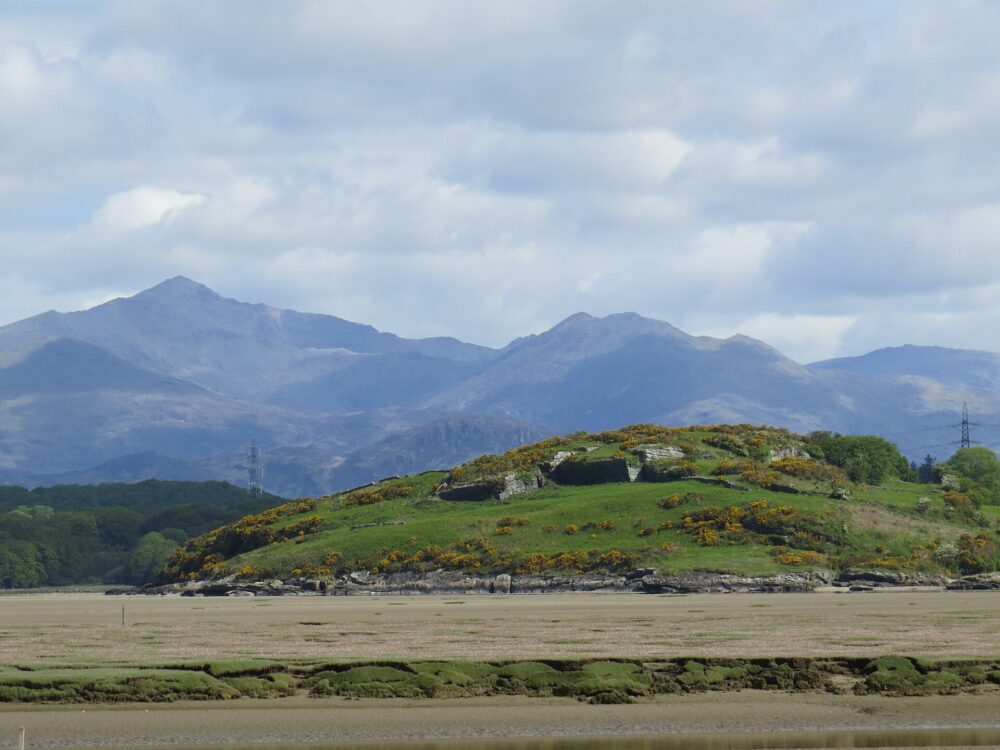
‘I think in the wake of post-Reformation Wales there was a lot of religious mania in Cymru,’ says David. ‘The non-conformist religions began to thrive. I think they were also politically motivated as well, because you could avoid paying your church taxes if you joined the non-conformists.
“And also, I think, radical Protestantism was seen as something much more favourable to the Welsh view of religion at the time and it also was a form of nationalism as well because it meant that you could be detached from the Anglican Church and the Anglican identity.’
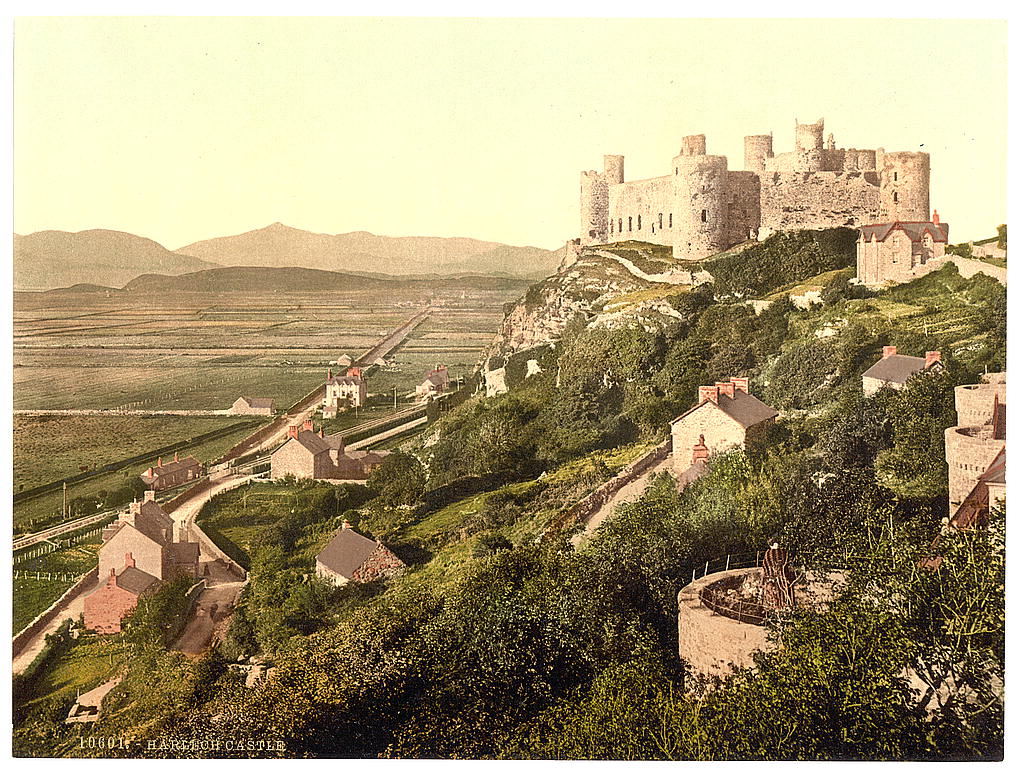
Some local stories suggest that the sea used to lap up against the crags on which Harlech castle stands, although David Craik thinks the jury’s still out.
‘There’s still a massive, ongoing geological, geographical debate about that. I fall on the side that thinks there was a canal dug from the Dwyryd estuary going along the Morfa towards the castle. There are two or three boat rings in the bottom rocks of the castle and no evidence of coastal erosion against the bottom of the castle.
“There are some fanciful paintings by people like Samuel Palmer in the 1830s showing the waves lapping up against the castle. But I don’t really think that ever happened. But I’ve seen a 1666 John Speed map which shows the channel that was dug from the Dwyryd estuary up to the castle, allowing boats to get up to it, basically.’
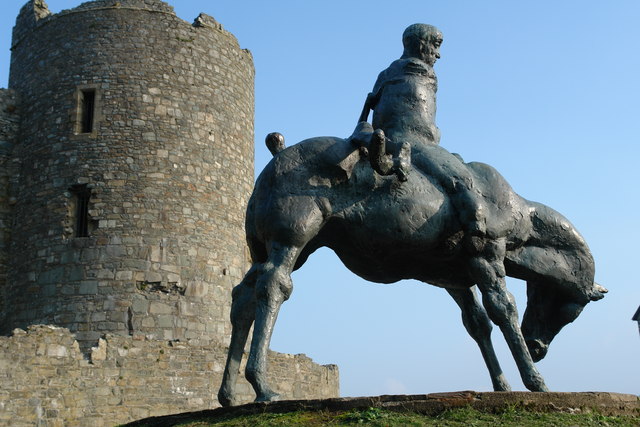
The castle features prominently as the home of the giant Bendigeidfran, Brân the Blessed, in the second branch of Pedair Cainc yn Mabinogi, which is the tragic story of the marriage of Branwen to the Irish King Matholwch.
David suggests that Bendigeidfran’s castle was probably not on the site of what is Harlech Castle today. It was probably up at Moel Goediog or Pen y Graig where you would have had a panoramic view of any arrivals out in the bay and the Irish arrivals, the Irish invaders did come according to the Mabinogion.’
In Welsh the inhabitants of Harlech are sometimes referred to as Brain Harlech, Harlech crows. I’m interested to find out if David can explain the etymology of the name. ‘We have the nearby Llechwedd Woods, where the crows actually live, and they’ve always been there. I remember them from my childhood, I remember them from my teenage years, always flapping backwards and forwards to the castle.
You have to remember that some crows and ravens are disappearing massively out of the environment, sadly, now. And the Rhinog mountains of southern Eryri are some of the only places where wild ravens now actually live.
If you go anywhere and tell people in Cymraeg that you’re from Harlech they will often say something like you must be one of Brain Harlech and I’m very proud to be one.’

Jon Gower is Transport for Wales’ writer-in-residence. He will be travelling the breadth and length of the country over the course of a year, reporting on his travels and gathering material for The Great Book of Wales, to be published by the H’mm Foundation in late 2026.
Support our Nation today
For the price of a cup of coffee a month you can help us create an independent, not-for-profit, national news service for the people of Wales, by the people of Wales.
Get more trusted Welsh news
Choose Nation.Cymru as a preferred source in Google News to see more of our journalism.



There are many that concur with you that Y Gamlas was dug to provision the castle. One interesting place name is Ffridd Rasus, which lies on the Morfa which traditionally is attributed to the occupiers of the castle originally starting horse races and some state that it goes back to Edward I. If this is so then then the sea did not reach to the bottom of the castle at this time which gives credence that Y Gamlas was indeed used to supply the castle.
I’m a little disappointed that there is no mention of Coleg Harlech in this article. In existence from 1927 until closure in 2017. Coleg Harlech provided academic opportunities for men and women who had been failed by the mainstream education system. Between 1968 and 1994 the college offered a two year course leading to the University of Wales Diploma in General Studies that was accepted as fulfilling entry requirements for all UK universities. Though the college was small, with a student body of around 120, it nonetheless represented significant boost to the town’s economy and was also a relativley large… Read more »
Thanks Padi…
It also worked minor miracles and had a formidable teaching staff…
A book that may have been missed is ‘The Evolution of a Coastline’ by William Ashton 1920…super rare for a first edition…
I know about the ‘formiddable teaching staff’ as I was fortunate enough to be a student at Coleg Harlech between 1984 and 1986. Some of the housekeeping and catering staff were pretty formidable too! Woe the student who tried to pull a fast one with Edwina!
TfW now needs to gradually expand with https://cadw.gov.wales/visit/places-to-visit/cadw-holiday-accommodation – few cottages currently and offer train- accomodation (with wifi) options through Jurnyon to get more people to visit Mid and North Wales 52 weeks per year. I am against costa plonka style resorts, but converting some old farms / derelict buildings will encourage more people to visit the castles / pubs off-peak. Plus TfW could offer its’ staff discounts November to March (excluding school holidays) to stabilise demand.
Have you seen ‘Legoland’ on the Morfa?