


Making Tracks: Inspiring Lines
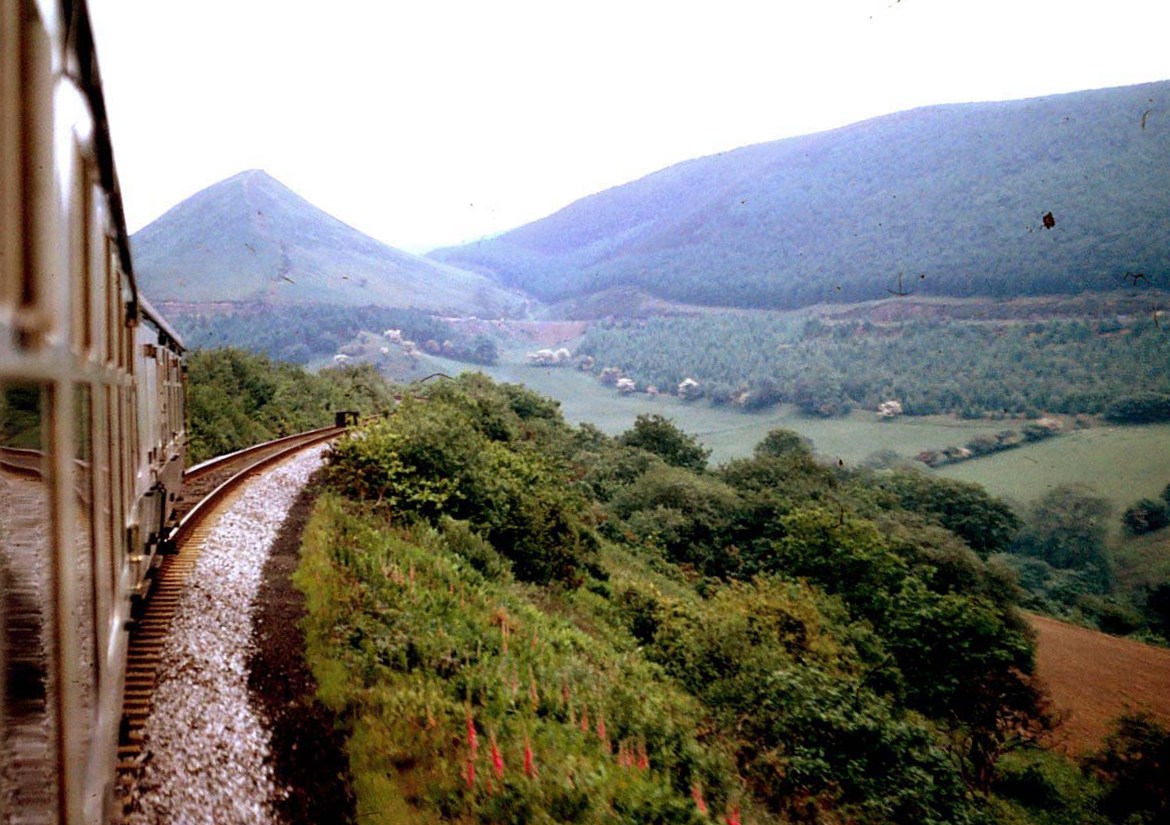
Jon Gower considers the ways in which artists and writers respond creatively to travelling by train.
Trains journeys certainly inspire and, like the railway system itself is a case of one line after another.
There is something perhaps about the rhythm of the travel, or the constantly changing views or chance encounters that is conducive to both ruminative meditation and eureka moments.
Take the example of Carys Shannon, a debut novelist who found the germ of her novel Truth Like Water on a morning train: ‘I used to commute from Swansea to Cardiff every day on the train. It was a great (pre-smart phone) time for reading and thinking. Somewhere just after Bridgend, the train passes a long stretch of woods. One day, I was staring out of the window, looking at the trees and bog as we sped past. I thought I saw something in one of the pools. For a second, I was convinced I’d seen a body in the ditch; it was a visceral feeling. I jumped up from my seat and ran back along the aisle to look. I was quick enough to glimpse a doll in the water, and I walked back to my seat feeling very foolish. As soon as I sat down, Catrin’s voice came to me, and I got out my notebook and started to write down everything she said.’
The great American writer Eudora Welty, who usually depicts the American South in her fiction, wrote a short story set on the train from London to Fishguard. It’s an account of four travellers who happen to share the same compartment as they head to catch the boat to Ireland:
‘What’s the time?’ The round man spoke softly, as if perhaps the new man had brought it.
The lady bowed her head and looked up at him: she had it: ‘Six minutes to four.’ She wore an accurate-looking wristwatch.
The round man’s black eyes flared, he looked out at the rain, and asked the American if she, too, were going to Cork – a question she did not at first understand; his voice was very musical.
‘Yes – that is—’
‘Four minutes to four,’ the lady in the raincoat said, those fours sounding fated.
‘You don’t need to get out of the carriage till you get to Fishguard,’ the round man told her, murmuring it softly, as if he’d told her before and would tell her again. ‘Straight through to Fishguard, then you book a berth. You’re in Cork in the morning.’
Meanwhile, Keza O’Neill’s short story ‘The Man on the Train’ won the 2025 Rhys Davies short story award. It tells the story of an unnamed man travelling towards Aberystwyth – ‘home’ – after 20 years.
As he passes through various stations along the way – Welshpool, Newtown, Dyfi Junction and so on – he wrestles with his own internal thought processes punctuated by childhood memories.
As the author explained: ‘My story, “The Man on the Train”, comes from a place close to my heart. It’s inspired by a train journey I’ve taken countless times, with the conductor’s familiar chant of place names stirring up excitement, longing or sometimes a heavy heart. I’ve always been fascinated by the idea of home, what it means, how we carry it with us, reach for it or even turn away from it in moments of joy or pain. The story digs into that urgent pull to return home at the end of life, where time, space, memory and the present all collide.’
One of the stops on that short-story-journey is Caersws, once the workplace of stationmaster John Ceiriog Hughes. Born in Llanarmon-Dyffryn-Ceiriog, Denbighshire, in 1832, as a 17-year-old, Hughes moved to Manchester where, after about three months, he obtained a situation as a clerk in the London Road Goods Station.
At that time there were many learned Welshmen in Manchester such as Creuddynfab, R.J. Derfel, Idris Fychan and Meudwy Môn. They, together with Hughes, formed a small literary society where the young man came very much under their tutelary influence.
In 1865 he returned to Wales to become stationmaster in Llanidloes on the Cambrian Railways, and in 1871 was appointed superintendent of the newly opened line which ran from Caersws to the nearby Van lead mines.
Ceiriog was easily one of the most popular poets of his day. His collection Oriau’r Hwyr sold no fewer than 30,000 copies. So popular was he in fact that, after his passing, all seven Welsh banks of the time contributed to the costs of erecting the Ceiriog Institute in his home valley and their coats of arms feature in one of the Institute’s windows.
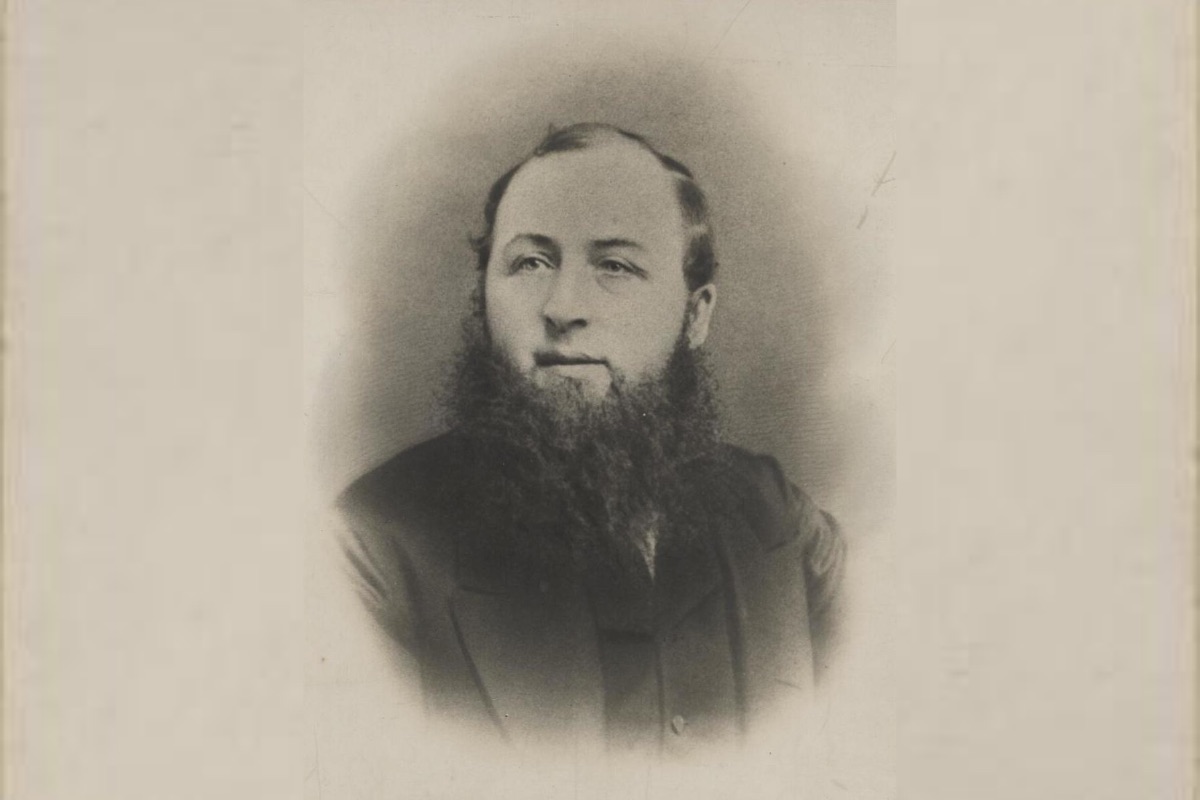
His fellow poet Graham Davies described the portrait: ‘Ceiriog is there, an Old Testament patriarch with bushy beard and no moustache.’
In the early days of the Railway Age, Welsh language writers and thinkers such as Thomas Gee and Samuel Roberts doted on what they described as yr agerfarch, the steam stallion, so much so that a body of work came into being praising it, requiring Tecwyn Lloyd to coin a new term, llenyddiaeth gerbydresol, locomotivistic literature to describe it.
The thrill of travelling at speed had to be put down on paper, although cartoonists warned of the effect railways might have on the distinctiveness of the country, duly depicting a woman in a petticoat and gown trying to hold back the advancing iron monster.
There were many such cartoons, perhaps reflecting the fact that almost 1500 miles of new track was built in Wales between 1840 and 1870, equivalent to an investment of £20 million in less than a single generation. This was all private money, for while the government had to bestow parliamentary authority to allow any new line to be built, it didn’t require them to spend a single penny.
Mind you, not every writer was besotted with the new-fangled steam trains. George Borrow, the indefatigable walker and author of Wild Wales, felt nothing short of hostility.
Here’s a sample of his splenetic attitude to the steam stallions from his classic Welsh travelogue, in which he chooses Shanks’ pony, or his own two feet, rather than climb aboard a train in Anglesey:
‘Leaving the road I made towards the light by a lane and soon came to a railroad station.
‘You won’t have long to wait, sir,’ said a man, ‘the train to Holyhead will be here presently.’
‘How far is it to Holyhead?’ said I.
‘Two miles, sir, and the fare is only sixpence.’
‘I despise railroads,’ said I, ‘and those who travel by them,’ and without waiting for an answer returned to the road. Presently I heard the train – it stopped for a minute at the station, and then continuing its course passed me on my left hand, voiding fierce sparks, and making a terrible noise – the road was a melancholy one; my footsteps sounded hollow upon it.’
But other authors certainly enjoy the ride. The great travel writer Jan Morris would sometimes start some of her global wanderings by taking the Welsh Highland Railway from a halt near her home in Llanystumdwy.
The cultural critic Raymond Williams conjured up Welsh train travel in his best novel, Border Country.
Here’s lecturer Matthew Price returning home to visit his ailing father, Harry. ‘Abruptly the rhythm changed, as the wheels crossed the bridge. Matthew got up, and took his case from the rack. As he steadied the case, he looked at the rail-map, with its familiar network of arteries, held in the shape of Wales, and to the east the lines running out and elongating, into England. The shape of Wales: pig-headed Wales you say to remember to draw it. And no returns.’
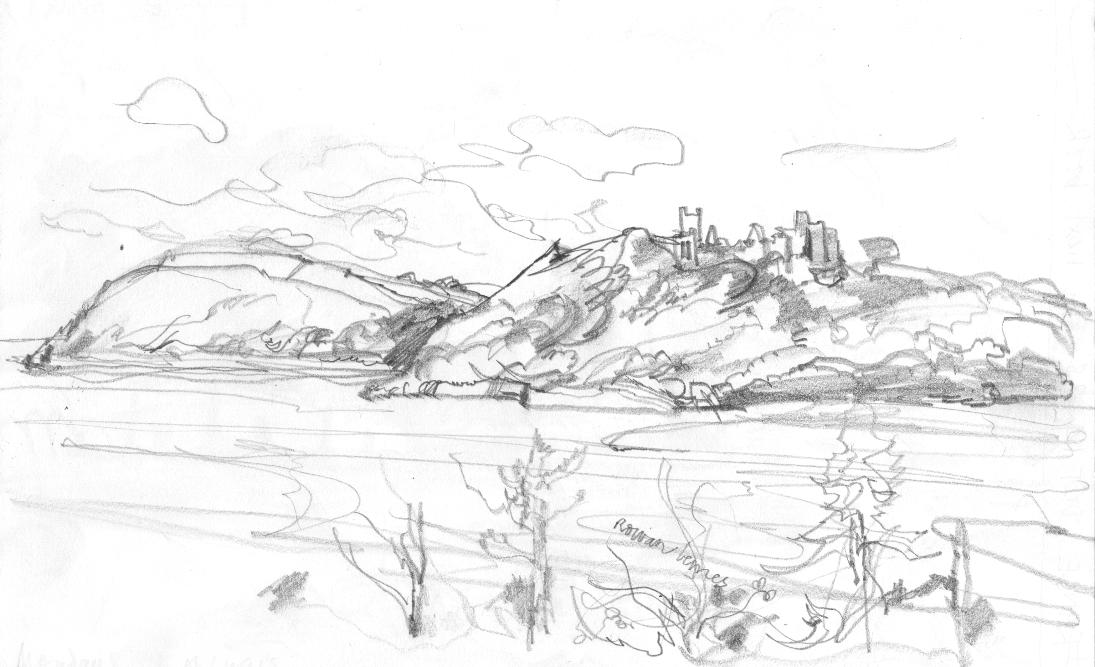
It’s not just writers who find train travel stimulating. Artists, too, find inspiration on the rails. Elizabeth Haines regularly takes the train, always bearing a sketch book. ‘I don’t really like driving, you can’t look around, see things to draw, and follow trains of thought. But the real train…that allows you to meditate, in fact encourages you to do so.’
Elizabeth’s journeys usually start in Whitland, the nearest station to her home in the Preseli Hills. Visually ‘It starts to get interesting along the estuary soon after Carmarthen where I’m eager to see what the tide is doing, and start drawing quickly as we follow the shoreline.
As we approach Ferryside, there is the ancient Norman castle at Wharley Point: from here you can even see as far as Lundy on a clear day. This is one of many locations where you look across a stretch of water and see another side, another place which is perhaps not easily accessible, a hiraeth place’.
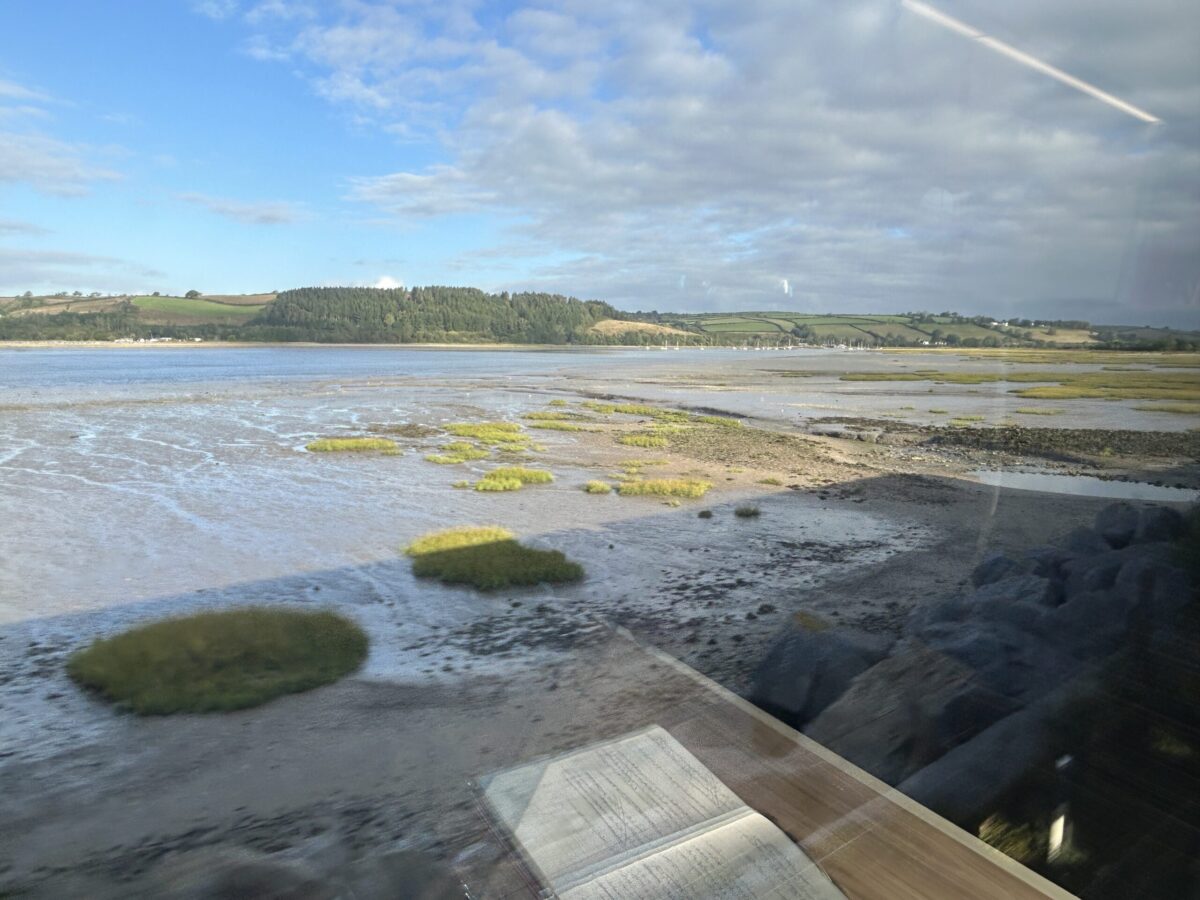
On one of Elizabeth’s regular journeys the train hugs the edge of the Towy Estuary pretty much as soon as it leaves Carmarthen on its route to Ferryside.
On then through St Ishmaels and its caravan park before crossing the Gwendraeth at Kidwelly Quay, where redshank probe the muddy margins.
Soon there’s more expansive, tidal coastline, looking out over the Burry Inlet and the widening course of the River Loughor: more scenes to be speedily committed to paper.
The iron lighthouse at Whiteford on the north side of Gower has been rendered in pencil by Elizabeth many times. She observes, ‘The tide – it reveals the bones and then it conceals, everything, all on the same day. At a really low tide I think of the drowned lands of Cantre’r Gwaelod, and wonder – what if all the water ran out, just like a fanciful picture in Henrik Van Loon’s The Story of Mankind, which was always on the bookshelf when I was a child. I still have that book.
‘Then there’s Swansea: sometimes a bit of a rush for a connection, if I’m going to London. I used to have anxiety dreams about missing connections, wrong platforms…but mercifully not any more. Stations are for farewells and greetings.’
The longer Elizabeth’s journeys, the more sketches are generated. ‘The Blorenge mountain near Abergavenny never fails to captivate, the perspective changing rapidly, the light and shade, the seasonal vegetation. Then the Skirrid starts to appear, and it’s even better on the way back when that strange peak rises from afar, above the patchwork of fields.
‘This great recumbent hill always makes me think of David Jones’ “The Sleeping Lord” which asks “Does the land wait the sleeping lord, or is that wasted land the very lord who sleeps?” These passing vistas through the trees also remind me of one of Robert Frost’s lesser-known poems “A Passing Glimpse,” which ends: “Heaven lends its glimpses only to those/Not in position to look too close.’”
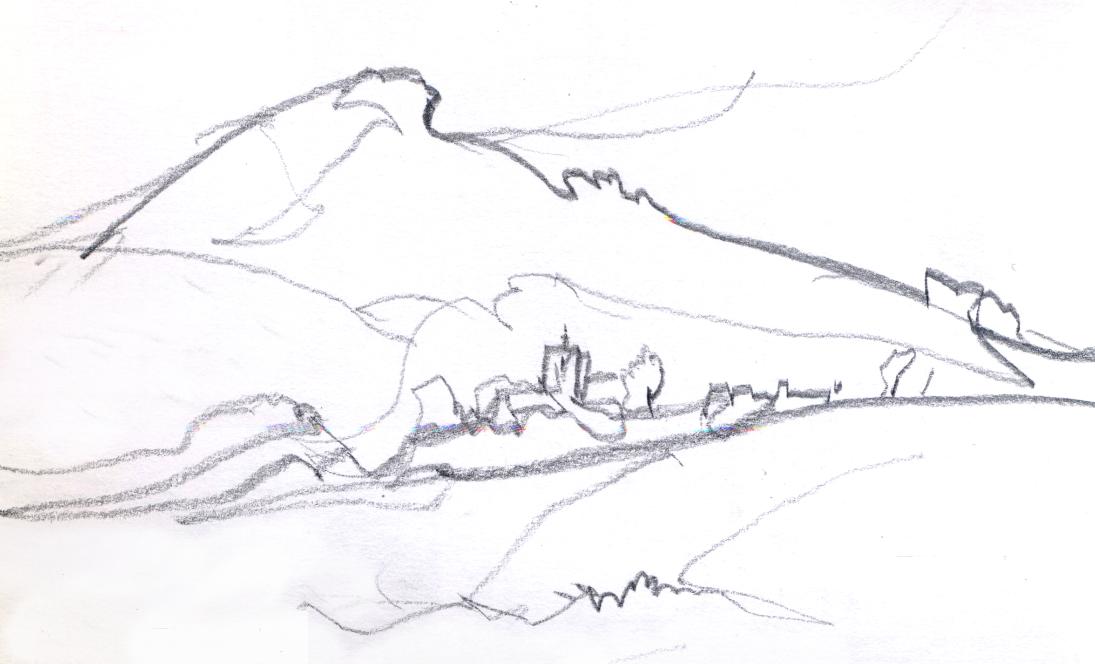
Haines thinks that ‘Being in position…drawing from the train is a bit like being a hunter; you take aim and fire quite quickly: but with a drawing you have to hold the details when you’re long past the spot, and incorporate them into the image. So, train drawings always have a sense of time passing, which is a delight peculiar to the situation.’
Some more social pleasures of train travel are supplied by dint of the people Elizabeth encounters. ‘At Carmarthen there was a man with a ferret peering out of his pocket. I was once needing a drawing of a cat for a book illustration, and behold! There was a cat in a basket, who was allowed out to pose. A wonderful assistance dog who was so black we didn’t see him under the seat. A gaggle of girls dressed to kill and off to a party, already three sheets to the wind at 10.30 in the morning.
‘And then there was that trolley man who entertained us all with humorous songs and anecdotes: we said, you ought to be on the telly, and he admitted that he was shortly to appear on Mastermind, but was not allowed to tell us the outcome.’

Jon Gower is Transport for Wales’ writer-in-residence. He will be travelling the breadth and length of the country over the course of a year, reporting on his travels and gathering material for The Great Book of Wales, to be published by the H’mm Foundation in late 2026.
Support our Nation today
For the price of a cup of coffee a month you can help us create an independent, not-for-profit, national news service for the people of Wales, by the people of Wales.
Get more trusted Welsh news
Choose Nation.Cymru as a preferred source in Google News to see more of our journalism.


