


Making tracks: Maesteg
Jon Gower finds lovely art, poetic heartbreak and a very hearty breakfast in the Llynfi Valley
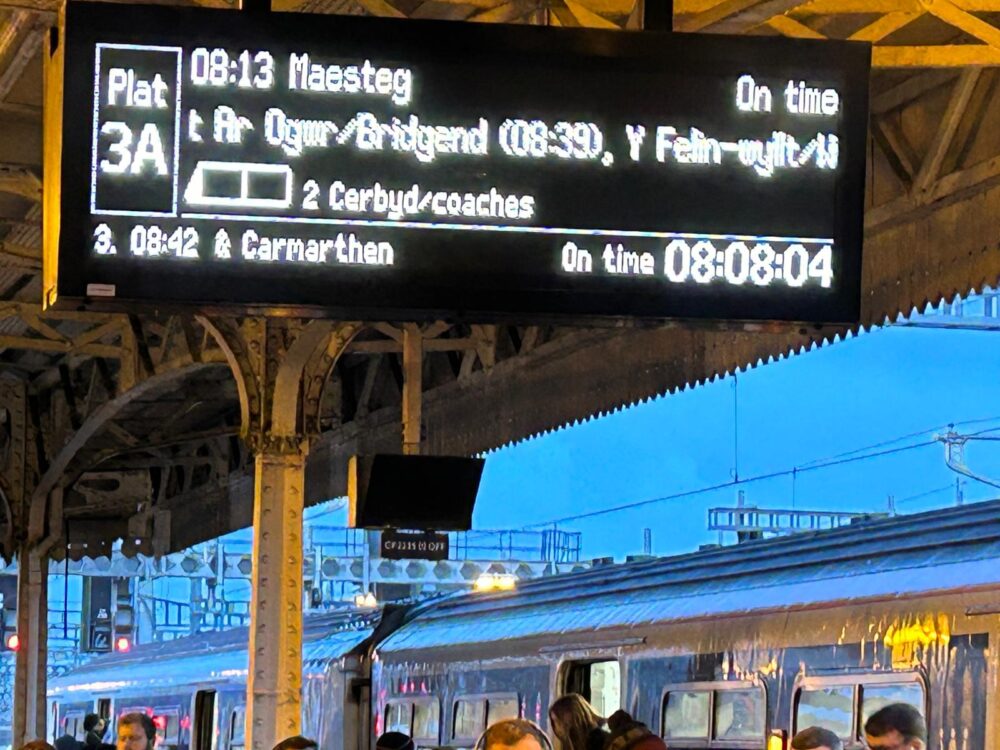
Compared with many Welsh towns much bigger in size, Maesteg, with its 20,000 inhabitants has not one but two stations.
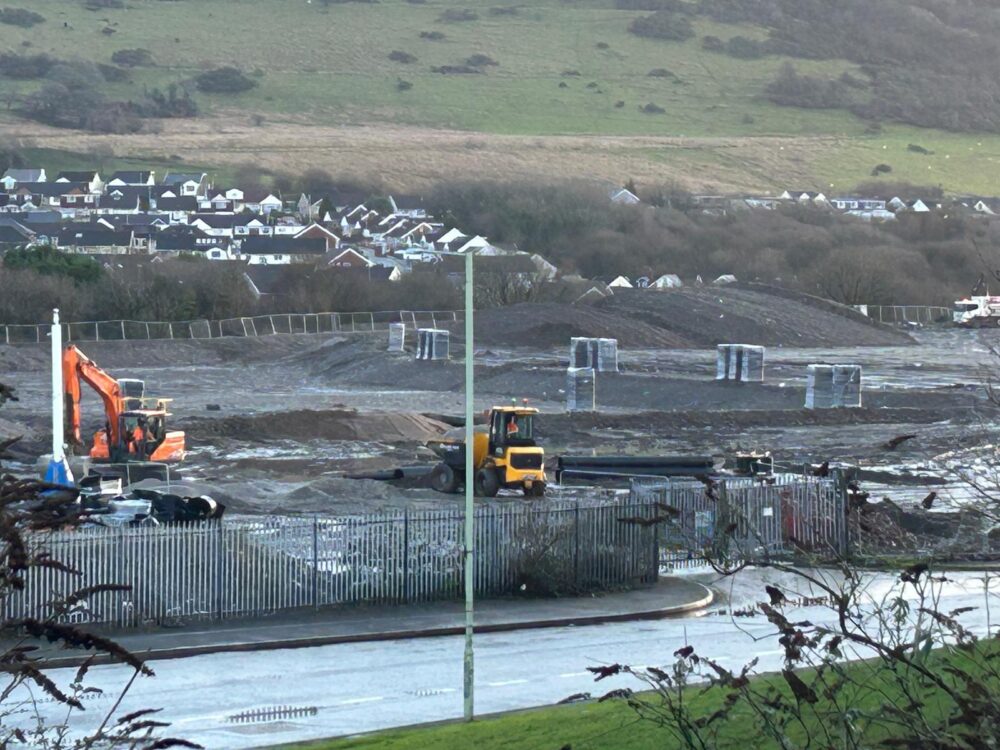
As you get off the train at Maesteg Ewenny Road the first thing you see are the busy earthmoving vehicles sculpting the site of the former Revlon cosmetics factory ready for new housing and a park and ride.
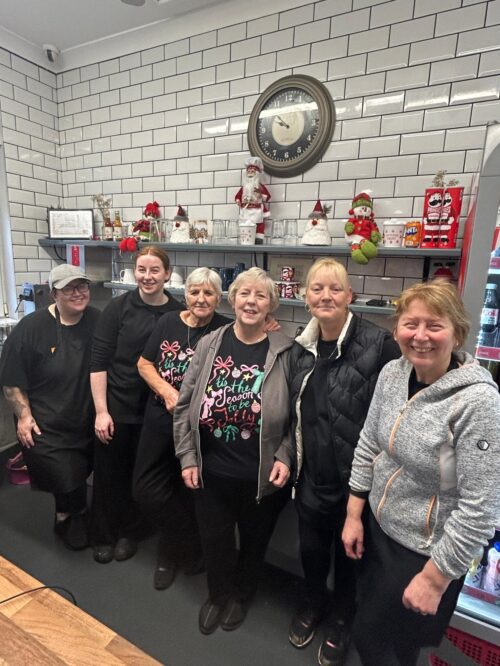
Alyson O’Connor, who runs the nearby Weighbridge Cafe, used to work in the factory. ‘I am a Revlon girl,’ she proudly proclaims as she points to a photo on the wall. ‘It holds great memories for me. At its height I think there were over a thousand people working there. I made great friends.’

Three years ago Alyson took over the cafe where the favourite item on the menu is the large breakfast, which would set a lumberjack up for the day. Customers are given a lot of choices – potatoes or hash browns, with or without black pudding, tomatoes or beans or half and half?
I ask Alyson if the staff wake up in the night with these words running through their heads? “All the time. We say that a lot during the day.”
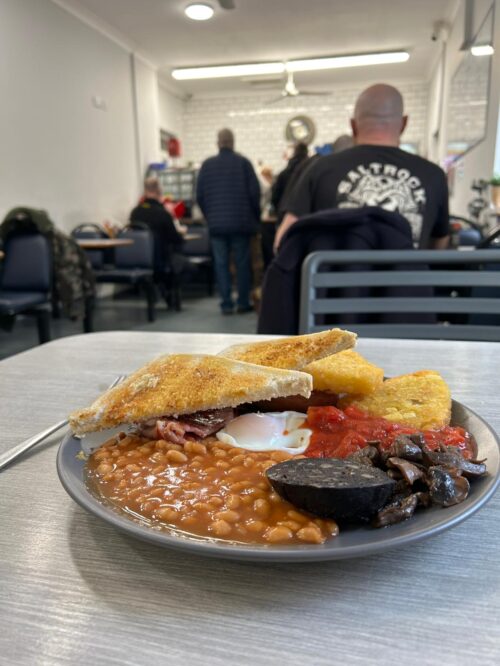
They serve hundreds of breakfasts at The Weighbridge each week and have a steady stream of regulars through the doors. “Some come every day and if we don’t see them for a couple of days we’re on the phone, asking is there something wrong?
“There’s a real sense of belonging. That’s what keeps me in business. I’m in a valley. If the people of the valley don’t support me I won’t last very long. Nobody’s going to come from far and wide to a little cafe in Maesteg.”
But they should. The Weighbridge is the very definition of welcoming and all of the main menu is home-made, including their very popular steak pie. Customers are treated as if they’re family and there’s an awful lot of laughter and plentiful good humour among the staff.
Kindness
A regular customer wearing a holly green Christmas jumper takes a box of chocolates up to the counter.
Alyson says they get a lot of this sort of kindness at this time of year. “Some people have nothing but yet they leave us a tip. We know some people don’t have money but they want to give. When they give us chocolates it means the world because it means they’ve thought of us.”
It’s just a short train ride from Maesteg Ewenny Road to Maesteg, but I’m on the platform long enough to do a little birdwatching. A party of long tailed tits add pale splashes of pink and greys to the deep green of thick ivy. A red kite floats overhead, splaying out the fork of its tail.
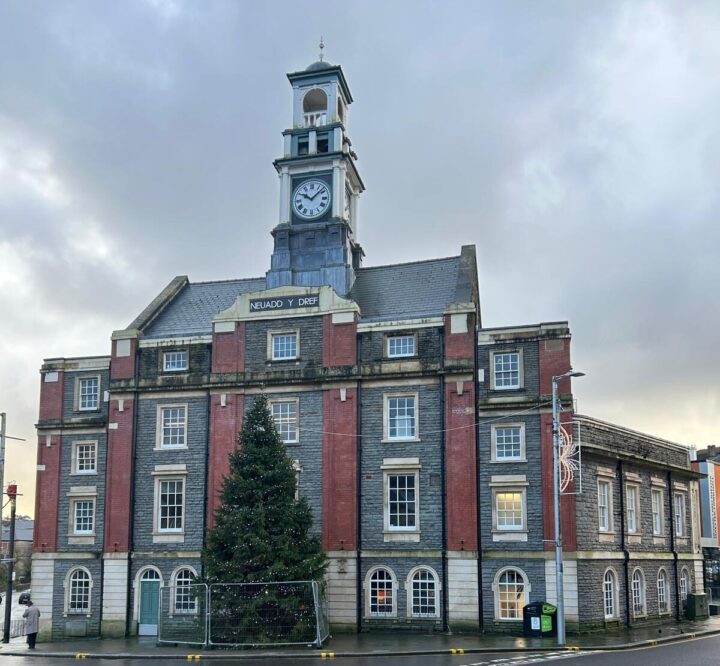
Alighting at Maesteg – the name means ‘fair field” – it’s just a brief step to Maesteg Town Hall. This is a building transformed, from the steadying of the wobbly yet iconic clock tower to the creation of a thriving theatre space, all part of a joint venture involving Bridgend County Borough Council and Awen Cultural Trust.
The current calendar of events lists a wide range of activities from ‘Rapunzel,’ a ‘Gong Bath With Temple Sounds’ to the Maesteg Stomp or twmpath.
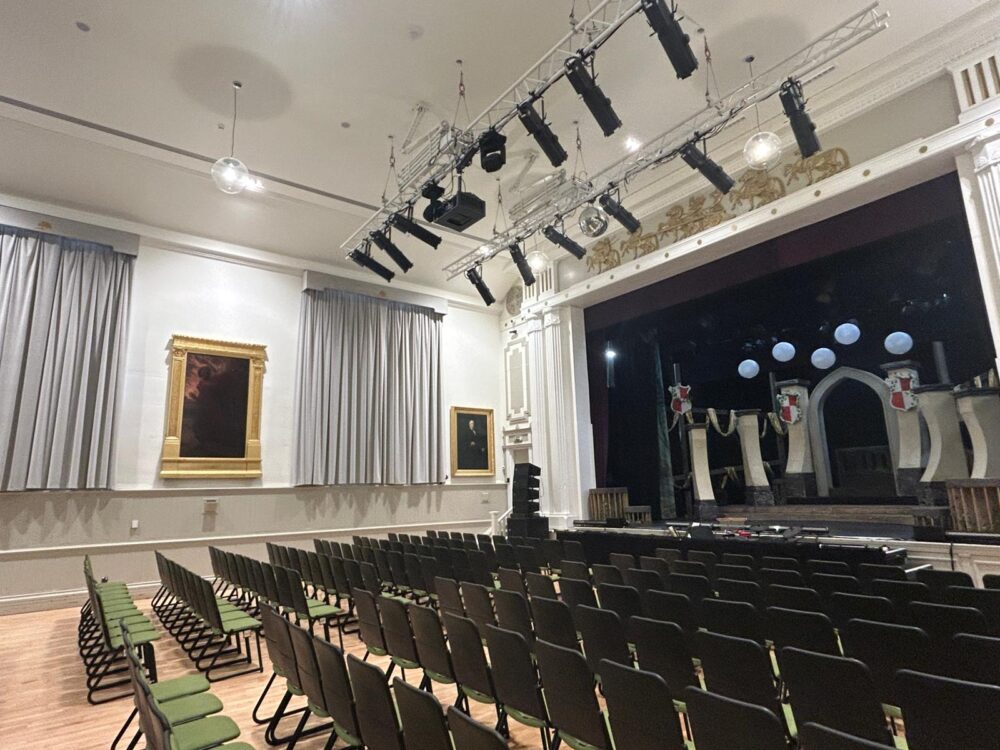
You can also enjoy the art of Christopher Williams, a local boy made good. Born and raised in Maesteg, he attended the British Llynfi School, just across the road from the town hall where at a young age he was already showing an interest in art, being an inveterate doodler.
Stefanie Van Stokkom gave me Williams’ potted biography: “One of his teachers went to his father and said he’s got talent and could be an artist. But he was given short shrift.
Christopher’s father was a grocer who kept Siop y Tebot, The Teapot Shop, with a red teapot for a sign outside and a range of teas for sale inside.
He and his wife had had a discussion three months before their baby was born and had agreed that should they have a boy he would become a doctor. His mother died in childbirth and Christopher was baptised on his mother’s coffin so that promise took on a deeper significance.

Stefanie continues: “As a boy Christopher was sent to nearby Nantyffyllon to be nursed, and thus spent his early days among coal miners, living free, running around the hills and in and out of people’s house and picking up some choice language. When Christopher was later in a school near Oswestry he visited the Walker Art Gallery in Liverpool where he saw a painting, ‘Perseus and Andromeda’ by Lord Frederick Leighton that inspired him to become a painter.”
Christopher was stubborn, totally determined to be an artist and eventually found a teacher called Mr Kerr in Neath. He would take the train from Maesteg to Pontrhydfen and then sometimes walk from there to attend classes.
Mr Kerr dutifully tried to dissuade him from the artist’s life, suggesting it was hard work for very little return and furthermore that nobody in their right mind would want to do it. But Mr Kerr also talked about artistic fulfillment and said that there was an excitement to that.
Royal College of Art
Williams duly followed the courses, passed his exams and eventually gained a scholarship to the Royal College of Art. It was at this point that his father recognised his son’s determination and drive and decided he would back him all the way. This proved essential, because for ten years Christopher would be obliged to live on his father’s money.
The first painting you see as you enter the town hall is the only known one Christopher Williams painted of his home town. An early work, ‘The Llynfi Iron Works’ was created around 1895, when Williams was receiving that early art training in Neath.
In fact it was painted over another work as the young artist had to be frugal with his canvasses. It depicts a substantial building, now in ruins, set among rubble and rocks.
The actual works stood where the Halo Maesteg Leisure Centre stands today, where you can find some evidence of what is the only large scale industrial heritage left in the town.
Williams would become one of the most popular portrait artists of his day, at a time when portraiture itself was very popular. In 1911 he painted the Investiture of the Prince of Wales, although, sited as he was on a wall, he couldn’t get any detail of the faces. A few days later he received an invitation from the King to create the official painting of the event, visiting Buckingham Palace to detail the facial features.
Deffroad Cymru
Wales was very important to him. At the other end of the country, in the council chambers of Caernarfon Town Council there’s a lovely, allegorical work by Williams called ‘Deffroad Cymru’ (Wales Awakens.) It shows a nude woman emerging from the jaws of a sea-dragon.
Stefanie confirms that: “Williams was a very proud Welshman, a supporter of eisteddfodau and wanted to promote art especially, arguing that we might be a land of song but why can’t we be a land of art as well?
Later in his life he became interested in The Mabinogion, really embracing his Welsh heritage and he wanted to embrace his people to be proud of those stories and to discover them – he was keen to promote Welsh stories, Welsh art and Welsh music as well. He loved it all really, a real supporter of the arts.”
An official and somewhat surprising commission was his painting ‘The Charge of the Welsh Division at Mametz Wood,’ sadly not currently on show anywhere.
Christopher Williams was a pacifist and thought the war and the suffering of people was abhorrent. In the early days of the First World War he would sometimes walk to the stepping stones at Ogmore, passing the army training camp in Bridgend, noting the awfulness of soldiers practising with their bayonets, plunging them into straw bales.
Mametz Wood
He didn’t go to war himself but in 1916, David Lloyd George, then Minister of War commissioned Williams to go to Mametz Wood to generate the official painting of the bloody battle. Given official permits, he travelled to France to a country in war where he found the soldiers in good spirits but the further he went in the battlefield he saw the effects of war unfolding in front of him.
He asked real troops to pose for his painting: he wanted to capture the suffering of the soldiers. Stefanie van Stokkom explains how “When it was first displayed at the National Museum in Cardiff they had to take it down after two days because ladies were fainting in front of it.
“This was a time when there was no television and photography would be very limited so people didn’t really see war, they saw soldiers marching, full of pride in their lovely uniforms before they went to war but they didn’t see the realities of war. This really big painting by Christopher Williams was really confrontational and shocking to people. Hence they took it off show because it was that controversial.”
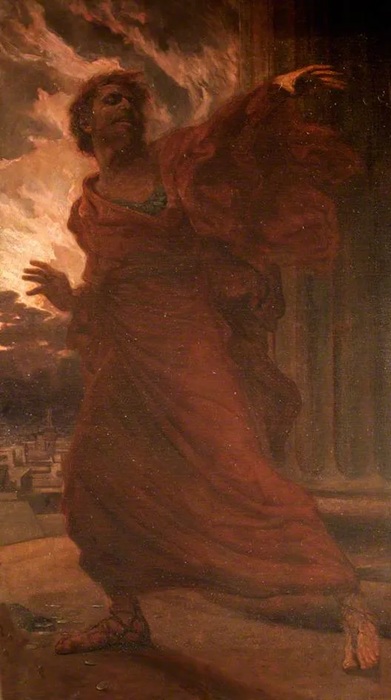
Williams also painted several Biblical scenes of which his portrait of Judas is one. It depicts the classic traitor walking up a mountain at dawn, scattering the thirty pieces of silver he had been paid to betray Jesus and presumably pondering the full dimensions of his deceit.
Williams had been in north Wales painting a portrait of the archdruid Hwfa Môn, staying staying in a hostel, his mind wandering to other projects such as the intended painting of Judas.
One day he was on the train and saw an older, weathered face which he thought was perfect for his version of the Biblical deceiver. He followed him to his house but didn’t have the temerity to knock on the door. It transpired that the face belonged to a Baptist minister who agreed to model for Williams.
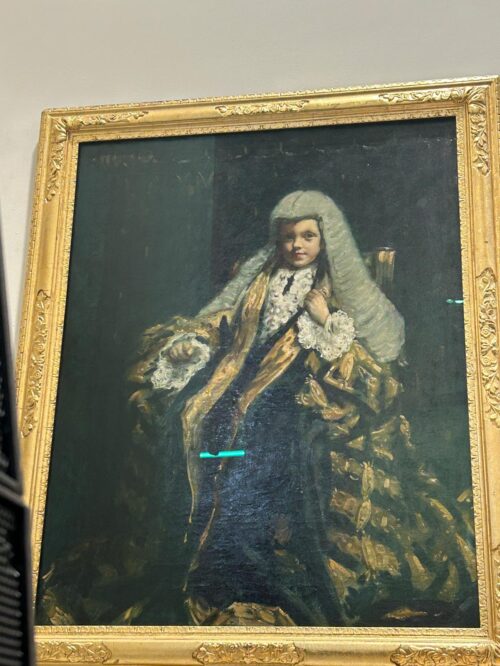
Christopher Williams often used his family as models, painting his son Ivor in a turban and his son Gwyn in judge’s robes . Williams was painting a local judge from Skewen at the time, who’d left his robes and wig behind after a modelling session. They dwarf the young lad but also lose their ceremonial power.
In the last years of his life both his his eyesight and general health were failing. Christopher Williams was living in London and he couldn’t travel to Wales, which he loved to do, so he decided to donate two painting to Maesteg Town Hall, to be the kernel of an art display. One was of his father, as he wanted him “to be with his people.”
His two sons attended the unveiling and many of Williams’ friends came for the day. The evening was a great success and his sons sent their father a telegram to tell him, The following evening he passed away peacefully: his ashes were later scattered on a hillside at Llangynwyd.
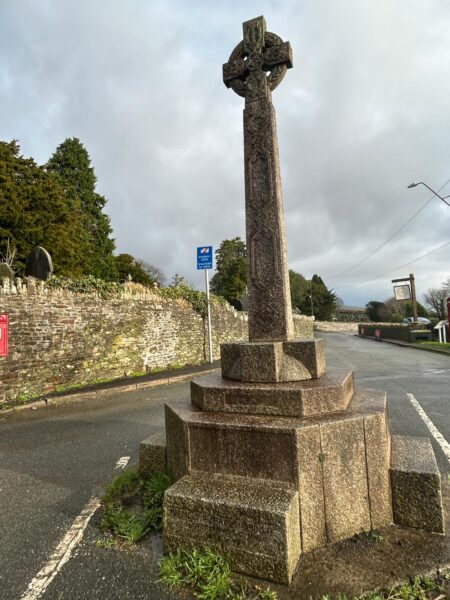
Christopher Williams always supported local events and in 1927-28 they raised the Hopcyn Cross in Llangynwyd which he designed. It commemorates the rather fanciful story of local blacksmith, thatcher and poet Wil Hopcyn and Ann Thomas, the daughter of a local farm, Cefn Ydfa.
They fell completely in love with but Ann’s father was dead set against a relationship involving a man so below his daughter’s station. Despite an enforced separation, Ann and Wil continued to exchange missives, secreting their messages within an old oak tree on the Cefn Ydfa estate.
When Ann’s mother chanced upon the letters, she took away anything Ann could use to write and thus contact Wil.
Heartbroken
Utterly heartbroken, Wil eventually left the area and Ann was forced to marry Anthony Maddocks but reputedly died of a broken heart. In terms of historical evidence there is precious little evidence of Wil’s biography but why should the facts get in the way of a true, if tragic story?
The story of love lost was chronicled in words by Hopcyn in ‘Bugelio’r Gwenith Gwyn,’ one of the most achingly beautiful songs in the Welsh language. Meanwhile the unveiling of the Hopcyn Cross formed part of the Ball of Britain celebrations, which Williams attended.
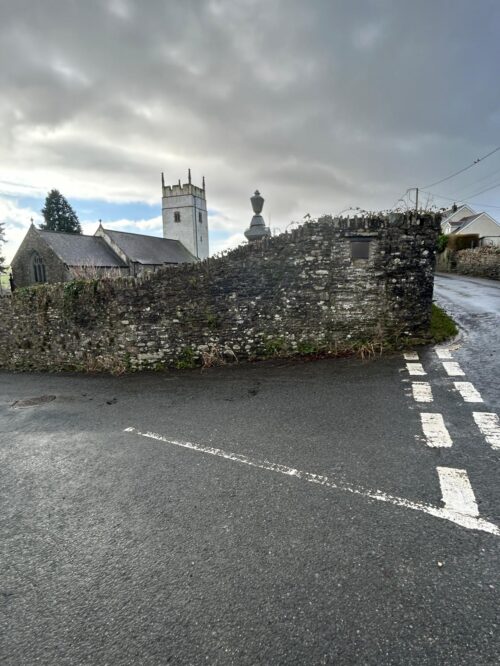
If you visit Llangynwyd, a medieval village once part of the commote of Tir Iarll, you can see the place, set in what is now the churchyard wall, where Wil Hopcyn’s smithy used to stand, as well as look for Ann’s grave in St Cynwyd’s churchyard. It’s a bit of a lungs-pumping climb to get here from the lower part of the village but as a reward you get uplifting views of the surrounding countryside.
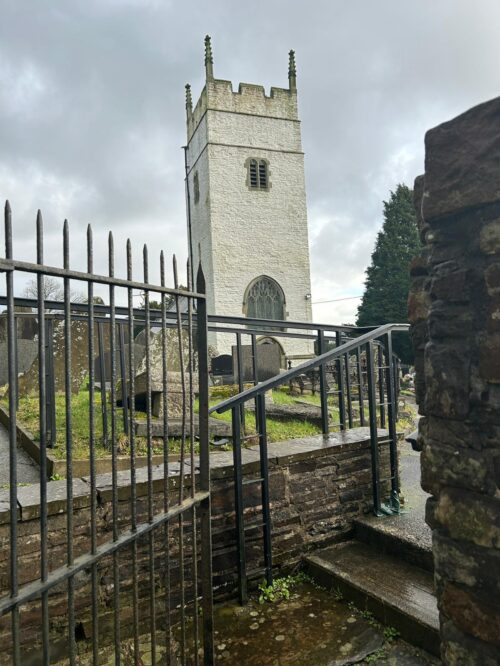
It’s an atmospheric, ancient village and at year’s end is one of those places visited by the Mari Lwyd, (the Grey Mare.) Indeed this is the place with the strongest and most unbroken tradition in Wales, according to Trac, the folk promotion agency.
The winter visit of the Mari Lwyd was popular in south Wales during the 19th century. It must have been an arresting sight when the white skull of a horse, with glass bottle eyes and brightly decorated with coloured ribbons would appear out of the darkness.
Groups of men would bear the Mari from door to door, one of the them working the hidden spring which would close the lower jaw with a snap. The fact that the carrier was hidden from view under a drape of white cloth helped create what must have been a ghostly and ghastly apparition.
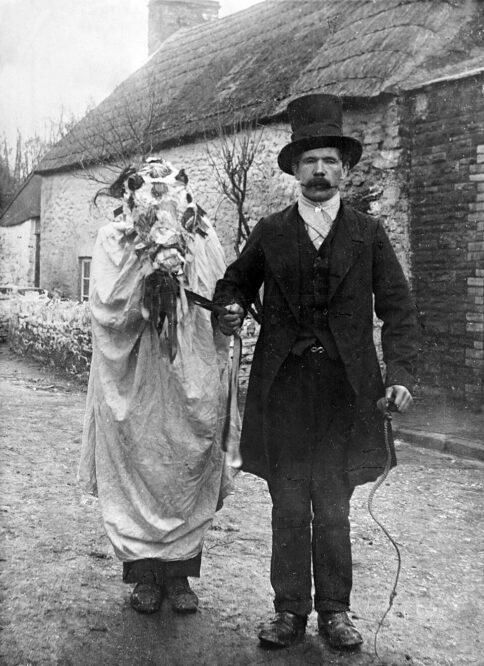
As Museum Wales tell us: “Occasionally the head was of wood, one account says paper, and in around 1935 a group of boys in Swansea used a pillow, but a horse’s head was characteristic. The same horse’s head tended to be used annually, for it was buried in lime to preserve it for most the year, and dug up each December.”
Although the Mari Lwyd is uniquely Welsh it connects with other midwinter rituals with a horse at its centre right across Europe, such as the pagan fertility rite continued as the Obby Oss in Padstow, Cornwall or the Hooden Horse in Kent. Perhaps for this reason eating horse-meat was seen as taboo in Britain. There are, of course striking and outsize horse shapes cut into the chalklands of the English Downs, not forgetting Rhiannon in the Mabinogi who is associated with the horse goddess Epona and rides a pale horse.
When the white horse of the Mari Lwyd stopped at a house the Welsh wassailers would knock the door and a sort of poetic jousting match called pwnco would begin, as those outside begged to come in and the inhabitants listed, in instantly composed Welsh verse, reasons why they should not.
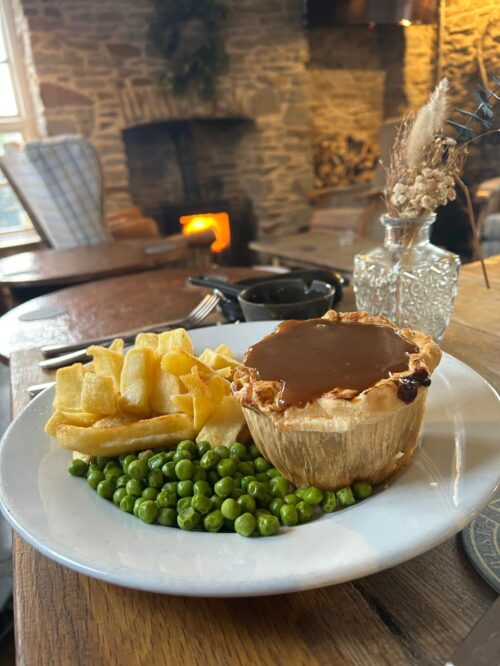
If you’ve walked to the old village, locally known as “Top Llan” from the new part of Llangynwyd, down the bottom of the hill, you deserve a rest at Wales’s second oldest pub, founded in 1147.
Here open fires, the fabulous Old House Pie and picture windows, offering vistas of open countryside, are ample reward for the mild exertion. A good moment to savour all you can see on a day out in Maesteg, before catching the train from nearby Garth station.

Jon Gower is Transport for Wales’ writer-in-residence. He will be travelling the breadth and length of the country over the course of a year, reporting on his travels and gathering material for The Great Book of Wales, to be published by the H’mm Foundation in late 2026.
Support our Nation today
For the price of a cup of coffee a month you can help us create an independent, not-for-profit, national news service for the people of Wales, by the people of Wales.



Maesteg needs more visitors arriving by train to see the town from South Wales. Lots of retired people from Swansea regularly travel West by train to locations such as Narbeth – so boosts Narbeths economy, especially on mid-week days. Transport for Wales should be offering its’ Jurnyon customers discounts on days out in Maesteg with train and lunch offers midweek November to March. Could be priced for £ 11 (train £1 and £10 for lunch – no revenue loss as giving away spare capacity). Also Maesteg could hold a Welsh Themed Christmas Market in town hall November and December and… Read more »
Please do not try to compare narberth Pembs,to maesteg,Narberth reminds me of Cowbridge,two beautiful,small Thriving towns.You will need a miracle or a council to do a lot more than they are doing at the moment.