


Making Tracks: Minffordd for Portmeirion
Jon Gower
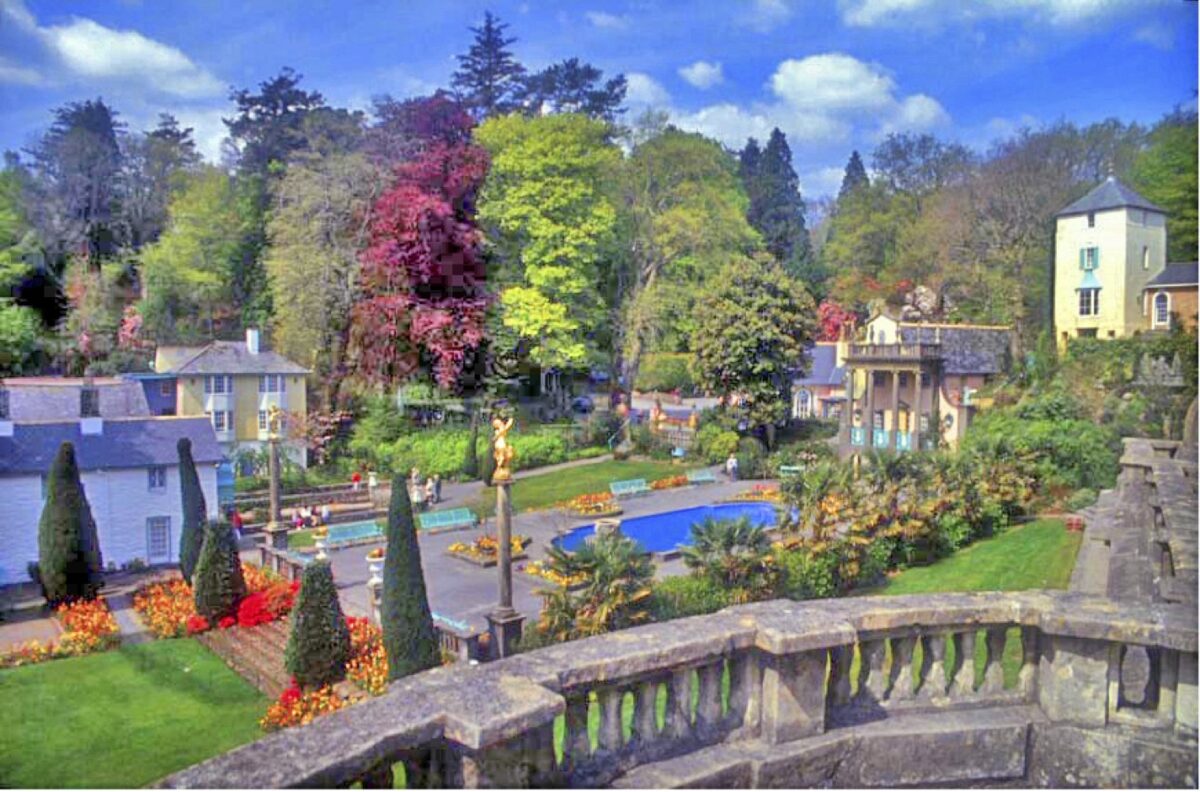
Never was an architectural salvage yard so ineffably beautiful. You walk from Minffordd station and, as you approach Castell Deudraeth along the half mile long drive, you catch bright glimpses of colour among the trees.
This is architect Clough Williams Ellis’ ‘home for fallen buildings,’ where bits and pieces of buildings were transported from elsewhere and then reassembled as part of the architect’s jig-saw vision.
He also designed and erected new buildings, too – a dome as the answer to what Clough saw as ‘severe dome deficiency.’
The iconic campanile or bell-tower ‘was obvious enough – it was imperative that I should open up my performance with a dramatic gesture of some sort.’ Indeed, the whole of Portmeirion can be seen as one, great beautiful performance, where the ghost of a visionary, knickerbockered architect is always taking a bow. In The Pleasures of Architecture, which Clough wrote with his wife Amabel, he set out his stall thus: ‘I wanted to show that one could develop and indeed, exploit even a very beautiful place without defiling it; that if you did things with sufficient care and skill, you could even enhance what was given as a backdrop.’
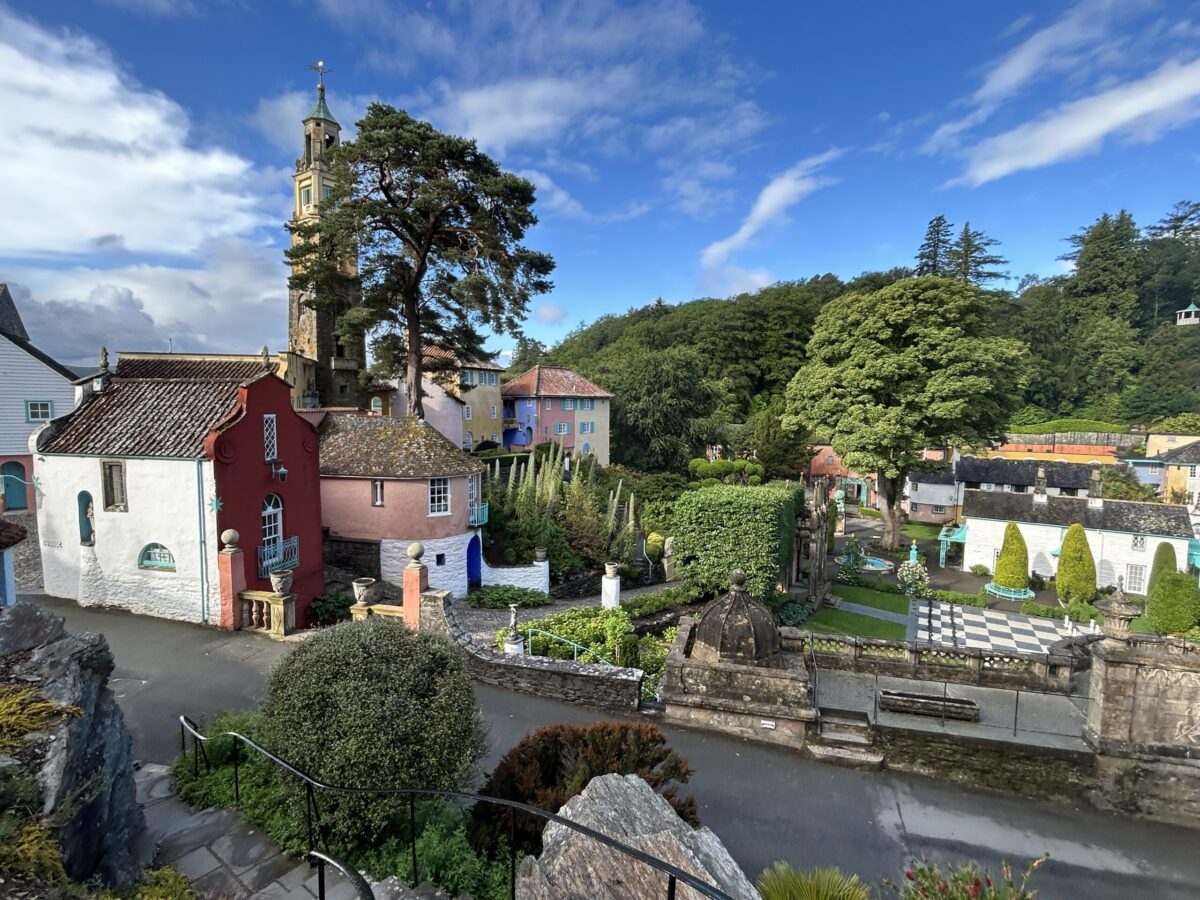
The village of Portmeirion, hugging the edge of the river Dwyryd, certainly adds bright dabs of colour to the Meirionnydd coastscape, to the backdrop of tawny sands at low tide where cormorants muster.
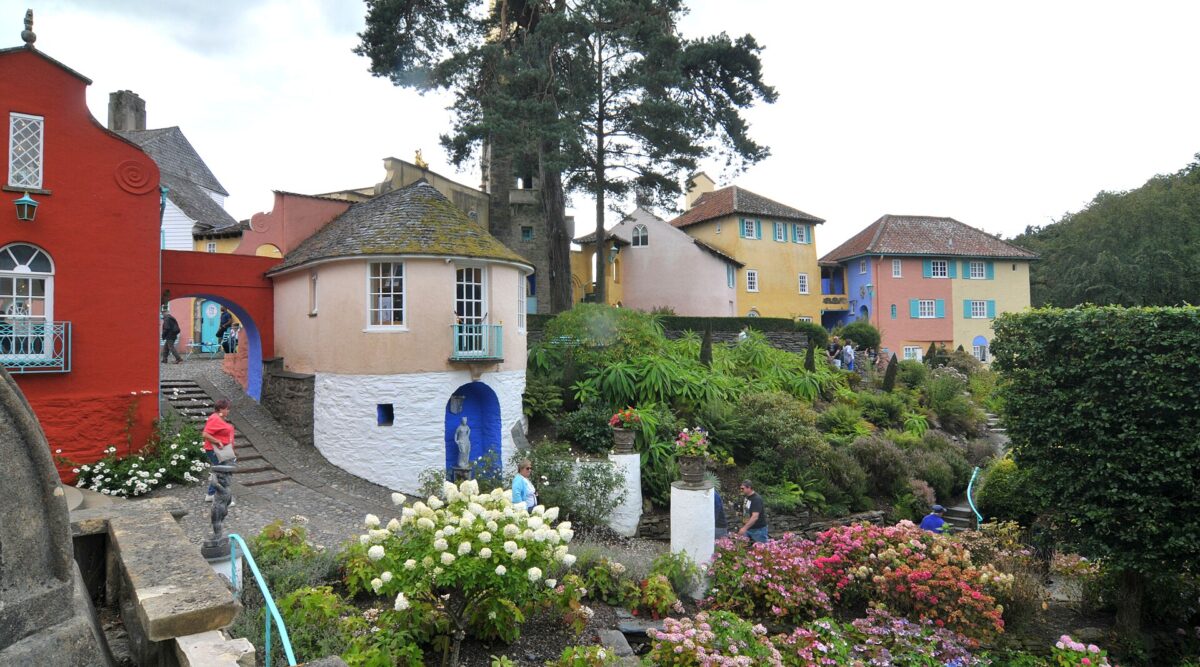
There are splashes of Portofino white, like Ligurian sea-spume and that rich cobalt blue so prevalent in the Mediterranean. The cottages of Chantry Row are pale pink, apricot, light blue and swamp green while gold paint adds lustre to the Burmese Dancers in the Piazza and to the eagle adornments, giving the birds an imperial authority.
As Roy Strong suggested, ‘Clough, one knows from Portmeirion, was never afraid of colour. The buildings are colour-washed ochre, terracotta, primrose, a dusky blue. The greeny-turquoise of his ironwork in the garden recurs on houses.’
Clough was not one for a fresh lick of paint, however. He liked his buildings to look weathered: buildings were painted with four gradations of colourwash, ‘the deepest at ground level – to stimulate the picturesque effects of age and weathering, of damp creeping up an old wall’ which was very much in keeping with his love of the patterns of mould and damp.
Sarah Baylis, author of the newly and lavishly illustrated Portmeirion: The Architecture of Pleasure tells me ‘Clough was observed in the 60s actually doing the painting himself, painting something darker at the base and then getting lighter. And he was always experimenting with paint effects. He liked old things, he liked the patina of age, he wanted to reproduce that. Anything where both the elements and time are interacting with the paint.’
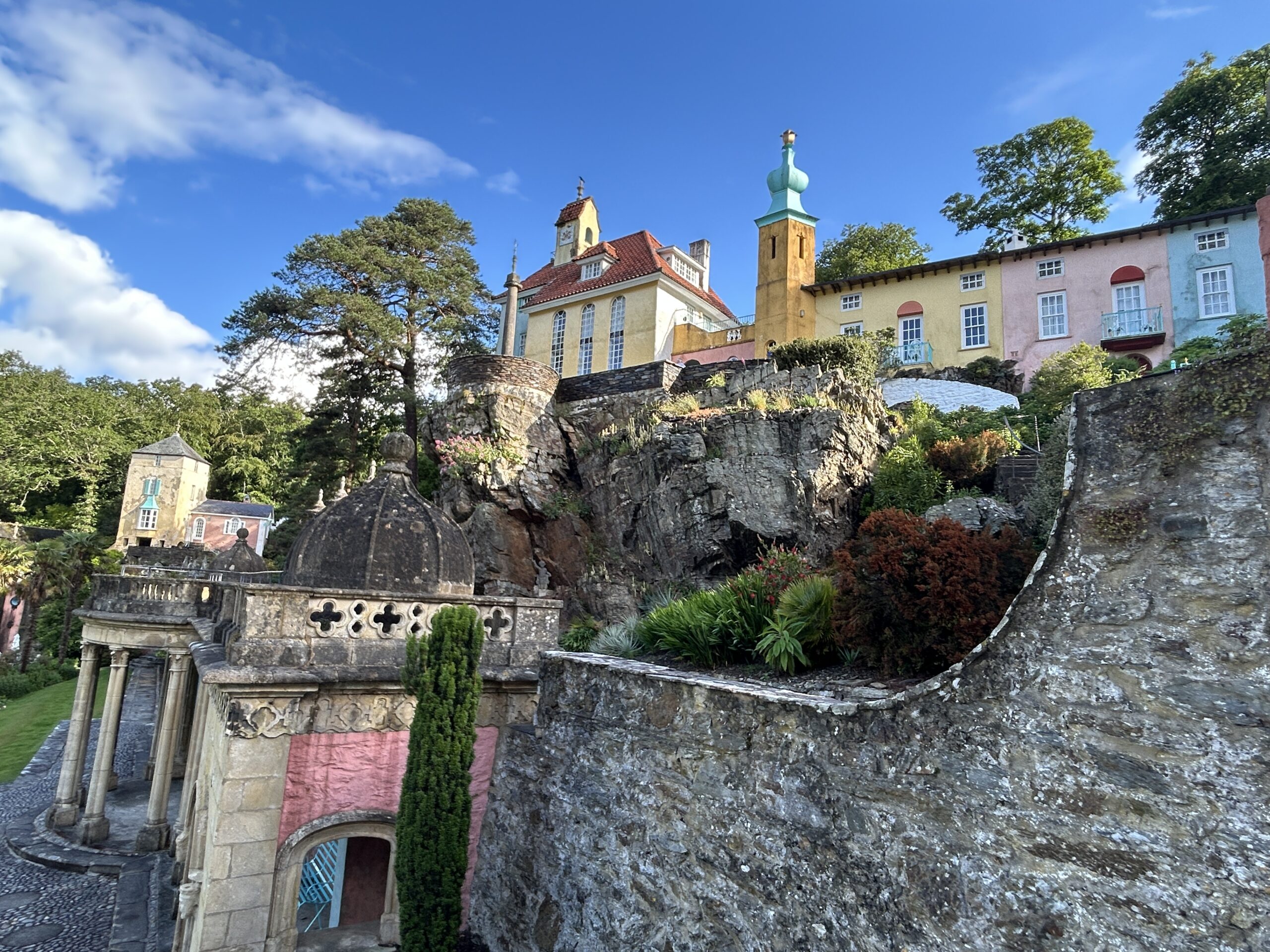
Much as a gannet builds it nest from chance materials – seaweed, drifts of discarded fishing line, stalks of sea-campion – so too did Clough slowly build his coastal village, a fantastical village accreting like an oyster shell to cling to Meirionnydd rocks.
His antennae were well-tuned to hear about stuff coming under the auctioneer’s hammer: the inter-war years saw many country houses being knocked down so there was ample choice. He picked up a turret clock from a demolished London brewery; rescued a colonnaded portico from Hooton Hall in Cheshire and salvaged masonry from all over.
Busily, Clough bought a seventeenth century plasterwork ceiling depicting the Labours of Hercules before Emral Hall in Flintshire was demolished, along with its entire ballroom, ‘knocked down to a derisory thirteen pounds’ and consequently rebuilt as Portmeirion’s Town Hall.
A cupola was made from an upside down copper pig-swill boiler. Waste not want not might well be his watchwords – rescuing a colonnade before it was turned into a public lavatory by Bristol Corporation or moving a green bronze sculpture of Hercules all the way from Aberdeen, a Herculean effort.
The chimes of the village bells, nowadays digitally generated, drift across the mudflats to meld with the piping calls of waders. The German playwright Goethe is reputed to have said that architecture is frozen music, to which the 1950s British sci -fi writer Michael Moorcock replied music must therefore be defrosted architecture. Which prompts the question what sort of music does Portmeirion produce?
Sarah suggests light opera. ‘Portmeirion is a performative space. It’s not passive, it’s interactive. It’s not about sitting back and admiring. It’s being there, walking through it. But I think there’s also musical theatre, because an awful lot of people with those skills came here in the early days? I suppose the singer Ivor Novello is the quintessential visitor, but he’s certainly not the only person from the world of musical theatre who found Portmeirion absolutely what he needed and wanted.
Clough actually said in an interview, I wanted to show people a sort of light opera approach, using false perspectives and so on that architecture could be fun, entertaining, interesting, intriguing. And so it has proved to be.’ This light opera approach might well be traced back to a production of John Gay’s The Beggar’s Opera, cram-full of very inspiring, colourful sets and costumes which Clough saw many times over at the Lyric, Hammersmith in 1920.
Which also helps explain the general theatricality of the place. Sarah Baylis thinks ‘That comes from the idea that this is a stage set, but also he wanted Portmeirion to look rooted in the earth and to look as if it had been there a long time.’
This very much chimes with the opinion of Christopher Hussey, who wrote an early guide to Portmeirion and extolled its virtues in the magazine Country Life. ‘Theatricality? Why of course – but whereas the scene painter does it with canvas and the actors themselves are but half conscious of their background, here one lives in these little perching houses and makes one’s own play out of the sea and mountains and idyllic surroundings. Mr Williams-Ellis’s object has precisely been to create, out of stone and concrete, a village of that fairy land across the footlights, where prosaic city dwellers can take rooms, or a complete house, for their holidays.
The village was also a propitious place to actually write plays. Noel Coward visited in 1941 and recalled, ‘On Friday, May the 2nd, Joyce Carey and I caught a morning train from Paddington, bound for Port Meirion in North Wales. For some time past an idea for a light comedy had been rattling at the door of my mind and I thought the time had come to let it in and show it a little courtesy…We arrived on a golden evening, sighed with pleasure at the mountains and the sea in the late sunlight, and settled ourselves into a pink guest-house.’
The idea blossomed into Blithe Spirit, the hugely successful three-act ‘improbable farce’ about seances and clairvoyance Coward had completed by the time he left a week later.
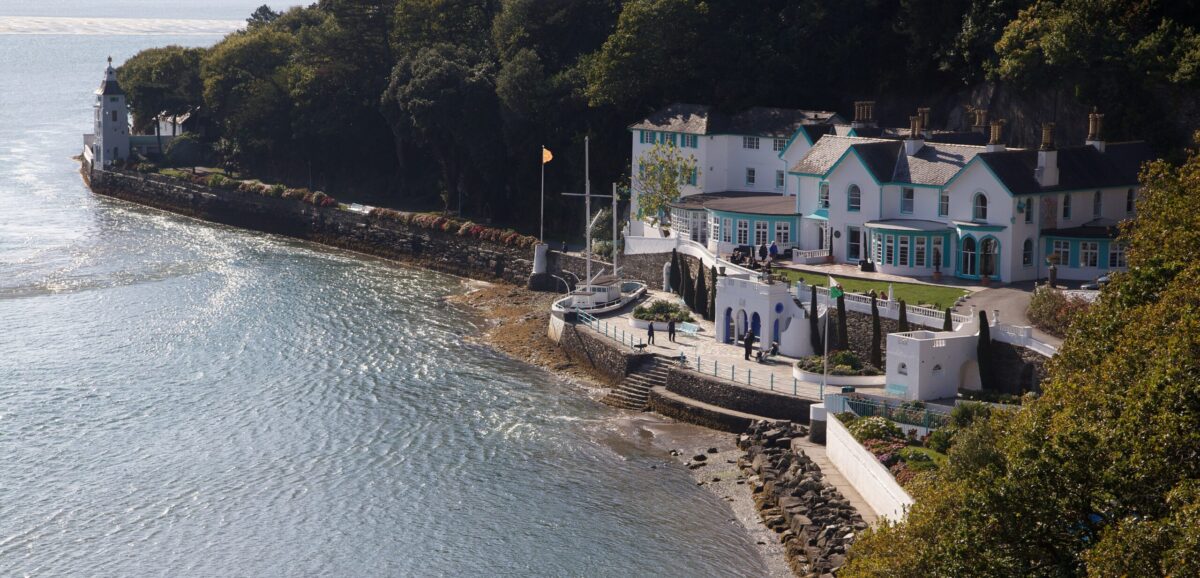
Over the decades Portmeirion attracted creatives by the score, with Clough as both presiding and resident spirit. There was so much to see. Rachel Hunt, Portmeirion’s collections curator views Clough as a deft-illusionist as well as a skilful architect. ‘There are things like trompe l ‘oeil windows – literally deceptions or tricks of the eye – and little cutaway sheet metal mermaids and cherubs.’
Sarah concurs: ‘I think it’s to do with the fact that they are just façades. You walk behind the back of Chantry Row and there’s nothing there. You think you’re looking at a terrace of Georgian houses and you go behind and it’s an illusion. Everything is an illusion to some extent but it does it seem much bigger because of this. It is extraordinary how small Portmeirion is and yet how utterly lost you can feel at times. I can still feel completely lost when I come out of a building or turn a corner. I just don’t know where I am. I have to find the sea to get my bearings.’
That sea is actually an estuary which fills or empties with the tide, yet there’s a thoroughly marine theme to Portmeirion. There are antique and modern replica copper galleons and the Amis Reunis, a Porthmadog trading ketch once converted into sleeping quarters. This almost sank after a storm and is now anchored in cement outside Portmeirion’s hotel.
Clough’s first enchantment with the place started when he approached Aber Iâ, the ‘frozen estuary’ – as it was then called – by boat, coming in from open water to dry land.
Sarah Baylis explains, ‘When he started, he was selling Portmeirion to people with boats. When it opened you could sail a yacht up here, you could moor it, you could even dive off Fort Henry. The estuary has changed, it’s not what it was, and I think that happened fairly early on. I think that was probably a big disappointment to Clough, that it stopped being focused on the sea and that it didn’t attract people in boats because it just wasn’t viable. When it opened in the 20s it was all about families and sea and sun and it was in every way peddling that idea of a Mediterranean resort.’
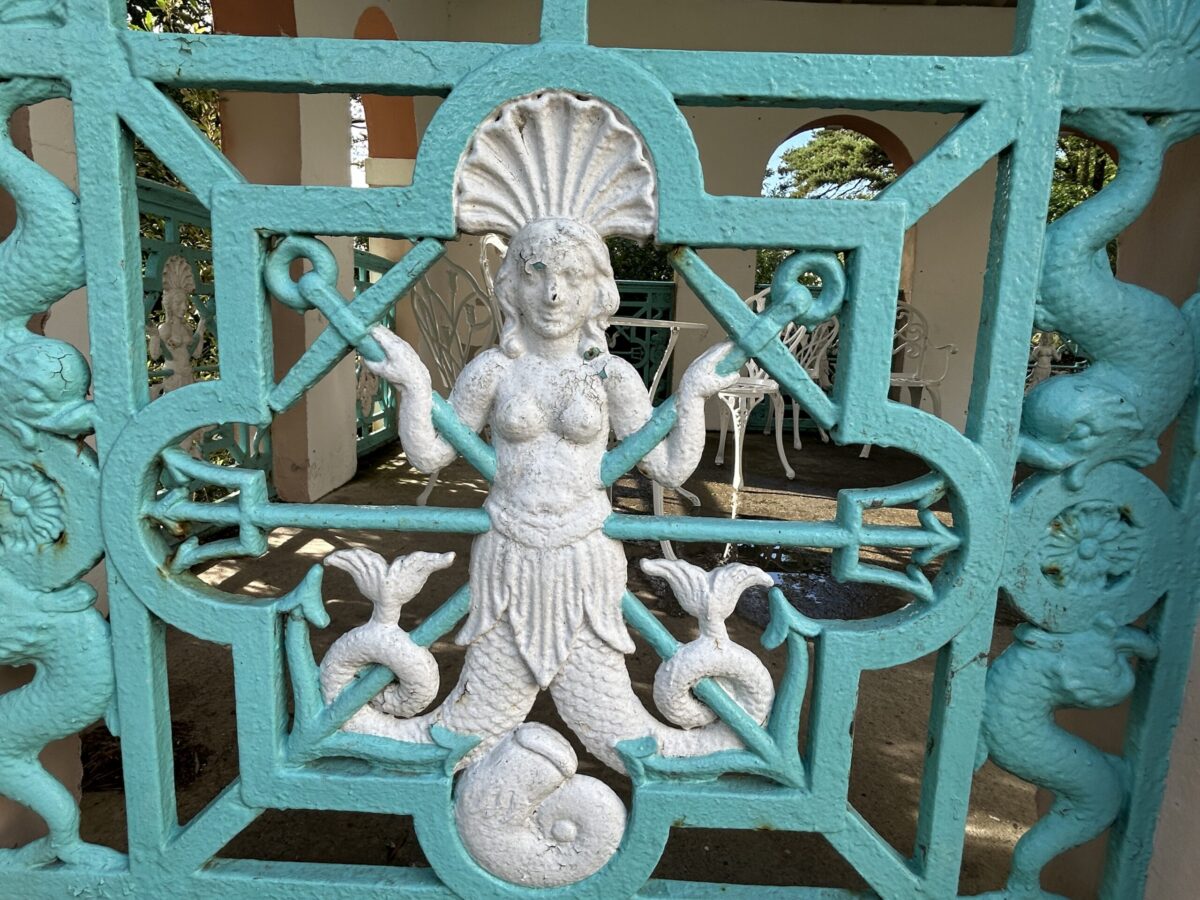
To underline that marine connection, mermaids are everywhere. Clough’s sketches date back to the mid-1920s. Rachel explains ‘He occasionally accompanied Amabel on her PEN Club trips, and it was during one of these excursions that he met the Swedish sculptor Carl Milles, “who had generously given me leave to crib his exquisite mermaid as my Portmeirion emblem”.’
Milles’s home was a sculpture garden by the sea so that was probably an influence as well.’ Sarah Baylis in her book sees it as an essential image: The ‘vigorous two-tailed mermaid – encapsulating the vitality and energy of the sea – designed by Clough as the original founding emblem of Portmeirion and still (though somewhat altered) its defining brand.’ Clough’s daughter Susan produced a more contemporary version while still keeping mermaid in the family.
The sea was a great source of inspiration for Susan, who even went as far as to create way of painting under the water. She was planning a book called The Compleat Mermaid, taking its cue from Izaak Walton’s The Compleat Angler.
Rachel thinks this is a curious irony, as ‘her first experience of swimming – aged twelve – precipitated one of the worst episodes of her life. In her autobiographical notes, Susan described a family holiday in Austria, where she learned to swim “in a weedy horse pond with the aid of a big very rotten log”. She subsequently contracted mastoiditis and was in hospital for weeks. Although she was able to walk again, she could never run. She’d grown very quickly and compared herself to “a stick of celery left out of water – long and white and weak”. To my mind Susan wasn’t a natural land animal, but when she was in the water, I think she felt at one.’
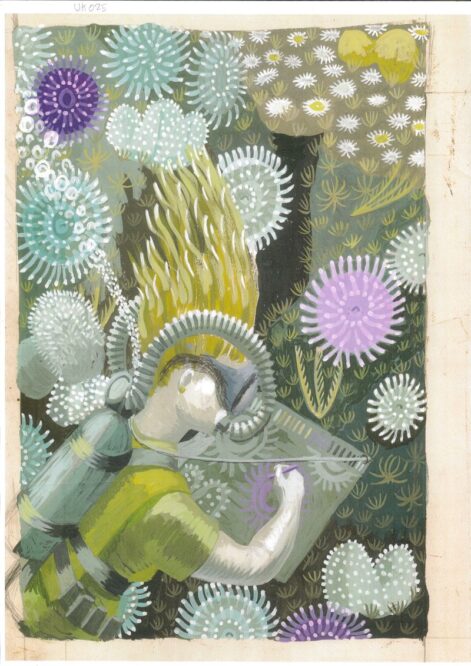
There’s a marvellous self-portrait Susan produced for The Compleat Mermaid, complete with mask, oxygen tanks and an aqualung. She depicts herself swimming underwater using coloured oil pastels to sketch anemones and flowering blooms of jellyfish on plastic tracing film. In the portrait, painted in the Dartmouth estuary, Susan’s hair floats upwards like golden seaweed as her strong hand guides a purple crayon.
Sarah thinks there’s a psychological element to this – ‘escaping a skin or adopting a skin – finding an element that you feel more comfortable in. She’s the world’s first mermaid artist, she does become a mermaid.’
In the portrait Susan Williams-Ellis is both pragmatic and fantastical, wearing breathing apparatus to enter another element.
It’s an experience not entirely unlike stepping into Portmeirion, a bright island of buildings conjured up by a veritable Prospero, who placed all the colours of a coral reef brilliantly into place.
You can visit Portmeirion as a day visitor, dine in the castle or even stay in one of the historical buildings.

Jon Gower is Transport for Wales’ writer-in-residence. He will be travelling the breadth and length of the country over the course of a year, reporting on his travels and gathering material for The Great Book of Wales, to be published by the H’mm Foundation in late 2026.
Support our Nation today
For the price of a cup of coffee a month you can help us create an independent, not-for-profit, national news service for the people of Wales, by the people of Wales.
Get more trusted Welsh news
Choose Nation.Cymru as a preferred source in Google News to see more of our journalism.


