

Making Tracks: Newtown
Jon Gower learns about both the birth of the “Co-op” and the idea of mail order in one mid Wales town.
Newtown, new ideas. The history of this Powys town features astonishingly influential pioneers, people who came up with new ideas as certainly as others draw breath.
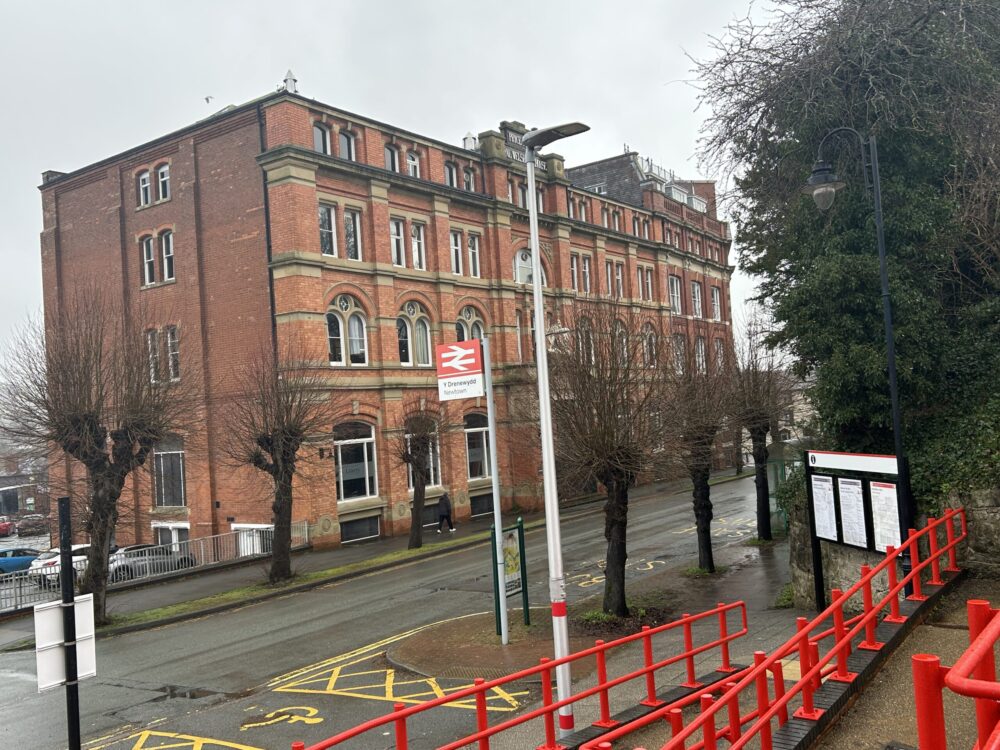
You’re very much aware of that as you step down off the train, as the station abuts the Royal Welsh Warehouse of Sir Pryce Pryce-Jones, pioneer of mail order in the UK. It’s a building that dominates the skyline of the town where at one time thousands of people were employed.
Ann Evans started working there when she was a young girl. “I was about 12 or 14 packing mail order catalogues in this building for pocket money. My mother was actually working in the sewing section of the building on the third floor. And occasionally I’d go and take fish and chips for her on a Friday as a treat.”
As Ann shows me around the cavernous spaces of the Royal Welsh Warehouse we meet Karen Griffiths. She is helping oversee the closing down sale of Liberty Furnishings, which is relocating. Karen’s family has many links with the Pryce-Jones warehouse, underlining the importance of the place to the town.
“My grandfather worked here after the First World War, worked here all his working life. He lived in a house which belonged to Pryce-Jones at the time. My father was born in that house and my father’s sister worked in this building.
“My godmother worked in this building. My mother’s cousins worked in this building. The guy that used to put the lights on the roof at Christmas, that was my cousin’s husband. There are so many links.”
Karen is clearly moved by listing so many family connections. “It’s just quite emotional for me, I have to say. It was a huge operation, wasn’t it? It’s so important that the town retains this part of its heritage. I’ve seen calls for the building to be demolished. That would be an absolute disgrace, a disaster for the town. We’ve lost so many precious buildings already.”
This view is very much echoed by Ann Evans who has taken an active interest in the pioneers of Newtown and, as chair of Heritage Hub 4 Mid Wales, works hard to safeguard and promote this heritage. A key part of that heritage, standing like a colossus over this town on the Severn, is mail order magnate Pryce Pryce-Jones.
Ann shares the basic biography with me. “He was an apprentice to a draper in Broad Street in Newtown, from the age of 12. At the time Newtown was a very vibrant town which the poet George Thomas described as “the busy Leeds of Wales.”
In 1835 there were 77 woollen manufacturers, and in the early 19th century there were 1200 looms rattling away: a cottage industry at scale, as it were. Newtown was making an awful lot of flannel, an English word which may well derive from the Welsh ‘gwlan’ and before that the Latin ‘lana.’
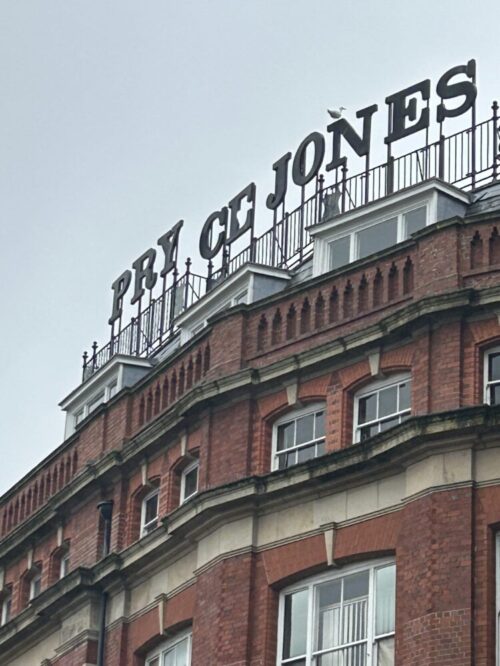
Flannel and wool were the making of Newtown’s pioneering entrepreneur, as Ann Evans tell me. “Pryce-Jones married in 1859 and that’s when he started his mail order enterprise by post, sending samples of linens and flannels to the gentry of London. As an apprentice he had got to know all the local suppliers, so he knew how to buy from the right people. And he had this amazing idea to expand his customer base outside of Newtown to the rest of the world.”
Eventually that base would include no fewer than 100,000 customers. This would double in size as the firm reached new markets overseas.
We pause our perusal of the Royal Welsh Warehouse to admire pausing to appreciate an enormous safe, one of two such secure vaults in the building, suggesting how substantial were the takings.
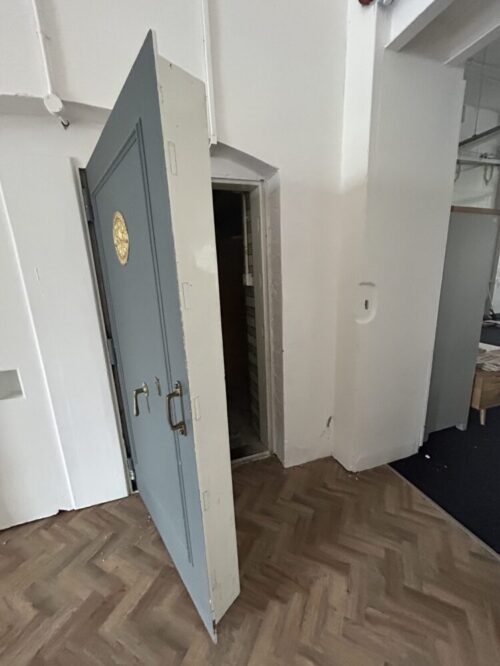
Key to the success of mail order was the presence of the railway in the town. As Ann explains: “The goods yard was right next to here.
By 1900 Pryce-Jones extended the building to include his own post office, but prior to that, he’d actually bought the Flannel Exchange, which was an amazing building, built two years before he was born, where fleeces were sold to dealers.” In the 1820s Newtown was reputedly the largest flannel production centre in Wales.
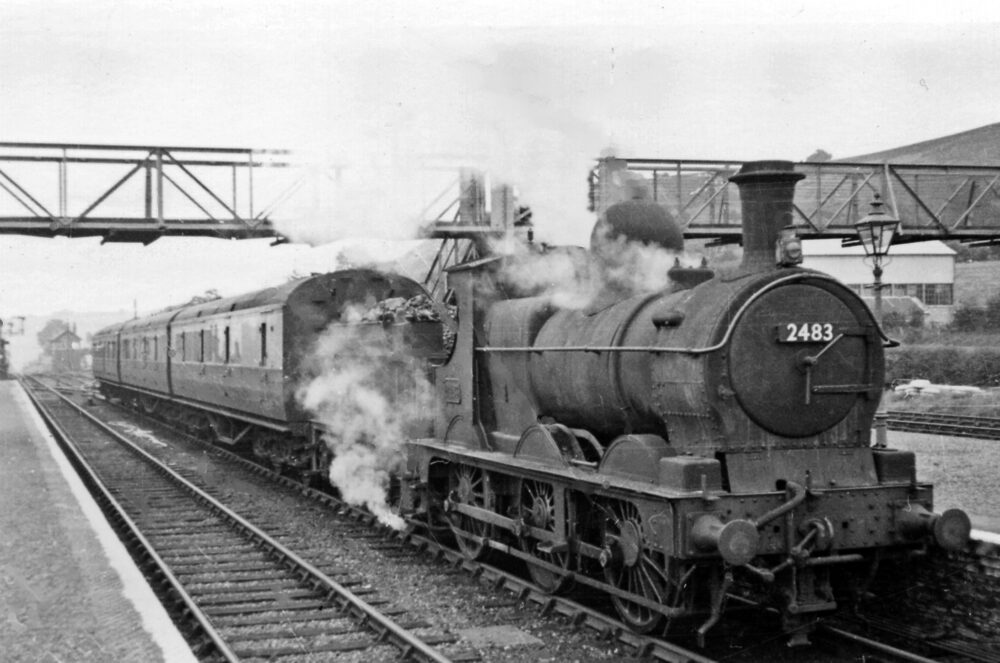
The importance of rail for the flannel trade in the area led to the creation of the Llanidloes and Newtown Railway, a 17-mile long line which was never commercially successful, as it passed through such a sparsely populated area.
This was eventually amalgamated into the Cambrian Railway, with most of the Mid-Wales line closing in 1962, other than a part of the line which carried cement from Aberthaw works in south Wales for the construction of the Clywedog Dam.
Rail was just one part of the mail order jigsaw. Another was the postal system. Ann explains that “One of the other things Pryce-Jones did, which was very clever, was to help establish a single price for a parcel’s journey.
By 1883 he’d become the MP for Montgomeryshire and he was sitting with the Postmaster General and suggested the idea of a flat rate parcel post system. He was delivering to countries all over the world, from Aden to New Zealand, you know, it was just amazing, really, what he was able to do.”
A flat rate meant that the cost of a parcel was identical whether it was from Newtown to Shrewsbury, to Glasgow or to Ennis Boffin off the Galway coast. Pryce-Jones was also sending goods even further, by rail and packet steamboat to Philadelphia and other places in America and to royal families across Europe, the latter being a customer base he particularly courted.
Pryce-Jones was akin to a one-man conveyor belt of bright ideas at a time before conveyor belts. He was clearly a very gifted salesman, who apparently invented the sleeping bag which he dubbed the Euklisia rug, selling no fewer than 60,000 of them to the Russian Army.
Crucially, for the success of his company, he produced the first illustrated mail order catalogue in 1861. As Ann Evans explains, the company ended up producing a very wide range of goods. “They would make clothes for cricket, for football, for tennis, so all of these clothing ranges were actually available through the Pryce-Jones catalogue. I found out recently they even produced clothing for the bards, for the eisteddfod, and Welsh national costumes for women.”
One of the highlights of the workers’ year was the Royal Welsh Warehouse annual trip. In 1892 they visited the seaside at Aberystwyth and The Montgomeryshire Express and Radnor Times was informed “The three trains consisted of 51 carriages, all crowded to their uttermost capacity, even the guards’ vans being fully and similarly utilised with over 3,000 jolly happy passengers.”
At the seaside “The Pryce Jones Royal Welsh Warehouse Cricket team played a match with Aberystwyth town, and in the afternoon the Royal Welsh Warehouse Band assembled on the Old Castle grounds, by kind permission of the Mayor and Corporation, and discoursed some popular music for two or three hours to the surrounding multitudes. A sharp shower caused a speedy stampede to shelter, but this temporary diversion was really the only drawback to an otherwise delightfully pleasant day.”
With so many people decamping to the Ceredigion coast they left a bit of a ghost town behind, as the Express informs us: “Deprived of nearly a third of its inhabitants, Newtown was remarkably quiet throughout the day, the Pryce Jones Royal Welsh Warehouse, the Cambrian, Severn Valley, and some of the other Woollen Flannel Mills having closed on account of the trip.”
Newtown was also the birthplace of another visionary, Robert Owen who was born in Broad Street, above a shop in what is now the HSBC Bank building. Here his father ran a saddlery and ironmonger’s. Owen, like Pryce-Jones was initially a draper’s apprentice.
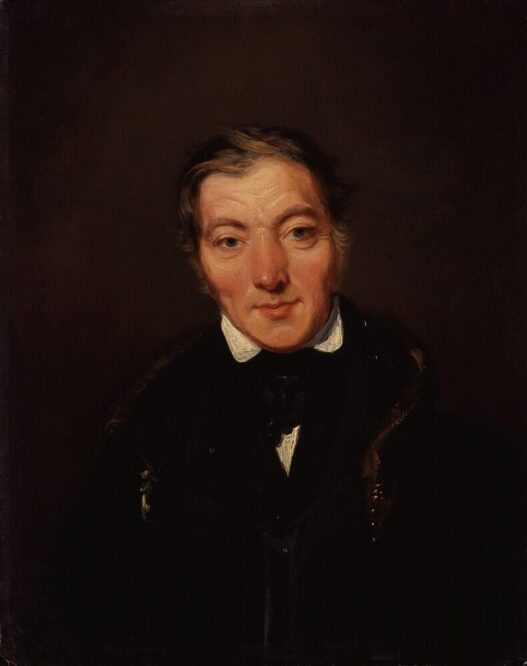
Ann Evans continues the story as we wander around the town’s Robert Owen museum, which concertinas the breadth of his life and an illuminating array of objects into a few small rooms. “Owen started work at the age of nine. I read in his autobiography, he wrote to the then Prime Minister when he was 14 so he was precocious. He had really big ideas. He believed that if you had a good education and were happy in your environment, you created a greater workforce.”
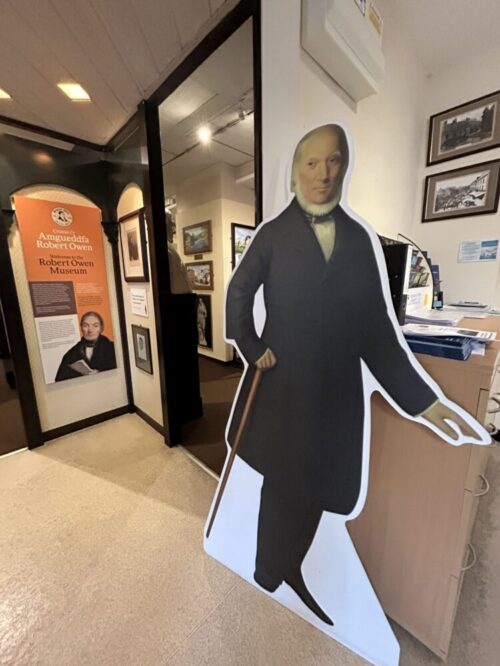
Owen left Newtown when he was only ten years old, moving to Manchester where he became a cloth merchant, then the manager of a cotton mill, By the time he was 23 he had moved to Scotland, where he was co-owner of the New Lanark Mills, “The most important experiment for the happiness of the human race that has yet been instituted in any part of the world.” Here Owen, a prophet of a happy society, gave his workers cheap and spacious housing, free medical care and the use of the first kindergartens in Britain.
But Owen found it difficult to overturn the Old World order with his ideas of shortened working hours and giving help to the unemployed, so he moved to the New World, helping to set up a model estate called “New Harmony” in Indiana. It was to be a brief and unsuccessful experiment which almost ended in penury for him two years later.
But he returned to Britain to find his idea of a co-operative movement had spread, with its shops and production all controlled by the workers themselves. In 1830 there were 300 “Co-operatives” and soon the word “Co-op” became embedded in the language. just as surely as the shops themselves appeared on the High Street.
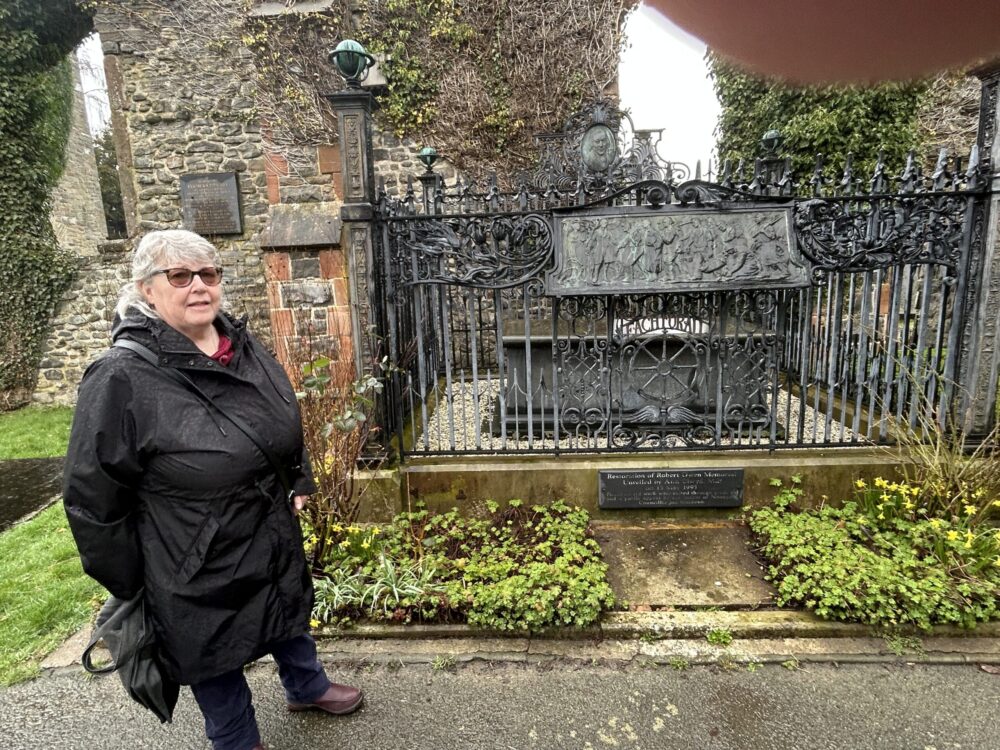
Ann concludes her impromptu Robert Owen tour at his grave in the yard of St Mary’s medieval church, which Jan Morris described as “his florid tomb, embellished by admirers long after his death.”
It is an ornate affair and somewhat surprising given Owen’s rejection of all forms of organised religion. Owen’s words on the grave, surrounded by Art Nouveau railings encourage us to believe: “It is the one great and universal interest of the human race to be cordially united and to aid each other to the full extent of their capacities.”
In Powys rain as fine as a flower spray, and with the nearby sound of river Severn running in full spate, it’s a suitably solemn place to ponder Owen’s achievements.
Ann considers him a man misunderstood: “I think that people underestimated what he was trying to do. When he came back here to die, it’s written in a diary that he wanted to make Newtown a paradise, and the inhabitants angels. He believed that he could change society for the better.”
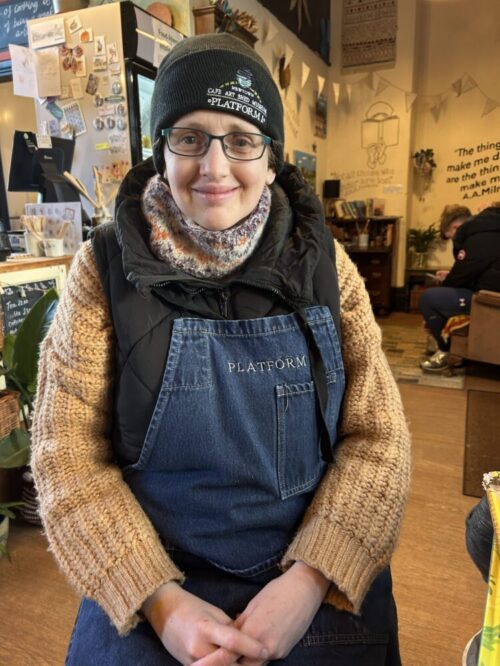
That sentiment would be certainly resonate with Ezma Zhao, who runs the Platform 1 café at Newtown railway station. Ezma is a poet and photographer, who studied textiles in Carmarthen and Manchester. She had a dream about developing this space. “I’ve lived here for most of my life and I’d always worked with community artists and wanted to promote the stories of Newtown.”
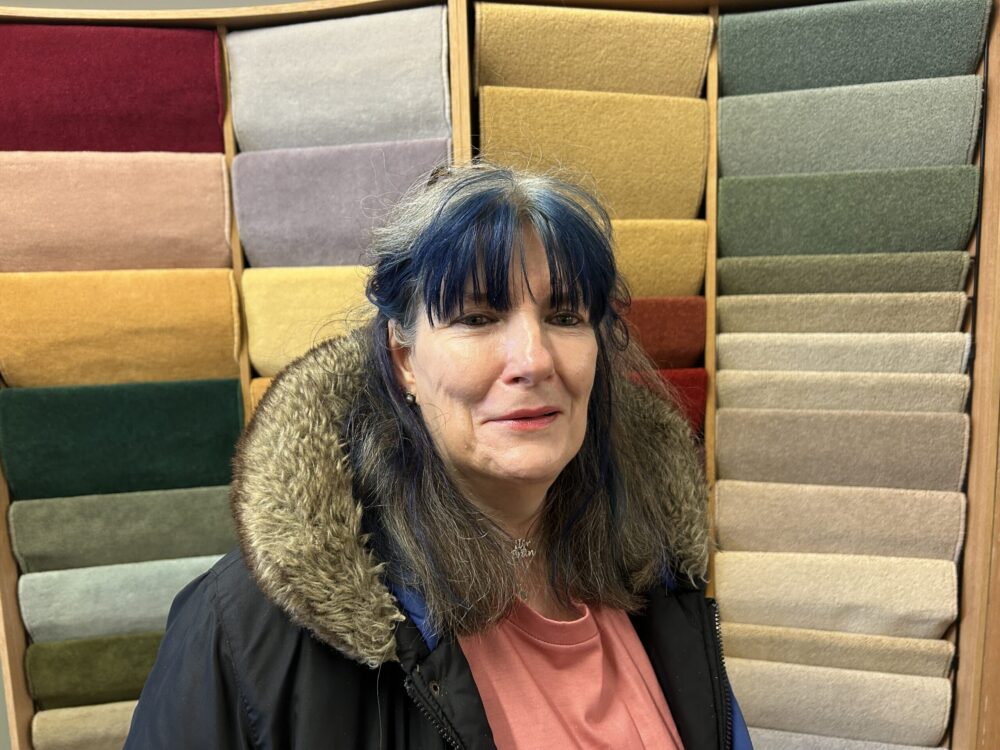
The café – a very warm space full of soft fabrics and as comfortable as a living room – is just a part of the Platform 1 vision, as Ezma explains. “We’ve got an art shed next door and a men’s shed and then the end bit will be a shop and a museum space. That will promote local artists’ work. The idea is to reduce all the barriers that stop people from creating and making and create a safe space for them to come. We’ve got weaving, drawing, knitting, there’s embroidery.
“And having this space, you get people from all walks of life that come in here. We have a chap that makes beautiful mosaics. He comes in a couple of times a week and he’ll just sit in the corner and paint or build some Lego. People that come in say it’s a safe space to be in and create.”
One of their other ventures is culinary, specifically cooking classes for children. “That started in September, where children cook together with us and their parents. The phone gets put away and they sit and eat with their parents. That’s been wonderful because some of the parents have said their children have never cooked and now they’re cooking at home, they want to cook at home, so that’s bringing families together.”
In a mid-Wales town that’s had more than its fair share of pioneers does she see herself as following in that tradition? Somewhat diffidently Ezma admits “I think I am.
I have a vision of everyone being accepted and being included. And being kind. And all coming together. Which we need a bit more of at the moment.”

Jon Gower is Transport for Wales’ writer-in-residence. He will be travelling the breadth and length of the country over the course of a year, reporting on his travels and gathering material for The Great Book of Wales, to be published by the H’mm Foundation in late 2026.
Support our Nation today
For the price of a cup of coffee a month you can help us create an independent, not-for-profit, national news service for the people of Wales, by the people of Wales.



A mention of Cheap Charlies of old, tank spanners and white arctic under fleeces, (a really fashionable garment at the time) ex officers mess furnishings on a market day near you. Carpet bag makers of the world made it to Charlies…