


Making Tracks: Swansea (Part Two)
Jon Gower finds out about feathery art, early power pop and very hardy sailors.
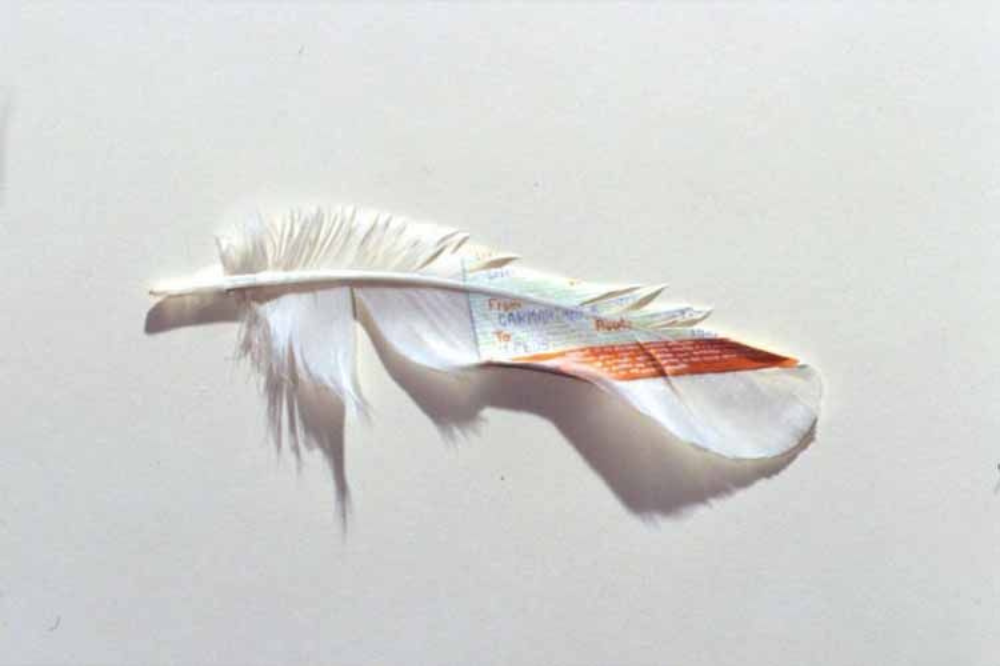
As works of art go, this one is just the ticket. ‘Carmarthen-Leeds Return,’ by Craig Wood, who teaches at Swansea College of Art, is a delicate and painstaking painting on a feather.
It was inspired by scenes painted by Cape Horners as mementos for their families during long sea journeys.
Wood’s feather painting was a careful undertaking, involving a keen eye and steady hand as the artist explained. ‘Technically, the painting was a highly concentrated endeavour using a tiny brush to replicate the pixilation of a train ticket.’
He used acrylic paint and had to use a special undercoat to build a ground on the oily surface of the feather. The feather itself belongs to a seagull and was found during Wood family walks on the Carmarthenshire coastline.
Craig Wood’s feather-ticket was first displayed as part of the city-wide LOCWS International event in 2000 and won the Wakelin award, which is administered by the Friends of the Glynn Vivian Art Gallery in memory of Richard and Rosemary Wakelin. ‘Carmarthen-Leeds Return’ was exhibited alongside a collection of originals to make it clear that his contribution was part of the tradition as opposed to an appropriation.
‘I came across the seamen’s feathers work whilst researching work for the LOCWS International exhibition,’ he told me. ‘They depict a range of scenes, through colourful thick paint, images of the sailors’ home villages, ships and poems sent to loved ones. I found them very sensitive and poetic, coming from what must have been a very physical masculine culture.
‘I empathised with these men being away from home for over a year, going ’round the horn’ to bring copper ore from South America to Swansea. To paint such poignant images on a feather is such a beautiful thing to do. My own situation at the time involved working at Leeds University, necessitated mere weeks away from home, separated from my partner and very young family…and this was painful enough. My thoughts were with those sailors when I made my train journeys between Carmarthen and Leeds.’
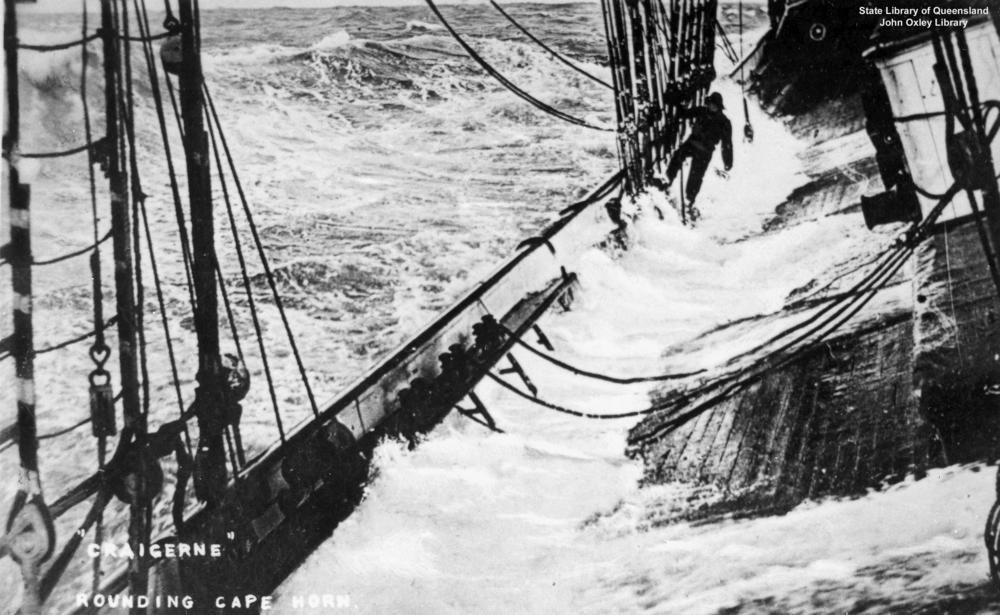
Cape Horners were tough seamen with brine in their blood, who voyaged far as part of the copper trade, venturing through often wild seas around Cape Horn.
Daily, yes daily sailings by clipper ships would set out from ports such as Valparaiso in Chile via some of the roughest seas on Earth to deliver copper-rich rock to Swansea. Sailors who had completed the voyage were entitled to bear a distinctive “Cape Horner” tattoo, displaying a ship with full rigging along with the words “Homeward Bound.”
Swansea earned the alternative name “Copperopolis” as the industry totally dominated the town. By the mid 19th century 90 per cent of the world’s copper came from the town, which smelted down the metal from imported ore, creating acrid fumes and wealth in equal measure. The ‘Welsh Process’ of copper smelting, which involved prodigious amounts of coal – three or four tons of it for every ton of ore – helped consolidate Swansea’s central position within the global trade, that is until the exporting countries started to smelt the metal themselves.
The ore came from Cornwall but also from countries further afield such as Cuba, Australia and Chile in South America so consequently Swansea had more Cape Horners than any other British port. It was no surprise that, given such a preponderance of old salts, there used to a pub called The Cape Horner on Fabian Way, on the edge of an area known as St Thomas, the hostelry sporting a sign featuring a ship with the wind fully in its sails.
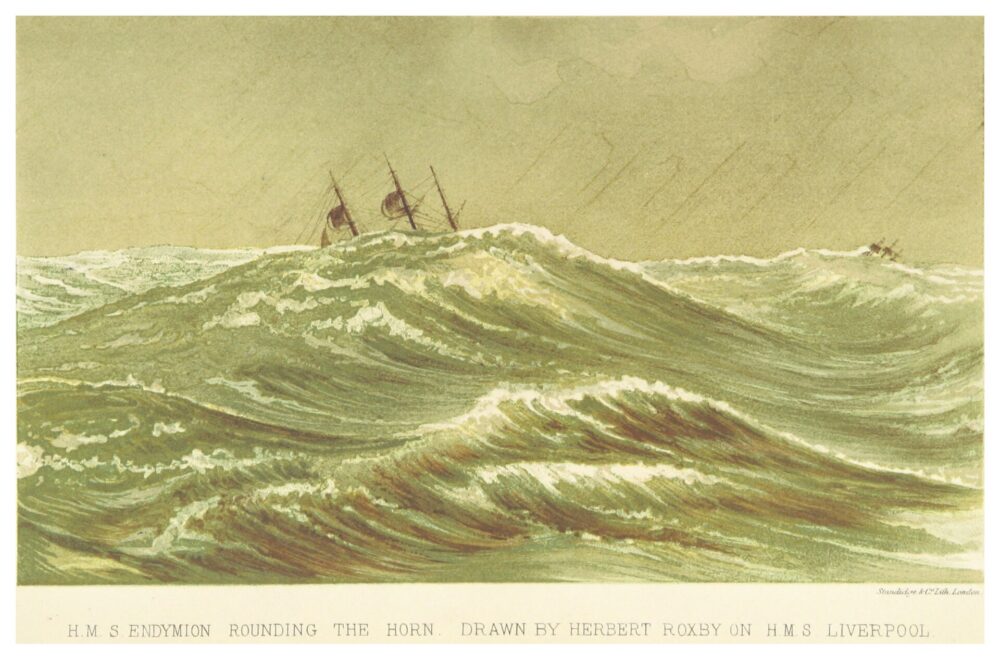
And that wind might be a whipping wind, a hurricane or a testing typhoon. The holds of ships leaving south America might carry a cargo of guano, seabird droppings to be used as fertilizer.
This made the trip even more dangerous. Potassium nitrate, or saltpetre in the bird excrement is notoriously unstable, a key constituent of black gunpowder, which added madly to the risks involved.
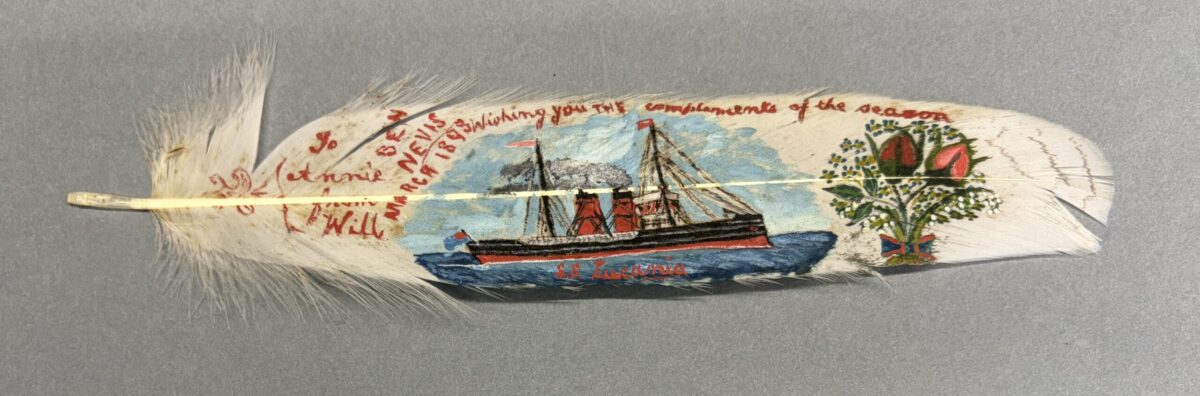
Voyages to Chile often took more than a year and the sea captains who commanded ships around Cape Horn were held in high regard. Some might send feathers home in lieu of postcards, souvenirs of so much seafaring.
At the close of the nineteenth century Captain Will Nelson from Malvern Terrace in Swansea painted many feathers that he gave to loved ones. One, painted in 1898, was a gift to his mother, bearing his name and that of his ship, the Ben Nevis.
Another recipient was his wife Annie, who received a lovely white feather bearing a delicate painting of the steam ship S.S. Lucania, along with the festive message, “To Annie from Will. Ben Nevis March 1898. Wishing you the compliments of the season.” It spoke of yet another Christmas Nelson would be at sea rather in the bosom of his family.
Some of these feathers floated to collections of Swansea Museum, the oldest museum in Wales, which is a treasure trove of the city’s history. Another image painted by Captain Nelson wasn’t of a ship but of a place much closer to home, being the church of St Mary’s in Swansea where, one imagines, Will and Annie got married.
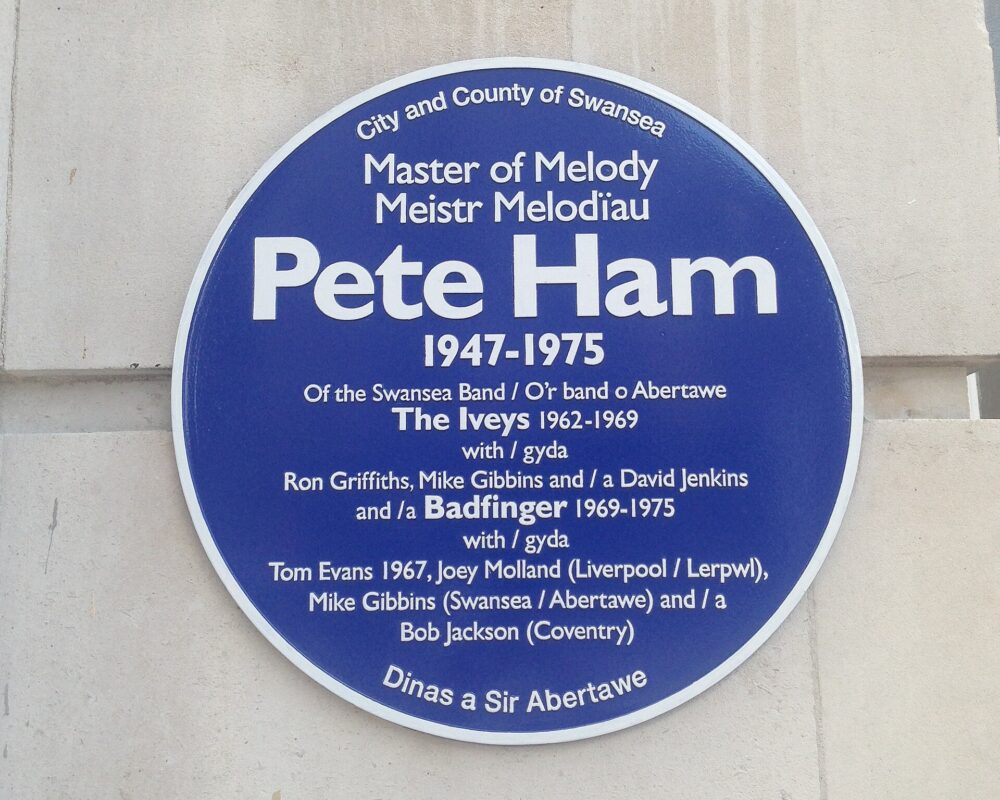
On the main façade of Swansea station, you’ll find the first blue plaque put up in the city. It’s dedicated to Pete Ham, the lead singer of the band Badfinger from 1961 until his death in 1975.
A supremely gifted songwriter, Ham’s 1972 song ‘Without You’, written with fellow band member Tom Evans, was subsequently sung by both Harry Nilsson and Mariah Carey and became a solid standard, described by no less than Paul McCartney as ‘the killer song of all time.’
Appreciating Ham’s talents, the lead singer of the Manic Street Preachers, James Dean Bradfield said ‘I can’t think of a musician who helped create so much amazing music but who was subsequently so unrecognised for his efforts’.
The Ammanford-raised, Oxford-based musicologist Dai Griffiths has long pondered the strengths of the song ‘Without You,’ not least when compared with what he considers to be the greatest song ever, namely 1972’s ‘Goodbye to Love’ by The Carpenters. ‘Goodbye to Love’ is both a great song and a great record,’ he told me. ‘Now, with ‘Without You’, we have to separate those two things: it’s a great song in the Pete Ham and Badfinger recordings, but it awaited the great record by Harry Nilsson, and that’s the one that does the two things, great song, great record.
‘Where ‘Without You’ and ‘Goodbye to Love’ meet is in the point about music and words: they’re sweet songs, poignant, nostalgic music, but they’re love songs that raise the idea of death and suicide. Listen to ‘Goodbye to Love’: ‘I’ll say Goodbye to Love, no one ever cared if I should live or die’. You’re going to think twice before saying something like that to a loved one. You don’t want to be in the gang marked ‘no one’. In ‘Without You’: ‘I can’t live if living is without you’. You walk out and I’ll be dangling from the rope.
‘But as Jim Morrison from The Doors would say, ‘no time to wallow in the mire’. These songs wallow in the mire. Apparently, John Bettis and Karen Carpenter often used to listen to each other go on about their unhappy love lives. But it’s Karen Carpenter, right? She weighed about six stone towards the end. Nilsson maybe less so, but what can you say about Ham and Evans? ‘I can’t live anymore’.
A naturally gifted musician and pioneering voice of so-called ‘power pop,’ Peter William Ham was brought up in Gwent Gardens on Swansea’s Townhill estate.
His very early interest in music manifested on the harmonica which he played with gusto in the playground at Gors Junior School.
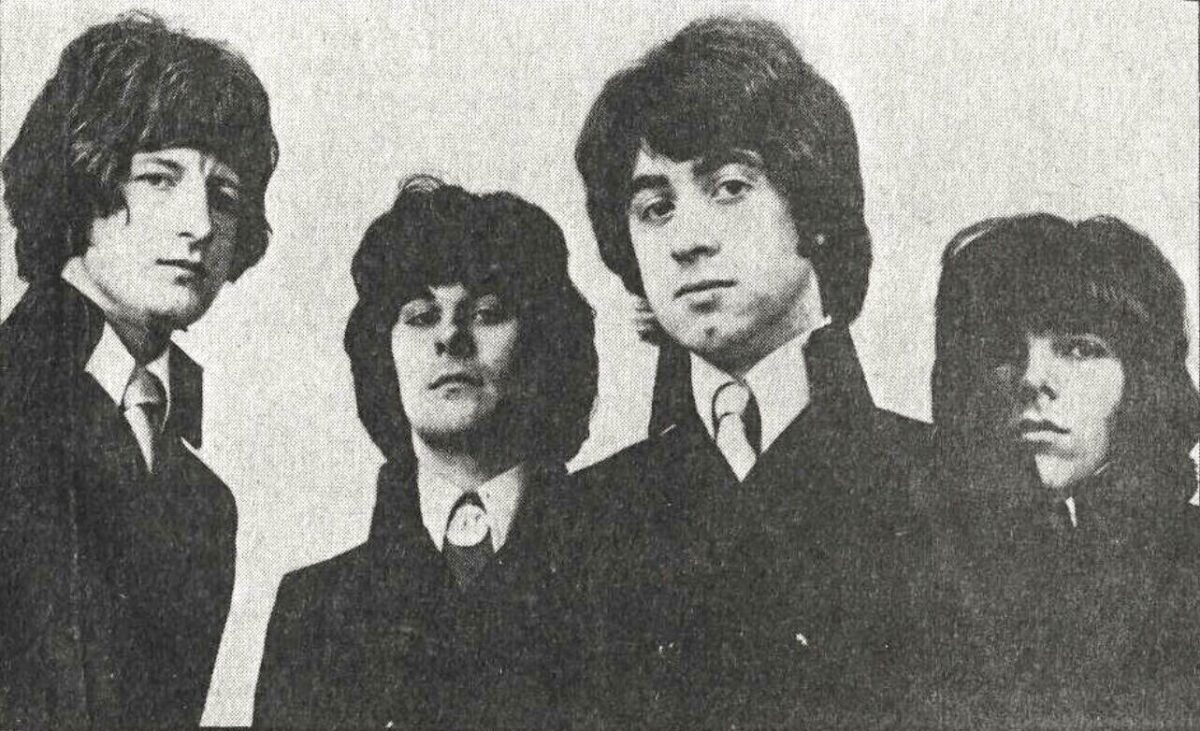
Already set on a familiar teenage trajectory, he then became totally besotted with rock and pop. Like so many other wannabes, he taught himself guitar in his bedroom before eventually prowling onstage with his first band The Panthers.
He then teamed up with the Iveys, named after Ivey Place, the square directly outside the station, where the Grand Hotel stands today – where the band used to rehearse.
They honed their live chops in concerts in a city then animated by a thriving live music scene, joining a flashy array of bands such as The Jets, Terry Maddison and the Rocking Rebels, The Meteorites and Roy Denver and The Fireflies, playing in a range of venues such as The Ritz in Skewen and Townhill’s Tower Ballroom.
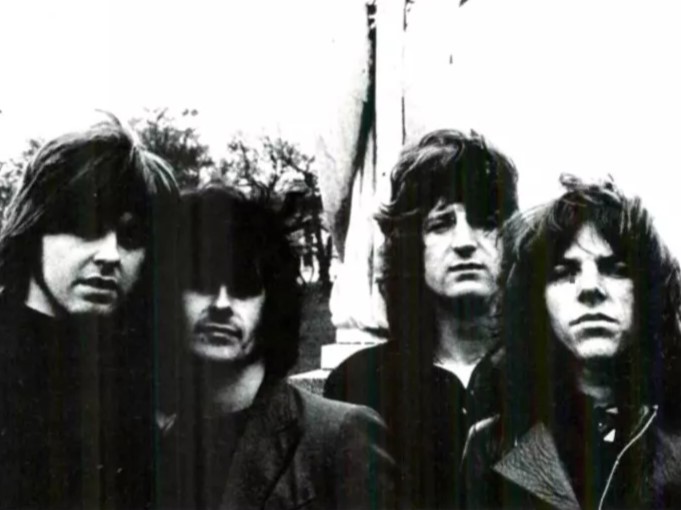
An early manager of The Iveys, Bill Collins encouraged Ham and bandmates Mike Gibbons, Ron Griffiths and Dai Jenkins to decamp, like Dick Whittington, to London.
Even if the English capital’s streets weren’t paved with gold, or, for that matter, gold discs, success came surprisingly swiftly. The Iveys had a huge break when the Beatles’ nascent Apple label snapped them up, after all four Beatles concurred about their demonstrable song-writing talents.
Later, Badfinger’s album ‘Straight Up’ was produced by George Harrison and gained them their first gold disc. Before that, Badfinger’s first bite at success for Apple was ‘Maybe tomorrow,’ – produced by Tony Visconti, who would later work with David Bowie – which became a solid hit in Europe and Japan.
It was felt the Iveys’ name needed changing for commercial reasons and so Badfinger was born – based on an alternative title for a song McCartney was then writing. But the Beatles not only gave the band a leg up but also cast a long shadow.
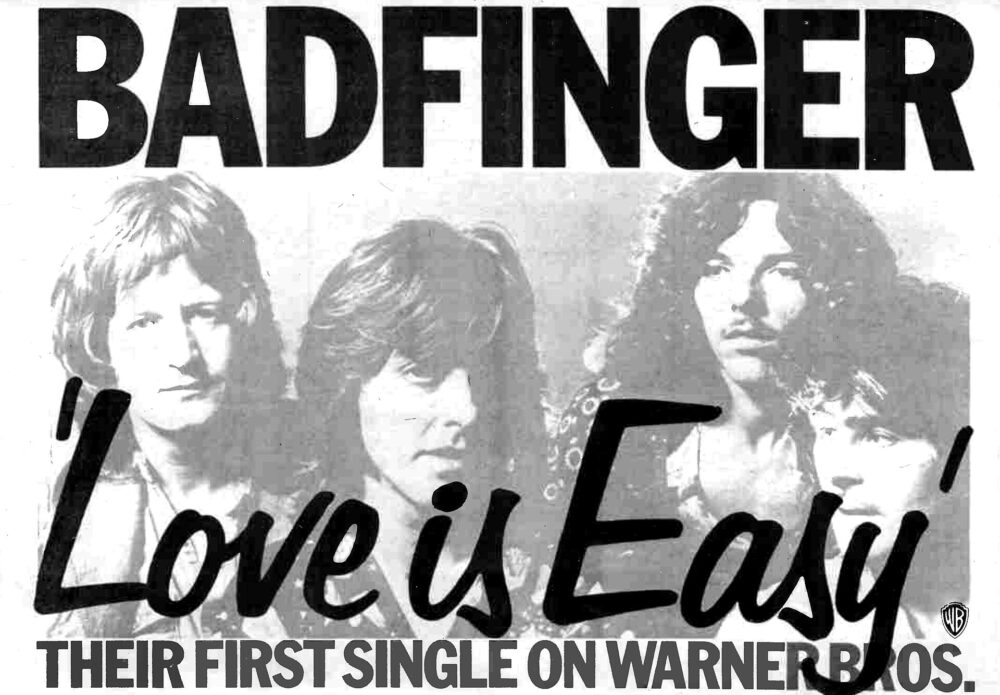
The group’s relationship with the Beatles went beyond merely being on Apple Records though as Mark Leviton explained in Phonograph Record magazine in May 1972. ‘Badfinger’s music varies in much the same way McCartney and Lennon’s – light pop music mixed with more haunting poetic images. Vocally the band sounds Beatlesesque – Pete Ham, who bears a vague resemblance to Lennon, is the one with the McCartney-sounding voice on tunes like “Day After Day” and “Take It All” while his leads are buffered in Beatle-like harmonies by Liverpudlians Evans and Molland.
There were many other Beatles connections as Caroline Boucher listed in Disc and Music Echo of 8 January 1972. ‘There was the Harrison album All Things Must Pass. Then Joey Molland and Tom Evans did the Lennon Imagine album. Pete Ham played for Ringo’s film score music he’s currently working on. And then of course there was the Bangla Desh concert and album – ‘an incredible experience’ – says Pete Ham.’
In article after article, Badfinger would be asked about being the second Beatles, to the point where such questions would get very irksome.
That wasn’t the only problem. The band’s album Wish You Were Here had to be withdrawn for legal reasons. Far worse, their manager Stan Polley had secretly drained away almost all of the band’s money. When this came to light it exacerbated Ham’s existing mental health problems, leading ultimately to his death by suicide in 1983. It’s fitting that this special Swansea talent is commemorated on this prominent blue plaque.
Playwright Simon Harris’s first play was called Badfinger and was staged at the London’s Donmar Warehouse in 1997, directed by Michael Sheen.
Harris explains why the band lends its name to the play. ‘I was in school with a really lovely girl called Julie Ham whose dad, John, had a music shop on Walter Road. Of course, Pete Ham, the lead singer in Badfinger was his brother and so I had a very slight personal connection. Anyway, the connection to Badfinger (the band) pretty much begins and ends with the title.
My thinking with the play was that it could reference – for those who knew – a remarkable musical talent that never got the chance to flourish and is crushed by tragic circumstance.
‘Looking back on what inspired me to write the play, I had a time after leaving RADA where I unexpectedly lost my accommodation in London for a while and had to move back to Swansea. It ended up being for longer than I hoped and I think a lot of the frustration and thwarted ambition that I felt for those few months went into the play ten years later. It was also a brutal time economically – the height of Thatcherism and before devolution.’
Simon was returning to a much-changed city. ‘The war had ripped the heart out of Swansea and Thatcher almost finished the job. In my months back in Swansea, I used to hang out in the snooker hall and in second-hand music and bookshops. There was one called the Exchange & Mart on St Helens Road and I came back to it when writing the play.
The rhythm in the dialogue came partly from there. But there was something additionally about men trying to make a living out of leftover, recycled and almost worthless items that struck me as compelling.’
There is a direct reference to Swansea station in the play. The lead character Meyrick takes exception to an inscription inlaid at the entrance to the station – “Ambition is critical.”
The words belong to Swansea poet David Hughes. He explained that there is ‘a third version of Ambition etc is outside the station. It is much smaller than the original that appeared in the film ‘Twin Town’ and less in your face!’
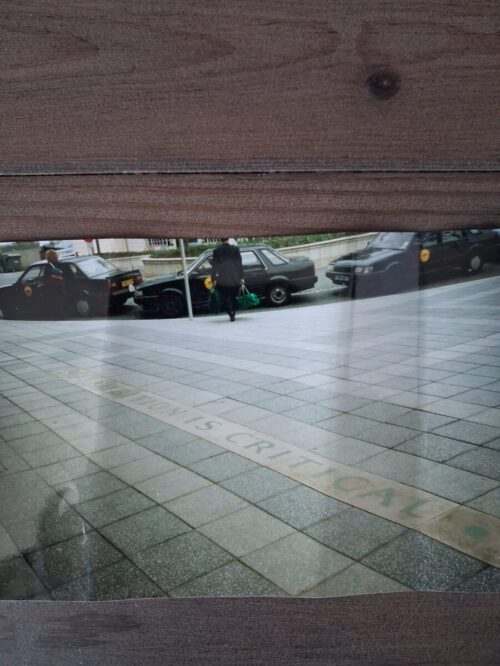
Hughes explained that, ‘in 1992, Nigel Jenkins, Menna Elfyn and I were asked by the planning dept of the then Swansea Council to provide some poetry for the planned pedestrianisation of Oxford Street.
Included in the brief was a request for one, two and three-word poems. ‘Ambition’ was one of my offerings. Robin Campbell of the Planning Dept, who was leading the project, decided those words should go outside High Street Station.
My intention was to refer to ‘the graveyard of ambition ‘ tag but also to echo the quote from Proverbs chapter 29 verse18 – ‘where there is no vision, the people perish’. I wanted it to be ambiguous with ‘critical’ having its health meaning!’
Of the mini-poem, ‘Ambition is critical’ the character Meyrick says, “What’s the use of dreams when you’re down to your last tea bag? Let’s face it, Speed, there’s not a sledge in this world who haven’t got ambition. It’s doing it that counts. And making it real, mun. Making it real. Specially in this flaming dump.”
Playwright Simon Harries felt that keenly at the time of writing it, but ‘it was the only part of the play that I felt embarrassed about when it finally played in Swansea. I find people in Swansea to be really proud and are desperate for the city to succeed. I felt I was rubbing their noses in it. I’m so happy that the city is very, very different now.
“Despite the many challenges and the danger of the coming elections, there is a definite sense of optimism and change – a feeling that the city is starting to rise and that there are many talented people in place ready to make things happen.’

Jon Gower is Transport for Wales’ writer-in-residence. He will be travelling the breadth and length of the country over the course of a year, reporting on his travels and gathering material for The Great Book of Wales, to be published by the H’mm Foundation in late 2026.
Support our Nation today
For the price of a cup of coffee a month you can help us create an independent, not-for-profit, national news service for the people of Wales, by the people of Wales.
Get more trusted Welsh news
Choose Nation.Cymru as a preferred source in Google News to see more of our journalism.


