

Making Tracks: Wrexham
Jon Gower enjoys vibrant art in a city on the cultural up and up.
There was a time when Wrexham was famous for something other than football. Wrexham Sauce was once a taste on everybody’s lips, a fine-dining rival to Lea & Perrins created by local chemist Richard Nokes and served up in places as fancy as London’s Dorchester and Savoy. It was ‘full-flavoured, piquant, rich and rare’ and produced to a secret recipe, much like Coca-Cola.
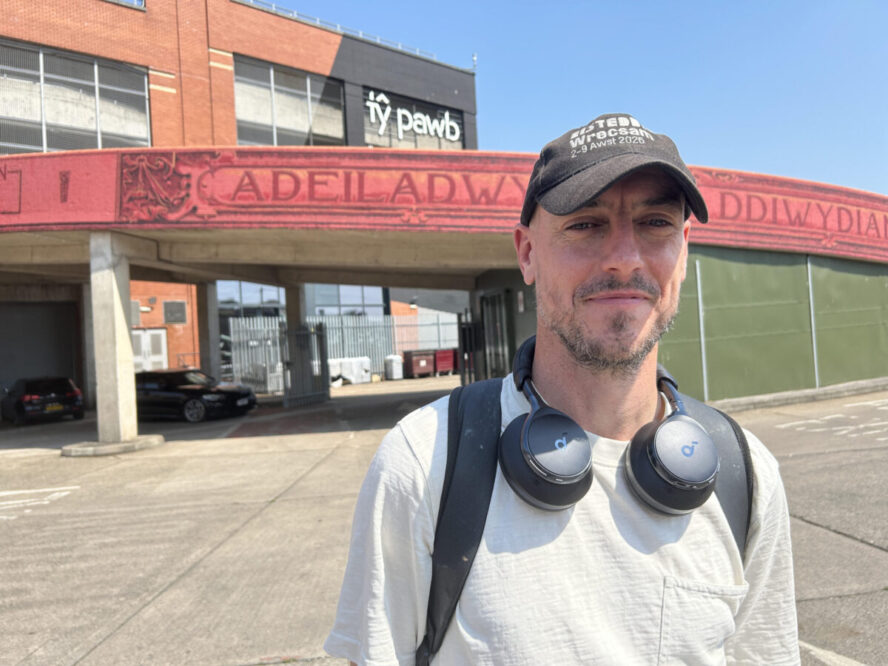
To get a flavour of the city today I met artist Liam Stokes-Massey, a driving force behind the city’s vibrant public art trail and an über enthusiastic ambassador for Wrexham’s bid to become UK City of Culture in 2029.
This promises ‘Big times ahead,’ according to local writer Emily Ashworth,‘for a municipality which many of its residents steadfastly refuse to refer to as a city. It has the down to earth feel of a working-class town with a rich and varied history, yet none of the potential pomposity of a city.
‘One thing Wrexham residents don’t do it take themselves too seriously. There aren’t many cities with a more prideful sense of community spirit than Wrexham.’
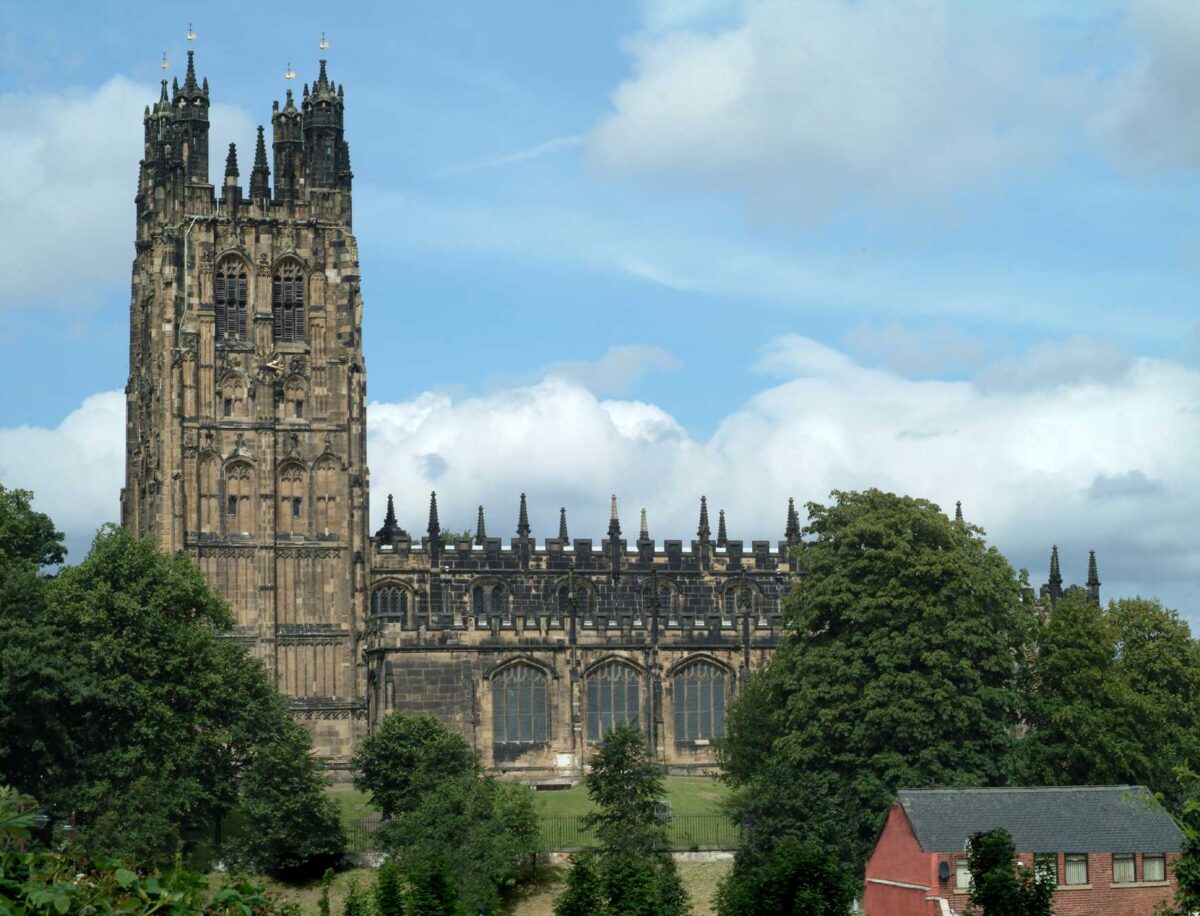
Liam’s pride-filled tour starts with some wonderful architecture, set in the heart of the city. ‘This is old Wrexham, St Giles’ Church, one of the seven wonders of Wales. I live literally just around the corner, so I get to hear the bells when they strike. If I lived anywhere and I couldn’t hear those bells it would feel like I’d lost something. It’s my very personal attachment to a church which is so beautiful.’
And it is beautiful, a cathedral-like edifice with elegant pinnacles and a figured façade together with a 150-foot tower.
This stands proud in some verse with an unashamed north-east Wales bias. This happily locates seven Welsh wonders in the local vicinity, namely ‘Pistyll Rhaeadr and Wrexham steeple, / Snowdon’s mountain without its people,/ Overton yew trees, St Winifred’s Wells,/ Llangollen bridge and Gresford bells.’
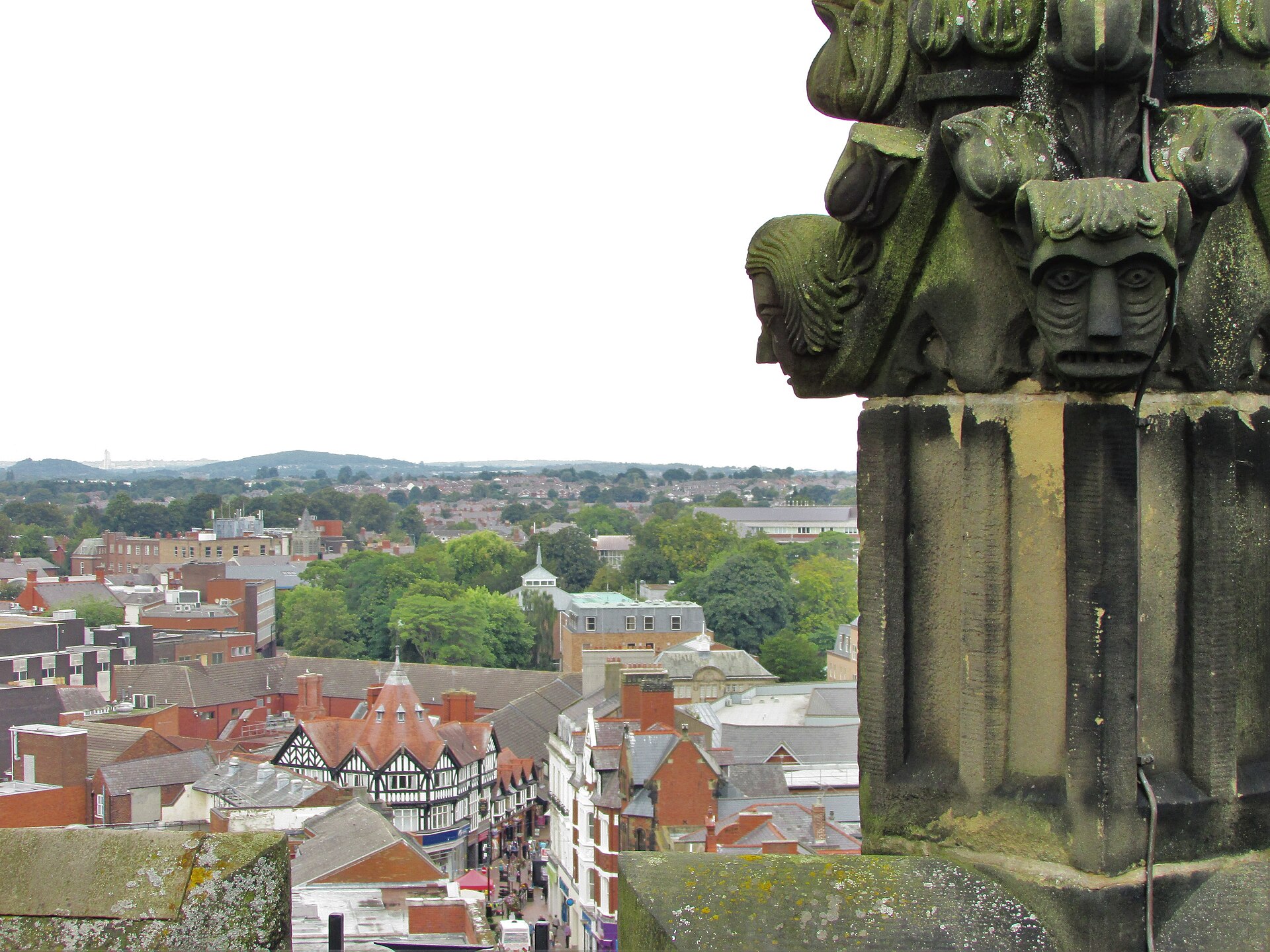
The bells ring out in a city actively in the process of being transformed, as civic pride deepens and confidence soars as high as the church belfry.
Some of that is the consequence of two Hollywood marquee-name actors rocking up to change the fortunes of Wrexham Football Club.
Liam well recalls the moment rumour solidified as fact. ‘I remember hearing the news that someone was interested in buying the club and there were a few crazy names being thrown around like Russell Crowe. And everyone’s like oh yeah there’s no chance it’s gonna be anyone like that. And then Ryan Reynolds and Rob McElhenney are announced and it’s just the most surreal thing.
The club and the city deserve it, absolutely deserve it, especially the old fans, the ones who’ve seen the lean years. Like my mates: they’ve been season ticket holders, absolute diehards for the last 20 years. The late 80s wasn’t pretty; the 90s a bit better but from 2007 onwards it was a club well and truly in the doldrums.’
Things most certainly turned around. Wrexham made history by becoming the first club across the top five tiers of English football to achieve three consecutive promotions. EFL League Two then League One followed by the lucrative step up to the EFL Championship.’
Liam still pinches himself. ‘It’s just a fairy tale. People say it’s just loads of money but it is a fairy tale. A club that’s been in the national league for 15 years gets plucked from a long list or a short list. It’s just mad. The effect it’s had on the city more widely, on the people, it’s just so special. Towns and cities around the country, around the world, would just kill for what we’ve been given.’
It has been one heck of a dramatic tale, with the Racecourse, Y Cae Ras as its main stage. The Welsh Football Association, or F.A was born here and that Cae Ras is the oldest international football stadium still used today.
It was also home to pioneering women’s matches, such as the one on Boxing Day, 1917 in which workers from Powell Brothers Munitions factory, next to Wrexham General Station took on women from Aintree Filling Factory.
As Georgina Gittins, who has researched the team can tell you, the women were all between the ages of nineteen and twenty-eight and ‘none of them would have been old enough to have voted in 1918, when most women over thirty were enfranchised to vote for the first time.’
And before you ask, Aintree won that day, the scoreline five-nil. As football teaches us, you can’t win them all.
Culture is fully part of Wrexham’s regeneration and this is very evident in the bright and vibrant murals which constitute the public art trail.
Liam explains there are thirty murals in total of which he himself has painted seven, often substantial in size and execution. ‘There’s one on a on a ramp at the back of Tŷ Pawb. I worked out it was something like 100 square metres.’
The Welsh playwright Ed Thomas once suggested that art was a sophisticated way of saying ‘Kilroy was ere.’ He was referring to the famous doodle of a big-nosed man peering over a wall which became hugely popular during World War Two.
The murals in Wrexham are perhaps similar messages of confidence and self-belief – ‘here we are,’ ‘we are here’ – which connect with the town’s history even as they anticipate a bright future.
Werewolves
Historically the most interesting marks on local walls might have been those in Marford, where crosses were painted on the walls of many houses in the late 18th century. They were there to ward off the so-called Gresford Wolfman, which killed two tramps, farmstock and some dogs, at a time when wolves themselves had been extinct in Wales for a couple of centuries.
More recent, and slightly more believable history is present in David Anand’s “The Arc” on Lord Street, unveiled in 1996.
Says Liam, ‘Some places around here, such as Brymbo were synonymous with steel. “The Arc” features two figures on brick plinths, feet astride two steel arcs with the figures at full stretch, each trying to bend the arc to meet at the top. The men’s effort to fashion hard metal into an elegant shape is a striking. ‘It’s what we were trying to get across in the mural trail, ‘says Liam. ‘History isn’t something that’s celebrated but it really should be.’
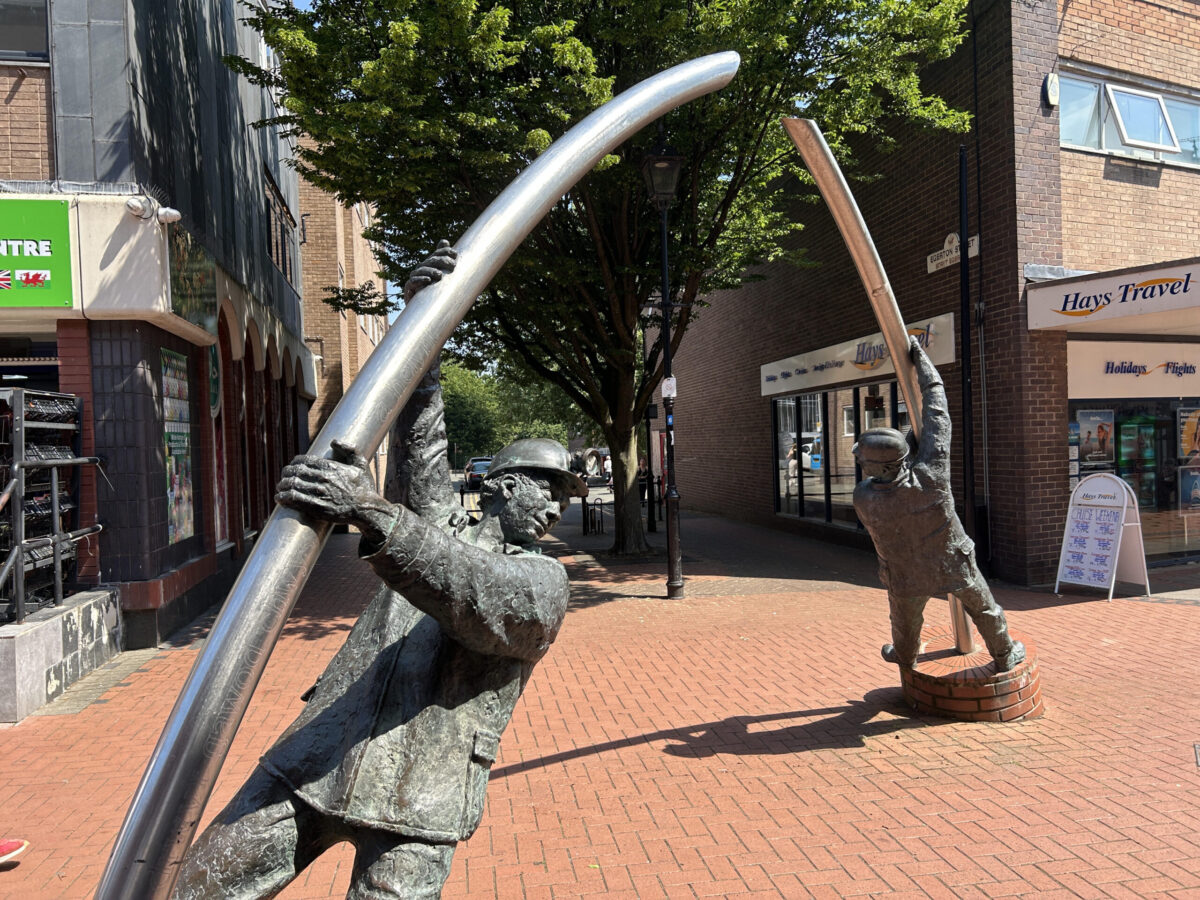
“The Arc” was the first major local authority public art commission in the area for 70 years. It paved the way for other works which today include Josh Colwell’s coal-miner and canary on Egerton Street and a collective work by a range of graffiti artists at Meadows Car Park which brings a touch of New York subway to the city.
The names of the contributors form a colourful list in itself: Art of Sok, Bone, Brat, Cartoon Life, Dime One, Dusk, Fivoe, GMC, Haes, Hyro, Japh, Kem/vegas, Keos, Kos/Rish, Oner, Mones, Michelle’s Painted Creations, Nates, Pase, Reasm, Revealist, RP Roberts, Santos, Scran, Snot, Sweet Toof, Tee2Sugars, Veal and Welsh Poppy.
Liam Stokes-Massey’s own artwork ranges from big murals to very detailed pencil work, usually on commission, often of family pets. ‘I’ve been doing this as a full -time job for about 12 years and that’s how I started out, doing pencil commissions of people and animals.
I didn’t do GCSE art so when I was 13 or 14 I just stopped. I didn’t pick up a pencil until I was about 26 years old, some 14 years ago. I was living in Cardiff and I was around a mate’s house and he was just gaming, and I spotted some Transformers graphic novels. I didn’t really get into Transformers, but there was something about them that struck me. I drew them myself: they’re the one that kickstarted my art again.’
One of Liam’s ambitious works is based on a sublime example of quilting by a local military master tailor, James Williams.
The original is part of Museum Wales’ collection of hundreds of examples of quilting and patchwork. It’s a masterwork of recycling alone, involving no fewer than 4,525 separate pieces of felted woollen cloth, some of which some might have been offcuts from military uniforms.
According to family history, James Williams spent a decade completing the piece, the complex, demanding work completed in his leisure hours between 1842 and 1852. The quilt soon became a literal exhibition piece: it was displayed at the Art Treasures Exhibition in Wrexham in 1876, at the Palace of Arts in Wembley in 1925, and to much public acclaim at the Wrexham National Eisteddfod of 1933.
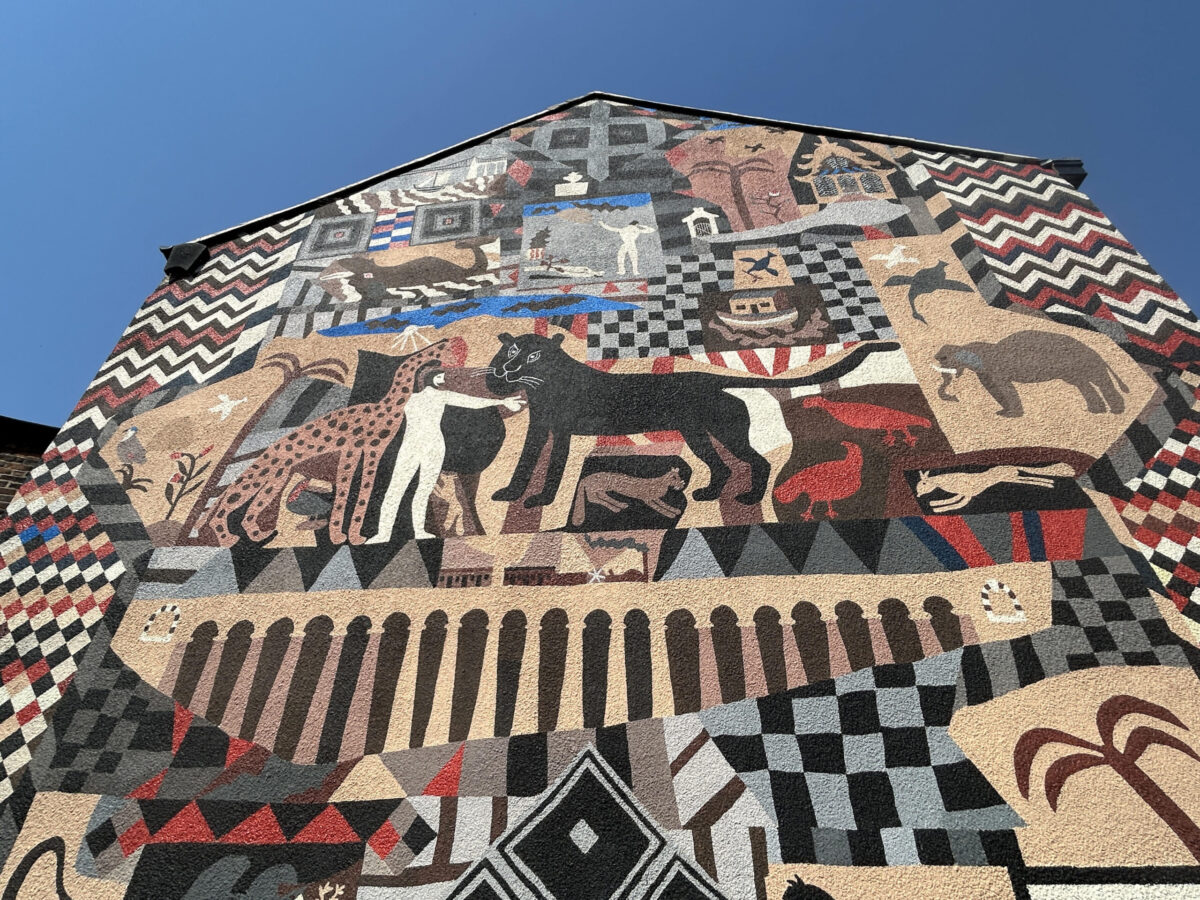
It’s little wonder that Liam Stokes-Massey was sufficiently inspired by the textures, brightness and complexity of James Williams’ quilt to want to recreate it at scale. ‘Wrexham people don’t really know about it but the craftsmanship is masterful and it’s really highly regarded in the world of quilting. His work is full of nods to the Bible so you’ve got God naming all the animals, Jonah and the Whale, Cain and Abel, the dove of peace and Noah’s Ark.
But he was also interested in engineering so there’s a steam train on the local Cefn Viaduct and Thomas Telford’s Bridge over the Menai Strait. There’s also a bird on the back of a deer and a Chinese pagoda. It took him 10 years to make so it’s like a journal of his travels and his religious beliefs.’
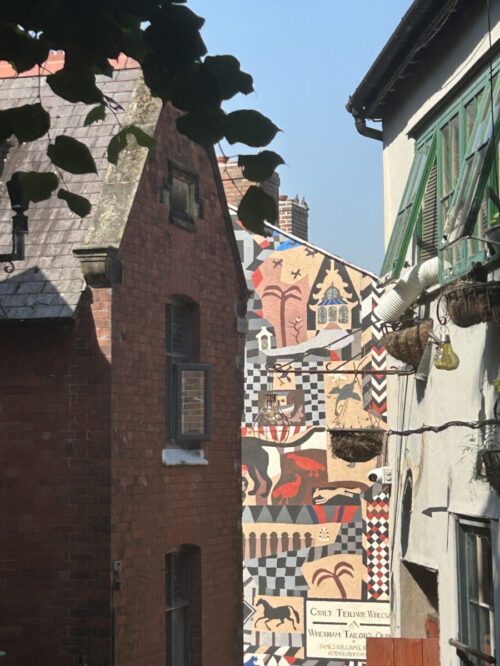
It didn’t take Liam ten years to paint his mural but it was still a hefty undertaking, helped by the fact that he has a good head for heights as he scaled the scaffolding. ‘I basically filled the wall with a grid and then sketched it from my iPad, making sure that everything’s as accurate. It took me seven or eight weeks but that was down to poor weather because the weather was a bit sketchy at times – there were periods where I just couldn’t do anything at all.’ With a nice touch of serendipity, the mural is sited precisely where James Williams’s tailor’s shop used to stand.
Another work on the trail belongs to Bethan Adey-Surgenor, from Signs & Wonders design. Bethan studied graphic arts in Leeds: ‘I then came back to north Wales, where I’m from originally, near Denbigh – my family is still up that way. I got a job here in Wrexham to open up this coffee shop in a new church in the old Burton shop.’
Bethan’s art work, located in the Central Retail Park, explores the word hiraeth, a nebulous word, its meaning just out of reach. Here are some definitions which may only serve to confuse. ‘A spiritual longing for a home which maybe never was.
‘Nostalgia for ancient places to which we cannot return. It is the echo of lost places in our soul’s past and our grief for them. It is the wind, and the rocks, and the waves. It is nowhere and it is everywhere.’
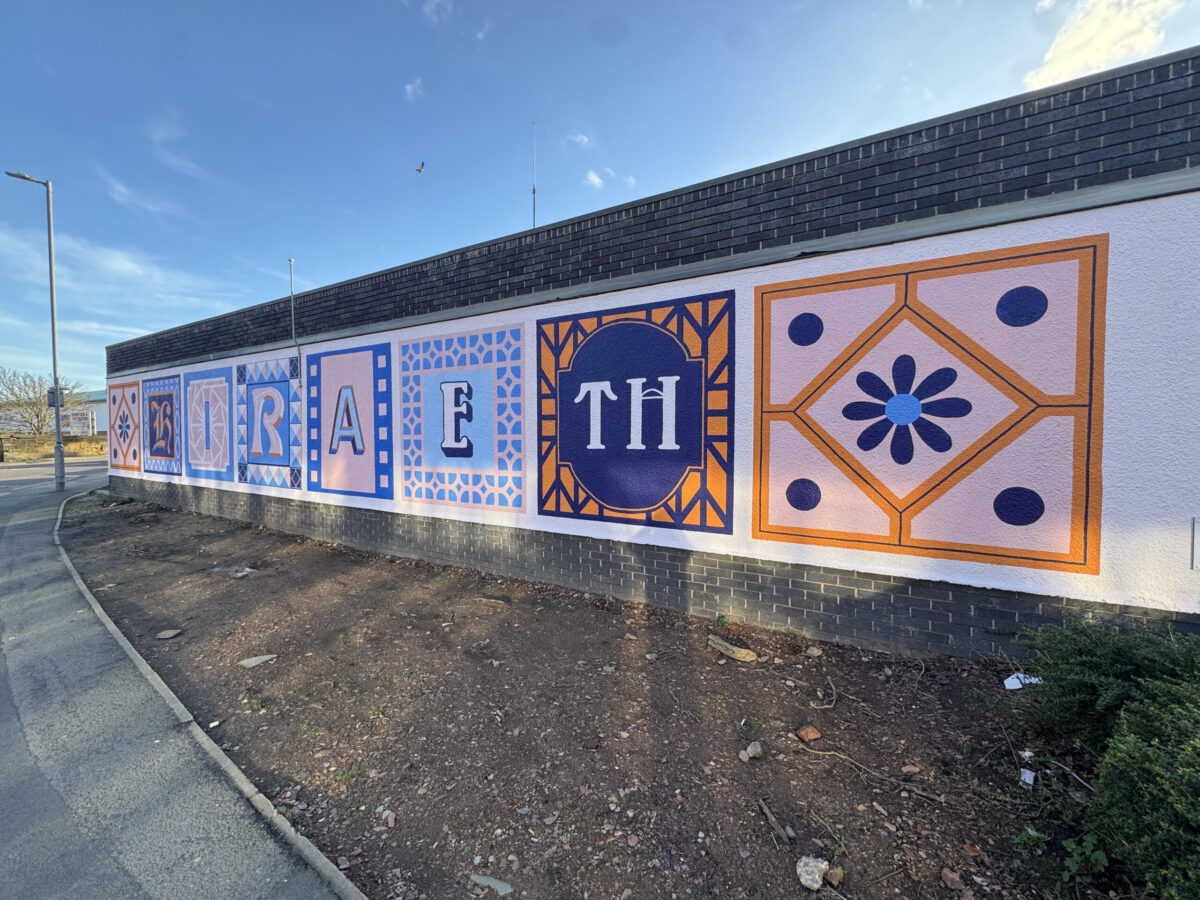
The word itself may be hard to pin down but the dimensions of Bethan’s mural are a bit easier. ‘It’s long and thin. I think we figured out it was 42 square metres, two and a half metres by 19. Hiraeth is a collection of tile-shaped designs based on the letters in the word and I basically picked up architectural details from around the city, incorporating them into my design.
‘I based it on my hiraeth for north Wales, on that kind of the longing to come back, of missing a place, which is why I returned myself. So it’s quite a personal work as well. The architectural motifs and some of the lettering I’ve picked from pub signage and various things like that so the first and the last tiles are based on some in the General Market.
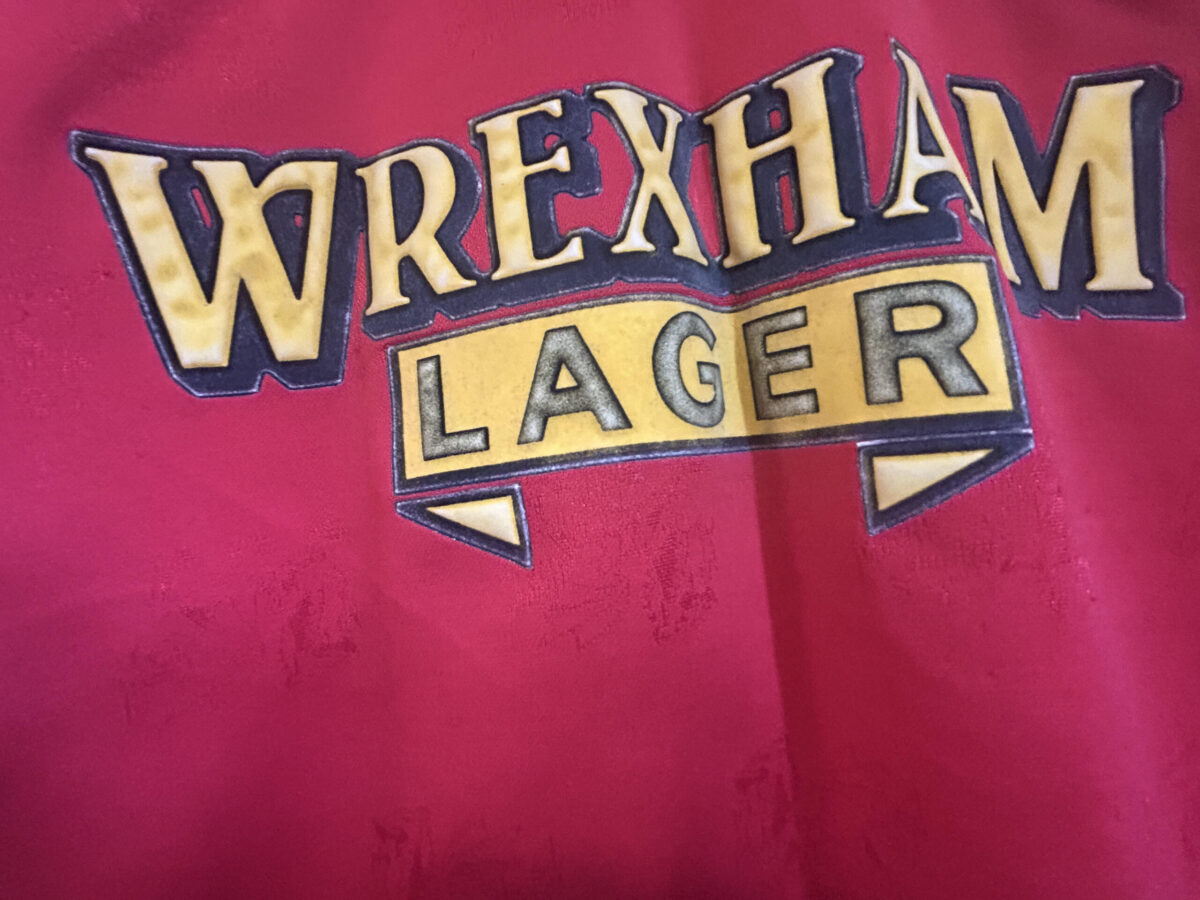
Colour-wise, it’s quite abstract. I went for a gothic-y sort of “H,” based on St Giles’, which is across the street. The border around the edge is based on the flooring that’s in the church. The “I” is from the sign for the Hippodrome in Wrexham. That was a cinema built as a temporary one, but it ended up staying for 50 years. The “E” is based on the “E” in the Wrexham Lager logo. I saw a lot more in doing that project because I was looking up, I was looking down. I feel like I learned a lot about Wrexham in doing the project.’
Wrexham’s public art isn’t just about adding splashes of colour to faded brickwork or brightening up dowdy urban space.
It’s a meaningful, creative engagement with a city with a reputation very much on the up and up. If it can claim its coveted culture crown it might easily soar even higher, even topping the spires of St Giles.

Jon Gower is Transport for Wales’ writer-in-residence. He will be travelling the breadth and length of the country over the course of a year, reporting on his travels and gathering material for The Great Book of Wales, to be published by the H’mm Foundation in late 2026.
Support our Nation today
For the price of a cup of coffee a month you can help us create an independent, not-for-profit, national news service for the people of Wales, by the people of Wales.
Get more trusted Welsh news
Choose Nation.Cymru as a preferred source in Google News to see more of our journalism.


