


May 7, 2026: The election that transformed the Senedd
Mark Mansfield
The seismic changes to Welsh politics brought about by May’s Senedd election have been revealed in a detailed analysis of the results.
More than two-thirds of the 96 politicians elected had never served in the Senedd before, while Plaid Cymru and Reform UK between them secured 77 seats.
The findings are contained in an analysis by Josh Hayman and Josh Jenkins of Senedd Research, which examines the election in detail, from party performance and turnout to proportionality, rejected ballots and lost deposits.
The May 7 election was already guaranteed to produce a very different parliament.
It was the first fought under the new closed-list proportional representation system, the first using 16 six-member constituencies and the first to elect an expanded Senedd of 96 rather than 60 Members.
But the figures contained in the Senedd Research analysis show just how profound the change has been.
New members
Of the 96 politicians elected, 66 – 68.75% – were new Members, while only 30 had served in the Senedd previously.
And just 19 of the 96 had served for more than one previous Senedd term.
Reform UK, which entered the election without an established Senedd group comparable to the other major parties, accounts for much of that change.
Of its 34 MSs, 32 – more than 94% – were new to the institution.
Plaid Cymru also brought a substantial intake of new politicians into Cardiff Bay, with 30 of its 43 MSs classed as new Members.
Labour’s nine-strong group contains seven returning MSs and two newcomers.
The Conservatives are the striking exception. All seven of the party’s MSs had served in the Senedd before, while the sole Liberal Democrat was also a returning Member.
Both of the Greens elected were newcomers.
The result means that while the Senedd has grown by 36 seats, the change goes considerably further than simply finding politicians to occupy the additional desks.
A large majority of the people now sitting in the chamber were not MSs before the election.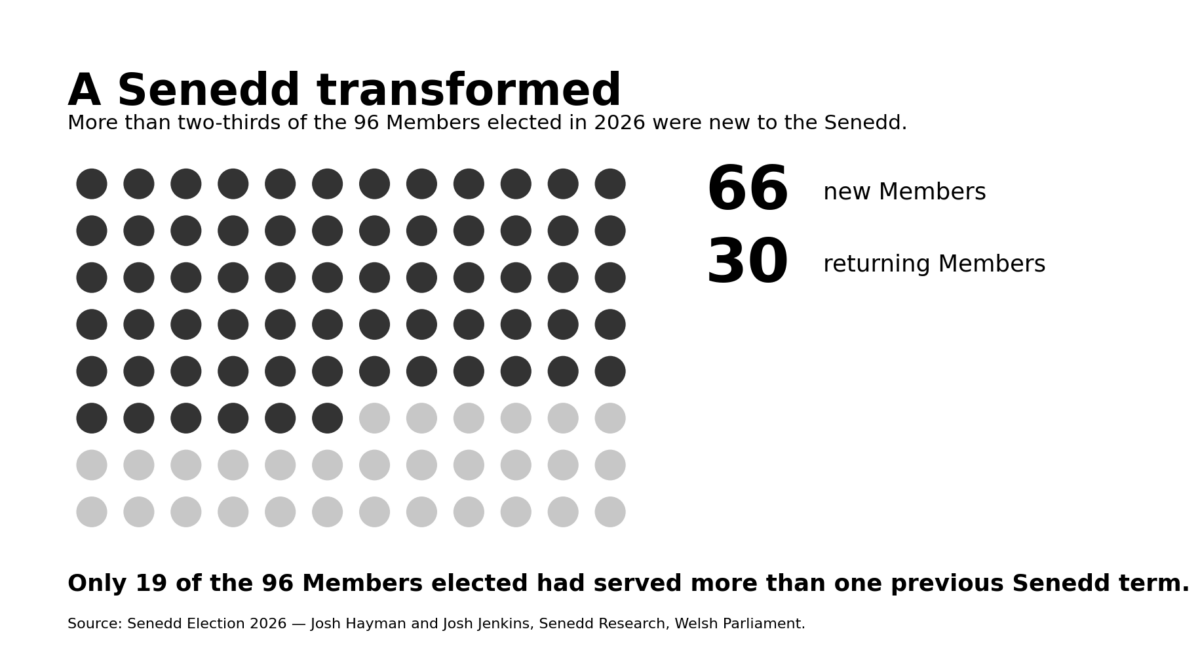
Two party dominance
The headline result was a victory for Plaid Cymru, which received 444,665 votes – 35.41% of the total – and secured 43 seats.
Reform UK finished second with 367,985 votes, or 29.30%, and won 34 seats.
Together, the two parties received almost two-thirds of all votes cast – 64.71% – and secured 77 of the Senedd’s 96 seats.
Their support was also spread across Wales.
Plaid’s best results came in Bangor Conwy Môn, where it took 44.93%, Gwynedd Maldwyn, with 44.18%, and Sir Gaerfyrddin, with 43.06%.
But even in its weakest constituency, Sir Fynwy Torfaen, it received 23.52% of the vote.
Reform’s support showed a similarly broad geographical spread.
Its highest vote share was 36.21% in Fflint Wrecsam, followed by 34.30% in Blaenau Gwent Caerffili Rhymni and 33.63% in Afan Ogwr Rhondda.
Its weakest result was in Caerdydd Penarth – and even there the party took 17.63%.
In 12 of the 16 constituencies, Reform received more than a quarter of the vote.
Labour couldn’t reach 17%
One of the starkest illustrations of Welsh Labour’s collapse is its best result anywhere in Wales.
The party that had been the largest in the Senedd at every election since devolution began failed to secure 17% of the vote in a single constituency.
Its strongest performance was in Afan Ogwr Rhondda, where it received 16.74%.
That was followed by Sir Fynwy Torfaen on 15.02% and Gŵyr Abertawe on 14.22%.
At the other end of the table, Labour received just 5.47% in Gwynedd Maldwyn, 6.43% in Bangor Conwy Môn and 7.29% in Ceredigion Penfro.
Nationally it won 139,203 votes – 11.08% – and nine seats.
That left it only narrowly ahead of the Welsh Conservatives in the popular vote. The Conservatives received 134,926 votes, equivalent to 10.74%, and returned seven MSs.
Direct comparisons with 2021 need to be treated cautiously because the constituencies, number of Members and voting system all changed in 2026.
The analysis notes that those changes mean shifts in seats and vote share cannot simply be compared like-for-like with the previous election.
How proportional was the new system?
One of the arguments for replacing the previous electoral system was that the new closed-list system would produce a more proportional result.
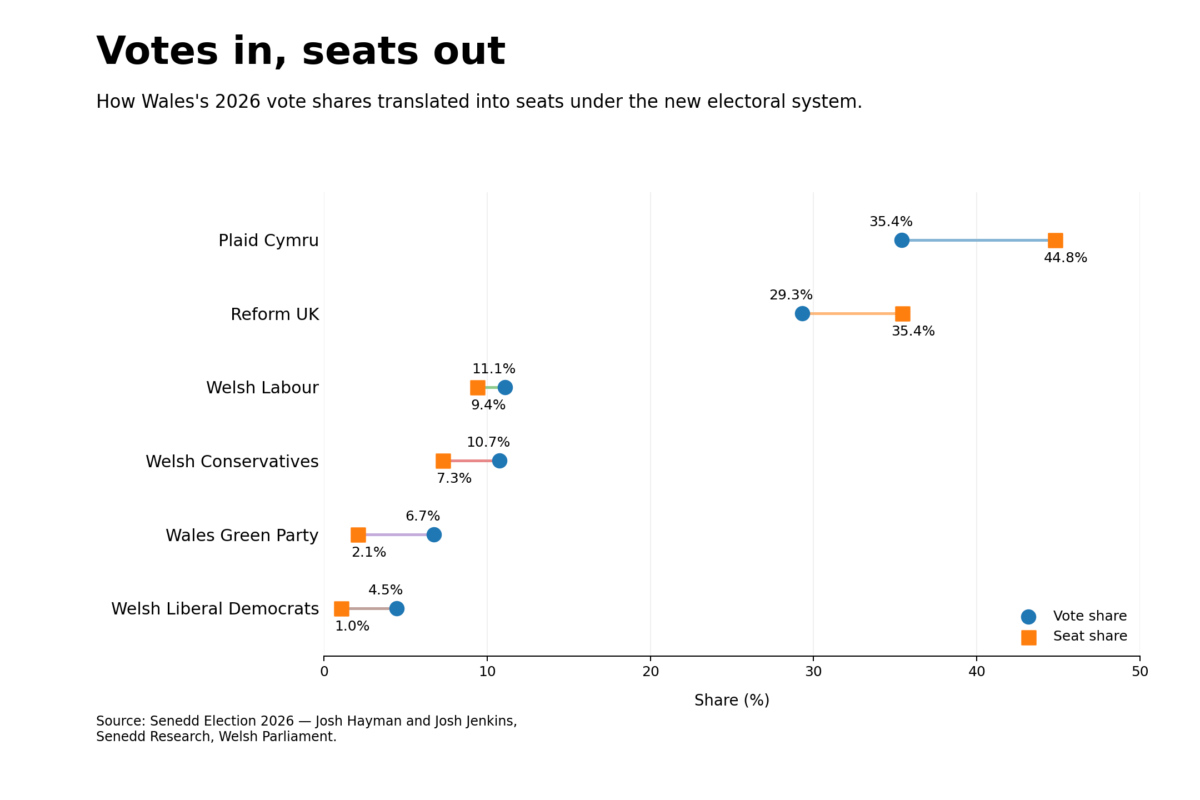
Plaid Cymru received 35.41% of the national vote but emerged with 44.79% of the seats – a difference of 9.39 percentage points.
Reform also received a sizeable seat bonus, turning 29.30% of the vote into 35.42% of the seats – 6.12 percentage points more.
For the other four largest parties, the allocation went in the opposite direction.
Labour’s 11.08% vote share produced 9.38% of the seats, while the Conservatives received 10.74% of votes but 7.29% of seats.
The Greens received 6.74% of the vote but just 2.08% of the seats, while the Liberal Democrats’ 4.46% vote share translated into 1.04% of seats.
Senedd Research uses the Gallagher index, a measure widely used by political scientists, to assess the overall proportionality of an election result. The lower the score, the more closely the distribution of seats reflects the distribution of votes.
The 2026 result produced an index score of 9.5, compared with 10.1 in 2021.
The report says the figures therefore do not suggest a substantial improvement in proportionality compared with the previous election, despite the change of electoral system.
It was nevertheless the second-most proportional Senedd election since 1999.
Record turnout
The election also broke a record that had stood throughout the history of Welsh devolution.
More than 2.43 million people were registered to vote and more than 1.25 million did so.
Turnout based on valid votes was 51.7%, compared with 46.6% in 2021.
It was the first time turnout at a Senedd election had exceeded 50%.
There were, however, substantial differences across Wales.
The highest turnout was in Caerdydd Ffynnon Taf at 58.50%, while the lowest was Afan Ogwr Rhondda at 44.68% – a gap of almost 14 percentage points between the two constituencies.
Rejected votes
The analysis also reveals a total of 2,986 ballot papers were rejected.
Of those, 1,732 were unmarked or considered void because the voter’s intention was uncertain, while 1,021 had more than one vote marked.
Another 135 contained a mark by which the voter could potentially be identified.
One figure stands out geographically.
A total of 98 ballots were rejected because they did not bear the official mark, and every one of them was in Gwynedd Maldwyn.
Ceredigion Penfro recorded the largest overall number of rejected ballots, at 247, while Bangor Conwy Môn had the fewest, at 123.
Election deposits
There were also financial consequences for parties and independent candidates who failed to attract sufficient support.
Election deposits are returned when a party or individual candidate receives at least 5% of the vote in a constituency.
Plaid Cymru, Reform and Labour retained their deposits in all 16 constituencies.
The Conservatives lost two, worth £3,000, while the Greens lost five, costing £7,500.
The Liberal Democrats lost their deposits in 11 of the 16 constituencies – a total of £16,500.
Smaller parties fared worse. The Heritage Party lost its deposit in all 16 constituencies it contested, while all 30 individual candidates also lost theirs.
Altogether, the figures in the report show £61,600 in deposits was lost by parties and individual candidates.
Taken together, the figures illustrate the scale of the change to Welsh politics on May 7.
Plaid Cymru and Reform emerged with 77 of the Senedd’s 96 seats, more than two-thirds of Members were newcomers, turnout passed 50% for the first time and Labour failed to reach 17% anywhere in Wales.
The first test of an electoral system intended to improve proportionality also produced a result only marginally more proportional than the system it replaced.
Support our Nation today
For the price of a cup of coffee a month you can help us create an independent, not-for-profit, national news service for the people of Wales, by the people of Wales.
Get more trusted Welsh news
Choose Nation.Cymru as a preferred source in Google News to see more of our journalism.



Something of a political wildfire, will all the new shoots produce any fruit this term! Unlikely, the competition for sunlight will be a sea-anchor as will the percentage of blind to one eyed taking pots of money for being clueless and humanly unsuited for the role…
A damp squib that has led to political paralysis. Just over half the electorate could be bothered to tick a box, while the leading party, which was up against a corrupt gaggle of racists, could still only muster just over 40% of the vote.
There’s only paralysis if the parties that don’t consider themselves a “corrupt gaggle of racists” side with those that do. As happened when Labour joined with Reform to block £145m more for the NHS.
Perhaps STV would’ve been more proportional after all.
Once we start changing electoral systems to engineer our favoured outcomes, its a treadmill that we’ll never get off. Already Plaid were muttering about changing things before the dust had settled. Instead of getting lost in the detail, the important thing is the trend. Reform came from nowhere to win a third of the votes. To claim that a third of Welsh voters are racists, fascists and all the rest of it clearly doesn’t work. This was a giant vote against the Status Quo. Labour were punished for losing sight of what was important to the voters. Under Drakeford, Labour… Read more »