

Meet me at Shibuya Station
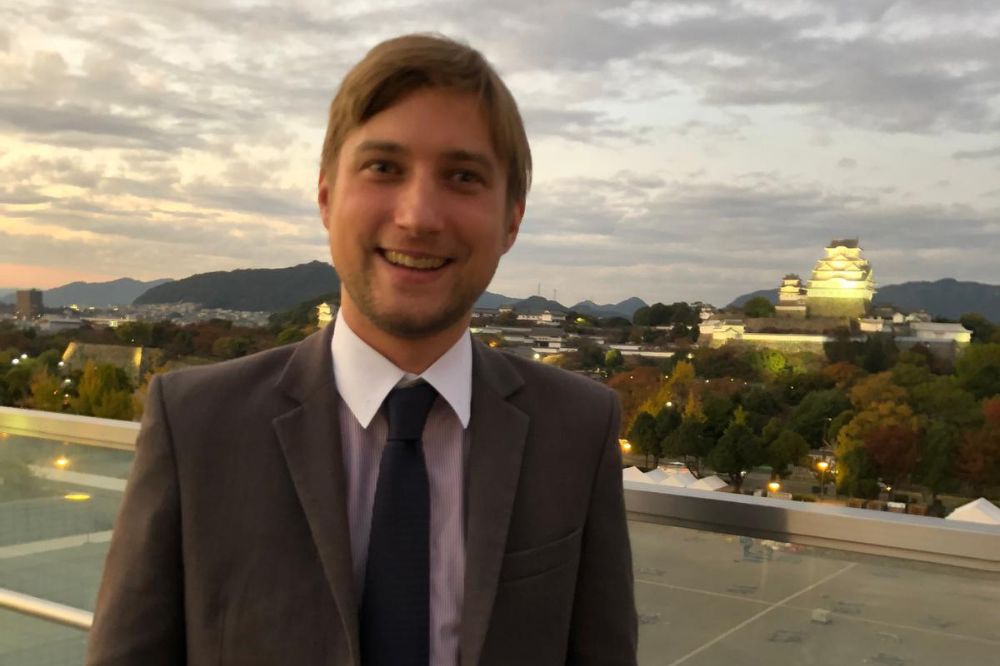
Lord Gregory Mostyn
One day in 2015, we were tidying up the library in Mostyn Hall when I was astounded to come across an old, dusty photo album.
It looked as if it had been almost hidden, and yet by some luck we found it and began to flick through it.
It is dated 1908 and chronicles my great-great-grandfather’s journey through Canada and Japan with his wife and two children. It is filled with black and white photos, postcards and drawings of famous sights in Japan, including the Golden Temple in Kyōto, the beautiful castle at Nagoya and the red Shinkyō Bridge in Nikkō.
Alongside all these fantastic and rare photographs is a diary, a daily update of what the family had done during their time thousands of miles away in far east Asia. They had ridden rickshaws, visited many shops and drunk tea with locals. Intriguingly, the album is almost a mirror into my own experiences of Japan.
In 2006, I had been celebrating finishing my university exams with my Japanese girlfriend, and a very good friend of mine. We had time to burn as we waited for our results, and it was time to let off some steam. As morning approached, I wondered out loud what I was going to do: maybe get a job back down in London or go to some career fairs.
My friend said his path had already been decided: he was going to teach English in Japan. This was the spark that made me think: why not move to Tōkyō? I was clueless about the city, the country and the people, apart from that they liked sushi and had some fast trains. But it all made sense: I could stay with my girlfriend who was moving back to her homeland, I could join up with my friend who was going out there, and I could learn a new language and culture.
Waking up the next day with a hangover, I told my parents that I was moving to Japan. They thought I had gone mad. I applied online and went to a job interview in London. I was nervous as hell but got the job. I remember being sent in the post a CD and information pack titled So You Are Going to Japan! I threw it in the bin – I thought everything will be fine – I will arrive in Tōkyō, meet up with my girlfriend and friend, settle down, and it will be great!
Good ideas
As I landed in Tōkyō in November 2006, I remember going to see my girlfriend, who told me to meet her at Shibuya station. We broke up instantly.
Meanwhile, my good friend had relocated to Ōsaka. Maybe this wasn’t such a good idea after all! I rang Mum and Dad the next day and said I wanted to go back to London, but they said, ‘No, no, stay in Japan, you’ve come this far and if it really doesn’t work out, you can fly back whenever you want.’
So I stayed, found a flat to move into in Tōkyō, and tried to find my bearings. This was back in the day with no Google Translate, no Google Maps, no online meeting websites or whatever. I soon found out that, boy, did I need to learn some Japanese!
Ordering food, finding out where the toilets were – even which seat I could sit down on in the train – were all confusing. It was very difficult in the beginning: Tōkyō can be a claustrophobic city, with tall skyscrapers hemming you in, masses of people walking all around you, shop signs leering down at you in a complex mess of characters.
But with time, I learned to embrace it, and, as I met new people and got better at the language, I felt so at home. The people are kind and welcoming, and they are extremely helpful and polite, too.
One day, I remember, after my Japanese had improved, I had dinner with an entire Japanese group, explaining to them in Japanese why my football team couldn’t win a game. I thought, wow what is happening here? Then with the language came an improvement in an understanding of local customs.
Don’t cross the road when the light is red. Don’t tip in restaurants. Apologise when you do something wrong. Some of my friends tell me that when I speak in Japanese, my entire body language changes to being more demure and shy.
I have too many special memories to record them all here. The year I lived in Japan was simply the best year in my life. Japan is my favourite country in the world, and since 2007, I have been back there every year. Which is why I was so surprised to see that album, showing that my family had made the trip before me, over one hundred years ago.
After I found it, I decided to take my own photos of the same Japanese places the album explores: from Kyōto to Nikkō, from Nagoya to Yokohama. It took me three weeks, and involved many funny episodes.
Dreams
I made an album out of the 2015 photos, and that photo album currently lies side by side with the 1908 family album. Then in 2019, a producer from Sekai Fushigi Hakken heard about the old album and he wanted, as I had done, to find out why my family had gone to Japan in 1908.
I appeared on TV and it was a great honour to show the volume; even now, I can’t believe the programme was actually viewed all across Japan.
The 2019 broadcast coincided with a dream that I have been pursuing in recent years: I love Wales and Japan a lot, and I would like to bring the two countries closer together.
Since 2018, I have been attending events in Japan to promote Wales and Welsh tourism, and have been on Japanese television a few times while making speeches about my experiences in the country, the background of my family and their connection to it.
I have also been giving Japanese-language tours, since 2019, for tourists who come to visit Wales. I think if anyone told me, in mid 2006, that this was what I would be doing now, I would have laughed. It was at one of these events in 2023, at a St David’s Day dinner, that I met Susan Karen Burton, and spoke to her about her work developing The Transplantable Roots of Catharine Huws Nagashima.
What I have written down here just a little snippet of my own story about my experiences in Japan, there are many more stories of Welsh people having their own adventures there. I think it is wonderful to see published such a wide range of encounters connecting Wales and Japan, and I’m sure you will enjoy reading the book as much as I have.
Support our Nation today
For the price of a cup of coffee a month you can help us create an independent, not-for-profit, national news service for the people of Wales, by the people of Wales.
Get more trusted Welsh news
Choose Nation.Cymru as a preferred source in Google News to see more of our journalism.



Diddorol iawn! Beth am Sumo yng Nghaerdydd?