


Moments of great joy: My latest visit to Skomer’s puffins
Cenric Clement-Evans
I first saw puffins at RSPB Ynys Lawd, on Ynys Môn about 10 years ago. It was like playing the bird version of “where’s Wally”, trying to spot one of only up to about a dozen puffins, at a huge distance on the cliffs and hidden amongst thousands of guillemots and razorbills.
The main distinguishing feature, from so far away, was their orange feet! It was still a moment of great joy and excitement.
Fast forward to Thursday, I was now making my third visit to Skomer in 5 years. The island is a little under a mile from the fairly remote Marloes Peninsula on the Pembrokeshire coast.
The island is managed wonderfully by the Wildlife Trust of south and west Wales. I had booked our visit as long ago as December 2025.
Booking well ahead is essential for day visits, as it is such a popular place to visit, with around 1000 visitors per week. Seeing Puffins was not in doubt, as long as the trip wasn’t cancelled due to poor weather.
Waking bright and early, my heart sank, when upon opening the curtains, I was greeted by a thick Pembrokeshire fog.
Fortunately, this lifted during the drive over to Martin’s Haven, for the short boat trip over to the island. It was still windy but not enough to prevent a slightly choppy 15 minute crossing.
As we waited for our boat, the Dale Queen, orange boarding passes in hand, a grey seal watched curiously from the bay. Swallows flew all around, wrens and a blackbird could be heard calling and a couple of cormorants landed on the rocks nearby to see us off.
Soon we were all on board, and after the mandatory safety talk, with great excitement we were on our way. Soon we could see wildlife from the boat, I was especially happy to see gannets flying close by.
A harbour porpoise passed nearer still, and I did manage to catch a brief sight of its back and dorsal fin.
Soon there were razorbills all about and then as we approached the landing site, the sheltered harbour area was full of swimming puffins. Fantastic!
Upon disembarking, we had to climb a set of some 90 steps. Undeterred by the challenge, and after all Sir David Attenborough had managed them without difficulty during his visits in 2022, we made our way to meet the Wildlife Trust staff.
On our way, we saw razorbills very close by, and of course there were more than a few puffins to be seen.
At the top of the steps, it was time for some instructions. The first and most important rule, is you must keep to the path!
There is good reason for this as there are burrows everywhere and leaving the path is likely to mean stepping onto the roof of a burrow, collapsing it and leaving a sleeping bird with no means of escape.
The second rule is to circumvent the island in an anti-clockwise direction, which avoids having to pass on the very narrow paths or leaving the paths.
A minor detail is the fact that the only toilets on the island are at the old farmhouse.
Much more important is to know that this is an excellent location to see lots of acrobatic nesting swallows, and also to hear and maybe to see sedge warblers.
At this point we learnt that there are around a million seabirds which have come to Skomer to breed! Not least of these are 350,000 manx shearwater, around 50% of the world’s population.
These won’t be seen during the day, as they come in under the cover of night to avoiding predatory greater black-backed gulls. Other seabirds to be seen on various cliffs around the island include thousands of guillemots and razorbills, kittiwakes, fulmar and of course the puffin!
The island is also home to 9 pairs of breeding curlew, various small birds, waders and ducks and also a few passing visitors as well.
Birds of prey, of which I saw none on this trip, include peregrine falcons, short-eared owls, kestrels and buzzards.
However the standout statistic is that the number of puffins on Skomer this year is 52,019. I do hope that a recount wasn’t necessary! This is up from the previous record of 43,626 in 2025 and despite a decline in global populations.
When it comes to numbers according to the RSPB spring/summer magazine of 2026, “the UK hosts around 474,679 breeding pairs, three quarters of them in Scotland”. So clearly Skomer makes quite a contribution, by my maths somewhere around 5.5% to UK figures.
At this point I realise that of the 52,019, at least one poor puffin is not going to find a mate this year!
So all clued-up, we were away! It was still quite overcast, which wasn’t necessarily a bad thing as other than the old farmhouse, there is literally no shelter on the island at all.
The light would improve later just in time to take some photos. Skomer is very beautiful at this time of the year, as the bluebells are just fading whilst the red campion are coming into their prime.
I love the sea-campion around the cliff edges and also mounds of thrift. This is all against a background of the verdant bracken.
A choice of trails is available, with the longest taking in the whole of the island and is
approximately four miles in length.
This is estimated to take approximately 2.5 to 3 hours. Knowing my tendency to stop and look around and take the occasional photograph, we felt it wise not to walk the whole island trail. There is really an awful lot to see in what is a very short space of time and there is much more to Skomer
than puffins. However puffins were my still focus.
I have noticed over my visits that the sites occupied by the puffins appear to have increased in number and expanded in size, although the best place to see them, especially at close quarters, remains at the Wick.
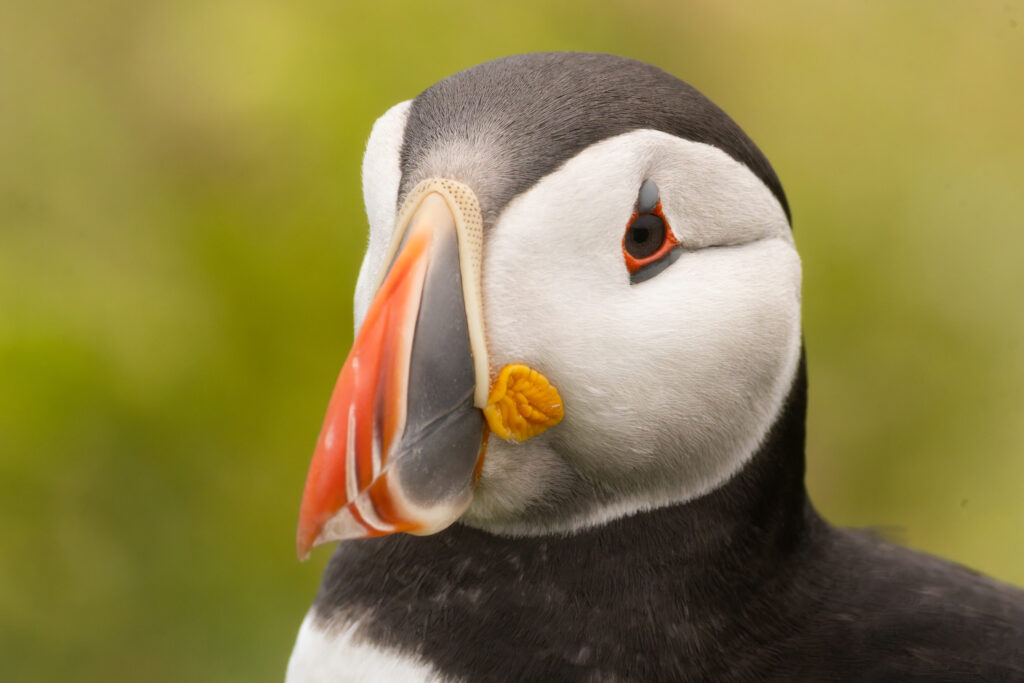
It is difficult to describe the feeling of seeing this beautiful iconic bird, which spends most of its life far out at sea, coming to land only to breed, so close at hand.
Any attempt to describe the puffin, can do it no justice. The birds are remarkably unconcerned by the presence of people, so many of us lined up taking photographs with a whole variety of cameras and lenses.
Whilst we all strictly kept to the rule of staying on the path, this clearly did not apply to the puffins, as a few would happily cross over the path often very close to people’s feet and seemingly oblivious as to our presence.
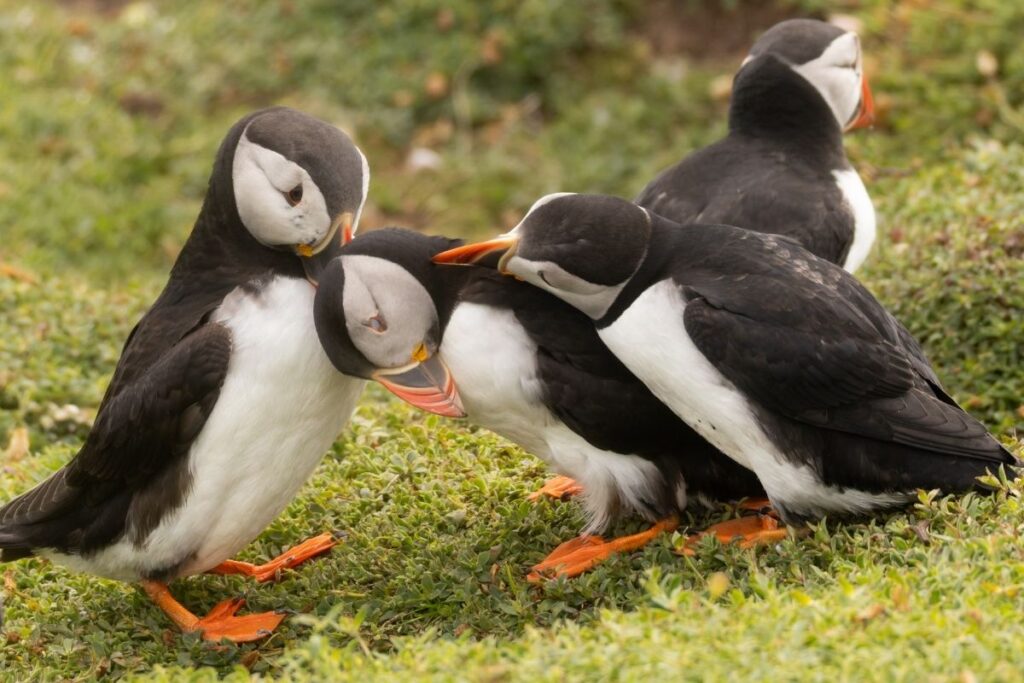
At the Wick literally everywhere in front of us were puffins. They were flying in and flying off, landing and taking off, appearing from and disappearing into burrows. They clearly nest in very close proximity to each other but there seemed very little evidence of disagreement between them.
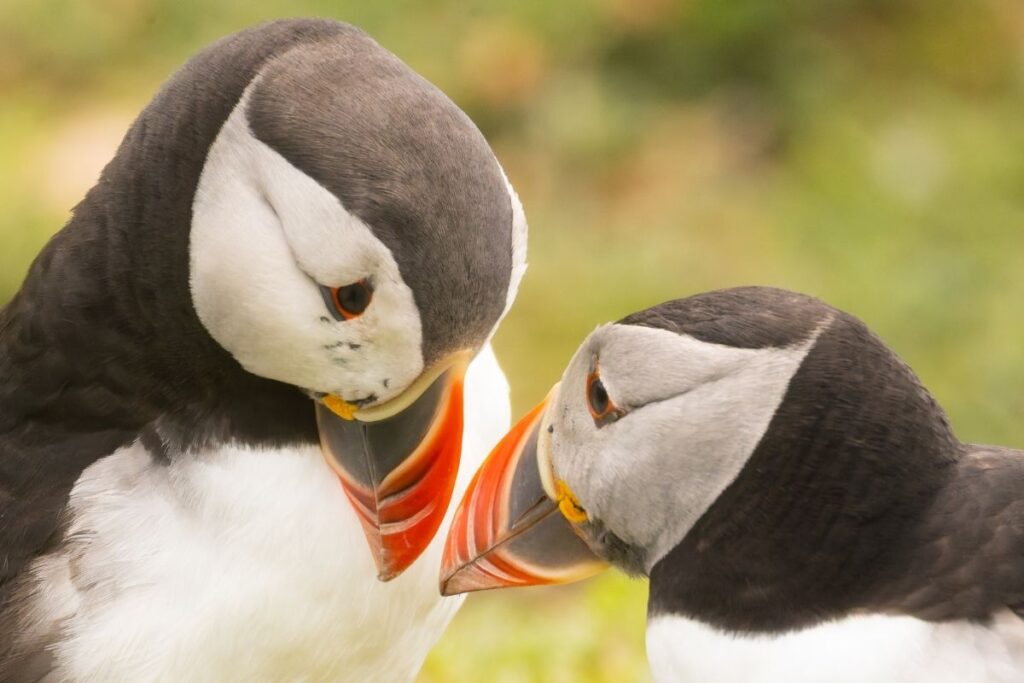
There was one exception that I saw to this. Whilst watching what appeared to be a loving couple greeting each other and rubbing their bills together, suddenly another puffin arrived and pecked at what I am guessing was the female bird of the original couple. She then disappeared off down a burrow. The new arrival appeared to confront the remaining bird quite aggressively until the original male (again I am speculating) gave way!
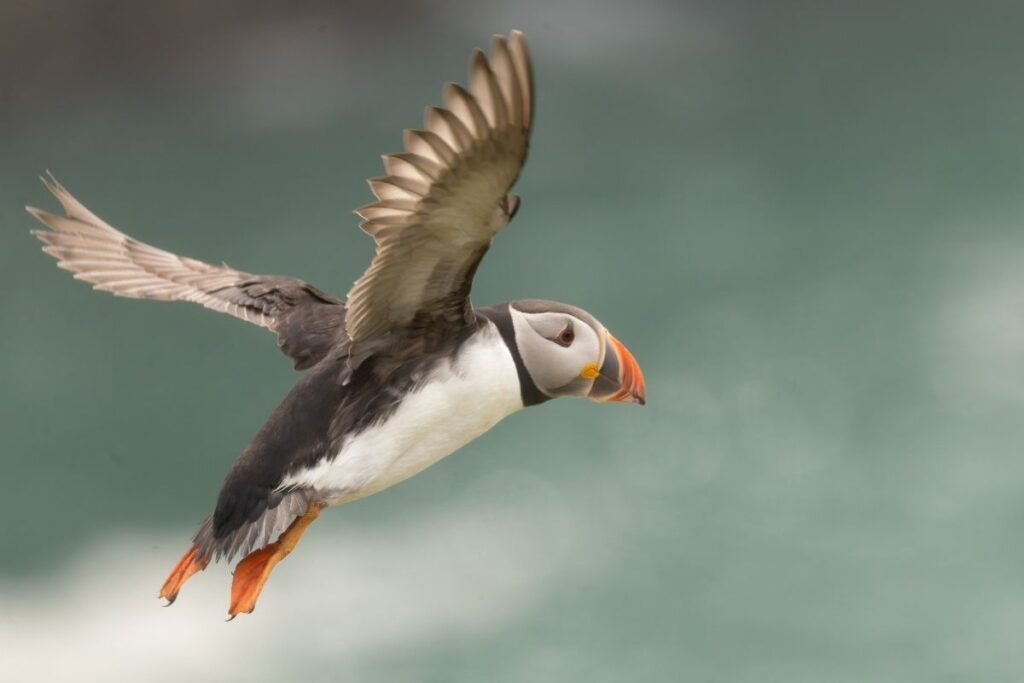
Other than this little drama, all seemed well despite the numbers! It was just wonderful to see them, especially in flight and either taking off or coming into land and of course trying to catch a photo. All too soon our 5 hours on island was over and we had to return to the Pembrokeshire mainland.
Even then before boarding the boat, there were plenty of birds to be seen on the waters of the harbour and basking grey seals on one of the island beaches.
The puffin is a bird that makes me exclaim with joy when I see one and nothing in this short trip has changed that! I will be back again next year.
Support our Nation today
For the price of a cup of coffee a month you can help us create an independent, not-for-profit, national news service for the people of Wales, by the people of Wales.
Get more trusted Welsh news
Choose Nation.Cymru as a preferred source in Google News to see more of our journalism.


