


‘Monumental’ novel published about the campaign for a Welsh Parliament
Martin Shipton
A retired journalist and think tank director who has spent decades writing about Welsh politics has launched a “monumental” documentary novel that traces the tortuous campaign to establish a parliament for Wales.
John Osmond worked for the Western Mail and ITV Wales before becoming director of the Institute of Welsh Affairs. He is also a longstanding member of Plaid Cymru.
His novel Soul on Fire begins with the crushing defeat of plans to set up a Welsh Assembly in a referendum in 1979 and ends with the narrow victory of the Yes campaign at a second referendum in 1997.
His earlier novel Ten Million Stars Are Burning, which took the story from 1973 to 1979 and was originally published in 2018, has been reissued.
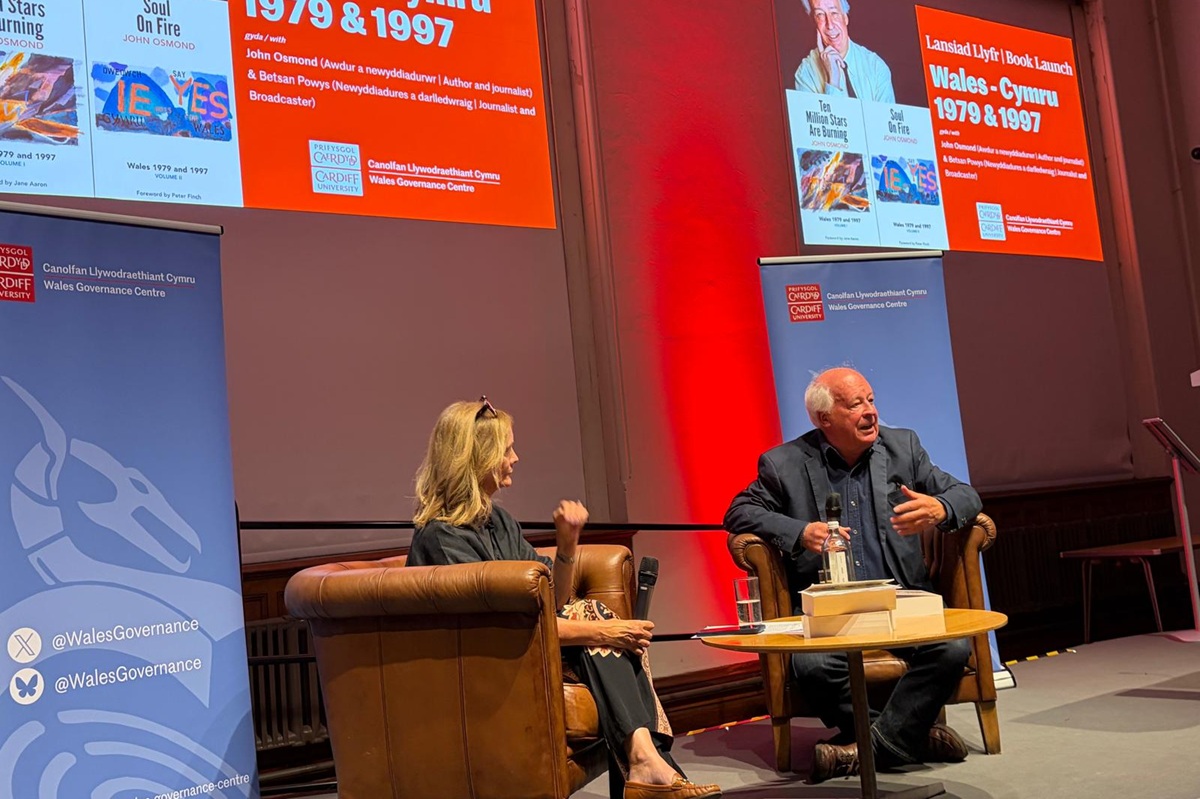
Soul on Fire was launched in the Senedd’s Pierhead building, where Osmond was interviewed by former BBC Wales political editor Betsan Powys at an event staged by Cardiff University’s Wales Governance Centre.
Explaining what he was attempting to achieve by writing the book, he said: “I spent weeks in the National Library. It’s a wonderful institution – a marvellous place. One of the places I love most of all in the world is the National Library in Aberystwyth.
“I looked at newspapers, I looked at archives. A lot of the characters whose papers are lodged at the library are major characters who appear in this book. And not just the National Library, but the South Wales Miners’ Library in Swansea, a huge resource, particularly for me and for this book, because its fundamental purpose is to understand and explain why the referendum of 1979 turned into the referendum of 1997.
“The 1979 referendum was a complete disaster for those of us who were pursuing the devolution cause. It was an extraordinarily overwhelming vote of four to one against. Yet within a very short time, less than 20 years, we had a majority, a very slim majority but nonetheless a majority.
“Why did that happen and how could it happen in such a short time? The purpose, the motivation of the book is to explain and understand that.
“The central reason, I believe, and I try to demonstrate this, was the miners’ strike and how that was experienced, felt and understood in Wales. And for that, you have to go to the Miners’ Library in Swansea, because it’s all there in extraordinary detail – all the main characters and personalities who were involved in that strike, who led the strike.
“There were interviews with them by a man called Hywel Francis [later the Labour MP for Aberavon], who himself was central to the events of that time and is a major figure in my second volume. He conducted many of those interviews at the time or shortly afterwards, and I’ve listened to them and transcribed them over hours, and a lot of them are in the book.”
Inner lives
Osmond said that writing the novels had forced him to see events he had covered as a journalist in a different way: “I’ve written quite a lot of books, but they’re all semi-journalistic, academic types of books. This is very different. I was dealing with the inner lives and personal lives of people. And I was having to write dialogue. So it was completely new. I was frightened of it, to be honest. I had to imagine situations.
“I had a list of episodes I wanted to engage with, but when I was researching them, I would turn up things I didn’t know and they would excite me and lead me in certain directions I hadn’t imagined I was going to take. I’ll give you an example.
“Soul on Fire deals with the campaign for the establishment of S4C, the Welsh-language television channel. In the early 1980s, we had this extraordinary melodramatic episode of [Plaid Cymru’s first MP] Gwynfor Evans threatening to starve himself to death unless the government reversed the betrayal of its promise to set up the channel.
Hunger strike
“One of the things I chanced upon when I was researching this was that Gwynfor was very concerned about the moral dilemma surrounding going on hunger strike. It was a form of violence at one level, and Gwynfor was a pacifist.
“He would be accused of inciting people to react and to then commit violent acts themselves, which undoubtedly actually would have happened. So he was conflicted about this.
“I discovered that he went to see a great friend of his, Pennar Davies, who was a poet and a minister. He was in charge of a theological college in Swansea, and Gwynfor went to see Pennar secretly to talk this dilemma through, and the moral issues around it. Was he justified in taking this action from a moral point of view?
“I discovered that he did this, but there’s no record of their conversation when they met. And so I had to make it up. I had to imagine what that conversation would have entailed.
“So there are certain episodes in the book of that kind where I know something happened, but there’s no record you can go to which tells you what they actually said. So you have to somehow imagine the scene.”
Professor Kevin Morgan, who chaired the Yes for Wales campaign in 1997, was at the launch event. He told Osmond: “Can I say on behalf of many of us what a monumental achievement it’s been to novelise these critical periods in the life of our nation.”
Ten Million Stars Are Burning and Soul on Fire are published by H’mm Publishing at £17.50 each.
Support our Nation today
For the price of a cup of coffee a month you can help us create an independent, not-for-profit, national news service for the people of Wales, by the people of Wales.
Get more trusted Welsh news
Choose Nation.Cymru as a preferred source in Google News to see more of our journalism.



Is there a chapter on Blankets?