


Most people would sacrifice some life satisfaction in exchange for a more equal society
Crispin Cooper, Senior Lecturer, Department of Computer Science and Informatics, Ana Fredrich
Department of Computer Science and Informatics, Wouter Poortinga, Professor of Environmental Psychology, Cardiff University
What kind of society would you rather live in: an equal one where everyone is just about getting by? Or an unequal one where most people are doing substantially better, but a small group consistently falls behind?
Now imagine having to choose that society before you were even born, but with no idea of where you’ll end up in it.
Seen this way, inequality becomes a question of risk. Would people gamble on the unequal world, knowing they might be among the unlucky few? Or would they stick with a basic but adequate life for all?
Back in the 18th century, philosopher and social reformer Jeremy Bentham would probably have taken the gamble. Two hundred years later, egalitarian philosopher John Rawls, who was behind this thought experiment (which he called the “veil of ignorance”), argued against it.
Economists call this an efficiency-equity trade-off; balancing fairness with the sometimes competing priority of making the most of society’s finite resources. Political scientists point to such attitudes on inequality as a fundamental difference between left and right. Yet it turns out most people want more details before answering the gamble. How big are the gains, how severe are the losses, and how likely are they?
To quantify this, our work (together with our colleague Tommaso Reggiani) measured wellbeing through subjective life satisfaction. Such measures have been used extensively in public policy over the last 20 years, reflecting a broader shift away from purely economic measures towards a fuller picture of how people actually experience their lives.
The Office for National Statistics asks citizens about life satisfaction on a scale from zero to ten: in the UK, 94% of people rate their life satisfaction at five or above, with the average around 7.5.
We asked people to rate various hypothetical situations to help us understand how each individual uses the zero-to-ten scale. We could then put numbers on the gambles Rawls asked us to imagine. Suppose you had a debilitating medical condition. Would you accept a risky treatment that improves your life satisfaction by one point nine times out of ten, but decreases it by one point the other time in ten?
We also scaled up such questions. What if you were a policymaker, deciding on behalf of the whole population? Would you end a pandemic lockdown, improving the wellbeing of most but causing the death of one person in 10,000?
The mathematics of empathy
As expected, we found that people’s decisions were naturally spread over a wide spectrum, from the risk-taking to the risk-averse. It is heartening, however, that most people were more cautious with the lives of others than with their own. What’s more, 87% were willing to trade away some of their own life satisfaction in exchange for greater equality.
With a computer-simulated model of people’s choices, we can assess both existing and new situations. We compared the UK’s unequal distribution of life satisfaction with the hypothetical case of a society where everyone has the same life satisfaction. The results imply the average person would be willing to accept roughly a one-point reduction in average life satisfaction to get there.
Although such an extreme situation would be impossible in practice (perhaps even dystopian), this one-point figure still gives us a useful measure of how much people value greater equality in wellbeing.
These findings suggest that policy based on wellbeing alone is not enough – it should also reflect fairness. UK government policy already does this to some extent, with gains for the worst-off being given greater weight.
But our research offers a more precise way to quantify fairness. These values should be embedded in decisions on everything from transport to the NHS, and should inform the AI systems increasingly being used to assist decision-makers (the AI community already recognises the relevance of the veil of ignorance). Governments could then quantify how well their wellbeing-equity trade-offs align with the values of the public.
This research is far from over. In particular, we would like to explore how we might reach a better consensus between the risk-takers and the risk-averse.
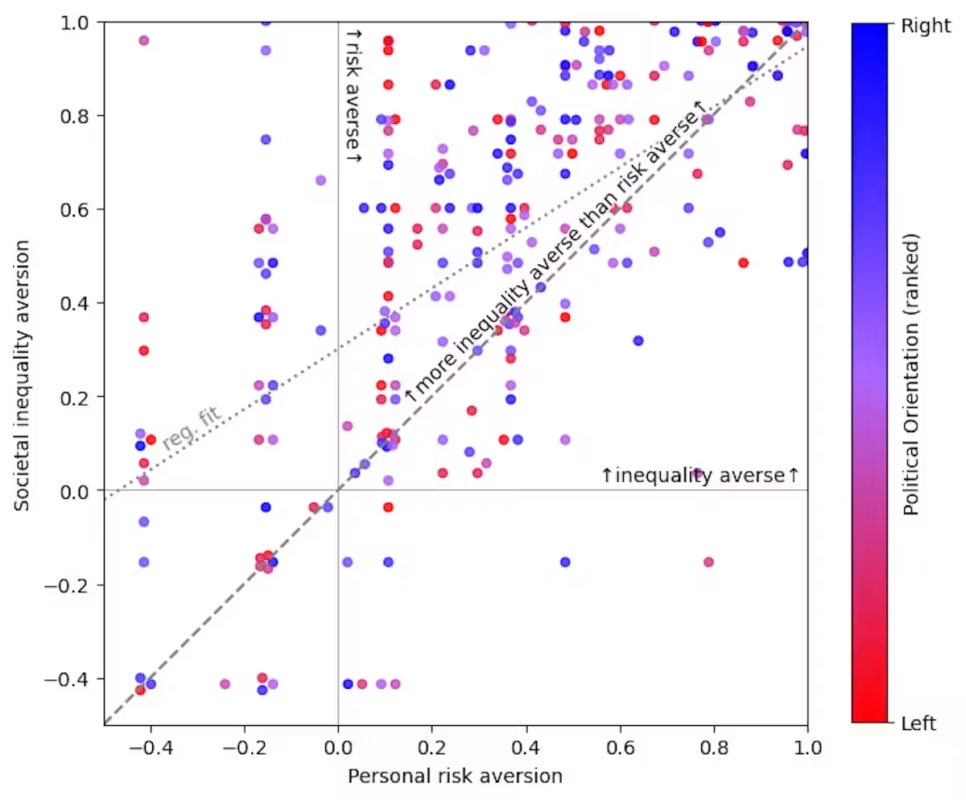
The promising part is that these differences do not appear to be political. In our sample of the UK population, the gambles people accepted on behalf of both themselves and others had surprisingly little to do with how they voted, or with their broader political views. In this sense, the model captures something we might describe as a common empathy.
This challenges a familiar narrative. Inequality is often framed as a political divide, with the left emphasising redistribution and fairness and the right focusing on incentives and individual reward.
But when we look at outcomes – how well people’s lives actually go – there is far more agreement than you might expect. The disagreement may lie less in what people want, and more in how they think it can be achieved.
This article was first published on The Conversation

Support our Nation today
For the price of a cup of coffee a month you can help us create an independent, not-for-profit, national news service for the people of Wales, by the people of Wales.
Get more trusted Welsh news
Choose Nation.Cymru as a preferred source in Google News to see more of our journalism.


