


My year of learning Welsh: Less is sometimes more

Ella Groves
As we break free of the cold winter months and move slowly into Spring, what better time to learn a new language than the season of new beginnings.
This past month of my Welsh learning journey has had both ups and downs, but despite my many mistakes I’ve kept going and kept learning.
So with another month under my belt, I’ve got more language learning tips and tricks to share with you all.
‘Progress’
The beginning of March marks the start of my third month of committing to learning Welsh in 2026.
Whilst some days have been more successful than others, I can really see the difference these last few months have made to my Welsh skills.
I must make an admission, however. As work and life have got busier, I’ve dropped my original aim of 30 minutes a day to just 15 minutes a day but surprisingly this has made a big difference to my productivity.
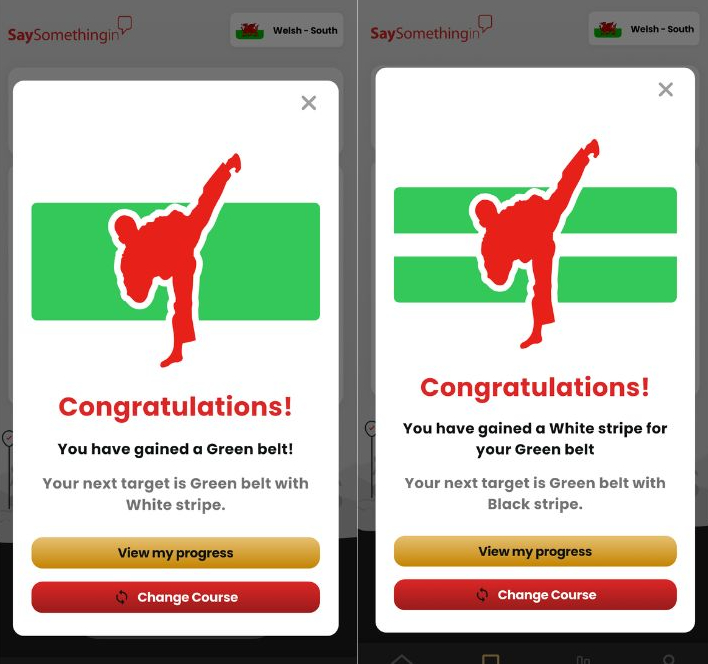
Setting myself a lower goal has made it feel more achievable and as such the number of days where I’ve practised Welsh has actually increased.
I have also noticed that I rarely stop after 15 minutes and often continue to practice for 20 or 30 minutes anyway, but the lower goal makes it considerably less daunting to just get started.
Throughout the different levels or stages (known as belts), SaySomethingIn provides regular ‘learning breaks’ during which you hear more about the SaySomethingIn method, language acquisition, and different brain functions.
The idea is that if you understand how your brain is learning you will feel more confident in your ability to learn.
A tip shared in one of the learning breaks in the green belt was to say five sentences out loud in Welsh every day as well as practising on the app.
The regular repetition of basic sentence patterns will increase your confidence in your spoken Welsh abilities.
To ensure you continue to say the five sentences daily, the app suggested habit stacking – a behaviour-change technique that links a new, desired habit to an existing routine.
For example, saying five sentences in Welsh every morning after you brush your teeth. The idea is that if you combine the habit with something you already do without thinking, it will become second nature and you will maintain the habit.
‘Dysgu Cymraeg’
Whilst SaySomethingIn is excellent at helping you build your Welsh skills, perhaps one of the most difficult things for a Welsh learner is finding places (and the confidence) to speak Welsh in daily life.
I, like so many of us in Wales, do not come from a Welsh speaking family. I went to an English medium school in which I was one of only 7 pupils in my year to take a Welsh GCSE meaning I also have few Welsh speaking friends.
All in all this means I have very limited opportunities to speak Welsh in my day to day life.
So, as part of my Welsh learning journey I have been attending Dysgu Cymraeg classes once a week alongside learning on the Say Something In app.
The classes have around 20 people of all different ages and backgrounds, making it the perfect opportunity to practice conversational Welsh.
But if you don’t have the time, energy, or desire to attend evening classes don’t worry – there’s plenty of ways to consolidate your language learning without even leaving the house.
‘Television’
Last month, I talked about how music can play an central role in language acquisition
Music is sometimes seen as a more practical way to immerse yourself in a language than television.
It is far more portable, you can enjoy music on your commute, whilst exercising, or whilst working, but watching television in your target language? Well that requires slightly more commitment, it requires the time to sit down and focus and understand what is going on.
But watching media in your target language can make a real difference to the speed of your learning.
Whilst I haven’t quite got the confidence in my Welsh skills yet to brave watching S4C classics such as Pobl y Cwm, I have tried to incorporate some Welsh language telly into my life this month and what better way to do that than with the Six Nations.

Now, I must admit, there are two reasons for my watching of the Wales fixtures on S4C. It is of course an excellent opportunity to practice my Welsh skills – but it also means I can avoid the terrible mid-game ads ITV have decided to add in.
Watching sports in your target language is an effective way to better both your listening and understanding skills.
As you likely already understand what is happening within the game without the commentary, you can use your knowledge of the sport and the active visual context of the game to work out what is being said. This, in turn, allows you to strengthen your understanding of spoken language.
Sports commentary is also largely very repetitive by nature, making it an ideal way to pick up some new vocabulary – with hardly any effort at all!
‘What next?’
Well this is my last article covering my Welsh learning journey here at Nation Cymru – but don’t fret, I’ll be continuing on with my learning – and so should you.
My goals for the next few months are simply to keep using the SaySomethingIn app every day whether that be for 15 minutes, 30 minutes, or even a full hour, and attend Dysgu Cymraeg classes once a week.
My goal for the end of the year however is slightly bigger, by 2027 I want to be able to speak Welsh confidently in public.
So take all my tips and tricks and get out there and learn some Welsh, it’s not as hard as you might think – pob lwc!
You can see my previous articles covering my Welsh learning journey here and here.
Support our Nation today
For the price of a cup of coffee a month you can help us create an independent, not-for-profit, national news service for the people of Wales, by the people of Wales.



I’ve been learning Cymraeg all my life and have failed spectacularly so good luck to Ela and all Welsh learners, you have my total respect and admiration. I have noticed a reluctance with my grandchildren to speak the language( they are 1st language speakers) I asked them to speak Welsh to each other the other day and the response was’ but vamps we aren’t in school🥴 We need to get children off this thought process