


New polling: Reform is winning over Christian support
Stuart Fox, Senior Lecturer in Politics, University of Exeter
When we look at how people vote in elections and why they choose certain parties, analysis often focuses on age, education, location or socioeconomic status. Less discussed in Britain is religion. But close to two-thirds of its adults are still religious – expressing either a religious identity, holding religious beliefs, or taking part in religious activities.
For the one-in-three adults in Britain who are Christian, this identity remains an important influence on their political behaviour. New polling, published here for the first time, shows how Reform UK is disrupting our previous understanding of how Christians vote in British elections.
The relationship between Britain’s Christian communities and the major political parties goes back centuries. The Conservative party has been very close to English Anglicanism since its emergence in the mid-19th century. Catholics and free-church Protestants (such as Baptists and Methodists) have tended towards the Labour and Liberal/Liberal Democrat parties. Even as Britain has become more secular, these relationships have persisted.
Anglicans
Anglicans, for example, have tended to vote Conservative even when the party was in dire straits. In the 2024 election, 39% of Anglicans voted Tory even as the party’s national vote share fell to 24%.
Since the 1980s and particularly in elections since 2015, however, we have started to see changes to the Christian vote. The traditional Catholic attachment to Labour has deteriorated, as has Labour’s appeal to other Christian communities such as Baptists, Methodists and Presbyterians.
Instead, driven by the rising salience of social values (attitudes towards immigration, social change and national identity) as a determinant of political support, the socially conservative leanings of some Christians of all stripes has led to increased support for the Conservatives. And those who traditionally did so – the Anglicans – have become even more supportive. The result has been a steady coalescing of the Christian vote behind the Conservatives.
Realignment
But now, new polling by YouGov (on June 23-24 2025) for the University of Exeter reveals that this realignment is being disrupted by the growing popularity of Reform UK.
Instead of asking who people would vote for tomorrow, a nationally representative sample of 2,284 adults was asked how likely they were to ever vote for each major party, on a scale from zero (very unlikely) to ten (very likely).
While not the same as a direct question about how someone would vote in an election, the likelihood question provides a much richer measure of the strength of their support for all of the major parties.
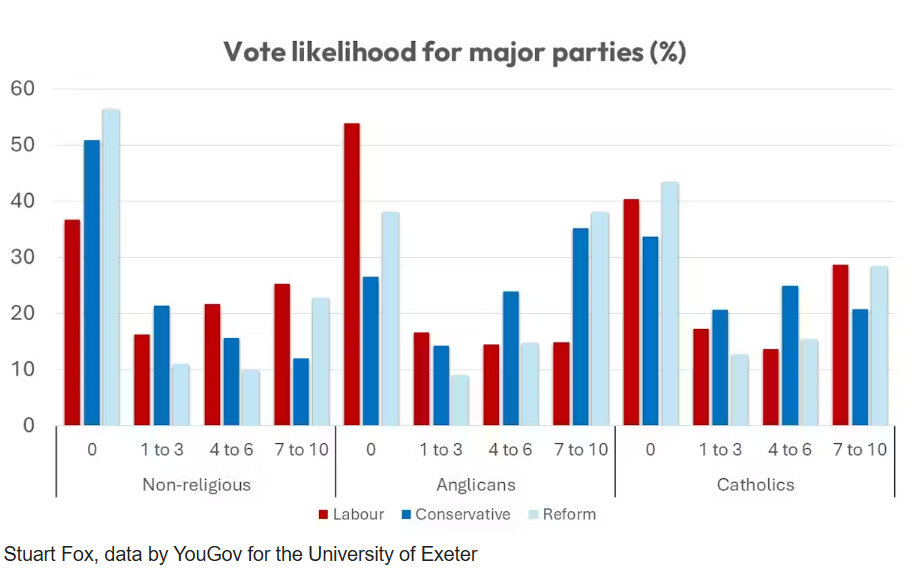
Among Anglicans, Labour remains deeply unpopular: over half gave the party a 0. In contrast, the Conservatives still enjoy strong support among Anglicans, with 35% giving them a vote likelihood of seven or higher – the kind of support associated with voting for the party in an election.
Reform, however, has caught up. Despite only 15% of Anglicans voting Reform in 2024, 38% now rate their likelihood of voting for the party as high. That’s the same as the proportion who are strongly opposed to Reform – showing that while the party polarises Anglicans more than the Conservatives, Reform could win as much Anglican support as the Tories in an election.
Catholics show a similar trend. Labour’s traditional support is eroding: 40% of Catholics said they had zero likelihood of voting Labour, while 29% are strong supporters. As with Conservatives for the Anglican vote, Reform is almost level-pegging with Labour for the Catholic vote at 28%. It has even supplanted the Conservatives, of whom 22% of Catholics are strong supporters.
It is not yet clear why this is happening. The distinction of Christian (and non-Christian) voting patterns is not an artefact of age – there are many studies that prove this is the case.
It may be that Reform’s stances on issues such as immigration resonate with Christians’ concerns to the extent that they are willing to set aside their historic party loyalties. Or it may be that Christians are as prone as other British voters to turn to Reform out of frustration with the performances of Labour and the Conservatives in office.
Swing voters and party competition
This data also shows the extent to which voters’ support for parties overlaps or is exclusive. In other words, which voters have a high vote likelihood for only one party (and so are likely committed to backing that party in an election), which do not have such high likelihoods for any party (and so will probably not vote at all), and which have similarly high likelihoods for more than one party (effectively swing voters, persuadable one way or the other).
Among the religiously unaffiliated, 29% aren’t strong supporters of any party. For Catholics, it’s 26%. Anglicans are more politically anchored, however, with only 20% in this category.
While traditionally, we would have expected this to reflect Anglicans’ greater tendency to support the Tories, only 17% of Anglicans are strong supporters of only that party, compared with 21% who are firmly behind Reform. These aren’t swing voters; they’ve switched sides.
A further 12% of Anglicans have high vote likelihoods for both the Tories and Reform. These are swing voters that the two parties could realistically expect to win over.
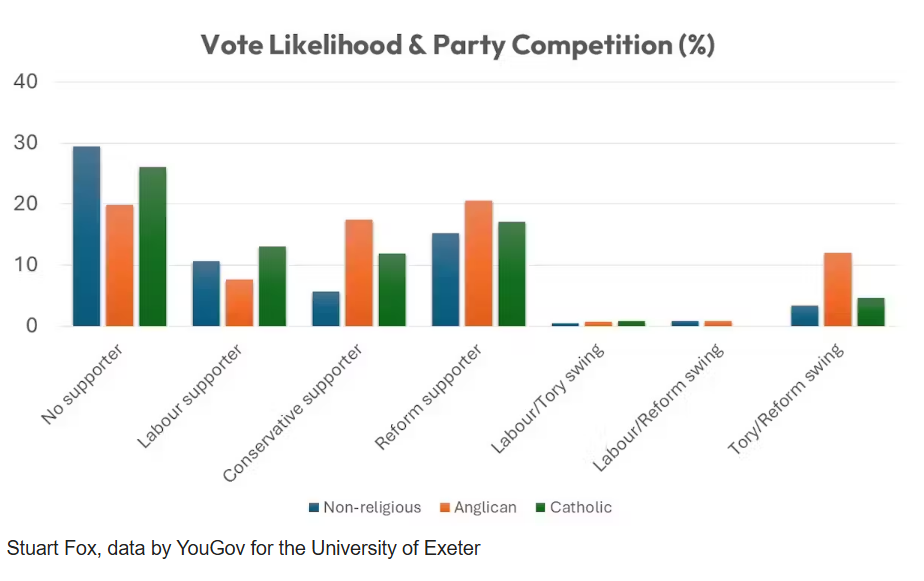 Catholics are even more fragmented. Only 13% are strong supporters of Labour alone, along with 12% and 17% who are strong supporters of the Conservatives and Reform alone, respectively.
Few Catholics are torn between Labour and the other parties, but 5% are swing voters between the Conservatives and Reform: the Tories’ gradual winning over of Catholics over the last 50 years is also being challenged by the appeal of Reform.
The party has provided a socially conservative alternative to the Conservatives, with the result that the Christian vote has become more fragmented. The Tories are no longer the main beneficiaries of Labour’s loss of its traditional Catholic vote.
In addition, Reform is as popular as the Conservatives among Anglicans, and as popular as Labour among Catholics. This suggests it is appealing across the traditional denominational divide more successfully than either of the major parties.
If there is to be a single party that attracts the bulk of Britain’s Christian support, at this point it is far more likely to be Reform than anyone else.
This article was first published on The Conversation

Support our Nation today
For the price of a cup of coffee a month you can help us create an independent, not-for-profit, national news service for the people of Wales, by the people of Wales.



How did trump get to power, what was one of his tools, oh yeah, mobilise the religious (preferably white).
People don’t seem to be paying attention.
I remember the Monica Lewinsky scandal in the late 90s? Those Christian fundamentalists who were demanding that Clinton be removed from Office today are now bending over backwards to defend Trump’s behaviour
Keep an eye on what happens to Maxwell and the files. That is how far the religious right are prepared to forgive in the US (and the convictions of some of those religious recently are quite horrifying).
Expect the same support here, tis why fartage courts them. Its why farage and tice rolled out “christian forgiveness” for an MP that gave a girlfriend a kicking but only balked when other issues arose.
Odd. The (true) Christians I know are all Greens or Plaid Cymru. If you take Christ’s message of care for others – for all others – then you could not possibly vote for the Faragists (nor Badenoch’s lot)
I guess pretend Christians might vote for a Party with a pretend politician leading it.
This is ironic. Either these are fairweather Christians or they do not know their own scripture. Nigel Farage and Reform UK attack asylum seekers fleeing war and persecution. Is overtly Islamophobic. Also , Reform under another name (s) Brexit Party & UKip were hostile to European Union and those nation states within My I remind them of their own teachings. In fact, they are going against them. Leviticus 19:18: “Love thy neighbour.” Deuteronomy 15:11: “‘Open your hand to the poor and needy neighbour in your land.” Psalm 82:3-4: Calls for the protection of the vulnerable and oppressed. Matthew 7:15: “Beware… Read more »
How anyone can profess to be a Christian and be a member of Reform is, if you’ll pardon the pun, beyond belief.
Christ’s parable of the Good Samaritan should be enough to question Farage’s vilification of asylum seekers and refugees.
Church and state should remain separate. If people want to live in a Christian fundamentalist society then go live in the American Bible Belt.
Flawed data, based on the presumption of ‘Britishness’ . ( middle england)
Christians are such hypocrits
Not all Christians, there are genuine ones who do have the interests of Humanity at Heart and do allot of good work helping to transform the lives of the less well off in society and those struggling with addictions.
Yet I do know where you are coming from, Unfortunately there’s a large number of Right Wing even Far Right Evangelical Fundamentalists who detest people who don’t have the same mindset as themselves.
Let’s hope that those Christians planning to vote Reform will take note of Farage’s latest plan to repeal the Online Safety Act putting our children at risk.
They are so blinkered in their hatred for people like me, they won’t notice anything else.
I suspect that the only really ideologically committed Christians likely to be drawn to Farage’s squalid politics are a segment of the fundamentalist protestant evangelical variety, who are dim and credulous enough to buy any glib preacher’s ignorant blatherings.
Look up James Orr.
Hearty thanks for pointing me towards that: I studied theology for my degree back in my idealistic youth; but that was sixty years ago, long before Dr Orr was born, and until you gave me the steer I hadn’t heard of him. I see that he’s a career academic philosopher, with a particular interest in Heidegger and Edith Stein. My experience of philosophy academics from my university days is admittedly limited, but, such as it is, it’s led me to suspect that their commitment to faith is generally and primarily – shall I say? – intellectually speculative, way more than… Read more »
US representatives visiting the Commons have a falling out with Farage. They labelled him “Unhinged” and “like a giant man baby” when farage does his usual when trump was brought up. Farage don’t like talking about trump. There was more as well.