


Norman Mania
Desmond Clifford
A story did the rounds at my school. An exam question asked: who was the first Norman king? Someone is supposed to have answered, “Norman I”. It’s just about plausible but could have been a joke – I never really found out.
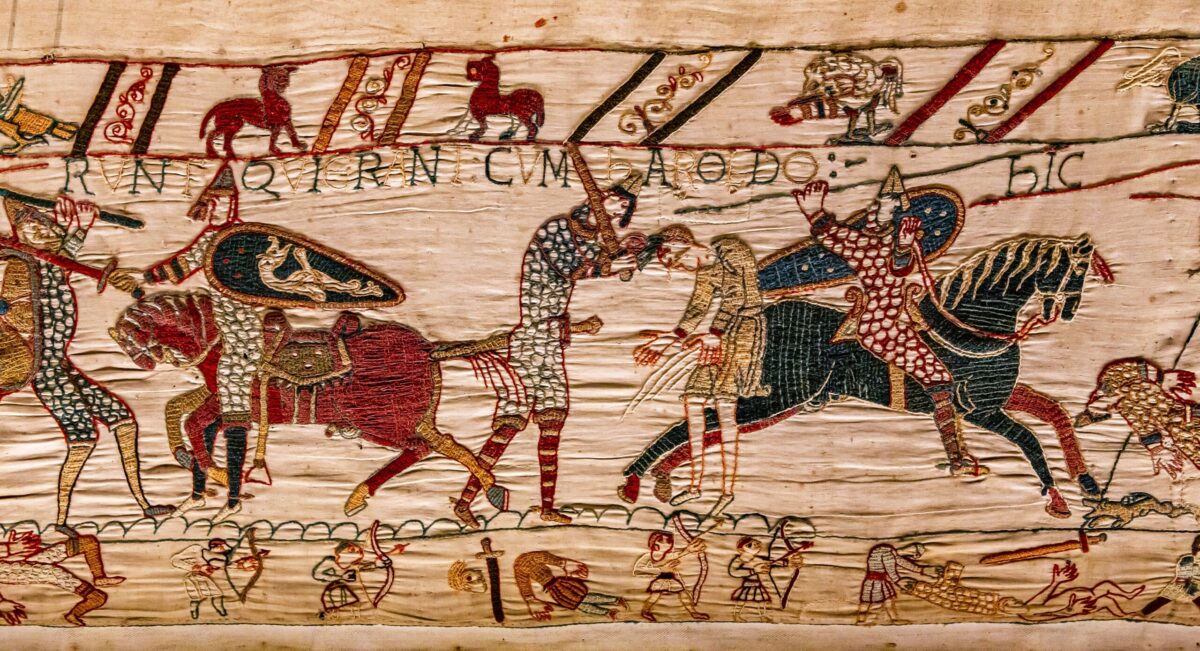
The Bayeaux Tapestry exhibition in London has driven the UK media into a Norman frenzy. The tapestry is back in England after nearly a thousand years.
It was embroidered by nuns in Canterbury and then taken to Normandy where it has remained ever since. It is propaganda rather than history and shows the story of the invasion from the Norman point of view.
The most famous tableau, the one that appears in all the history books, showing King Harold with an arrow in his eye, was, apparently, added later to provide a fittingly dramatic denouement to the battle. Many historians are now doubtful about the arrow-in-the-eye; there’s seemingly little solid evidence for it.
I imagine tickets for the tapestry will be hard to get. Anyway, you can count me out. I saw it around 20 years ago in its normal location, a provincial museum in sleepy Bayeux. It was a Saturday morning, and I had the tapestry practically to myself. There was scarcely a single other visitor.
Amazing. It won’t be like that at the British Museum; expect hoopla-galore, if you’re going. I saw the tapestry at eye level; the British Museum is required to show it flat. It’s massive, about 70 metres long. Tickets cost £33, so that’s around 50p per metre, if it helps to think of it that way. Not cheap, but a football match costs about the same.
The Normans are a big deal here, but the French don’t seem to care too much about them. They see it all as Britain’s story, not theirs, even though William the Conqueror is buried in France, at Caen.
His grave is unremarkable but accounts of his death by fever are horrifying. Like Everyman in the morality play, he was deserted at the end by all his retainers. Then his putrefying body was held ransom and couldn’t be buried until his family handed over cash. A tough end, although William dished it out while he lived.
In his favour, the Conqueror was devoted to his wife, Matilda of Flanders, and had eyes for no one else – almost unheard of among medieval monarchs.
1066 is the seminal date in English history. I’ve never understood why lists of English kings and queens only count back until then. The English crown was unified under Athelstan in 927, and England was a united country, more or less, from then on.
The Saxons were soundly beaten by the Normans and written out of history into the bargain. It’s true what they say about history being written by the winners (which reminds me of my favourite Churchill attribution, “History will be kind to me, for I intend to write it”. He did, too).
If the UK media has gone overboard, in Wales there is a surprising dearth of interest. Surprising because, ultimately, it was the Normans who succeeded where the Saxons failed. The Saxons couldn’t seriously penetrate Wales and ended up building Offa’s Dyke to keep them out.
The Normans, on the other hand, cut a swathe across the country. William FitzOsbern began work on Chepstow castle as early as 1067. Within a couple of decades, the Normans had run riot through Wales, taking land, building castles, colonising, demanding tribute.
Prince Llewelyn
Classic Welsh history hangs an awful lot on 1282 and the defeat of Prince Llewelyn. In reality Welsh power, such as it was, had been broken long before. The Normans occupied the lands they thought were worth taking, the Marcher territories of Glamorgan and the borders. Welsh rulers were confined to hill fortresses and lands the Normans scarcely thought worth the cost of conquest in blood and treasure.
For the most part, Wales lacked central authority. Its lords were as likely to fight and betray each other as they were to fight the invaders. There were some exceptions. Lord Rhys, based at Dinefwr and Cardigan, emerged as a remarkable figure combining military prowess with diplomatic and political skills.
The basis of his power was his clear insight that the Normans couldn’t be defeated militarily and that the way to preserve freedom was to treat with the king, which Rhys did with great skill and success.
There was intermingling between the Norman and Welsh aristocracies. Gerald of Wales, born at Manorbier Castle, was of mixed Norman and Welsh descent. He was a cousin of Lord Rhys but spent much of his life as a trusted court advisor to the Norman king.
When Henry II ventured to Ireland for England’s first invasion, at the invitation of the Pope of all people, Gerald joined the mission. As a result, among Gerald’s remarkable achievements were the first books ever written about both Wales and Ireland.
Influence
The Norman influence across Wales is massive. They built castles everywhere. The motte and bailey at Cardiff castle still stands. Had she but realised – perhaps she did – Katy Perry gazed upon the Conqueror’s work during her summer concert in Cardiff.
The Conqueror’s son, Robert Curthose, was imprisoned in Cardiff castle, an episode captured on the décor on the wall of the banquet hall.
The Norman conquest of Britain was complete. Just a few thousand Normans subdued a massively bigger Anglo-Saxon population and codified their new assets in the remarkable Doomsday Book.
When he’d finished in Wales, Edward I, still speaking Norman French, took war to Scotland. His gravestone calls him “Hammer of the Scots”, and he was the first king to unify all of Britain under a single crown, at least for a time.
A massive Norman building programme produced dozens of new cathedrals, churches and castles, and created the character of the country. Eventually Norman French mixed with Anglo-Saxon to form a newly-minted language, English, which from these obscure roots, came to dominate the world.
The Welsh language had already been influenced by Latin and was, in turn, influenced by English, as it continues to be.
Norman French
George Orwell reckoned there was great distinction to be made between words of Saxon origin and those of Norman French origin. He favoured the Saxon. When a UK parliamentary bill becomes law, the Clerk in the House of Lords declares “Le Roy le vault”, the King wills it – one of the last remaining usages of Norman French in official British life. Fortunately, this is one practice that wasn’t transferred to Cardiff with devolution.
The Normans were brilliant, bold, brutish and cultured. Their invasion created an English consciousness and established England’s domination of the British islands. In time that had implications for Wales, as well as Scotland and Ireland. We still live with the consequences.
It pointed England definitively towards the south-east, France and continental Europe. Previously the northern sea lanes traversed by the Anglo-Saxons were at least as important; gradually Britain lost its Scandinavian character.
The Normans began the long integration of Wales into England with those confusions of identity which confuse still.
Support our Nation today
For the price of a cup of coffee a month you can help us create an independent, not-for-profit, national news service for the people of Wales, by the people of Wales.
Get more trusted Welsh news
Choose Nation.Cymru as a preferred source in Google News to see more of our journalism.



Although it is fascinating to see the Bayeux Tapestry on loan from France after nearly a thousand years, the truth is that it has nothing to do with Wales: it is a work created by Anglo-Saxon (Germanic) embroiderers in England for the Norman French, celebrating their victory in 1066—just three years after the English king Harold Godwinson invaded Wales and was responsible for the murder of the Welsh king Gruffydd ap Llywelyn, an act of terror that destroyed Welsh unity. Thereafter, Wales suffered numerous attacks until Edward I’s incursion in 1283 and his subsequent “iron ring” of castles, which established… Read more »
Think it was a bit more complicated than Harold Godwinson invading Wales. Gruffydd was allied with Ælfgar of Mercia (in an anti-Godwinson alliance) and Echmarcach of Dublin. Gruffydd put out all the other dynasties when he conquered Wales and think we all can agree that they had every right to challenge him. Problem was. Echmarcach was ousted from Dublin and Harold Godwinson and Cynan ap Iago (father of G. ap Cyan) both ended up in exile there under the Ard Rí, Diarmait mac Máel na mBó. Alliances were obviously formed and some sources say it was Cynan who landed the… Read more »
Sorry, but it was Gruffudd ap Cynan’s father Cynan ab Iago who murdered Gruffudd ap Llywelyn — not the Godwinsons!
As someone curious about Welsh history but largely ignorant of it, I was curious what you think to the theory of an ancient Welsh fort having been based on the top of the wrekin in Shropshire?
Gerald went to Ireland in 1185 with John. Not with Henry II. He’s actually known to have been in Paris until 1174.
He doesn’t seem to have ever had a wide dislike for foreigners. Just the Irish. When Archdeacon of Brecon there were Irish settled over the border in the Cantref Mawr and likely Gaels in his cousins court. That and one of the de Barrys was married off to Diarmait MacMurchada’s younger, cleverer, brother Murchad.
There is no evidence that the Bayeux Tapestry has any association with Canterbury. The theory was that Williams cleric, Bishop Odo of Bayeux, who was subsequently made Earl of Kent for a brief period, commissioned it. However, he was imprisoned in 1076 for embezzlement. Most historians now suggest that the purpose of the tapestry was to glorify the successful invasion amongst the nobles of Normandy who funded the expedition and prove that William was now the legitimate King of England. To ‘win the north’. Evidence suggests that it was Edith Godwinson, the wife of King Harold who commissioned it, on… Read more »
I think you’ll find the Welsh kingdoms before the Normans were tributary to the Anglo-Saxon kings for many hundreds of years beforehand, and the dyke of Offa may have been built to act as a place where Welsh could meet with English taxmen. There is a tenth century poem, the Armes Prydein, complaining of this situation! Only Gruffudd ap Llywelyn’s career broke this trend.
And the name is Llywelyn ap Gruffudd, not ‘Prince Llewelyn’ [sic]! Give me a break!
The article suggests that Normans and Welsh intermarried and formed a CambroNorman elite. This did not happen and the incomers remained hostile to the natives up to and including Edward I. In Ireland a HibernoNorman elite did develop and became known as the Old English. This was no doubt due to the Norman failure to conquer the entire island and the distance of the settlers from the centre of English power.