


‘Now in a minute’: Oxford English Dictionary adds new words from Wales
Stephen Price
Six new Welsh words have made it into the latest update of the Oxford English Dictionary – including a creature from Welsh folklore and a phrase many of us have been mocked for using.
The Oxford English Dictionary (OED) is widely regarded as the accepted authority on the English language, providing an unsurpassed guide to the meaning, history, and usage of 500,000 words and phrases past and present, from across the English-speaking world.
As a historical dictionary, the OED is very different from dictionaries of current English, in which the focus is on present-day meanings.
You’ll still find present-day meanings in the OED, but you’ll also find the history of individual words, sometimes from as far back as the 11th century, and of the language—traced through 3.5 million quotations, from classic literature and specialist periodicals to film scripts, song lyrics, and social media posts.
A word will be considered for inclusion in the OED when we have gathered independent examples from a good variety of sources, and evidence that the word has been in use for a reasonable amount of time.
The oldest word from Wales in this update is a Welsh English word borrowed from the Welsh language.
Dating as far back as 1724, Bwbach is the name of a creature in Welsh folklore: a benevolent, though sometimes mischievous, spirit resembling a goblin, which inhabits homes and farm buildings and helps with household tasks and other work.
A couple of phrases in this batch also show the influence of Welsh on Welsh English, even though they consist entirely of English elements. To be in one’s oils(1900), a colloquial expression used in Wales and in northern and south-western England, means ‘to be at ease, comfortable, in one’s element’.
It is apparently modelled after the Welsh phrase yn ei hwyliau, frequent variant of yn ei hwyl, ‘in good form, in a good mood’, with alteration within English by association with oils.
The seemingly contradictory (and widely mocked) phrase now in a minute, used in Irish as well as Welsh English to mean ‘in a moment, very soon, before long’, follows the construction of similar Welsh phrases nawr mewn munud (nawr ‘now’, mewn ‘in’, munud ‘minute’) and mewn munud yn awr (yn awr ‘now’).
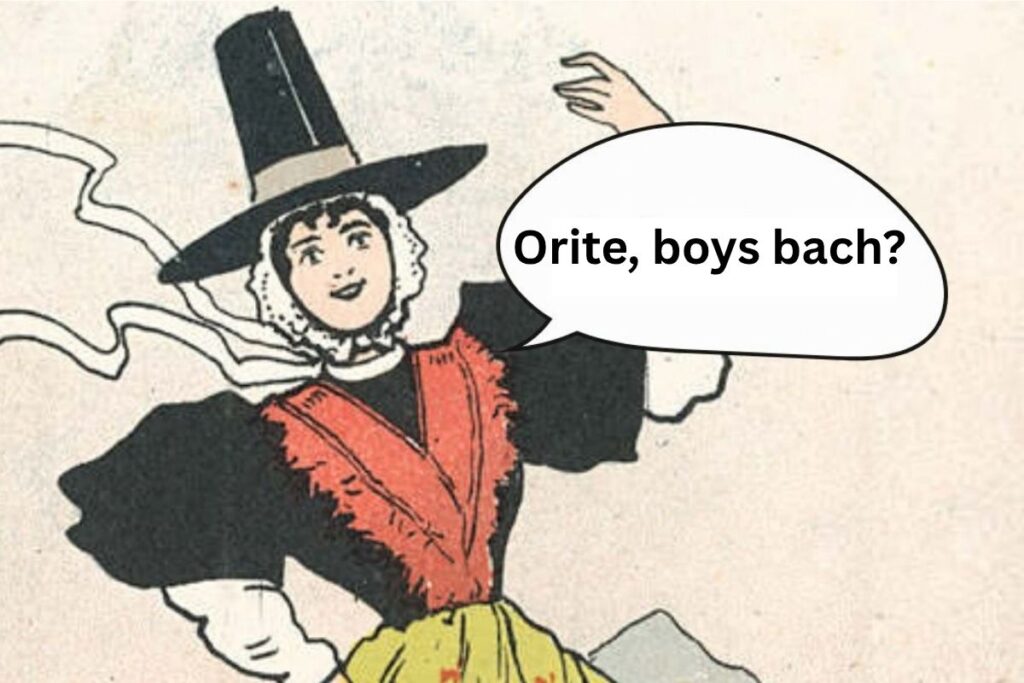
Bachgen, first attested in 1888, is a Welsh English word for ‘boy’ which is also used as a term of endearment. Boys bach, also from the late 19th century, is a familiar form of address to a group of men or a mixed group of people, which from the early 20th century has also been used as an exclamation of surprise or dismay, equivalent to ‘my goodness!’ or ‘good grief!’. Another Welsh loan word, twpsyn, dating to 1941, refers to an idiot or a fool.
The full list of Welsh English words added in this update is as follows:
New words:
- bachgen, n.
- boys bach, n. and int.
- Bwbach, n.
- in one’s oils, phrase in oil, n.1
- now in a minute, phrase in minute, n.1
- twpsyn, n.
Revised entries:
- ap, n.
- braggot, n.
- coracle, n.
- coracler, n.
- crwth, n.
- Cymric, adj.
- Cymricize, v.
- cynghanedd, n.
- cywydd, n.
- eisteddfod, n.
- eisteddfodic, adj.
- englyn, n.
- flummery, n.
- Gorsedd, n.
- goryd, n.
- hwyl, n.
- keffel, n.
- listred, n.
- stethva, n.
- tallet, n.
- voel, n.
You can find out more about the OED’s new additions from Bermuda, the Caribbean, East Africa, New Zealand, and Wales in these World English release notes. For more information on World Englishes generally, visit the OED World English Hub. For more information on the broader update, check out these new words updatesand these revision notes.
You can also hear more about this update on the latest episode of the OED podcast Lexipoddery. Join editors Fiona McPherson and Craig Leyland as they dive into some of this quarter’s new additions, and hear from fellow editor Jonathan Dent about some of the newly revised entries.
Support our Nation today
For the price of a cup of coffee a month you can help us create an independent, not-for-profit, national news service for the people of Wales, by the people of Wales.
Get more trusted Welsh news
Choose Nation.Cymru as a preferred source in Google News to see more of our journalism.



Twpsyn must be older than 1941…
I do wonder how the OED does these things. Yes, coracle is an English word. From cwrwgl, clearly. I wonder if most of the others are not English words at all, just Welsh words which turned up in a passage of English. ‘Now in a minute’ is a phrase not a word. Is the OED for phrases? BTW, if you add a comma, ‘Now, in a minute’ is not a sign of deficient logic. Its a phrase, which I admit always makes me smile, which conveys, as English does not, the idea that I’d like it to be immediate, but… Read more »
They can add annibyniaeth soon
As they say in the valleys . . . Tidy like butt.