


Our police, their rules: The Welsh injustice.

Jibreel Meddah
It was a four-word answer that echoed across the floor of the House of Commons, reverberating all the way down the M4 to Cardiff Bay.
When asked if the major restructuring of UK policing was the right moment to finally devolve powers to Wales, Home Secretary Shabana Mahmood didn’t hesitate.
“No, I do not.”
With that blunt dismissal, the UK Labour government didn’t just shut down a request from Plaid Cymru. They humiliated their own colleagues in the Senedd.
It is February 2026, and Wales is still the constitutional anomaly of the British Isles, a nation with a parliament that can make laws but cannot police them.
For years, devolving policing was treated as a small bureaucratic change rather than a big political decision. But this month, it became personal for every taxpayer in Wales.
The announcement that Police and Crime Commissioners (PCCs) are to be abolished by 2028 has laid an uncomfortable truth. Under Westminster’s new plan, English regions will see power transferred to elected Mayors. However Wales will see power sent back to London.
We are witnessing a power grab dressed up as reform. And for a nation that now pays more for its policing than ever before, the question isn’t just “why not?” It is “how dare you?”
The incarceration trap
This lack of control isn’t just hurting Wales financially but destroying its potential too. In order to better understand why the current system is failing, you only need to look at the statistics that shame our nation.
For over a decade Wales has cemented its title as having the highest incarceration rate in Western Europe. We are locking up our population at a rate that outstrips England, France, and Germany. This isn’t because the Welsh are inherently more criminal; it is because the system we rely on is structurally flawed.
This is the sharp edge of a divided justice system. On one hand, the Welsh Government is responsible for social policy, things like housing, mental health and education. With these it takes a progressive, open-minded approach. Under its “trauma-informed” and “child first” model, teachers and social workers are trained to see troubled young people as children shaped by difficult experiences who need help and support.
But on the other side of the jagged edge lies the unforgiving justice system. The moment that same teenager enters a police station or a youth court, they step into a non-devolved world driven by Home Office targets that prioritise “tough on crime” metrics over rehabilitation.
The result is a fractured system. We have Welsh social services trying to pull young people out of the Taff, while a justice system run from Westminster risks pushing them back in.
Experts have long argued that if policing and youth justice were devolved, we could finally align the police, the courts, and social services into an integrated system that stops criminalising poverty and starts solving it.
The Council Tax trap
If the social case is compelling, the financial one is difficult to overlook. As households start preparing for their 2026/27 council tax payments, the harsh reality of the settlement is becoming clear.
In north Wales alone, the police precept has risen by over 7.5% this year. Across the nation, Welsh taxpayers and the Welsh Government now contribute roughly half of the total funding for our four police forces. Meaning we are no longer passive spectators on the sidelines; we are team members. Yet, we have no say in the game plan.
Plaid Cymru’s Liz Saville Roberts MP captured the mood perfectly in the Commons last week, accusing the UK government of ignoring the “fragmented, haphazard nature” of the current setup. Her argument is simple: if we pay for it, we should control it.
“It is constitutionally illiterate,” Saville Roberts argued, “that a Labour First Minister in Cardiff calls for these powers, three independent commissions recommend them, and yet a Labour Home Secretary in London simply says ‘no’.”
The Labour ‘Civil War’
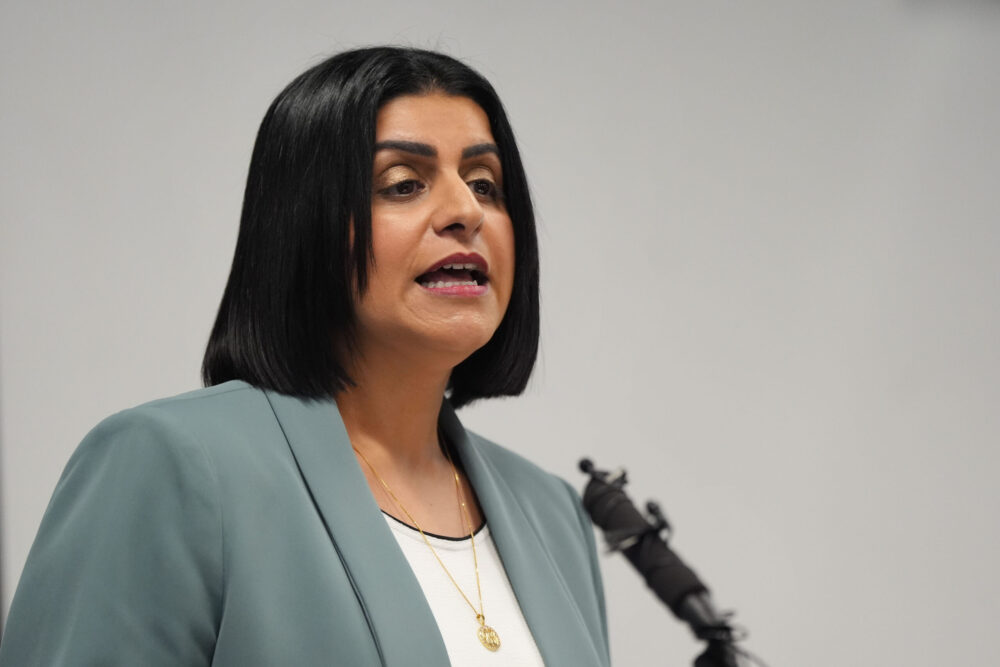
The political optics of this are disastrous for Welsh Labour. First Minister Eluned Morgan has been clear: she wants policing devolved. She knows that to deliver her government’s social justice agenda, she needs authority over the justice system.
However, her authority is being undermined by her own party in Westminster. When Shabana Mahmood rejects devolution, she isn’t just rejecting Plaid Cymru; she is telling the Welsh Labour government that they cannot be trusted with the keys to the squad car.
This friction was captured sharply by Plaid Cymru leader Rhun ap Iorwerth MS, who recently argued that the promised cooperation between the two governments has failed to materialise.
“The ‘partnership in power’ that Eluned Morgan talks about is proving to be a partnership of silence,” he noted. “It is a one-way street where Wales gives and Westminster takes.”
The “betrayal,” as described by critics, is magnified by the impending abolition of PCCs.
In Greater Manchester, Mayor Andy Burnham will take charge of policing, integrating it with his transport and social policies.
In Wales, despite having a national government ready and willing to take responsibility, the Home Office intends to retain control. Indirectly stating that the Welsh government is less capable than an English city/region.
A Matter of Common Sense
The age-old arguments against devolution (usually citing cross-border crime or cost) are melting away under scrutiny.
Scotland has managed its own police force for decades, seamlessly cooperating with English forces.
Northern Ireland, with its complex security border and religious tensions, manages its own policing.
Claims that devolving justice would isolate Dyfed-Powys Police from its neighbours are overstated.
Forces already collaborate across borders every day, and reporting to a minister in Cardiff wouldn’t suddenly sever those vital connections.
“It is common sense,” says Adam Price MS. “Decisions on the health, education, and economic services provided to those within the justice system are made in Wales. Yet Labour believes decisions on the justice system itself should be made in England. It is a system designed to fail.”
The human cost
This isn’t about politicians arguing in a chamber. It’s about the victims of crime who get lost in the gaps between devolved support services and London-run justice systems. It’s about the young people in our valleys who are criminalised by a system that doesn’t understand their community, rather than supported by one that does.
In 2026, the data is clear: non-devolved policing is bleeding resources and failing communities. The Welsh public is paying a premium for a service they cannot hold to account. While the UK Government is actively choosing to centralise power rather than respect the democratic maturity of Wales.
The rejection of devolved policing is no longer just a constitutional grievance; it is a practical barrier to making Wales safer.
As we look towards the abolition of PCCs in 2028, we must draw a line in the sand. Wales doesn’t need an English Home Secretary in Westminster deciding our local policing priorities. We need a system that answers to us.
We are paying for the car. It’s time we were allowed to drive it.
Support our Nation today
For the price of a cup of coffee a month you can help us create an independent, not-for-profit, national news service for the people of Wales, by the people of Wales.



Someone needs to hold Westminster to account over this. We as voters in Cymru/Wales need to send a clear mess to Westminster, devolved power or we leave. It’s as simple as that!
Wake up Wales, please wake up it’s time to end this colonisation of our country
As a supporter of devolution this bureaucratic doubling up really ruins it for me, and with all the associated costs that would be better spent on services. We don’t need everything doubled up and devolved – only truly regional matters. They are debating the Assisted Dying bill in the Senedd at the moment. This is not a Welsh specific issue. Its a moral one for society as a whole. Imagine if they decided differently and a kinder death became a cross border travel thing. I find it such a turn off as we expand to 96 MS and spend £4m… Read more »