


Pride Month: The controversial 1932 novel The Summer Flood

Norena Shopland
When Goronwy Rees (1909–1979) published his novel The Summer Flood in 1932 it disappeared almost immediately, and original copies are rarer than hen’s teeth.
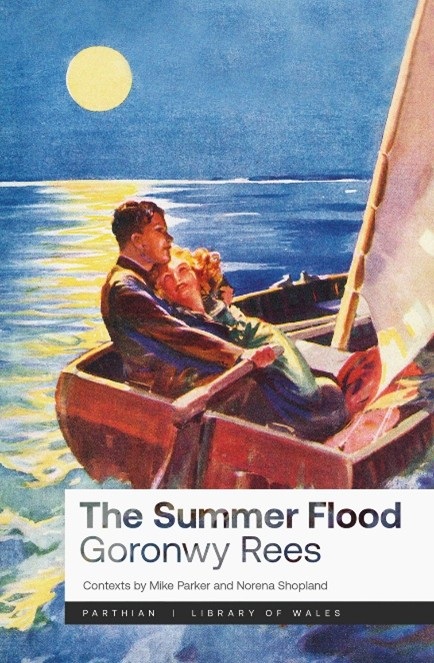
Now, Parthian Books are republishing what has turned out to be an important work in queer literature.
Goronwy’s fame in LGBTQ+ history rests mainly with his influential role on the Wolfenden Report (1957) that saw the partial decriminalisation of male homosexuality.
Described as the most liberal thinker on the committee, he persuaded a reluctant chair of the committee, John Wolfenden (1906–1985), to discuss the report with homosexual men.
Wolfenden had been reluctant to do so because being homosexual was against the law, so the men were essentially criminals. However, Goronwy insisted they should be included. A risky move, Alan Turin had been convicted in 1952 when he told police he was homosexual, yet the men were swayed by Goronwy’s arguments.
Scandal
However, even before the report was completed Goronwy had been removed from the committee due to a scandal.
A series of articles appeared in The People about the spy Guy Burgess, written by a ‘most intimate friend.’ Goronwy did not put his name to the articles, and when discovered he was disgraced due to the content.
Why he did such a foolish thing is a mystery, but possibly he was trying to distance himself from his friendship with Guy, and from accusations of homosexuality. Accusations which would have some merit.
When Goronwy wrote his first novel in 1932, he was 23 and at Oxford where he began his friendship with Guy. There, he had a relationship with Alexander “Hamish” St Clair-Erskine (1909-1973), the inspiration for the Sasha Matthews character in the novel.
Goronwy himself appears as the main character, Owen Morgan, who throughout the book struggles with his sexuality.
Having returned to his family home on the rural north coast of Wales for the summer, Owen recovers feelings he had for his cousin Nest, while trying to come to terms with conflicted desires. Never far away are his thoughts of Sasha.
When he pulls out an expensive cigarette case, too splendid for someone like Owen, ‘The impecunious Welsh of his own class neither bought, nor gave as presents, such expensive trifles,’ he is asked who gave it to him. Owen recalled Sasha’s voice on the night when he had pressed the gift upon Owen.
“My dear,” said Sasha, turning away from the flames that lit up his beautiful head, “you must take it. I got it for you and I want you to have it. It would be beastly of you to refuse it now.”
Secret
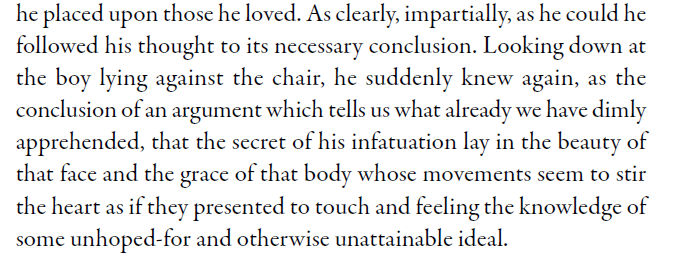
What secret was it, Owen had wondered then, that made all Sasha’s faults so irresistibly seductive and charming when combined in him?
Sasha leant his head against the side of the chair in which Owen sat, until Owen’s dangling finger-tips almost touched his smooth, blue-black hair. The spell of Sasha’s physical presence seemed to destroy all power of thought.
The handful of reviews generally praised the novel, and while some discuss the relationship with Nest, all ignored Sasha. Although there are hints, one writing the novel ‘defies analysis,’ another, ‘beneath the author’s marked restraint lie hidden fires.’
A reviewer, E.M.H. describing the miseries of being in love as ‘too complicated and too miserable, and the analysis of Owen’s state of mind wearies one a little … I found the book difficult to read here and there.’
The novel caused controversy within Goronwy’s family for including thinly disguised relatives in the plot, but why this book is so important is where it sits in queer literary history.
Numerous homoerotic books had been published worldwide during the nineteenth and early twentieth centuries, but most could not be considered openly homosexual.
Early novels containing male same-sex relationships or desire were, due to laws that criminalised male homosexuality and to societal attitudes, ambiguous and now require a ‘queer reading,’ the ability to move past the direct text and see a coded sub-context.
Of the more overt novels, these tend to be based on real people. In Oscar Wilde’s (1854–1900) The Picture of Dorian Gray (1890), the character of Lord Henry Wotton is based on Lord Ronald Sutherland Gower (1845-1916), and Wilde said Dorian Gray was what he would like to be.
In 1932 there were only a handful of these overt novels, including The Summer Flood, and so it gained an important place in the vanguard of openly ‘gay’ male novels.
Furthermore, given the protagonist’s desire for both men and women, the book is a rare and important example of a novel depicting bisexuality.
For more on Goronwy Rees see Forbidden Lives: LGBT stories from Wales (Seren Books, 2017). The Summer Flood, with context by Mike Parker and Norena Shopland, will be published by Parthian Books in the Library of Wales, July 2025.
Support our Nation today
For the price of a cup of coffee a month you can help us create an independent, not-for-profit, national news service for the people of Wales, by the people of Wales.


