


Rape of the Fair Country: A strange, beautiful and moving book
Chris Barber
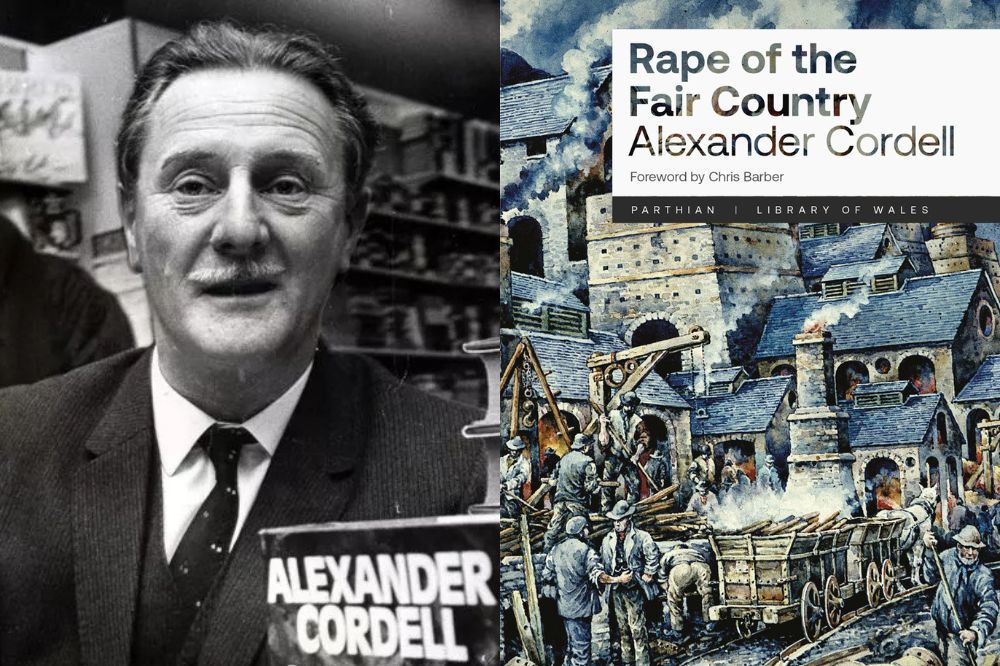
With Rape of the Fair Country returning to book stores from this weekend, publishers Parthian have kindly shared the foreword to the new edition written by Chris Barber, a friend and lifelong champion of Alexander Cordell.
Alexander Cordell was one of the most influential writers of his generation for his novels have given a great insight into the history of industrial Wales. No other writer has captured the atmosphere and spirit of the 19th century so well, because it was always his aim to make Welsh people proud of their turbulent past by bringing it vividly to life in his historical novels.
Cordell’s real name was George Alexander Graber, and he was born in Colombo, Sri Lanka, on 9th November 1914, the son of a regimental sergeant major in the Royal Engineers. He claimed his mother was from a Rhondda valley family. He was educated first at St Louis College, a Marist Brothers school at Tianjin in north-eastern China, with a private tutor, and at the University of Westminster, then known as the Royal Polytechnic Institution, London.
He followed his father into the army in 1932, when he joined the Royal Engineers, serving in the ranks. During the retreat of the British Expeditionary Force from Boulogne-Sur-Mer in 1940, he was seriously injured when hit by a bullet in the hip. Later in the war he was commissioned and given the rank of major and spent the rest of the war devising and testing special weapons for the D-Day landings.
His convalescence following his injury was spent at Harlech in north Wales where he quickly developed a love and fascination for the country and its people. He decided that when the war was over, he would like to work somewhere in Wales. After the war he was employed as a quantity surveyor with the Ministry of Public Buildings and Works in Shrewsbury. Then in 1950, when a vacancy arose in Wales he agreed to be transferred to Abergavenny.
Initially, he rented a cottage in Llanellen and it was there that he began writing short stories which were published under the name George Alexander Graber and sometimes Major George Graber. The pseudonym Cordell was initially used when his first novel, A Thought of Honour, based on his war experiences was published in 1954. This was because the publisher had felt that Graber was too Germanic and the Second World War was still a very bad memory.
The book did not sell very well, and one reviewer even commented: ‘Perhaps Mr Graber should write a novel about Wales, its custom and its people.’ These were prophetic words, for in the summer of 1957, Alex was riding his motor bike up the side of The Blorenge mountain on the road to Blaenavon. Captivated by the dramatic view, he stopped to look down on the beautiful Usk Valley and became puzzled by the sight of black material scarring the hillside below him. On seeing a postman pushing his bicycle up the road, he asked him what had happened at this location. With much feeling, the man replied that the land had been “raped” by industry, and that near this spot was the site of an iron works and a village called Garnddyrus where the workers once lived.
The idea came to Alex that here was a fascinating story just waiting to be told. He would write about the people who had laboured here in an industry that had now vanished. It would be the story of people who lived in Blaenavon and Garnddyrus during the Industrial Revolution.
In order to develop a writer’s ear for the Welsh Valley speech he used to go to Abergavenny market and listen to the women who came down on the train from Brynmawr and tried to tune in to their lilting musical accents. Their conversation was lively and even bawdy at times and this gave him inspiration for envisaging how the Welsh might have spoken in the time of which he would be writing.
In later years he commented: “I wrote the book at white heat, scarcely altering a chapter; in between spells of writing I studied at the University of Wales, Aberystwyth, and befriended every available librarian; more I suddenly discovered that hand in hand with the mountain town of Blaenafon, went the last bloody revolution in Britain, the Chartist Rebellion.”
His novel Rape of the Fair Country was published in January 1959 by Victor Gollancz and thanks to pre-publication reviews, it was an overnight success. Translated into seventeen languages it sold millions of copies. People as far away as America and Japan were now reading about Blaenavon, Garnddyrus and The Blorenge mountain, imagining the lives of Cordell’s colourful characters portrayed in his moving and powerful novel.
His next book was The Hosts of Rebecca which is set in Carmarthenshire at the time of the Rebecca Riots and this was followed by Song of the Earth, set in the Vale of Neath. in due course he completed this successful trilogy with a second Welsh trilogy: The Fire People (1972), This Sweet and Bitter Earth (1977) and Land of My Fathers (1983).
During his writing career Alexander Cordell wrote a total of thirty books, which were set in a variety of periods and locations, but his most popular novels are the ones describing the turbulent times of the Industrial Revolution in Wales, for that undoubtedly was his favoured subject. No other writer has managed to capture the atmosphere and spirit of that period so well.
Enduring
I first read Rape of the Fair Country just after it was published and the story has stayed in my mind ever since. It became an important part of my life, for twenty years later, I came to live in the village of Llanfoist which is situated beneath the majestic Blorenge mountain where much of the action takes place. I began to explore the local area, tramping the paths and old tramroads that steeply ascend and criss-cross The Blorenge. As I walked, I began to hear voices – no, I was not going mad – but imagining the characters in Rape of the Fair Country walking the same routes that I was following. On these bracken-clad slopes I found myself listening to the rumble of horse-drawn trams loaded with pig iron and limestone. Then standing on the site of Garnddyrus Forge I tried to imagine the whine of the rolling mill.
An idea was taking shape in my mind and having previously written some guidebooks to the Brecon Beacons National Park, I decided to write one describing walking routes on The Blorenge and the history of the surrounding area. At the same time, it would be appropriate to link it with locations in Cordell’s novel.
I wrote a letter to Alexander Cordell, who was living on the Isle of Man at that time, and put my idea to him, seeking his approval and permission to include some extracts from his novel. I tentatively suggested that I might call my book Cordell Country and would be most grateful if he could write the foreword. He replied, return of post, saying, “Yes, I like both the idea and the title. I will certainly write you a foreword and give you any help that I can.”
It took me three years to research and write the book and when I sent Alex a copy of my manuscript, he gave it his approval and sent me his foreword. The book was launched in July 1985 at the Angel Hotel in Abergavenny, with about one hundred guests present, including Alexander Cordell and his wife who had flown over from the Isle of Man specially for the occasion. To entertain my guests, I had put together an audio-visual presentation relating to the area that I had named Cordell Country. The atmosphere in the room was quite electric when the presentation finished, and Alex stood up to express his pleasure in returning to Abergavenny and how thrilled he was that this corner of Wales was to become known as Cordell Country for it marked a very important period in his life.
‘Cordell Country’ now became a tourist destination, just like ‘Shakespeare Country’, ‘Bronte Country’, ‘Wordsworth Country’ and ‘Thomas Hardy Country’. Visitors came from far and wide to walk in the footsteps of Cordell’s large than life characters and time and time again, the question was asked: “When are they going to make a film of this wonderful book?”
Alexander Cordell and his wife Donnie invited me to spend a long weekend with them at their home on the Isle of Man. I was delighted to receive his letter and because he had helped me create the book, I wanted to return the favour by doing something for him. One evening, after a meal, I began to outline a possible theme for his next novel. I suggested that he could write a prelude to Rape of the Fair Country and that a suitable title could be This Proud and Savage Land.
Alex was very enthusiastic about the idea and within a week he completed a draft synopsis and obtained a commission from his publisher to write the novel. During the next twelve months he made regular visits to Abergavenny, and we undertook numerous research trips, visiting locations that could be included in the plot. It was fascinating to work with this famous author and to be able to help him with his research by providing historical information. The novel was packed with many of the characters who had appeared in Rape of the Fair Country and an important theme of the book became the exploitation of child labour for Cordell wanted to portray the grim working conditions for young people of those times.
Sacrifice and courage
In October 1987, the Cardiff based Chrysalis Theatre Company premiered the first stage production of Rape of the Fair Country at the Newport Leisure Centre. I sat beside Alexander Cordell who watched the play with great delight and commented to me that, “The play is faithful to the book, and it is a tribute, not to our generation, but to the people of the past, who by their sacrifice and courage created the industrial greatness that is Wales today.”
A few days before the opening night, I had been asked to meet the cast near Garnddyrus and take them for a short walk in Cordell Country where the novel is set. It seemed uncanny to be walking around that historic landscape with fictitious characters from the book and it was an experience I will never forget.
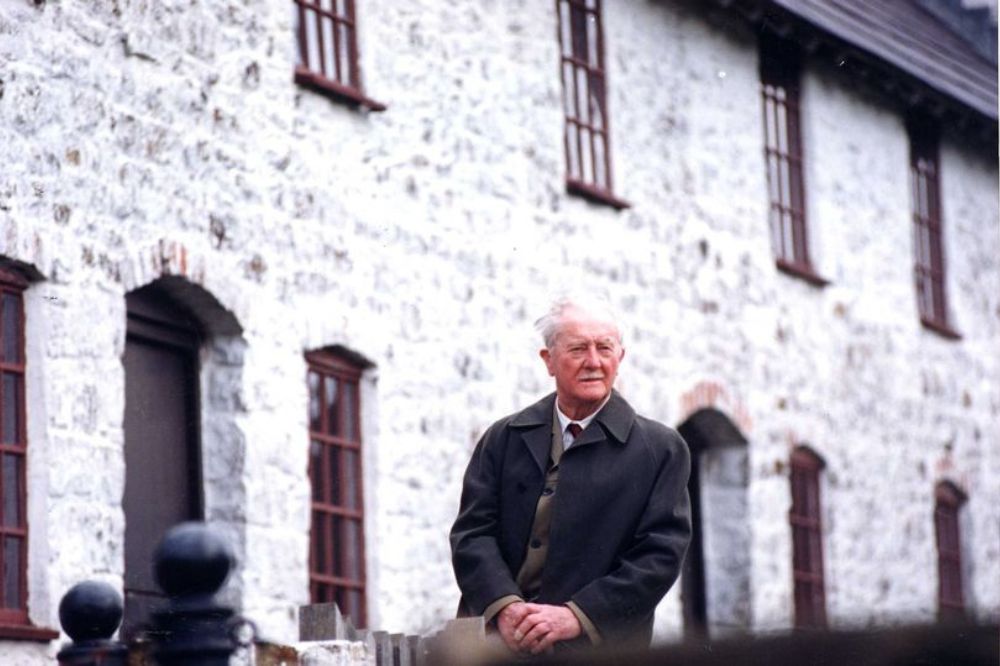
In 1997 Theatre Clwyd Cymru undertook the staging of not only Rape of the Fair Country, but also the two following novels in the trilogy, making it in one of the biggest theatrical enterprises ever attempted in Wales. All three performances received standing ovations and fantastic reviews. Alexander Cordell gave the idea his full blessing shortly before he died on the 2nd of July 1997, at the age of eighty-three.
He went missing from his home in Rhosddu, Wrexham, and it was not until eight days later that his body was found in a lonely spot near the Horseshoe Pass, Llangollen. A medical examination revealed that he had died of a heart attack. His ashes were buried in Llanfoist cemetery beside the graves of his two wives appropriately directly opposite The Blorenge mountain.
Following his death his books gradually became unavailable, and people began asking me where they could get hold of a copy of Rape of the Fair Country because they wanted to read it again. They usually told me how years ago they had loaned the book to a friend who had failed to return it. They could no longer find the novel in any bookshop.
The literary rights of his work are owned by his daughter who lives in Finland. I wrote to her saying that I would like to republish some of his books. She wrote back giving her permission and put me in touch with his London agent. I managed to persuade him to give me a contract for republishing Rape of the Fair Country in 1998, just under forty years after its first publication by Gollancz. In due course I was given permission to bring five other titles back into print, for I felt strongly that a new generation should have the opportunity to read these books.
It is important to understand that Rape of the Fair Country brought to people’s attention the historic importance of Blaenafon, and when Alexander Cordell sold the film rights to the book in 1960, the resultant publicity had the effect of saving the old ironworks and the cottages in nearby Stack Square from destruction. The Blaenafon Town Council decided that these crumbling ruins should not be bulldozed and levelled as part of their slum clearance scheme, but instead retained as a possible film set
Among the many offers were ones made by Stanley Baker and Lew Grade. The well-known actors Richard Burton, Sian Phillips, Hugh Griffiths, and even the singers Mary Hopkin and Tom Jones, despite their lack of acting experience, were suggested as likely stars, Sadly, the necessary finance was not forthcoming and none of these film proposals came to fruition.
This was a great disappointment to Alexander Cordell and it is surprising that it failed to happen during his lifetime, even though several attempts have been made during the last sixty years. Most people who have read the book would agree that it would prove a very popular and entertaining film, giving a great boost to tourism in Wales and a worthy tribute to Alexander Cordell.
World Heritage Site
When in the early 1990s some thought was being given to the possibility of the Blaenavon Industrial Landscape becoming a World Heritage Site, Cordell commented that if this could be achieved it would be a fitting epitaph to the people who died making this small town such an industrial giant. He remarked: ‘All that the people of the past have to commend them for the sacrifices they made, are the dirt monuments they left behind. That is why it is so incumbent on people with influence to sacrifice everything to get this done. There is no town which deserves it better than Blaenafon!’
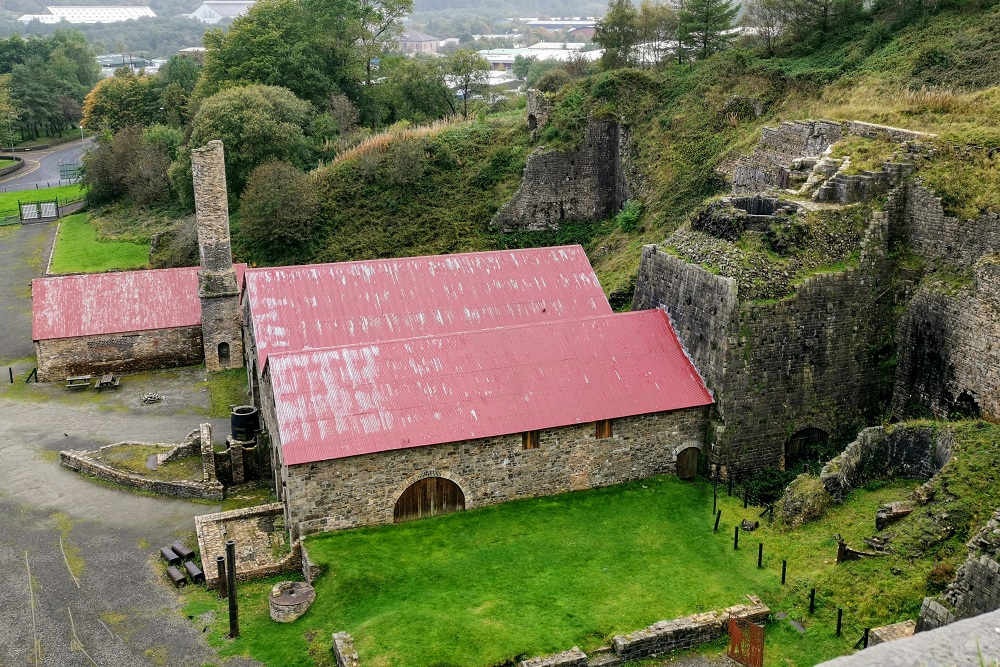
On 30 November 2000 at a meeting of the World Heritage Committee at Cairns in Australia, the ‘Blaenavon Industrial Landscape’ was inscribed as a World Heritage Site. In my opinion this is largely due to Cordell’s novel which helped to preserve the Blaenavon Ironworks which has been preserved and opened as a very important visitor attraction.
I kept Rape of the Fair Country in print as a Blorenge Books publication for twelve years and I am now pleased to arrange for this classic novel to be republished by Parthian in their Library of Wales series.
Chris Barber, Llanfoist, The Blorenge, 2025
Chris Barber is a writer with over forty titles published covering a wide range of subjects from industrial heritage to walking guides to interpretive history and biography. He was born and raised in Newport. He established Blorenge Books in 1985 which became a significant publisher focusing on the history, geography and the natural history of Wales. He has a particular interest in the history and industrial heritage of south-east Wales and the Bannau Brycheiniog area. He was awarded the Member of the Order of the British Empire for services to the community and in encouraging tourism. He is a fellow of the Royal Geographical Society.
Chris Barber was a close friend of Alexander Cordell and has represented his estate since his 1997.
Reviews of Rape of the Fair Country
‘It is a tremendous book, an exciting book – I shall be astonished if this novel is not universally regarded as one of the outstanding literary events of the year.’
Aneurin Bevan
‘His chapters are bursting with vitality, zest, gusto. His fighting and love-making – and there are plenty of both – are on a Homeric scale. It is wonderfully alive. And the whole wide scene of the ravaged countryside, with the moor and mountain looking down on the furnaces, pitheads and hovels, is al solidly and beautifully there. To all readers except those who have been running away from life so long they cannot stop, I recommend, most warmly and gratefully, Rape of the Fair Country.’
J.B. Priestly
‘How to describe Mr Cordell’s strange, beautiful and moving book? How to suggest the powerful spell it lays upon one’s imagination? Perhaps it would be best to say that he has filled his pages with a wild Welsh poetry as authentic as anything Dylan Thomas ever wrote; that he has told as exciting and tragically violent a tale as ever recorded… yet somehow made his novel a hymn to the glory of life itself.’
Orville Prescott, New York Times
‘One of the finest novels of its kind since How Green Was My Valley… and I think, far superior to it. A novel of astonishing gusto and, despite the savagery of its theme, one that is distinguished by the richness of its humour.’
Chicago Tribune
Rape of the Fair Country is available direct from Parthian or from all good book stores from 1 November.
Support our Nation today
For the price of a cup of coffee a month you can help us create an independent, not-for-profit, national news service for the people of Wales, by the people of Wales.
Get more trusted Welsh news
Choose Nation.Cymru as a preferred source in Google News to see more of our journalism.



Cordell was a brilliant writer and “…Fair Country” is a great book. The characters are so vividly drawn you feel they have become your friends and neighbours.
It never left the second-hand bookshops…
That first book was news to me, the ‘Library’ have found me a copy, was he one of those who worked on Hobo’s Funnies I wonder, maybe he designed the ‘Bangalore Torpedo’…a good read all round…