


Research reveals Welsh areas facing biggest energy bill increases
Nation.Cymru staff
Research has revealed the Welsh areas facing the biggest energy bill increases under the new July price cap.
The energy price cap came into effect on July 1, meaning electricity is now more expensive for millions of homes across the UK.
A new study from structural warranty experts Buildsafe has revealed the Welsh areas where households are likely to see the biggest increases in electricity costs under the latest price cap.
The study looked at the latest government data on average domestic electricity consumption by local authority and compared annual costs using the previous April to June 2026 electricity unit rate with the new July to September 2026 rate, which is now in place.
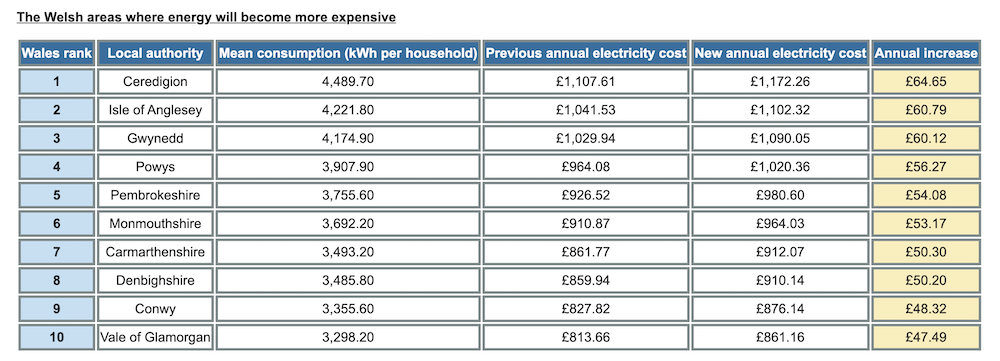
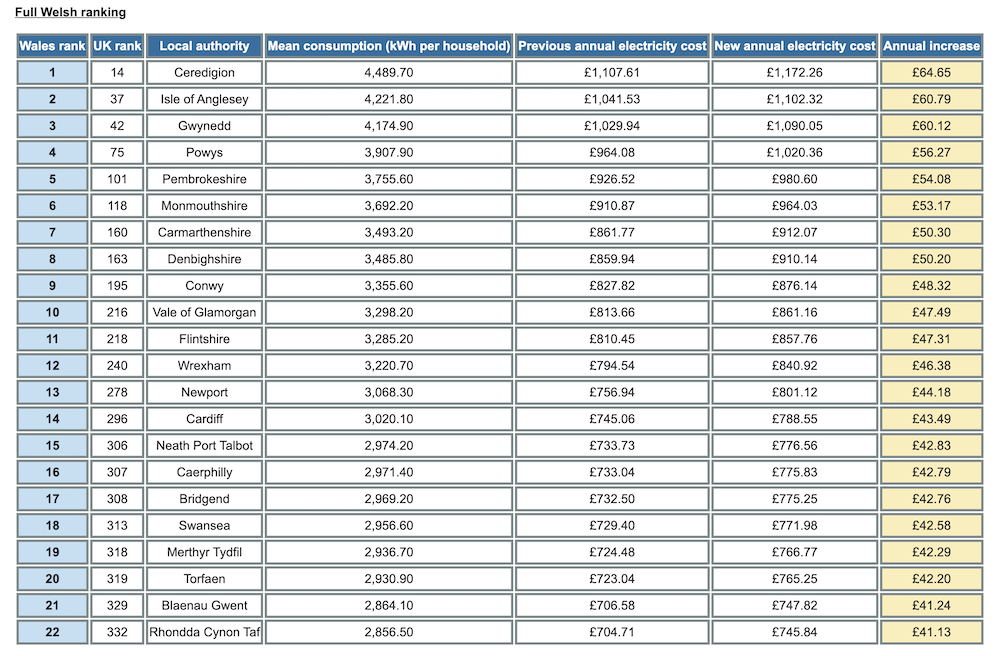
Ceredigion is the most impacted area in Wales, with households facing the sharpest rise under the new electricity unit rate. Average domestic consumption stands at 4,489.70 kWh per household, taking estimated annual electricity costs from £1,107.61 to £1,172.26. This means households could pay £64.65 more a year. The area also ranks 14th across the whole UK.
Isle of Anglesey follows in second place, with average household consumption at 4,221.80 kWh. Estimated annual electricity costs will rise from £1,041.53 to £1,102.32, adding £60.79 to bills. The area ranks 37th across the UK overall.
Gwynedd ranks third in Wales, with households expected to pay £60.12 more a year. Average electricity use in the area is 4,174.90 kWh per household, taking annual costs from £1,029.94 to £1,090.05 under the new unit rate.
Powys places fourth in Wales, with households facing a £56.27 annual increase. Average domestic electricity consumption stands at 3,907.90 kWh per household, meaning estimated costs are set to rise from £964.08 to £1,020.36.
Pembrokeshire completes Wales’ top five most impacted areas. Households in the area use an average of 3,755.60 kWh a year, pushing estimated annual electricity costs from £926.52 to £980.60, an increase of £54.08.
Monmouthshire ranks sixth in Wales, with annual electricity costs expected to rise by £53.17. Based on average household consumption of 3,692.20 kWh, costs are set to move from £910.87 to £964.03 under the new rate.
Carmarthenshire follows in seventh place, with households facing an estimated £50.30 increase. Average electricity use in the area is 3,493.20 kWh per household, taking annual costs from £861.77 to £912.07.
Denbighshire ranks eighth in Wales, with annual electricity costs rising by £50.20. The area’s average household consumption of 3,485.80 kWh means costs are expected to increase from £859.94 to £910.14.
Conwy places ninth, with households set to pay £48.32 more a year. Average domestic electricity consumption stands at 3,355.60 kWh per household, taking estimated annual costs from £827.82 to £876.14.
Vale of Glamorgan rounds out Wales’ ten most impacted areas. With average household electricity use of 3,298.20 kWh, annual costs are expected to rise from £813.66 to £861.16, adding £47.49 to bills.
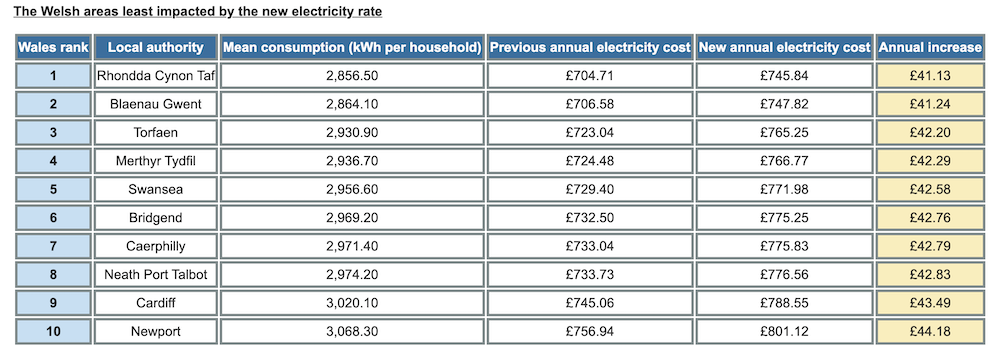
At the other end of the ranking, Rhondda Cynon Taf is the least impacted area in Wales. Households still face an increase, but at £41.13 a year, it is £23.52 lower than the rise seen in Ceredigion. Average domestic consumption stands at 2,856.50 kWh per household, taking estimated annual costs from £704.71 to £745.84.
Blaenau Gwent follows as the second least impacted area in Wales, with households expected to pay £41.24 more a year. Average electricity use in the area is 2,864.10 kWh per household, meaning annual costs will rise from £706.58 to £747.82.
Torfaen ranks third among Wales’ least affected areas, with a £42.20 annual increase. Its average household consumption of 2,930.90 kWh means electricity costs are expected to rise from £723.04 to £765.25.
Merthyr Tydfil places fourth, with households facing an estimated £42.29 rise. Average electricity use in the area stands at 2,936.70 kWh per household, taking annual costs from £724.48 to £766.77.
Swansea completes the five least impacted areas in Wales, with annual electricity costs set to rise by £42.58. Average domestic consumption is 2,956.60 kWh per household, meaning costs will increase from £729.40 to £771.98.
Bridgend ranks sixth among the least impacted Welsh areas. Households there use an average of 2,969.20 kWh a year, leaving them with an estimated increase of £42.76 as annual costs rise from £732.50 to £775.25.
Caerphilly follows in seventh place, with households set to pay £42.79 more a year. Average domestic electricity consumption stands at 2,971.40 kWh per household, taking estimated annual costs from £733.04 to £775.83.
Neath Port Talbot ranks eighth, with annual electricity costs expected to rise by £42.83. Based on average household consumption of 2,974.20 kWh, costs are set to move from £733.73 to £776.56.
Cardiff places ninth among Wales’ least impacted areas, with households facing a £43.49 increase. Average electricity use in the city is 3,020.10 kWh per household, taking annual costs from £745.06 to £788.55.
Newport rounds out Wales’ ten least impacted areas. With average domestic consumption of 3,068.30 kWh per household, estimated annual electricity costs are expected to rise from £756.94 to £801.12, adding £44.18 to bills.
Giles Fallan, CEO at Buildsafe, commented on the findings: “This study shows that the impact of the new price cap will not be felt evenly across Wales. Areas with higher average electricity consumption will naturally see the biggest cash increases, which is why Ceredigion, Isle of Anglesey and Gwynedd sit at the top of the Welsh ranking.
“What stands out is how strongly rural and coastal areas feature in Wales’ most impacted list. Larger homes, older housing stock, colder or more exposed locations and a greater reliance on electricity can all contribute to higher consumption, which means the same unit-rate increase can translate into a much bigger cash rise.
“With hot temperatures already hitting parts of the UK and further heatwaves expected, this rise could feel even more frustrating for households. Energy bills are usually talked about as a winter issue, but summer can bring its own pressures, especially when people are using fans, portable air conditioning units, extra refrigeration or working from home more during the day.
“The areas at the top of Wales’ ranking are not just paying more because the unit rate has gone up; they are paying more because their homes are already using more electricity. That makes energy efficiency especially important. Improving insulation, keeping rooms shaded during the hottest part of the day, using fans before portable air conditioning, and switching off appliances that are not being used can all help reduce avoidable costs.
“The least impacted Welsh areas will still see bills rise, but the increase is smaller because average household consumption is lower. Rhondda Cynon Taf, Blaenau Gwent and Torfaen are seeing smaller cash increases than places like Ceredigion, Isle of Anglesey and Gwynedd, which shows how much difference the type, size and efficiency of a home can make when energy prices change.”
Source:
Department for Energy Security and Net Zero
Methodology:
Buildsafe analysed the latest UK government subnational electricity consumption data, broken down by local authority and measured in kWh per household.
Estimated annual electricity costs were calculated by multiplying average household electricity consumption by the relevant Ofgem electricity unit rate.
The previous estimate uses the April to June 2026 Ofgem average electricity unit rate of £0.2467/kWh. The new estimate uses the July to September 2026 average electricity unit rate of £0.2611/kWh.
Standing charges were excluded from the calculations to isolate the impact of the electricity unit-rate increase.
Support our Nation today
For the price of a cup of coffee a month you can help us create an independent, not-for-profit, national news service for the people of Wales, by the people of Wales.
Get more trusted Welsh news
Choose Nation.Cymru as a preferred source in Google News to see more of our journalism.



Developers are eager to cover Cymru with pylons, wind turbines and solar panels yet we get charged with higher energy bills. Are we being treated as bloody fools?
This article is about different areas using more or less energy rather than being charged differently. There are differences in charges across the UK with north and south Wales split in two and the north paying more. It’s baffling that energy doesn’t use the same model as the postal system and standardise costs across the UK which is surely a supposed benefit of union.