


Revealed: How Wales ranks in wettest places in the UK

A new study has identified the UK cities most likely to experience high rainfall during the summer months.
Researchers analysed historical rainfall data from the Met Office from 2000 to 2025 across the summer months of June, July and August.
And if you thought Wales might top the charts you’d be mistaken – although Welsh cities Swansea (7th), Cardiff and Newport (joint 8th) do make the top 10.
Glasgow has been revealed as the UK’s wettest summer city, with an average monthly rainfall of 95.20mm during the summer period. The city’s closest weather station, located in Paisley, records an average of 82.97mm and contributes significantly to Glasgow’s top ranking.
Belfast claims the second position with 91.43mm of average monthly rainfall during summer. Northern Ireland’s capital is influenced by readings from the nearby station in Armagh, which records 72.71mm of monthly rainfall.
Derry places third with an average monthly rainfall of 89.40mm across its five closest weather stations. Like Belfast, Derry’s high position is influenced by readings from Ballypatrick Forest station, which records the highest rainfall (101.30mm) among its nearby stations.
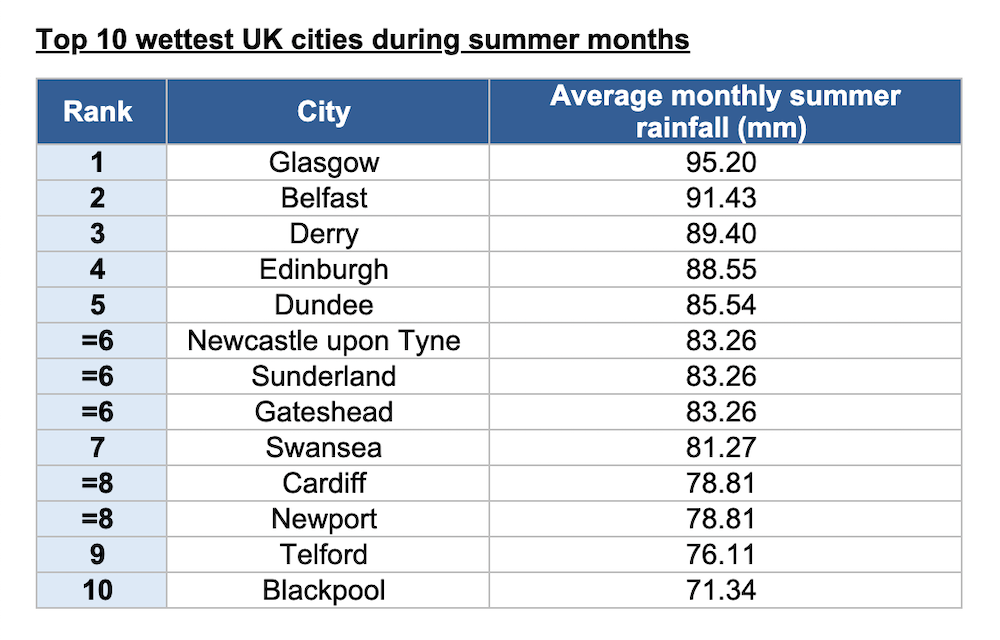
Edinburgh, Scotland’s capital, takes fourth place with 88.55mm of average monthly summer rainfall. The city’s readings are affected by the Eskdalemuir station, which records a substantial 138.37mm of monthly rainfall – the highest reading among all stations in the study.
Dundee rounds out the top five wettest cities with 85.54mm of average monthly rainfall. Dundee’s readings are influenced by the Leuchars weather station, the closest to the city, which records 69.24mm on average.
The North East of England features prominently in the rankings with Newcastle upon Tyne, Sunderland, and Gateshead all tied for sixth place with identical readings of 83.26mm. All three cities share the same five closest weather stations, with Durham (64.71mm) being the primary station for each.
Swansea emerges as Wales’ wettest summer city, placing seventh overall with an average monthly rainfall of 81.27mm.
Cardiff and Newport share eighth position with identical rainfall figures of 78.81mm. Both Welsh cities are influenced by the same five weather stations, including Ross-on-wye (56.74mm) and Chivenor (71.19mm).
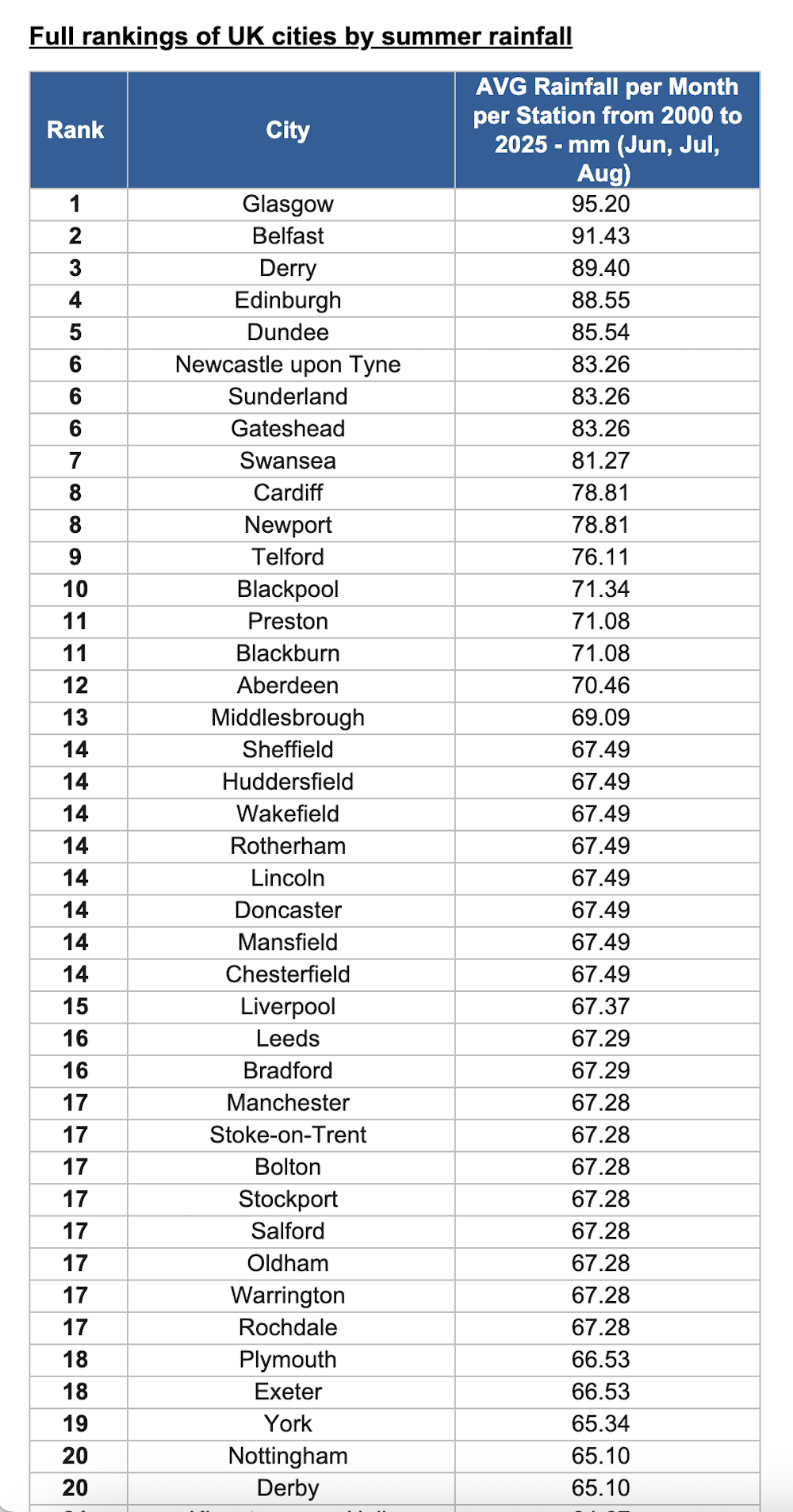
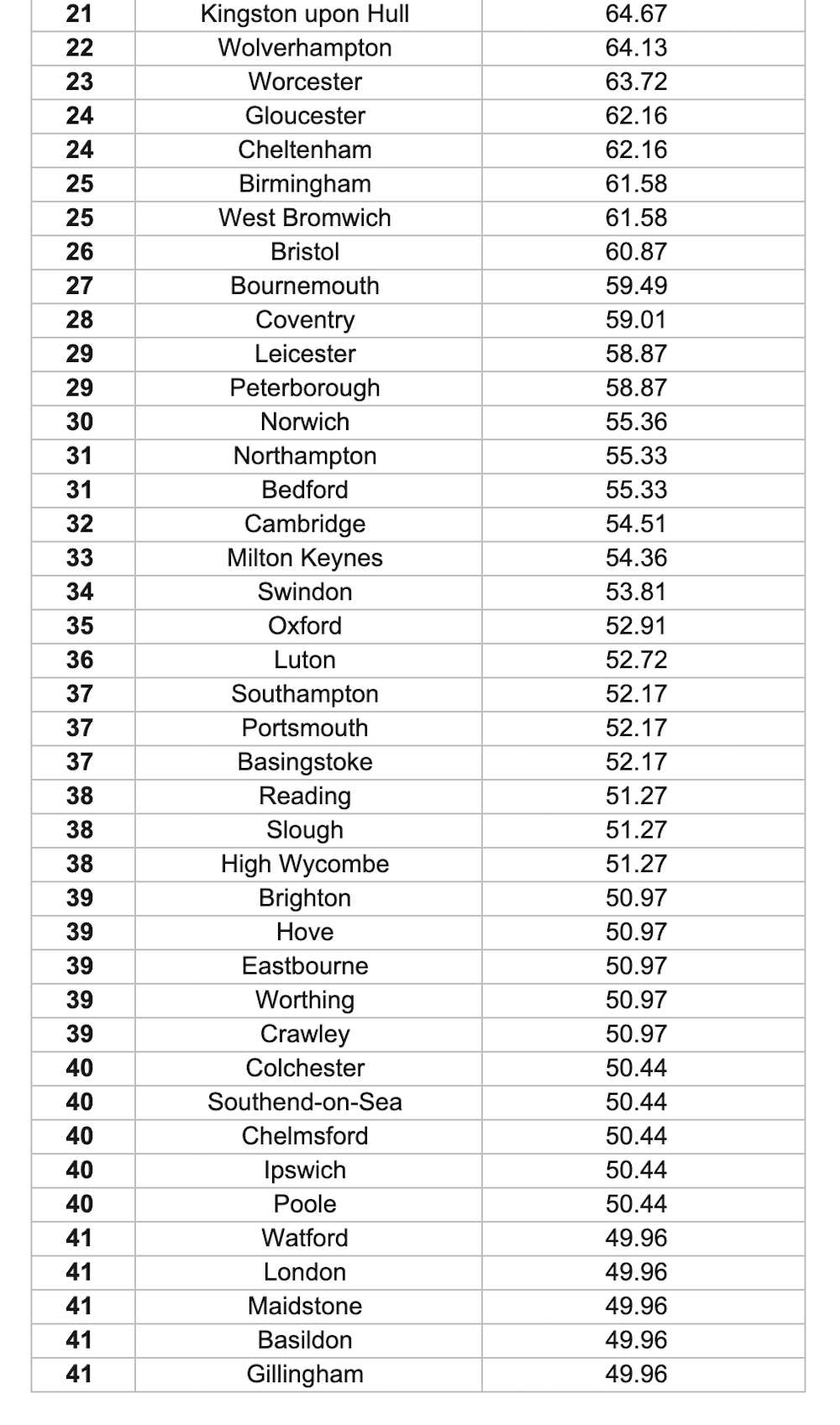
The neighbouring cities of Wolverhampton (64.13mm), Worcester (63.72mm), and Birmingham (61.58mm) in the West Midlands show a gradual decrease in rainfall, demonstrating how regional geography impacts local weather patterns even between nearby cities.
Telford places ninth on the list with an average monthly summer rainfall of 76.11mm. The town’s rainfall figures are shaped by a combination of inland and western stations, with Cwmystwyth recording the highest at 127.42mm.
Blackpool rounds out the top ten with 71.34mm of average monthly rainfall during the summer months. Its coastal location and proximity to stations like Newton Rigg (80.39mm) and Bradford (72.48mm) contribute to its relatively high position, reflecting the consistent influence of north-western maritime weather systems.
In stark contrast, the research also identified the UK’s driest summer cities, with locations in the South East of England recording significantly lower rainfall figures.
London, Maidstone (Kent), Basildon (Essex), Gillingham (Kent), and Watford are among the driest cities during summer months, with an average of just 49.96mm of rainfall – nearly half that of Glasgow.
Kaylyn Tanner, flood restoration expert at Water Damage Specialist who conducted the research, commented on the findings: “These rainfall statistics show a clear north-south divide in summer precipitation, with Scottish and Northern Irish cities experiencing nearly twice the rainfall of southern England. This pattern has significant implications for homeowners in these wetter regions.
“Properties in cities like Glasgow and Belfast face higher risks of water ingress during summer downpours, which can lead to damp issues if drainage systems aren’t properly maintained. But even in supposedly drier cities like London, sudden heavy thunderstorms can cause localised flooding due to the high proportion of paved surfaces and pressure on drainage systems.
“Homeowners in high-rainfall areas should ensure gutters and drains are clear before summer storms, check that roof tiles are secure, and consider installing water sensors in basements or areas previously affected by flooding. These simple precautions can help minimise damage during heavy summer rainfall.”
Methodology
The study analysed historical UK weather data from the Met Office for the period 2000 to 2025, focusing on the summer months – June, July, and August. It utilised data from all stations listed on the Met Office’s historic station data portal (https://www.metoffice.gov.uk/research/climate/maps-and-data/historic-station-data).
The analysis focused on UK cities with populations exceeding 100,000. For each city, the five nearest weather stations were identified. By examining the average monthly summer rainfall per station at these stations, the study provides insights into which UK cities experience the highest levels of summer rainfall.
Support our Nation today
For the price of a cup of coffee a month you can help us create an independent, not-for-profit, national news service for the people of Wales, by the people of Wales.



So this piece of research confirms what we all knew all along, the further south and east you go the drier it is. Wonderful.
This data extract of the three summer months does not tell us anything we didn’t already know. What it can inform us is how this need be reflected in agricultural policy in rural areas. We are not the same. Summer pasture is essential for livestock so west is best. Sunny months ripen fruit so east is feast. The built infrastructure in urban areas need reflect this difference too. Noticed a ‘new build passive house’ in the Gwendraeth valley and it includes Kentish weatherboarding now covered in algae and moss with the strange addition of water butts on all the downpipes.… Read more »